


9,33 €
Mehr erfahren.
- Herausgeber: Amber Books Ltd
- Kategorie: Lebensstil
- Sprache: Englisch
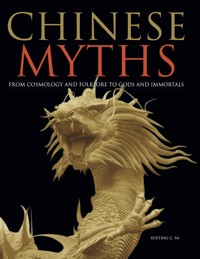
Chinese mythology has been passed down in written and oral form over many millennia, emerging from a range of cultural traditions that often have their origins in Daoism and Buddhist religion. At times merging history and folklore, Chinese myths are rich in symbolism and teach us about the complexities of an ancient culture that stretches back more than 4000 years. In this book, learn about Pangu, the creator being, who sprang from an egg after the forces of yin and yang emerged out of a formless chaos; or Hou Yi, the greatest archer of all time who shot down nine of the ten suns; or Fuzanglong, the treasure dragons, who are said to live underground guarding massive hoards of gold and jewels; or the mad monk Ji Gong, a man of great appetites who used his supernatural abilities to seek justice for the poor; and enjoy the adventures of the short-tempered, super-human Monkey King, who after being defeated by the Bodhisattva Guanyin, gains modesty and becomes a disciple of the monk Tank Sanzang. Illustrated with 120 photographs and artworks, Chinese Myths is an accessible, entertaining and highly informative exploration of the fascinating mythology underlying one of the world’s oldest and most influential cultures.
Das E-Book können Sie in Legimi-Apps oder einer beliebigen App lesen, die das folgende Format unterstützen:
Seitenzahl: 310
Veröffentlichungsjahr: 2024
Ähnliche


















CHINESEMYTHS
CHINESEMYTHS
FROM COSMOLOGY AND FOLKLORE TO GODS AND IMMORTALS
XUETING C. NI
This digital edition published in 2024
Copyright © 2023 Amber Books Ltd
All rights reserved. No part of this publication may be reproduced, stored in a retrieval system, or transmitted in any form or by any means, electronic, mechanical, photocopying, recording, or otherwise, without prior written permission of the copyright holder.
Published by
Amber Books Ltd
United House
North Road
London
N7 9DP
United Kingdom
www.amberbooks.co.uk
Instagram: amberbooksltd
Pinterest: amberbooksltd
Facebook: amberbooks
X (Twitter): @amberbooks
ISBN: 978-1-83886-375-3
Project Editor: Michael Spilling
Designer: Mark Batley
Picture Research: Terry Forshaw
PICTURE CREDITS
Alamy: 6 (PjrTravel), 10 (CPA Media), 12 (Eddie Gerald), 13 (Artokoloro), 15 (Granger Historical Picture Archive), 24 (Heritage Images), 27 (CPA Media), 30 (Imaginechina), 33 (John Astor), 34 (Ivy Close Images), 35 & 39 (CPA Media), 42 (Charles Walker Collection), 45 (Michael Grant Travel), 47 (CMA/BOT), 51 (Sergio Azenha), 54 (Japan Art Collection), 59 (Keren Su/China Span), 62 (Chronicle), 63 (Dorling Kindersley), 68 (Heritage Image Partnership), 82 (Artokoloro), 84 (Imaginechina), 88 (Interfoto), 91 (CPA Media), 93 (Ching Tak FU), 94 (Wirestock), 100 (Heritage Image Partnership), 106 (The Print Collector), 120 (Science History Images), 122 (Xinhua), 123 (Imaginechina), 124 (CPA Media), 131 (BTEU/RKMLGE), 141 (The Print Collector), 142 (Album), 145 (Laoma), 147 (Kevin Archive), 155 (Album), 164 (Betty Johnson), 175 (CPA Media), 176 (Imaginechina), 178 (Album), 180 (Zoonar), 187 (TAO Images), 194 (Ilona Kryzhanivska), 195 (ALLTRAVEL), 196 (Louise Batalla Duran), 198 (robertharding), 213 (CPA Media), 214 (Artokoloro), 221 (Imaginechina)
Cleveland Museum of Art: 108, 113, 128/129, 161, 186
Dreamstime: 23 (Wuwei1970), 28 (Klodien), 52/53 (Richie0703), 58 (KirillPolyakoff), 69 (Suwatsir), 72 (NGSpacetime), 87 (Maocheng), 97 (Tsangming Chang), 98 (Keitma), 104 (Pavlovicaleksandar), 105 (Wing88), 119 (Hxdbzxy), 132 (13902474131), 138 (Tuayai), 158 & 159 (Unteroffizier), 170 (Wxh6763), 192 (Jasonyu)
Getty Images: 16 & 21 (Heritage Images), 37 (Pictures from History), 40 (De Agostini), 48 (Domingo Leiva), 50, 99 & 140 (Pictures from History), 156 (USC Pacific Asia Museum), 171 (Pictures from History), 172 (Bob Sacha), 181 (Dorling Kindersley RF), 183 (Los Angeles Times), 206 (De Agostini), 207 (Sepia Times), 208 (Pictures from History), 210 (South China Morning Post)
Library of Congress: 133
Licensed under the Creative Commons Attribution 2.0 Generic License: 80 (Photo Dharma)
Licensed under the Creative Commons Attribution-share Alike 3.0 License: 71 (Shallowell)
Licensed under the Creative Commons Attribution-Share Alike 4.0 International: 163 both (Toadboat)
Licensed under the GNU Free Documentation License: 60 (Bernard Gagnon)
The Los Angeles County Museum of Art: 205
Metropolitan Museum of Art, New York: 8, 20, 22, 44, 46, 55, 56, 61, 64, 67, 74, 75, 77, 90, 96, 101, 110, 115, 127, 151, 152, 191, 193, 202, 216, 218, 219
Public Domain: 14, 38, 78, 85, 116, 126, 166, 167, 188, 203
Shanghai Museum: 65, 107, 114, 146, 184, 185
Shutterstock: 9 (Bill Perry), 73 (gary718), 103 (LCRP), 130 (beibaoke), 134 (Sofiaworld), 135 (Young Swee Ming), 137 (Sarunyu L), 148 (Chatham172), 160 (Sing Studio), 169 (chinahbzyg), 200 (Stefano Politi Markovina), 209 (D.Kvasnetskyy)
Yale University Art Gallery: 112
CONTENTS
Introduction
Chapter 1 Cosmology: The Dao
Chapter 2 Creation Myths
Chapter 3 Mythological Creatures
Chapter 4 Gods and Immortals
Chapter 5 Mythological Heroes
Chapter 6 Monsters and Ghosts
Chapter 7 Legends
Chapter 8 Treasures of the Earth and Forge
Bibliography
Index
INTRODUCTION
As you walk around any modern Chinese city, you can still encounter many signs of the mythic. Stone lions stand guard outside banks and offices, charms are pasted around doorways and household shrines grace even the smallest of shops and noodle bars.
Figurine of an assistant to the Judge of Hell dating to the Ming dynasty. Chinese mythology features a plethora of figures from heroes and magical creatures to gods of the underworld.
I remember the great care and attention my grandmother gave to cleaning her statues of the gods of longevity, wealth and good fortune, and can still vividly picture the apples stuck through with burning incense sticks that dotted the back alleys of my hometown, warding off evil spirits (and bad smells), and protecting loved ones. China’s relationship with its mythologies is a living thing, still growing and developing with each new generation. There has been a contemporary resurgence in interest in its myths, along with the growth of China’s national pride and re-examination of its history. In fact, the country’s size and the diversity of its peoples have meant that China’s mythologies have always been an ever-evolving concept, interweaving tales from its deep shamanic past and the folk stories of its many different ethnicities, together with the beliefs of Daoism, and later, the influence of Buddhism.
Diverse influences
While some countries or cultures may have been unable to accommodate this broad set of beliefs, China’s particular history has led to a unique patchwork of colourful, exciting stories, filled with contradictions and conflicting views, but which ultimately coexist. This book brings together some of the best-known, well-loved, culturally important and just plain interesting or entertaining mythological heroes, gods, legends and stories from China’s vast heritage, all arranged in an accessible order. There will, of course, be many regional variations on these stories, the local names and their derivations, and if you have knowledge of these pantheons, you may find things that differ to your own experience – but this all simply adds to the wild chaotic mix of Chinese mythology. I have tried to keep to the most well-documented versions, or those which I have learned about during my own life in China, having lived as far in the north as Changchun and as far in the south as Guangzhou.
Sources
This is the second book I have written on Chinese mythology, and while the first one focused mainly on the stories of deities and how they are perceived culturally in modern China, this volume has allowed me to look more closely into some of the stories around humans, monsters and spirits. I have returned to various of the classic sources (listed below) for details on China’s mythical monsters and fantastic beasts.
Liao Zhai 聊斋 (Tales From the Hearth) – compiled by Pu Songling and first published in the 18th century – was an early work of folkloric anthropology, in which the scholar decided to sit himself by the side of a busy road with his writing desk and a small fire, offering passersby rest and tea, in exchange for their stories of ghosts and spirits.
Shanhai Jing 山海经 (Classic of Mountains and Seas) – a collection presented as reportage by author/s unknown –is thought to have been compiled between the Warring States period and the Han Dynasty. It records the peculiarities of each region and includes the cryptology of many creatures, plants and peoples, some of whom we will recognize today as far more mundane creatures. This collection is considered to be China’s oldest surviving book of mythologies.
The dragon, the ultimate mythical creature of China, lends its image to a Ming dynasty imperial medallion.
Huainanzi 淮南子 (Great Words From Huainan) – compiled for the nobleman Liu An in the 2nd century BCE – represents a collection of writings that ponders subjects including cosmology, metaphysics and social order, and which also elaborates on concepts of early Chinese mythoi.
Incense burns at the temple of Three Kingdoms in Sichuan province. Chinese myths sometimes derive from remarkable real-life people. Warriors and statesmen of the Three Kingdoms period (220–280 CE), such as Kong Ming, are still venerated in China today.
Common themes
You will find many common themes in these stories and myths, and perhaps some surprising omissions. For example, none of the main branches of Chinese mythology has a concept equating to Ragnarok or Armageddon, being far more concerned with creation and the everyday goings-on of the living. There are multiple deities, heroes and monsters, whose existence pivots around seas and rivers, floods and droughts. Water in China is one of the great uncontrollable elements around which the lives of everyone has revolved, from fishermen and farmers, to generals and regents. With a country the size of China and its periods of fragmentation and unification over thousands of years, statecraft, record-keeping and hierarchy have been essential to keeping nations safe, which also becomes clear in myths with bureaucratic themes.
Mythologies are reflections of the hopes and fears of a people. Heroes show us a society’s ideals; monsters, its fears. Gods and treasures reflect what a people strive for. I hope this book not only helps explain concepts and patterns in Chinese myths, but that it also provides some insight into the mentality behind them, and consequently encourages cultural understanding.
1 COSMOLOGY: THE DAO
In Chinese mythology, there is no supreme or divine being that created the world. Instead, from nothingness arose a force, the Dao. The word simply means ‘the way’ or ‘the path’. This is the way of nature, the universe and the origin of all things. Everything comes from the Dao, and everything will eventually return to it.
This scroll painting portrays the ancient philosopher Laozi as a Daoist deity. He is best known as the author of the Daodejing (Tao Te Ching) – a cornerstone text of the Daoist faith.
The Dao runs through all things, filling the skies, flowing across the seas. This force is boundless, eternal and indestructible. It moves the sun, moon and stars and makes them shine. It makes the beasts run and fowl fly. It is the reason why mountains are high and lakes are deep. Nothing is above or apart from the Dao; even the actions of gods and immortals are ruled by it. Those who can grasp the essence of Dao will be the leaders of humanity. And when unjust or incompetent rulers push against the Dao, they upset the balance of nature, and nature manifests signs of its displeasure.
Yin and Yang
The Dao is comprised of two opposing currents – the Yīn 阴 or Yin and Yáng 阳 or Yang. Yin and Yang coexist and are present in all living things. Yin represents all that is cold, moist or dark, whereas Yang represents all that is hot, dry and bright. It was the creation of the world that brought these two forces into being as separate energies. All that was light and airy floated up to become the skies, while all that was heavy and thick came together to form the earth.
These two forces are in constant flux, struggling for ascendancy. Yet neither one could exist without the other, and even as one waxes and the other wanes, it is understood that this is only a temporary state, and that the situation will soon move in the other direction, and ultimately, these forces are in perfect balance. It is from these interactions between Yin and Yang that the four seasons were created. Manifestations of weather such as thunder, lightning and fog are all due to clashes and imbalances between Yin and Yang.
The hero Fuxi holding a bagua plate. The symbol in the plate’s centre represents the forces of Yin and Yang in constant, kinetic balance.
More Yang flows through birds that fly in the air, more Yin through fish that swim deep in the oceans, however, each has some of the other element present in them. Thus all creatures are connected to each other and to nature, through the Dao. Humans are the creatures capable of balancing the Yin and Yang within, and it is their role to keep the balance between the two forces in the world, so that the Dao can run its course.
The creation of the world
Many of the mythology sources concerned with the creation of the universe have been lost to time. Among those that remain, the concept that heaven and earth were once close together is a common one. Some stories say that the two were separated by the primordial being Pangu, as he pushed the sky away from the ground, while others tell of humanity being led astray by the warmongering Chiyou, a warrior who rebelled against the legendary ruler Huangdi, and began to lie, cheat and steal. So, the Supreme Deity Zhuanxü sent some gods to prise the sky and the land apart, confining gods to the former and mortals to the latter.
The skies
The celestial bodies – the sun, moon and stars – were all either created by, or otherwise, derived from, the gods. Myths from ethnic groups such as the Dong, Naxi and Zhuang tell of the sky being not only filled with myriad stars, but multiple suns and moons, too, with many legends telling of how this abundant sky was pruned back to the one we see today.
The reverse of a lobed mirror depicts heaven and earth as separate realms, with two phoenixes flying between them.
The suns
According to Han mythology, the suns and moons were the offspring of the Supreme Deity Di Jun, and his two companions. The mother of the ten suns was Lady Xihe from a kingdom beyond the east and southern seas, in the region of the Gan River. The ten suns lived on Fusang, a giant tree that grows out of the waters of the Tang Valley. About 160km (100mi) tall, with a trunk just as wide round, its top branches reach all the way up to the sky. It is so vast that it houses a whole palace for the immortals and bears its immortality-giving fruit only once every 9000 years.
The story goes that the ten suns lived and worked in the branches of Fusang. They stayed for the most part in the lower branches, taking it in turns to ascend to the very top of the tree every day. When each of them descended from their duties, Lady Xihe would bathe them, to wash away the reddening dust they gathered on their climb and keep them shiny and bright.
In some stories, Xihe drove the suns across the skies herself in a chariot pulled by six dragons, while in others, they were carried back and forth by crows. These crows liked to eat the Di Ri and Chun Sheng grasses that grew on earth. After the split between heaven and earth, Xihe did not like her children visiting the land, so she blinded the crows in order to stop them from flying down and her children from stowing away with them. Xihe’s strict repression fed a rebellious nature in her children, which would lead to tragedy.
One day, the ten suns thought it would be fun to be at the top of Fusang together and asked the crows to carry them all up at the same time. The crows did so and all ten suns shone down on the earth at once. Their intense heat scorched the earth, dried up the seas and rivers, withered the crops and burned down people’s homes.
Dazzled by their own splendour, the suns did not care about the chaos and refused to return to the lower branches, despite the entreaties of their parents. Their father, Di Jun, ordered the hero Hou Yi to bring them back by whatever means necessary. At first, Hou Yi tried to talk to the suns and threatened them with his arrow, but to no avail. In the end, he shot down nine of the suns, leaving only one at the top of Fusang. The remaining sun was so distraught at the loss of his brothers that he refused to come out. This is why the cockerel crows before dawn, to encourage the sun to rise and remind him of his duty.
Lady Xihe, the mother of the ten suns, bathing her children.
The moons
Di Jun took a second wife, the Lady ChangXi, who gave him 12 daughters, who were the moons. Like Xihe’s suns, each of the daughters travelled across the sky at night, before being bathed by their mother. Each took the journey many times in succession, changing every month, rather than every day like the suns, and giving rise to the lunar calendar. Surviving myths do not elucidate their manner of travel or their ultimate ends, but suffice to say, we only hear of one moon in any future myths, and that is the one that becomes the home to the moon goddess Chang’e.
Hou Yi takes aim with the divine bow and arrows gifted him by Di Jun.
The stars
Yi, a descendant of the fire god Zhuanxü, was appointed caretaker of the suns, moons and stars by the Jade Emperor. He was stationed on Riyue (‘Sun and Moon’) Mountain, where the suns and moons set. His duty was to ensure that each constellation and body followed their path, weaving between each other, to avoid crashing. Prominent individual stars have been mythologized and re-mythologized over the centuries. For instance, Han myths made an appearance in the skies of Bixing, eight stars in the constellation of Taurus, a forecast sign of rain. Beidouxing (Ursa Major) in the Big Dipper constellation has been imagined variously as Mother Dipper – a protector goddess that watched over humanity – and Shouxing – the god of longevity.
The goddess Chang’e – in her earthly form – contemplates the moon in this Ming dynasty painting.
One surviving star myth relates to Ebo and Shichen, the brightest stars in the sky. They were the sons of Diku, one of the Five August Emperors – the first rulers of humanity. Ebo and Shichen did not get along and were always fighting, so Diku moved them to opposite sides of the heavens: Shichen would rise in the east, in one of the corners of the constellation we now call Orion, whereas Ebo would appear in the western sky in what we call today the Scorpius constellation, but only once Shichen had disappeared beyond the horizon, ensuring that they would never meet, or even appear in the skies at the same time.
Some star myths surround Taiyi, the Star of the North Pole, believed to possess the power to grant people’s wishes, if they pray to the star god with sincerity every day for a hundred days. The god answered the prayers of a poor girl who kept vigil, appearing before her as an old man with a long white beard, and granted her the wish to make her ailing mother well again.
The Gods of the Elements
At a time when people could not explain the occurrences in their environment, elements attributed to mythical beings naturally became some of the earliest deities. Since wind is not a visible phenomenon, it has taken abundant mythical forms in Chinese mythology, sometimes as tribal totems, at other times as a great bird, a dancing phoenix, a strange beast with horns, a stag’s body with leopard spots and a snake’s tail. Later, Fengshen 风神, the wind god, became Feng Lian who found a lingshi mystical stone in the mountains and transformed it into a Fengmu, a magical wind sack, which he tamed and used to control the wind. The wind personified continued as a powerful and sometimes destructive god that required ritual sacrifices, but nevertheless a familiar one, morphing at one point into the Fengyi (Wind Aunty) of folklore and finally settling as Fengbo (Uncle Wind), an old man with a long beard who carried a wheel in one hand, and a fan in the other.
Rainfall levels are key to the growing of crops in an agricultural civilization. In early Chinese society, the summoning of rain was the role of the shamans, and was accompanied by state ritual sacrifices. Early forms of this deity include the primeval being of Xuanmo and Yushi Qie 雨师妾 (Rain Master’s Concubine), who has black skin, wears a snake in each ear and wields one in each hand. Later, the deity took on the masculine form of Chishong Zi 赤松子 (Immortal of the Crimson Pine). This version began life as a hairy savage in straw cape and animal hide who danced around wildly, and was trained by a Daoist master to transform into a crimson dragon and to command the rain, hence his name. In a more dignified mode, he appears as a strongly built man with a long beard who carries a basin in which a dragon dances. With the other hand, he dispenses the rain. As Yushi, Chi Songzi is subordinate to the dragon kings who, along with dragons, are some of the most powerful water gods.
THE FIVE ELEMENTS
The Wuxing – Cycle of Elements Metal, Water, Wood, Fire, Earth – is an integral part of Chinese philosophy and mythology. In traditional medicine, they are used to define the energies and matter within the human body, and in other circles are often used in conjunction with systems such as the Chinese zodiac, to define larger cycles of time or events. As with Yin and Yang, there is no dominance or hierarchy to the elements. Each is thought to exist in equal measure throughout the universe. Each element is created by, or creates another, while at the same time, being controlled by, or controlling the other two. In this way, all five elements are interdependent and their relationships clearly defined.
The Creation Cycle:
Metal cups, hold Water
水
Water in rain, grows Wood
木
Wood burned, feeds Fire
火
Fire reduces, creating Earth
土
Earth refined, gives up Metal
金
THE BEST-KNOWN VERSION OF THE GOD OF FIRE IS ZHURONG, ALSO THE GOD OF THE SOUTH.
As with many cultures, earth myths have been an essential part of early myths across different Chinese ethnicities, from the primitive worship of earth mounds to that of Wutu 五土, the Five Earths (mountains and forests, plains, hills, burial grounds, lowlands and marshes) and Houtu Hangdi Qi 后土皇帝衹, Emperor Earth Spirit, who in some stories was descended from the Five Legendary Rulers. The female form of Houtu, Houtu Niangniang 后土娘娘, Lady Earth, one of the twelve ancestral wizards, is by far the most prominent. She has received imperial tributes across dynasties, and been made one of the Four Imperials, the highest-ranking Daoist deities in the pantheon. While this powerful earth queen enjoyed popularity in the inland regions, people felt the need for more approachable gods who could be close at hand. These needs are met by the Tudiye 土地爷 (affectionately known as Grandfather Earth), much lower-ranking local gods whose powers were specific to the terrain. Great scholars like Wen Chang and warriors like Yue Fei have all been earth gods for their regions during various times.
In Chinese mythology, the gift of fire has tended to be bestowed on humans by human heroes, such as Buluotuo of the Zhuang people, Leiling of the Buyi and Surenshi of the Han, who discovered how to make fire by observing trees that were struck by lightning or by rubbing two pieces of stone together, and often went on long journeys to seek it. Sometimes they are shown fire by mythical creatures or gods. Occasionally they have to snatch it from monsters, like Azha of the Hani, who stole fire from between the eyes of a monster, ended up swallowing it and then later cut himself open.
THE REALMS
By the time of the Tang dynasty (618–907 CE), the mythical world view had begun to be more organized by the established systems. For example, Buddhism divides the universe into three realms:
1) The realm we understand as the mortal world;
2) The realm of underworlds and the six planes;
3) The realm of form and the heavens.
The six planes and the realm of form can be seen more as paths than places. There are further important places, where the realms touch, or at least draw close enough that one can communicate between them.
The best-known version of the god of fire is Zhurong 祝融, also the god of the south. According to different myths, he was either descended from Yandi or Huangdi. He has a human head and a beast’s body. The two dragons he rides are indicators of his great power. Zhurong cuts an important figure in China’s creation mythology. It was he who executed Gun, stole the Xirang from heaven, and who Gonggong fought in one version of the Mount Buzhou sky pillar story. Another version of the fire god is Li, an offspring of Zhuanxü, and one of the gods the latter ordered to separate the connection between heaven and earth.
Heaven
Although Chinese beliefs do not credit an all-powerful god with the creation of the universe, since as early as the Shang dynasty (c.1550–c.1045 BCE) there has been the idea of a supreme divine being overseeing adherence to the Dao and the conduct of the other gods. This being is called Tiandi, the Emperor of the Skies. Tiandi not only controls the celestial bodies and the elements, but also death, war and the outcomes of important undertakings. He was given numerous names, such as Shangtian and Huangtian. Rulers of the Zhou dynasty (c.1046–256 BCE) claimed themselves to be the sons of Tiandi, thus representing the sole connection between heaven and the mortal world. This was the beginning of China’s belief in the divine right to rule, or the mandate of heaven.
As Chinese society’s religious and bureaucratic structures developed, so did the belief that it was in fact replicating the structure of heaven on earth. The Buddhist heavens are separated into 21 tiers, all inhabited by the Tianlong Babu – the multitudes of gods, immortals and creatures who dwell in the skies and look after the mortal world below. These include the celestial dragons, which look after rainfall; the yecha, fierce protector gods that devour ghosts and demons; and the Gandapo, heavenly bards in charge of worship. Gods and ascended good souls live peacefully together and are housed by rank and importance – the highest tier, of course, being the court of the Supreme God himself.
By the Ming dynasty (1368–1644), Daoism had created a new name for the Supreme God that’s more akin to emperors on earth: Yùhuáng Dàdì 玉皇大帝 (Yuhuang Dadi), the Jade Emperor or the Grand Emperor of Jade, who oversees the immortal and mortal worlds. He is the embodiment of pure Yang, in the same way that the Supreme Goddess Xīwángmu 西王母 (Xiwangmu), the Queen Mother of the West, is the embodiment of Yin. Under this pair, a vast array of celestial beings run their ministries, rather like an ancient Chinese court or government. There are teams that regulate the manifestation of the elements, and teams that oversee aspects of human life. There are gods of the household and well-being; a range of patron deities for the trades; gods for every region and city; and ambassadors from the underworld, who are still beholden to the Dao and the rule of the Jade Emperor, to whom they report the goings-on at their different stations.
An intricate design on the back of a mirror represents the square world, the cardinal directions, the 12 earthly branches, the rings of heaven and the cosmic ocean.
The Sky Ladder
The sky ladder that connected heaven and earth is common to the myths of many different ethnicities in China. This ‘ladder’ takes a range of forms, from ladder to giant mountain or tree, to rainbow or tower. The most famous sky ladder is Kunlun, but there are others documented by the Shanhaijing and Huainanzi, such as Dengbao Mountain, which was a bridge for sorcerers and Ling Mountain, where many herbs grew. Also, the giant Jianmu tree, with no shadow, no echo and no branches, was thought by some to be the centre of the world.
The Bodhisattva Dayuan Dizang is depicted here with the Ten Kings of Hell, guardians of the ten gates in the Chinese underworld.
Many sky ladder myths involve humans climbing up and getting involved with the gods, which ultimately leads to the ladder being destroyed. According to one of these, a young man climbed to heaven on the sky mountain and married one of Tiandi’s daughters, bringing gifts such as grains and husbandry animals to earth. Tiandi felt this to be an overreach and broke the mountain into two. According to another story, a young man climbed to heaven on the sky tree and fell in love with the water goddess, who began to neglect her duties, causing a flood to descend on earth, leading to the demise of humanity. The gods repopulated the earth by scattering grain and sesame seeds and turning them into humans, but they lifted up the sky so that it could no longer be reached by the tree.
This painting separates the realms of hell into different areas by a long winding road. Newcomers are confronted with records of their actions in life.
Other stories are less noble in nature, such as the one about a woman pounding rice with a mortar and pestle, who was annoyed at how low the sky was. She poked at it with her pestle until it rose and rose. Sometimes it’s animals that cause the separation. In one of these, the Supreme Deity instructed a dung beetle to inform humans that they should eat only once in three days. The dung beetle supposedly made a mistake by telling the humans they should eat three times a day. As a result, they produced so much excrement that the Deity, no longer able to stand the foul stench, moved the sky upwards.
Earth
China mainly consists of broad plains and flat plateaus, with a few mountains in the south-east and the extreme north-east, and a ridge of soaring mountain ranges along the west and north-western regions. Its major rivers all flow east into the seas. Each of its geographic peculiarities gives rise to myth.
In Chinese mythology, the earth is bound together and prevented from sinking into the sea by the Diwei or ‘earth cords’. These cords are in turn held by mystical creatures such as turtles, dragons and snakes, which tether the land to the cords and to the four corners of the mortal realm. Together with the seven pillars, they hold the skies and the land in place. China, of course, sees itself as the centre of this arrangement, which is why its own name, Zhong Guo (中国), means ‘Middle Kingdom’.
Pillars holding up the heavens is a recurring idea in the myths of many of China’s ethnicities, and are explained as being anything from solitary mountains or giant trees, to gold or silver monoliths, or even the remains of giants. The best-known pillar is Mount Buzhou (‘Incomplete’). This was a main pillar that held up the whole sky, until it was destroyed by an angry god, causing a great catastrophe and requiring the goddess Nüwa to try to set the world to rights. The inexact work, under the pressure of saving humanity, led to the sky being slanted, so the sun does not travel directly from east to west, and a tilt in the land that leads all the rivers to flow to one corner of the world.
Although an actual range of mountains shares its name, the mythical Kunlun is a ‘soft’ place between the realms of heaven and earth.
Mount Peglai (Mountain of the Immortals) as imagined by artist Tessai Tomioka. Might those blue-green rocks in fact be the outline of a giant turtle’s shell?
The underworld
The most fascinating region of mythological China is probably the underworld. It combines all the elements of shamanistic, Daoist and Buddhist beliefs, and being a chaotic realm, there has been no real reason to simplify it.
This realm is presided over by the Yanwang (‘King of the Gates’), the Jade Emperor’s equivalent in the netherworld. Some stories say that Yanwang is the son of Pangu and the primeval female being Milun. With his impassive iron-black face, the supreme ruler of the underworld is stoic and famous for his impartiality. After all, if the processing of souls, administration of punishments and progression to reincarnation were not handled with a strict adherence to the rules, the mortal world would be thrown into chaos. The Buddhist idea of hell that comprises 18 levels has become proverbial in Chinese society – to admonish misbehaving children, lazy students or anyone who needs to be made aware of the consequences of their actions. Among these 18 levels are the Hell of Knife Mountains, the Hell of Boiling Faeces, the Hell of Flaying and the Hell of Maggots. As with the heavenly palace, hell’s harshness is applied with a bureaucratic model of efficiency. In Han mythology, Yanwang rules over his domain with the aid of ten deputies, the Yanluo. Each has their own gate to tend and their own palace from where they manage a different stage of the trials and punishments that the guihun, the souls of the dead, must go through before they pass to the next cycle of life.
The king of the first gate is responsible for processing new arrivals and passing souls with enough good deeds on their slate straight through to the last gate, thus avoiding all hardship. Those who are on the cusp of this fast-track processing are assessed in front of the Mirror of Misdeeds, before being directed on to the appropriate gate to atone for their sins. Apart from universally accepted atrocities, such as murder, assault and destruction, other misdeeds that warrant severe punishment demonstrate the distinctly Confucian outlook of this netherworld system. The fourth gate, for instance, is reserved for those who have evaded taxes and debts or cheated in business, whereas the unfilial are ground to a meaty paste by the Yanluo of the seventh gate, before being reconstituted and forced to live as beasts for eternity.
For those who make it to the final gate, the Yanluo there is tasked with allocating souls to a suitable reincarnation, according to their status and the record of their deeds in life. Those with the worst record get reincarnated repeatedly into simple organisms with short lifespans, such as fleas and worms, until they have atoned sufficiently for their sins and can slowly work their way back up to humanity.
THE BUDDHIST IDEA OF HELL, WHICH COMPRISES 18 LEVELS, HAS BECOME PROVERBIAL IN CHINESE SOCIETY – TO ADMONISH MISBEHAVING CHILDREN, LAZY STUDENTS OR ANYONE WHO NEEDS TO BE MADE AWARE OF THE CONSEQUENCES OF THEIR ACTIONS.
This last gate is attended by a very important being, Mengpo. She picks herbs by the banks of the underworld river in order to brew the Mihun Tang, a memory-cleansing soup of forgetfulness. The soup takes on all the flavours of life, which have sunk down to the underworld, and drinking it is like tasting every kind of earthly existence at once. Each and every soul that passes through the last gate must drink this soup, which blanks out the memories of the last life, so that they can live the next one afresh. However, there are always accidents, bad batches or lovers who persuade the old woman to take pity on them, in which case she gives them watered-down broth, which is why some people may still have distant memories, as if from a previous life.
While all who die in the natural way of things are brought to the six planes and subsequently to the underworld, not all deaths are natural and there are bound to be souls that are unwilling to leave the mortal world. Such wandering spirits are unnatural and disturb the flow of Yin and Yang, which is why Yanwang has two agents who travel the earth to corral errant souls back into the system.
This pair of ghoulish soul hunters, the Heibai Wuchang, are very distinctive, dressed in their signature outfits of black and white. The short and stocky Hei Wuchang, dressed entirely in black, has a glowering expression, a menacing demeanour and holds a pair of handcuffs, whereas the tall and slim Bai Wuchang, all in white, is perpetually smiling and holding an umbrella. This pair is the mythological harbinger of death, and their appearance symbolizes the duality of their roles. It spells misfortune for whoever they are here to collect.
The Soft Places In Between
Kunlun 昆仑
Even after the world of gods and mortals were separated, the connections were not completely severed; the gods remained fascinated by the mortal world and have maintained various points for visitations and exploration. One of these places is the magnificent geographical mountain range of Kunlun, which runs over north-west China and has long inspired the national imagination. In the earliest myths, Kunlun is the earthly dwelling place of the Supreme Deity, Tiandi, where he is served by phoenix-like Chunniao. It is also the home of Xiwangmu and her famous Jade Tree and Emerald Lake. In other words, it’s a paradise on earth – a place of magic where immortals fly about on the backs of cranes and wonders such as Dan Shui (‘Cinnabar River’), the Pearl Tree and Muhe (‘Tree-sized Grain’) can be found.




