


13,99 €
Mehr erfahren.
- Herausgeber: Parkstone International
- Kategorie: Geisteswissenschaft
- Sprache: Englisch
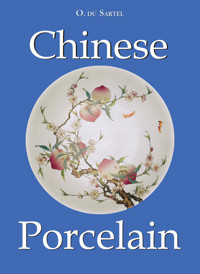
The art of porcelain manufacturing is linked closely to China and its history, appearing in the 7th century when it became an important symbol of royalty or high status. The masterpieces of the genre featured in this book range from simple tea bowls and fantastic vases to hair ornaments, figurines and snuff boxes with intricate, multi-coloured designs. The presentations of these fragile objects are accompanied by an informative outline of the history of Chinese porcelain. This delicate material attracted and continues to attract the attention of art lovers throughout the world.
Das E-Book können Sie in Legimi-Apps oder einer beliebigen App lesen, die das folgende Format unterstützen:
Seitenzahl: 53
Veröffentlichungsjahr: 2022
Ähnliche




















O. du Sartel
Author: O. du Sartel
© 2014, Confidential Concepts, Worldwide, USA
© 2014, Parkstone Press USA, New York
© Image-Barwww.image-bar.com
All rights reserved. No part of this may be reproduced or adapted without the permission of the copyright holder, throughout the world.
Unless otherwise specified, copyright on the works reproduced lies with the respective photographers. Despite intensive research, it has not always been possible to establish copyright ownership. Where this is the case, we would appreciate notification.
ISBN: 978-1-78160-957-6
Contents
Chinese Dynasties Chronology
Introduction
I. Han Dynasty (206 B.C.E.-221)
II. Three Kingdoms Period (220-265) and Subsequent Dynasties
III. Tang Dynasty (618-907)
IV. Song (960-1279) and Yuan (1279-1368) Dynasties
V. Ming Dynasty (1368-1644)
VI. Kangxi Period (1644-1722), Qing Dynasty
VII. Yongzheng and Qianglong Period (1723-1795), Qing Dynasty
List of Illustrations
Chinese Dynasties Chronology
2205-1767 B.C.E.:
Xia Dynasty
1767-1122 B.C.E.:
Shang Dynasty
1122-256 B.C.E.:
Zhou Dynasty
771-475 B.C.E.:
Spring and Autumn Period
475-221 B.C.E.:
Warring States Period
221-207 B.C.E.:
Qin Dynasty
206 B.C.E.-221:
Han Dynasty
220-265:
Three Kingdoms Period
265-420:
First Jin Dynasty
302-439:
Sixteen Kingdoms Period
420-589:
Southern and Northern Dynasties
581-618:
Sui Dynasty
618-907:
Tang Dynasty
690-705:
Second Zhou Dynasty
907-960:
Five Dynasties and Ten Kingdoms Period
907-1115:
Liao Dynasty or Khitan Empire
1036-1227:
Western Xia Dynasty or Tangut Empire
1115-1234:
Second Jin Dynasty of Northern China
960-1279:
Song Dynasty
1279-1368:
Yuan Dynasty or Mongol Empire
1368-1644:
Ming Dynasty
1644-1911:
Qing Dynasty or Manchu Dynasty
1911-1945:
Republic of China
1949-today:
People's Republic of China
Introduction
Porcelain was certainly invented in China. This is acknowledged in England by the adoption of the word “china” as equivalent to porcelain. Even in Persia, the only country to which an independent invention of the material has been attributed by some writers and where Chinese porcelain has been known and imitated for centuries, the word chini carries a similar connotation.
For the creation of a scientific classification of ceramic products, it may be necessary to define here the distinctive characteristics of porcelain. Porcelain ought to have a white, translucent, hard paste, to be scratched by steel, homogeneous, resonant and vitrified, exhibiting, when broken, a conchoidal fracture of fine grain and brilliant aspect. These qualities inherent in porcelain make it impermeable to water and enable it to resist the action of frost even when uncoated with glaze. Among the characteristics of the paste given above, translucency and vitrification define porcelain best. If either of these two qualities is absent, the material is considered a different kind of pottery. If the paste possesses all the other properties with the exception of translucency, it is stoneware; if the paste is not vitrified, it belongs to the category of terracotta or of faïence.
The Chinese define porcelain under the name of tz’u, a character first found in books of the Han Dynasty (206 B.C.E.-221 C.E.), as a hard, compact, fine-grained pottery (t’ao); they distinguish it by the clear, musical note that it gives out on percussion and by testing that it cannot be scratched by a knife. They do not insist on the whiteness of the paste or on its translucency, so some pieces may fail in these two points when the fabric is coarse. However, it would be difficult to separate these elements from porcelain’s character. Porcelain may be divided into two classes: hard paste, containing only natural elements in the composition of the body and the glaze, and soft paste, where the body is an artificial combination of various materials fused by the action of the fire, in which a compound called frit has been used as a substitute for natural rock. All Chinese porcelain is of the hard paste variety. The body consists essentially of two elements: the white clay kaolin, the unctuous and infusible element that gives plasticity to the paste, and the feldspathic stone petuntse, which is fusible at a high temperature and gives transparency to the porcelain.
Of the two Chinese names that have become classical since they were adopted by the West, “kaolin” is the name of a locality near Jingdezhen where the best porcelain earth is mined and “petuntse”, literally “white briquettes”, refers to the shape in which the finely pulverised porcelain stone is brought to the potteries, after it has been submitted to the preliminary processes of pounding and decantation. The feldspathic stone from the province of Jiangsu is a white, compact rock with a slightly greyish tinge, occurring in large fragments covered with manganese oxide in dendrites and featuring imbedded crystals of quartz in a mass that fuses completely into a white enamel under the blowpipe.
In actual practice, many other materials – such as powdered quartz and crystallised sands, for example – are added to the two essential ingredients above in the preparation of the body of Chinese porcelain, which varies very widely in composition. A special paste made of huang tun, or “yellow bricks”, derived from a tough, compact rock that is pounded in large watermills, is used for coarser ware and said to be indispensable for the proper development of some of the single-coloured glazes of the high fire. The yu glaze of Chinese porcelain is made of the same feldspathic rock that is used in the composition of the body, the best pieces of petuntse being reserved for the glaze, selected for their uniform greenish tone, especially when veined with dendrites like leaves of the arborvitae. This is mixed with lime, prepared by repeated combustion of grey limestone and piled in alternate layers with ferns and brushwood cut from the mountainside foliage. The purpose of the lime is to increase the fusibility of the feldspathic stone. The finest petuntse, yu kuo or “glaze essence”, and the purified lime, lien hui




