


6,99 €
Mehr erfahren.
- Herausgeber: Editorial Zadkiel
- Kategorie: Geisteswissenschaft
- Sprache: Englisch
During a travel in Romania as a social clown, in October 2006, together with my friends we visited an institute hosting orphaned. The children were more than a hundred and the service staff in total counted no more than six people. In particular, I was impressed by a child among many; although he was three years old, he wasn’t able to speak. No-one spent time teaching him. Something broke and, at the same time, something was born in me. It was a new awareness that, left for years at the bottom of my heart, day after day, pulse after pulse, helped me in writing this book.Francesca Romana Pistoia was born in Rome in 1968, she graduated in international political science and orients her career on issues on thematics such as social inclusion, ethical finance, microcredit and active labour market policies as tools to fight unemployment and social exclusion. Journalist since 2000, she writes about music, art, theatre and cinema. She is fluent in five languages and since 2005 she is a social clown, active part and organizer of the "smile missions” in Guatemala, Romania, Ivory Coast and Tanzania. Her motto is: enthusiasm!
Das E-Book können Sie in Legimi-Apps oder einer beliebigen App lesen, die das folgende Format unterstützen:
Veröffentlichungsjahr: 2017
Ähnliche



















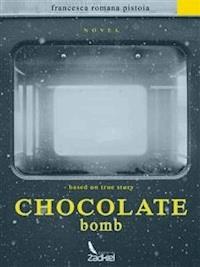
Chocolate bomb
Francesca Romana Pistoia
Original title: Bomba al cioccolato
Copyright – All rights reserved
ISBN original version: 9788827506783
Translation: RDR Traducciones
Cover design by Rosso China
Pictures inside the book by Pixabay – CC0 (Olichel, Free-Photos, Mirror_eyes, Terimakasih0, Stokpic, Counselling, RonPorter, Skeeze)
Digital version by Rosso China
Editorial Zadkiel www.editorialzadkiel.com
Follow us on Facebook
This book is dedicated to
Alessia and Corrado
Preface
What does a child feel when abandoned by his parents?
It’s a dramatic reality. It’s the most terrible experience for a child: fear, affliction, confusion, profound anger and a sense of guilt for their birth, thinking they were a mistake. It’s a stab, a pounding pain.
Piotr is only ten non-lived years old, or rather, years lived in cold, inside and out. His life is like the scenario of his native country, populated by marginalization and uncertainty, in which ensuring a stable future to progeny is considered a luxury. Suffering is like a second skin that you can’t get rid of as you would with a worn suit. A panorama of streets and snow covered trees most of the year. A surreal landscape where the freeze mutes the singing of the daring bird which just by chance, is seen perched on a tree limb. The bird is not alone. Nearby his mother is vigil, she keeps her eyes on him, she doesn’t leave him alone; Priotr’s mother and father do the same. In a situation as this one, where the murmur of silence is louder than everything else, someone is bound to ask: how can a child survive a pain so overwhelming? How can a child be forgotten by his parents?
It is difficult to explain to a child that he will soon be left on his own, that he will no longer see his parents or the house where he has lived. How can you explain him that, all of a sudden, even the small things will cease to exist. The train he will take with his father will be the last. For Piotr it will be the most profound, fear and anguish trip, where he will take note of every detail and will secure in his mind every moment, even the most faded of his family, waiting to hear the explanation behind such situation… whether he is living a dream or a nightmare. The waiting will soon give way to resignation and impotence, preludes to depression and anger which often turns into violence against himself... and the world. Not being able to escape, to fight against something inescapable. Great will be the fear and inability to express his grief. The only possible answer will be total paralysis. He will turn into a small wax statue, ready to melt under the warmth of an embrace that will never take place. He will not be able to cry and the contained tears will dig deep furrows in his ailing soul.
Following his father in silence, Piotr will get lost in the deep shade of a trauma too immense to be preserved and, more important, understood. He will freeze his emotions and feelings as the only way to avoid dying inside. He will bury deeply all questions, which will nonetheless in time return with increasing urgency.
The Institute in which he will be welcomed, with its 400 souls, will become his only reference point. His family, his brothers, his friends. Those with whom share everything: anxiety, anger, games, a piece of bread, rice, the suffer, the desires, the fantasies. Imagination will become the only way to invent a better present: a precious gift that no one can take away from a child. These children cannot think or imagine the future. Because future doesn’t exist.
What could eventually be the fantasy of a future for an abandoned child? The bitter taste of uncertainties vanishes even the smallest dreams; a hot dish, a bed, a roof. They can’t imagine small certainties, much less what they never had: a family. A mother who embraces you while pronouncing your name; a father who helps you put on your coat and brings you to school; lunches and dinners together around the same table; a real family where with love, also the most simple loaf of bread becomes a fragrant cake, fresh from the oven. This is how imagination is censored by sorrow for something you can’t have. Here follows the fairy tale, in which they can express feelings and emotions, where the protagonist becomes the warrior who can defeat evil. The ending is always the same.
As the days lived within the institution that welcomed him. There are no birthdays because, they are often a date for fantasies, nightmares and hopes: not remembering in order to not feel pain never subsided is better.
In this routine, Priotr will build his small securities. His entertainments will be: a rectangle piece of land where he can kick a ball; a bath in the river during the brief period when snow and ice give way to the warm sun season. Days with the same rhythms, where the only certainty is the present they can share with others; this until the day in which events made Priotr and all children of the Institute tremble with fear.
Suddenly it was like being on a raft in the middle of the river, the feeling of drowning. A break that opens and lets emotions and never forgotten pains flow.
Priotr found himself catapulted into a new and unknown dimension. He couldn’t know that, soon after the unexpected event, he would have met Martha and, with her, he would have lived a joy never experienced before. A meeting that gave him the chance to dissolve his resistance, to open his heart: he understood for the first time what love means.
That child, bearer of omitted truths and often ignored, with the help of Marta, learned with great effort to face his pain and accept his own past by accepting feelings and emotions. This opening will allow him to change the course of his life. This new awareness will allow him to recognise and accept what, because of fear, pain and anger he believed he didn’t deserve, or didn’t have the right to try. Although a source of great pain, this new force will convince him to not deny his past and his roots. He will understand that everything happens for a reason and, the greatest mistake can become infinitely small in front of the great feeling which is love.




