


Erhalten Sie Zugang zu diesem und mehr als 300000 Büchern ab EUR 5,99 monatlich.
- Herausgeber: The History Press
- Kategorie: Geisteswissenschaft
- Sprache: Englisch
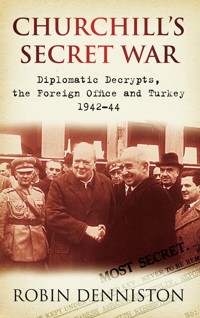
The key part played by Winston Churchill in shaping the course of the Second World War is still of great interest to historians worldwide. In the course of his research, Robin Denniston has uncovered previously unknown files of diplomatic intercepts which show that Churchill's role in British foreign policy and war planning was far more signficant than has hitherto been supposed. Although neither a commander-in-chief nor a head of state, he personally exerted considerable influence on British foreign policy to force Turkey into the Second World War on the side of the Allies. This ground-breaking book explores Churchill's use of secret signals intelligence before and during the Second World War and also sheds fresh light on Britain's relations with Turkey - a subject which has not received the attention it deserves. The book examines a little-known plan to open a second front in the Balkans, from Turkey across the eastern Mediterranean, designed to hasten D-Day in the west, and reveals new information on the 1943 Cicero spy scandal - the biggest Foreign Office security lapse until the Burgess and Maclean affair some twenty years later.
Sie lesen das E-Book in den Legimi-Apps auf:
Seitenzahl: 480
Veröffentlichungsjahr: 2016
Das E-Book (TTS) können Sie hören im Abo „Legimi Premium” in Legimi-Apps auf:
Ähnliche



















CHURCHILL’S SECRET WAR
In memory of Alastair Guthrie Denniston 1881–1961
CHURCHILL’S SECRET WAR
Diplomatic Decrypts, the Foreign Office and Turkey 1942-44
ROBIN DENNISTON
Cover picture: Winston Churchill and President Ismet Inönü at the Anglo-Turkish Summit, 1943 (IWM K3989)
First published 1997
This edition first published 2009
The History Press
The Mill, Brimscombe Port
Stroud, Gloucestershire, GL5 2QG
www.thehistorypress.co.uk
This ebook edition first published in 2016
All rights reserved
© Robin Denniston, 1997, 1999, 2009
The right of Robin Denniston to be identified as the Author of this work has been asserted in accordance with the Copyrights, Designs and Patents Act 1988.
This ebook is copyright material and must not be copied, reproduced, transferred, distributed, leased, licensed or publicly performed or used in any way except as specifically permitted in writing by the publishers, as allowed under the terms and conditions under which it was purchased or as strictly permitted by applicable copyright law. Any unauthorised distribution or use of this text may be a direct infringement of the author’s and publisher’s rights, and those responsible may be liable in law accordingly.
EPUB ISBN 978 0 7509 7955 9
Typesetting and origination by The History Press
eBook converted by Geethik Technologies
CONTENTS
List of Plates
Author’s Note
Acronyms and Abbreviations
Introduction
1 Why Turkey?
2 Churchill’s Diplomatic Intercepts
3 Before the Deluge: 1940–41
4 Turkish Neutrality: Liability or Asset?
5 Churchill’s Turkey Hand 1942
6 Adana and After
7 Churchill’s ‘Island Prizes Lost’ Revisited
8 Cicero, Dulles and Philby: 1943–44
9 Conclusions
Appendices
Notes
Bibliography
LIST OF PLATES
1 Churchill and Inönü, 1943
2 Oshima intercepted: BJ
3 A classical cryptographer, 1934
4 Roosevelt, Inönü, Churchill, 1943
5 Churchill in Cairo, 1943
6 Churchill on Turkish soil, 1943
7 Oshima and Hitler, 1939
8 Rommel and Mussolini, 1944
9 Knatchbull-Hugessen and Churchill, 1943
10 Anglo-Turkish Summit, 1943
AUTHOR’S NOTE
Churchill’s interest in secret signals intelligence (sigint) is now common knowledge, but his use of intercepted diplomatic telegrams (BJs) in the Second World War has only become apparent with the release in 1994 of his regular supply of Ultra, the DIR/C Archive. Churchill proves to have been a voracious reader of diplomatic intercepts from 1941–44, and used them as part of his communication with the Foreign Office.
This book establishes the value of these intercepts (particularly those Turkey-sourced) in supplying Churchill and the Foreign Office with authentic information on neutrals’ response to the war in Europe, and analyses the way Churchill used them. Turkey was seen by both sides to be the most important neutral power.
Why did Turkey interest Churchill? This book answers the question by tracing his involvement with diplomatic intercepts back to 1914, and then revealing how the Government Code and Cipher School (GCCS) was empowered to continue monitoring such traffic until 1939, when ‘Station X’ was established at Bletchley Park (BP).
After tracing the interwar work of GCCS on the secret diplomatic traffic of most major powers and outlining Turkey’s place among those powers, Robin Denniston concentrates on four events or processes in which Churchill’s use of diplomatic messages played a part in determining his wartime policy, which was sometimes at odds with that of the Foreign Office. He examines the use Churchill and the Foreign Office made of BJs to persuade Turkey to join the Allies between 1940 and 1943, suggesting that the Adana Conference of January 1943 produced little change in Turkish foreign policy partly because of the lack of BJs, due to tight British security on the train. The Dodecanese defeat of 1943 is explained in the light of the signals intelligence Churchill was reading. A later chapter shows the results at GCCS in London of the theft of secret Foreign Office papers in Ankara from November 1943: whether actual BJs were included in these papers, how they were received and how they led to a breakthrough in reading the German diplomatic cipher, too late to be useful to Churchill.
Acronyms and Abbreviations
ADM
Admiralty
AM
Air Ministry
BJ
Secret signals intercept circulated in Whitehall in blue jackets
BP
Bletchley Park
BSC
British Security Co-ordination
‘C’
Gen Sir Stewart Menzies, Head of the Secret Intelligence Services
C&W
Cable & Wireless
C-in-C
Commander-in-Chief
CCC
Churchill College, Cambridge
CIGS
Chief of the Imperial General Staff (Lord Alanbrooke)
COS
The (British) Chiefs of Staff
DEFE
Files of the Minister of Defence (Churchill) at the PRO
Dedip
Foreign Diplomatic Decrypts, accepted usage from 1943
DF
Direction Finding
DGFP
Documents on German Foreign Policy – see Bibliography
DIR/C
The files brought by the Chief of the British Secret Service to Churchill. Called HW1 in the PRO.
DMI
Director of Military Intelligence
DNI
Director of Naval Intelligence
FO
The (British) Foreign Office
GCCS
The Government Code and Cipher School
GCHQ
Government Communications Headquarters
GHQ
General Headquarters
GPO
General Post Office
IWM
The Imperial War Museum
JIC
Joint Intelligence Committee
ME
Middle East
MEW
Ministry of Economic Warfare
MI
1B Military Intelligence (Cryptanalytical Section)
MI6
Secret Intelligence Service (MI6)
MTB
Motor Torpedo Boat
NAC
National Archives of Canada in Ottawa
NSA
National Security Agency (USA)
OTP
One Time Pad: an unbreakable code system employing pages of 5-figure numbers available only to sender and recipient
PRO
Public Record Office
RAF
Royal Air Force
SD
Sicherheitsdienst: the Intelligence Branch of the SS under Heydrich.
sigint
signals intelligence
SIS
Secret Intelligence Service (MI6)
sit rep
situation report
TA
Traffic Analysis
W/T
Wireless Telegraphy
Introduction
Whence did WSC get his more outrageous strategic ideas . . .? The answer is strictly and absolutely from his own brain.
Desmond Morton, 9 July 1960
The literature on Churchill’s use of secret intelligence at war is large and growing, in the USA as well as the UK. This book studies his use of diplomatic intercepts, based on newly discovered files Churchill himself hoarded during his lifetime. These files – which came to him almost daily from his intelligence chief, Brig Stewart Menzies – contain a surprise, in that together with much Ultra traffic (high-grade or Enigma/Fish intercepts frequently referred to as ‘Boniface’) there was much more diplomatic material in what Churchill was reading than any historian has hitherto realised. It was widely recognised, of course, that he studied the military, naval and air intercepts supplied to him from 1941. But it has only recently become apparent that Churchill’s absorption in the product of the government’s deciphering department had its origins in the First World War. In November 1914, when First Lord of the Admiralty, he had written the original charter for the legendary ‘Room 40 OB’, ensuring that German naval intercepts were available to his nominees. This involvement with, and possessiveness over, secret signals intelligence continued unabated until 1945 when Japanese diplomatic messages between Berlin and Tokyo informed the war leadership that the time had come to drop atomic bombs on Hiroshima and Nagasaki. The intercepted telegrams he studied were diplomatic as often as army and navy traffic in and between both world wars.
Churchill had always been interested in Turkey, ever since intercepts supplied to him by the Director of Naval Intelligence, Adm Reginald Hall, told him he could have secured Turkish non-participation in hostilities in February 1915 and he chose to disregard this vital information. Later he backed a Greek foray against the Turks at Smyrna in 1922 in an episode in which intercepted diplomatic messages between the Turkish ambassador in Paris and Constantinople provided him, Curzon and Lloyd George with vital information on the attitude of the Turkish leadership. By 1940 he had convinced himself that he alone could bring Turkey into the war as an ally. Few people, then or now, agreed with him, but he took immense pains to develop British policy towards Turkey in a manner that would shorten the war.
Why was Churchill so interested in Turkey? He believed that Turkey, like the other major neutral powers, collectively and individually, had the opportunity to affect the outcome of the war. Turkey was the most powerful neutral, for historical and geographical as well as strategic reasons. So Turkey could help to determine which way the war would go. Other questions then follow: what effect did Churchill’s interest have on Turkey’s determination to stay neutral in the Second World War? By what means did Turkey exploit the international situation to safeguard its own sovereignty? In Whitehall, how did the policies of the Foreign Office and the War Office differ from Churchill’s own policy in playing ‘the Turkey hand’? And within the Foreign Office whose voice counted for most, and did the diplomats there speak with one voice? How did the government obtain authentic and timely knowledge of Turkish intentions? How did the diplomatic intercepts produced in London and Bletchley between 1922 and 1944 alter the course of British foreign policy in the eastern Mediterranean, and what use was made of them by the Foreign Office and Churchill?
In considering these and related questions, this book focuses on three specific events – the conference in January 1943 between Churchill and the Turkish leadership; the abortive British campaign to recapture the Dodecanese later that year, with its diplomatic consequences; and one of the single most spectacular spy coups of the war, the so-called ‘Cicero’ affair, on which new light is thrown by reference to Churchill’s files of diplomatic intercepts in November 1943. All these events are seen against a background of international diplomatic intrigue in which Turkey’s determination to stay neutral plays a central role.
The PRO has provided access (except where documents have been withheld by GCHQ) to files Churchill valued so highly that their contents had often to be reciphered and cabled to him – sometimes in the exact words (ipsissima verba) – whenever he was out of the country. Their recent arrival at the PRO means that diplomatic historians have had no more than a few months to review the material and undertake the dangerous counterfactual exercise of answering the question, how would Churchill and the Foreign Office have handled Turkey without the Turkey-sourced intercepts? An attempt is made here to strip out these messages from the general progress of Turco-British relations to see how differently Churchill would have played the Turkey hand had this material not been available to him, in its ipsissima verba state, in DIR/C.1
Little attention has hitherto been given to the British government’s achievements in obtaining intelligence by intercepting letters and telegrams and by breaking the diplomatic ciphers of neutral and friendly nations, and its impact on the conduct of foreign policy during the Second World War. Such references as there are to the non-military side of the wartime secret intelligence have been made despite the fact that both the US State Department and Her Majesty’s government have been unwilling until recently to disclose any diplomatic material. The arrival of DIR/C in the PRO means that a new source of secret information available throughout much of the war to the Foreign Office but hitherto unknown to most historians of secret intelligence can now be studied at least for part of the period during which Turco-British relations were a major concern of British foreign policy. This also raises questions related to the Foreign Office’s perception of the Turkish mind which require answering.
I suggest that the intelligent reading and use of secret signals intercepts, in war and peace, by the major western powers, assisted foreign policy makers (notably Churchill) who understood their limitations as well as their potential value. But the corollary that diplomatic history might need to be substantially rewritten in the light of recent releases in London, Ottawa and Washington does not necessarily follow. Little now known from the released intercepts, and unknown or only partially known before, actually affects existing diplomatic history.
Turkey was a crucial case. The Foreign Office had been hard at work improving Anglo-Turkish relations since the early 1930s, but by 1940 this was reduced to Turkey’s trade in chrome with Britain and with Germany. Without Churchill relentlessly seeking any opportunity to divert German armies from the Eastern Front and looking for an ally in the eastern Mediterranean, it is unlikely that Turkey would have loomed so large in Allied war strategy. At least two policies, therefore, towards Turkish neutrality in the Second World War can be discerned: those of Churchill and of the Southern Department of the Foreign Office which was responsible for Turkey. What united them was their common reading of Turkey-related diplomatic decrypts.
Within the Southern Department, the wartime minutes of George Clutton and John Sterndale-Bennett (nicknamed ‘Benito’ after Mussolini) predominate, but the observations of very senior diplomats such as the Deputy Under Secretary, Orme Sargent (‘Moley’) and the Permanent Under Secretary, Sir Alexander Cadogan, throw light on the different perceptions of Turkish neutrality within the government. The Foreign Secretary, Anthony Eden, himself played a part, marred by his too obvious concern with the consequences to his own political career of the success or otherwise of British Turkish policy. From Ankara the British ambassador, Sir Hughe Knatchbull-Hugessen, wrote informally about Turkish affairs to both Sargent and Cadogan. John Sterndale-Bennett and another even abler colleague, Knox Helm, were posted to the embassy in Ankara, thus ensuring co-ordination of policy between Ankara and London. This relationship can be traced by studying the FO 371 (general correspondence) and FO 195 (embassy and consulate) files of the period. While this book concentrates on DIR/C, these and other Foreign Office files have also been useful. There are drafts of Churchill’s unsent letters to colleagues and to Roosevelt, relating to Turkey, in the PREM3 and 4 (Premier) files. Some War Office, Admiralty and Air Ministry files contain references to decrypt diplomacy which the ‘weeders’ have missed.
That a new theme in Churchillian historiography has thus emerged is due to the release of DIR/C. The evidence therein points up Churchill’s enthusiasm for playing the Turkey hand alone and demonstrates his personally directed policy towards Turkey, despite this being the responsibility of the Southern Department under the Secretary of State. This book includes an attempt to assess:
• The importance to the Department of the diplomatic intercepts as distinct from other sources of information.
• How officials regarded and used them.
• How their advice, consequent on these questions, was received and adopted or otherwise by the framers of British foreign policy in the eastern Mediterranean throughout the war.
This study of Churchill’s use of secret signals intelligence, before and during the Second World War, breaks new ground in several other respects. The role of the neutrals has never received much attention from historians.2 In focusing on Turkey’s remarkably resilient and subtle diplomacy towards Italy, Germany, Britain and, especially, the Soviet Union throughout the war, several significant themes develop. One theme is the alternating strategies of Germany and Britain towards the Balkans – the former involving an invasion of Turkey from Bulgaria to carry the Blitzkrieg to Egypt and Persia in 1940–41, the latter the opening of a second front in the Balkans from Turkey across the eastern Mediterranean in 1943, to divert German divisions from the Eastern Front and thus hasten D-Day in the west. Another is the predominating voice of Churchill in Allied war planning in the eastern Mediterranean. Since he was neither a commander-in-chief nor a head of state (as Roosevelt and Stalin were) his strategic ambitions could only be promoted through a cumbersome programme involving the Americans, the Russians and his own War Cabinet and Chiefs of Staff. Despite these handicaps, Churchill struggled with his allies and colleagues for what he saw as the best way forward from 1941, and Turkish involvement in the war was always on his agenda.
Why this was so leads to the third theme of this study – his lifelong interest in and use of signals intelligence.3 Churchill had always read naval and diplomatic intercepts. As early as 1915 when he was First Lord of the Admiralty he had personally drafted the first charter of Room 40 OB – the navy’s legendary decrypting department. Its longest serving member remarked scathingly of this charter, that ‘to have carried out his instructions literally would, no doubt, have safeguarded the secret but must also have nullified the value of the messages’ – because of the restricted distribution and the prohibitions attached to any mention of them.4 This sentence, it may be said, neatly encapsulates the whole problem of how to use intercepts while protecting their security – not enough security and they cease to exist; too much and they cannot be used. Churchill’s use of intercepts continued through the long interwar years of ‘his War against the Russian Revolution’ in 1920 and the Turks at Chanak in 1922.5 At the approach of the Second World War he was reading diplomatic intercepts received from a friend in government (Desmond Morton).6 He found the study of raw authentic intercepts, not gists or summaries or paraphrases, indispensable in formulating policy, and explained their importance to Lord Curzon in 1922. While this is now acknowledged, what he was reading between 1941 and 1945 has only recently been released and so has not yet been studied by historians.7 His written comments and observations on many of these messages can be seen for the first time, both on Axis service traffic (Enigma) and diplomatic (medium-grade) traffic. They are a pointer to his daily study of the inner movement of the war through the voices of his enemies, and of the neutrals.
So far as Turkish neutrality went this was, of course, the responsibility of the Southern Department, not of the Minister of Defence. By reading the new (DIR/C) files alongside the FO files on wartime Turkey it is possible to discern significant differences in attitude between officials of the Southern Department whose Turkish remit was jealously safeguarded against GHQ ME, and against Churchill himself, who wished to ‘play the Turkey hand’ alone, and proceeded to do so in early 1943 much against the wishes of the foreign secretary and the rest of the War Cabinet. New connections can thus be drawn between Churchill and the FO over Turco-British wartime relations, themselves an organic development from the FO’s prewar policy towards Turkey, ably set out by D.C. Watt in his How War Came.8
These causal connections cannot be fully developed without some account of two separate strands in British twentieth-century history. Chapter 2 describes the development of British cryptography from 1915, through the Russian, Turkish and Italian crises of the 1920s and ’30s. This is followed by an account of Turco-British relationships between the Dardanelles crisis of 1915 and the Chanak crisis of 1922 up to September 1939. A bridging chapter (3) carries the story of Churchill, wartime signals intelligence and the progress of the war in the Mediterranean to the end of 1941, at which point the DIR/C files come on stream. Thereafter until January 1943 when Churchill made his surprise visit to the Turkish leadership at Adana – and beyond, until early 1944 – the files relating to Turkey are reviewed in the light of the changing nature of the war.
The Adana Conference was followed later in the year by two significant events – one disastrous, the other ludicrous. The disaster was the Dodecanese debacle of October 1943 in which British forces were beaten by better-officered Germans with a consequential loss of British credibility in the area.9 The other was the theft, inside the British ambassador’s residence in Ankara, of important Foreign Office papers by his Albanian valet, Eleysa Basna – codenamed ‘Cicero’ by the ambassador’s German counterpart in Ankara, Fritz von Papen. Chapter 8 seeks to demonstrate that, since much of this material was identical with Churchill’s own reading, and since captured German documents have demonstrated the great interest shown in it by Hitler, Goebbels and Jodl in Berlin, a revised account is necessary of what diplomats until recently have regarded as the biggest FO security lapse until Burgess and Maclean. This is written in the light of what we now know, fifty years later, about British cipher security, Churchill’s use of deciphered messages, and the state of the war in 1943–44.
The Dodecanese debacle and the ‘Cicero’ affair conclude this study of Churchill’s use of signals intelligence and the FO’s policy towards Turkey in the Second World War. A year was to elapse before Turkey joined the Allies and in that year much diplomatic activity persisted, but the end was no longer in doubt and the focus of Churchill’s interest moved to western Europe, and to Operation ‘Overlord’, the invasion of Normandy in June 1944. The concluding chapter develops the basic thrust of my argument – that while the release of the new files is to be welcomed as revealing interesting new connections between Churchill and his war work, it does not materially alter the history of the Second World War.
Wartime Turkey has been the subject of several ambassadorial memoirs (René Massigli, Hughe Knatchbull-Hugessen, Fritz von Papen) and spy memoirs (Eleysa Basna, Ludwig Moyzisch, Nicholas Elliot, Walter Schellenberg). The opening up of DIR/C is by far the most notable primary source, but does it add to or alter what is already in the books? Much was known before: Churchill knew it at the time because he read DIR almost every day. President I·nönü of Turkey knew it because he was reading much of the same material, the reports his ambassadors sent to the Foreign Ministry in Ankara, which was pivotal in formulating Turkish foreign policy. Whitehall knew it. Hitler and Goebbels knew it. Turkey-related diplomatic intercepts corroborate the historical record but contain few surprises, since the narrative is already in place. While that does not reduce their importance, which is in relating the study of diplomatic signals intelligence to foreign policy in wartime Whitehall, Berlin and Ankara, it may provide a convincingly negative answer to the question previously raised of the requirement to adjust the record.
How the British came by the Turkish diplomatic telegrams is another question this book seeks to answer. British wartime radio and telegram interception and decryption at Bletchley Park have, of course, been the subject of a substantial literature of which Hinsley’s monumental British Intelligence in the Second World War holds pride of place.10 Prof Hinsley (with his co-authors) not only had full access to the files when writing, but was himself a key figure in running Bletchley Park from 1941 to 1944: originating, developing, modifying and operating the complex procedures which turned the raw messages which arrived at Bletchley at all hours of the day or night from many intercept stations scattered across the world into usable, relevant, topical material – still authentic despite the many processes they had gone through. Other BP veterans have written about signals intelligence in the Second World War including Gordon Welchman, Peter Calvocoressi and Ralph Bennett, but none of these, apart from Hinsley, had access to the diplomatic material which is the subject of this book.11
Churchill famously told his researchers that his own history of the Second World War was not history, it was his case.12 Official historians, as will be shown, followed him, particularly in 1943 over the Adana Conference and the Dodecanese assault, not because he had put his ‘case’ together with his own selected documents before they had completed their task, but because they found that the files gave little extra useful information, and that what Churchill thought and did at the time, as recorded by him, remained the best source available. The Dodecanese affair is particularly illuminating, in that immediately after it Churchill ordered his personal staf to collect all his relevant memoranda and telegrams, in order to have ‘his case’ ready for publication. This was duly done and they appear as PREM 3/3/3 at the PRO and form the basis of his ‘Island Prizes Lost’ chapter in vol. 5 (Closing the Ring, London, Cassell) of his war history, published eight years later. They were published in toto in 1976 as vol. 2 of Principal War Telegrams and Memoranda (Kraus Thompson, 1976). It is rare for such a significant combined operation to be reported on by its principal participant, for his own actions to become, relatively without comment, the historical record. Nor did a subsequent generation of revisionist historians greatly alter the received, Churchillian, account of the years of the Second World War, as recent scholars have pointed out. The missing material for a definitive account of Churchill’s 1943 war work is to be found in the diplomatic intercepts. Though they throw valuable new light on what Churchill was up to in his eastern Mediterranean policy (as this book hopes to demonstrate) they require little, if any, rewriting of history. To trace these intercepts, through Churchill’s use of them, to his directives and memoranda – and then to his actual history, and on the lavish use made of them by both official and revisionist historians – is to gain a glimpse at last of how diplomatic decrypts infiltrated the historical record.
I should like to thank Professors Kathleen Burk and David French of University College, London, for help and guidance in the preparation of this book; and also Professors Christopher Andrew and Peter Hennessy for encouragement and information. Thanks are also due to Rupert Allason MP, Dr Rosa Beddington, Dr Selim Deringil, Ralph Erskine, Professor John Ferris, Margaret Finch, Tony Fulker, Randal Grey, David Irving, Professor Sir Harry Hinsley, Rachel Maxwell-Hyslop, Dr Joe Maiolo, Simona Middleton, Sir Patrick Reilly, and the ed itors at Sutton Publishing. Special thanks are due to the staff of the PRO at Kew, at the Churchill Archives in Churchill College, Cambridge, and at the National Archives of Canada in Ottawa. Extracts from the Ian Jacob and Denniston papers are published by kind permission of the Archivist at Churchill College. An early version of chapter 2 appeared in Intelligence and National Security (July 1995). All quotations from PRO documents are Crown Copyright and reproduced by kind permission of the Public Record Office
Robin Denniston
I am after the Turk – Winston Churchill to Anthony Eden, 8 June 1942
[Churchill’s] volatile mind is at present set on Turkey and Bulgaria, and he wants to organise a heroic adventure against Gallipoli and the Dardanelles – Lord Asquith to Venetia Stanley, October 1914
Turks are most awful brigands. We daren’t threaten them, we can’t bribe them – Alexander Cadogan, 24 August 1942
Turing: I am a code-breaker. I deciphered all the German codes and won the war single-handedly. That’s top secret, of course, nobody knows Ron [grinning]: Just me Turing: You and Mr Churchill – Hugh Whitemore, Breaking the Code
Reading the whole war . . . every day, from the enemy viewpoint, the British being the enemy – Christine Brooke-Rose on Hut 3, Bletchley Park, Remake, p. 108
The distribution of diplomatic intercepts throughout the chancelleries of many powers between the wars suggests an interesting new angle on both the conduct and the study of international diplomacy – The author, 1996
It is said about Foreign Office minutes that if you read the odd paragraph numbers and the even paragraph numbers in series you get both sides of the case fully stated. – WSC, vol. 5, p. 627
England has organised a network of intercept stations designed particularly for listening to our radio. This accounts for the decyphering of more than 100 of our codes. The key to those codes are sent to London where a Russian subject, Feterlajn, has been put at the head of cipher affairs. – Trotsky to Lenin, 1921
CHAPTER ONE
Why Turkey?
Those who remember the operations of 1915 and 1916 in the Dardanelles and Mesopotamia may be glad that the Turks, who were then against us, are now for us. What is the cause of this change? It was because, during the same years in which the Germans turned to thievery, the Turks turned to honest ways.
R.G. Collingwood, The New Leviathan, p. 374
This chapter attempts to answer the question, why was Turkey so important to Churchill in 1941? It brings together Turco-British international relations from 1914 to 1943, relates Churchill’s failed attempt on Turkish neutrality in the First World War to his playing of the Turkey hand in the Second World War; links his perceptions of, and intelligence on, Turkish foreign policy to his war strategy, considers the balance of advantage of having Turkey as an active and demanding ally, and then summarises Turco-British relations between 1940 and 1943 using newly disclosed diplomatic intercepts.
The following pages also touch on the importance of Turkish economics, geography and history in relation to world affairs since the ascendancy of Atatürk. His successors shared with Britain (and probably also with Germany) a common source of intelligence – ambassadorial reports from most European capitals sent to Ankara for their guidance, which were also intercepted and used by the FO in London. Churchill’s interest in signals intelligence generally is then integrated into the picture, particularly that related to Turkey. His obsession with the Turks had strong roots in the First World War, and thus can be seen to lead directly to his unilateral decision to seek out the Turkish leadership on Turkish soil in January 1943.
Churchill and Turkey in the First World War
To answer the question, ‘Why Turkey?’, some account of Turco-British relations in 1914–15 is first required, for significant parallels can be observed between British war strategy towards the Turks at the Dardanelles, in part driven by Churchill as First Lord of the Admiralty in 1914, and remarkably similar thoughts of a Balkan offensive launched from Turkey harboured by an older if not wiser Churchill in 1942–43.
In August 1914 the German failure to destroy France following the ‘miracle’ of the Battle of the Marne induced the Reich to look at Turkey, then still neutral. A Turkish threat to distract Russian armies from Germany’s Eastern Front would stop Russian trade through the Dardanelles, might hasten Bulgarian involvement and would threaten British imperial communications at Suez. The parallel with the Second World War, so far as Germany was concerned, was clear, and von Falkenhayn in 1914, as Jodl would do in 1943, promoted the view that a threat to Suez would weaken British forces in the west.
In Whitehall Winston Churchill urged the cabinet towards an offensive against Turkey – first conceived as involving a strong military contingent as well as the then all-powerful Royal Navy, subsequently a navy-only operation. The generals and admirals – ill-prepared culturally for the onset of total war – failed to deliver unequivocal support. On 30 October the Germans provoked the Turkish navy to shell the Russian Black Sea Fleet and provided Churchill with his opportunity in the Mediterranean. He unilaterally – and unconstitutionally – ordered the Royal Navy to shell the Turks stationed round the Dardanelles. This obliged the Turks to strengthen their defences, though their ammunition remained in short supply.
Churchill’s advocacy of an attack on the Dardanelles was based on the perception that a successful result would give Britain the chance to dictate terms at Constantinople. However, he knew (as he would know about the Dodecanese assault in 1943) that the venture would be both costly and risky. In 1914 he found insufficient support for his plan: an attack on Turkey would only relax pressure on Russia, it was said, and play the German game. But he did have support from Adm ‘Jacky’ Fisher, the First Sea Lord, who wrote on 3 January 1915: ‘The attack on Turkey holds the field, assuming a strong body of British troops to achieve a continued assault.’ In the event, this was unforthcoming but Churchill pressed on, despite Fisher’s view, expressed to the Dardanelles Commission in 1917, that the naval operation alone was doomed to failure.
The consequence of the confused leadership structure in Whitehall and of the First Lord’s determination to play the Turkey card himself, led to disaster for Britain. This remained in the collective memory as a stigma to be born by Churchill for the next twenty years.1 That leadership structure was no less confused at the outbreak of the Second World War, except that Churchill was in undisputed command by June 1940, and not compelled to work entirely through advocacy. A parallel situation with regard to Turkey quickly developed in the stricken years of 1940–41 but before that Turco-British diplomatic relations had taken a turn for the better. To see why, Turkey needs to be seen in a European context.
Turkey in Context
The dismemberment of the Ottoman empire in 1879 followed the successful Russian siege of Erzerum five years earlier. Previously extending to the Adriatic in the west and the Danube basin in the north-west, the empire had been in decline since 1690. By 1878 new nation states had grown within the Ottoman boundaries; Bulgaria had thrown off the Turkish yoke in a revolt backed by fellow Slavs in Russia, to whom thereafter she was tied by race, religion and gratitude. Despite their victory over the British at the Dardanelles, the First World War proved disastrous for those in Ankara reluctant to face the realities of the post-Ottoman world.
The Treaty of Versailles left Turkey with no European territory, and western leaders, in particular Lloyd George, were determined to exclude her from the Continent. She was disliked and feared by the international community. The dislike stemmed in part from a deep-seated anti-Muslim prejudice, partly explained by the residual predominance of Christian prejudices in the chancelleries of the great western powers. The legacy of Ottoman oppression and corruption had left Turkey the sick man of Europe and something of a pariah. The fear arose from Turkey’s strong tradition in arms, weakened but not allayed by being on the losing side in the First World War.
The rise of Atatürk signalled to the architects of Versailles a recrudescence of Ottoman imperialism, symbolised by Turkish victory over Greece at Chanak in 1922. Greece, backed only by Britain and in spite of British public opinion, was repelled from Turkish territory amid some savage ethnic cleansing.2 A severe earthquake then compounded the problems of the Turkish leadership. Thereafter Atatürk was to prove a friend of the west, and Britain in particular, thanks in part to the close friendship he established with the British ambassador in Ankara, Sir Percy Loraine.
The world longed for peace, and thus good relations with the nascent, etiolated Turkish state became the cornerstone of the Balkan policies of all the western great powers – of none more so than Britain. Additionally Turkey’s foreign minister, Ismet I·nönü – later to lead the Turkish nation through the Second World War and beyond – proved to be a formidably successful negotiator at the Lausanne Conference of 1923. While Lord Curzon was perceived to be the ablest tactician of the great power statesmen present, it was I·nönü who won for his country significant modifications to Versailles, including parts of western Thrace which made the Straits in effect a broad river through Turkish territory, much to the chagrin of generations of Russian and Bulgarian diplomats.
Chanak in 1922 and Montreux in 1936 were significant moments in the development of Turkish foreign policy in the interwar period. British attitudes to Turkey were affected by two factors which bound Turco-British relations together for the next twenty years. One was the presence of Winston Churchill back in government after serving in a sort of honourable disgrace as a battalion commander on the Western Front. Churchill was passionately in favour of the Chanak provocation in 1922, pressing information derived from Turkish diplomatic intercepts on his colleagues to show which way the wind was blowing. The second, arising from the first, was Britain’s access to Turkish military and diplomatic ciphers continuously from 1916 to 1945. These informed Churchill how he could have taken advantage of the shortage of Turkish ammunition and the willingness of the Turkish banks to accept bribes to intervene: thus informed, he could have averted the Dardanelles fiasco. Seven years later he read the intercepts which spelt out the chances of the success of the Chanak provocation and, twenty years after that, he plotted each step in Turkey’s plans to stay neutral in 1941–43. Thus the relationship between Churchill, Turkey and diplomatic intercepts can be traced over twenty-nine years, which helps explain why playing the ‘Turkey hand’ was so important to him in the Second World War.
Some account of Turkey’s economic and political developments will serve to bridge the interwar years. The crises and conferences which brought modern Turkey into being created an essentially non-viable state, lacking the infrastructure and resources of other Middle Eastern countries, settling uneasily for a centralised one-party state on Portuguese lines but with a commitment to some form of eventual social democracy which was slow to come and over which the Turkish leadership procrastinated, often with good reason.
Turkey’s strategic position at the eastern end of the Mediterranean and the southern shore of the Black Sea meant that it was a target of constant surveillance by Whitehall, but in fact the country was split, not geographically but ethnically and culturally, into two quite distinct groupings. Turkish discrimination against Armenian, Azerbaijani, Kurdish and Greek minorities obscured the fact that many Turks shared more in common with populations between the Caucasus and the Caspian than with their Balkan neighbours. The huge Anatolian hinterland was comparatively undeveloped, and schools, roads and amenities generally were scarce. The economy was fragile, illiteracy extensive and taxation yielded insufficient revenue to support not only a large standing army but by 1939 a massive call-up of reservists and a state of emergency. Foreign trade was hard to come by without credit, or barter, or state intervention. Here was a third world country in which a million peasant farmer producers had become consumers through the call-up, as Prime Minister Saraçoğlu explained in the Turkish National Assembly in July 1941.3 A wealth tax, introduced as a consequence, caused widespread alarm, particularly among the non-Muslim minorities in the west of the country, against whom it was targeted and who involuntarily contributed 85 per cent of the additional revenue raised. After a good harvest the peasantry regularly worked on the roads for additional subsistence, and thus gradually opened Anatolia up to the internal combustion engine.
Looking east and south, to Mecca and Arabia and central Asia rather than to Europe, the 18 million population had no wish to fight the Germans, the Russians or anyone else, except perhaps the Bulgarians. Only Muslims could bear arms and many of the minorities suffered discrimination. Dissent was discouraged and the press followed the government line with only mild differences of emphasis depending on whether the proprietor or editor inclined to national socialism or democratic capitalism. All alike were afraid of Russia, until Mussolini’s interventions in Africa, Spain and Albania made Italy Turkey’s chief problem.
I·nönü knew that his army was equipped to fight and win on Turkish soil and elsewhere in Asia but not against the Wehrmacht (German army) with its new weapons and frightening new ways of carrying out Blitzkrieg (lightning war). On Atatürk’s death in 1938 I·nönü had been appointed his successor in the presidency. He concentrated his attention on foreign policy, to maintain his predecessor’s priorities, holding Turkey’s new borders inviolate, keeping her hard-won rights in the Straits, buying only from nations that bought from them, making wary non-aggression noises to her equally fragile neighbours – Romania, Greece and Bulgaria – ignoring the Arab world and the Jewish refugees from Eastern Europe, and maintaining friendship, albeit on their terms, with the great powers, particularly Britain. And he based the policy on the reports of his ambassadors which were invariably delivered straight to him.
At the start of hostilities in September 1939 Turkey’s major enemy was Italy, whose advance into Albania two months previously was seen as further evidence of Mussolini’s neo-imperialist policy, already condemned by the League of Nations, though later condoned. It was clear to the Turks that Mussolini’s ambitions were by no means fully realised, and his occupation of the Dodecanese islands might prove to be the prelude to sharp fighting in the eastern Mediterranean. But elsewhere I·nönü followed Atatürk in seeking to ensure the balance of power in Europe was maintained. So Germany’s ambitions in eastern Europe, already realised in Austria, Czechoslovakia and Poland, loomed menacingly, although German diplomats then and thereafter, on Hitler’s orders, treated Turkey with politeness and care. The British approach by way of reciprocal guarantee in April 1939 came as the climax of several years of diplomatic activity designed to keep Turkey sweet. The formalities were completed by the Franco-Turco-British Pact which guaranteed Turkey’s borders from any threat in the west – but the FO files reveal that almost no one understood what the pact really entailed, and in particular what would happen if a belligerent country attempted to sail its ships through the Straits. And it was never put to the test. French influence, hitherto dominant,4 was severely eroded by the unmoving nature of the French position which failed to maintain her mission civilisatrice in the Middle East, and was effectively eliminated when France surrendered to the Germans in June 1940.
Thus preserving Turkish neutrality required all I·nönü’s concentration and formidable negotiating powers. Conflicting concerns swirled round the politicians in Ankara, and historical and ancestral memories skewed the negotiating processes. Fear of Russia was compounded by the widespread fear of international Bolshevisation – which by 1938 threatened to bring parts of northern Spain into the Russian orbit – with a growing awareness of what Stalin’s purges were doing to the officer class there. With France immobile and Italy flexing its muscles, with Germany enticing her into trading dependency and Britain unable to deliver what she promised, Turkey also had potential problems on her eastern borders where in Persia and Afghanistan unstable regimes, tribal loyalties and oil complicated international relations. Many Turks – sometimes I·nönü himself – hankered for a recrudescence of panturanism – the re-establishment of the wider frontiers and spheres of influence of the declining years of the Ottoman Empire – and longed at least to fight the Bulgarians, their erstwhile vassals. Control of the Straits was maintained only through the terms of the Montreux Convention which were widely resented by the other Black Sea littoral powers.
Such was the geopolitical reality for Turkey in 1939. This was the situation Churchill manipulated constantly, though in the end unavailingly. He was kept informed of Turkish military thinking by Adm Howard Kelly whom he sent to Ankara where he struck up a friendship with Marshal Kakmak.5 Kelly’s manuscript diary entries covering these years are at the National Maritime Museum. The Turks, he reported, admired German efficiency. He went on unauthorised walks near strategic installations and was constantly being arrested. In 1940 he noted that it was evident that Turkey had no intention of going to war except for the protection of her own interests, but Churchill disregarded his view. Despite his knowledge of Ottoman history and the wounds left by the Dardanelles venture, Churchill’s wish to get Turkey into the war was not based on geopolitical reality but on a mixture of hope and desperation. In 1940 when France fell he had no one else in Europe to turn to, and when a year later Russia joined the Allies, and America six months after that, neither partner went along with his Turkish ploy, though such was his influence until mid-1944 that the other two sometimes pretended to do so.
He went about bringing Turkey into the war by proposing a platonic marriage, based on mutual convenience. He ignored Turkey’s fear that the success of any great power would threaten the balance of power in Europe and her own territorial sovereignty. By 1940 Germany was almost at Turkey’s doorstep, Russia was a less than friendly neighbour to the north, whose plight in 1941 raised the spectre of a plea for help against the German invader. Russia’s later successes displaced Italy and Germany as the major threat, as the prospect rose of Germany being rolled back by a newly victorious Soviet Union, still suspected of promoting Bolshevism internationally. And when British successes in the Mediterranean seemed likely to throw the Axis out of the region, Turkey grew to fear yet another imperial superpower would displace Italy as a potential aggressor. Thus Germany, Russia, Britain, Italy (and France until mid-1940) had all constituted a direct challenge to Turkish independence.
In 1941 all Churchill had to go on was the Turco-Franco-British guarantee of mutual assistance of 1939, effectively nullified in 1940 by the collapse of France. But he had something else which only Hitler, Ribbentrop and a handful of FO officials in London and Berlin shared: he had intimate access to the formulation of Turkish foreign policy through the secret diplomatic intercepts from Turkish ambassadors abroad to Ankara. These told him in great detail when to press his platonic marriage suit and when to quench his ardour; when President I·nönü might be ready to receive him, and under what conditions and with what agenda and with what outcome; what Axis pressures were exerted on Ankara and how they were received; how the Turks reacted to German successes in 1940 and 1941, and the Russian successes thereafter; their suspicions of American intentions, their fears of the Bolshevisation of Europe, shared by the Iberian countries, their scepticism of his own good faith – would the British, could the British, deliver what they were promising: both success in fighting the Germans and sophisticated new weaponry for the Turks to defend themselves against the Bulgarians.
He had little help from his colleagues. Anthony Eden, Secretary of State for Foreign Affairs, did not like the Turks and was not liked by them. Harold Macmillan was assigned political responsibility for most Mediterranean littoral countries, but specifically bound out of Turkey.6 The British generals were too assertive, the admirals only marginally less so. Turkey should be handled by London, Churchill ruled. And London meant Churchill, and only Churchill had the diplomatic intercepts.
As for the other Allies, neither America nor Russia shared his enthusiasm for Turkey – but for different reasons. To the Americans Turkey looked like a part of a plot to set up a second front as far away as possible from the British or imperial homelands, in the Balkans, an area they regarded as an exclusively European can of worms. In November 1940 the Russians had urged on their Axis partners a carve-up of the world: Molotov wanted Russian expansion at the expense of Turkey and proposed that Moscow and Berlin should impose these claims by force. But a year later the Russians, fighting for their lives, had no time for or interest in the Turks. They could not understand why the British continued to court them after Adana and though they agreed it was important they join the Allies in 1943 they cooled to this project, as indeed to Turkey, when they saw the diplomatic game the Turks were playing so successfully.
So Churchill had his platonic marriage of convenience, a stick and carrot method of proposing it (if you don’t you’ll be invaded by someone, probably Russia, perhaps Bulgaria; if you do you’ll get the best new weaponry and maybe the Dodecanese) and his Turkish diplomatic intercepts. Given such a poor hand he may be thought to have played it with panache and skill and an endearing lack of self-importance. All present at Adana thought so. The conference itself took place amid scenes of amazing friendship and conviviality. But the British could not or would not deliver as promised, while the Turks were reluctant to accept and make use of what did arrive, for fear of provoking the Germans. A stalemate developed thereafter and a year of diplomatic gerrymandering began, until President I·nönü quite unexpectedly removed his reputedly pro-German foreign minister, Numan Menemencioğlu, stopped sending chromite to Germany, forbade passage of German naval vessels through the Straits and ultimately, with one week to go, entered the war. By that time the fighting was almost over. Despite the malingering and some consequential ill-tempered remarks, Churchill persisted in his attachment to his idea of Turkey and was personally instrumental in bringing her into the United Nations in late 1945.
If Churchill thus failed basically to secure a useful ally in the Turks, it was because there was nothing in it for them. The Turkish leadership called his bluff, very politely, and the German bluff (perhaps the more honest of the two). They also called the Russian bluff when in 1945 Molotov proposed a revision of the terms of the Montreux Convention.
The Turkish ambassadors, attachés, diplomats and foreign ministry officials kept their president au courant with the progress of the war, mainly by means of the diplomatic reports, which were systematically intercepted, decrypted and read assiduously in Whitehall and the Wilhelmstrasse – and by none more assiduously than Churchill himself, as we shall see. These Turkish officials were all remarkably and genuinely united behind I·nönü in working for continued Turkish neutrality at almost any cost. They all refused to think seriously about becoming a belligerent unless and until Turkish sovereignty had been infringed. It never was.
Churchill’s Secret Source
Two factors can now be seen to tie Turkey umbilically to Whitehall in the interwar period. One was Churchill at the Dardanelles and at Chanak; the other was the secret signals intelligence that the British obtained, unknown to the Turks, which gave them easy access to the reports from European capitals on which the Turks themselves, and I·nönü in particular, relied in shaping foreign policy.7 This form of intelligence had always been highly regarded by Churchill and some account of his early use and appreciation of it now follows.
Churchill’s direct involvement with the product of the cryptographers did not start in 1940 when he became prime minister or even in the latter days of peace when Maj Morton kept him au courant with what the intercepts were saying to the government.8 It started in 1915 when he was First Lord of the Admiralty and Room 40 OB was born. He himself wrote the rules and procedures whereby naval decrypts – wireless messages and telegrams – should be processed. He decided who should see them, apart from himself, and more significantly who should not.9 He dealt with Room 40 through successive DNIs – first Sir Alfred Ewing, then Adm Sir Reginald ‘Blinker’ Hall. His relationship with Hall was not easy because they were both mavericks. It was Hall10 who without cabinet authorisation fixed the price on receipt of which the Turks would withdraw from the Dardanelles. His negotiation was aborted by Churchill who was too preoccupied with his own agenda, and looked Hall’s gift-horse in the mouth. Hall’s use of signals intelligence in the First World War went on to include the spectacular success of the disclosure of the Zimmermann telegram11 – bringing the USA into the war – a feat Churchill may have envied as well as admired, and for lack of a similar intercept in the Second World War he had to wait many anxious months before the United States was forced into the war by Japan and Germany.
So diplomatic intercepts, or blue jackets or ‘BJ telegrams’ were familiar to Churchill over nearly thirty years in and out of government. What they were, where they came from, how they evolved from the routines of those manning Room 40 Old Buildings in the First World War, who read them and what they thought of them – and what was done with them, at the time and afterward – all throw light on their use in the Second World War.12
Diplomatic as well as naval intercepts were decrypted by Room 40 in the First World War and became part of foreign policy making in 1919 when decisions were made to maintain an intercepting and decrypting facility based on cable censorship and the identification of appropriate diplomatic traffic. Similar work continued in Germany, the USA and the USSR. The British specifically targeted traffic to and from the USA, France, the Soviet Union and Japan.13 Italy, Spain and Turkey followed later.
The fledgling Government Code and Cipher School (GCCS) eavesdropped on all major countries except Germany, which adopted supposedly unbreakable machine encipherment, and the Soviet Union, which used the labour-intensive but secure ciphering technique known as the One Time Pad (OTP) after British politicians had revealed that they were reading her secret messages.14 Japanese and Turkish diplomatic traffic proved to be of particular interest and importance. The lack of naval and military traffic was an inevitable consequence of peace. Targeting Japan proved clever or lucky or both, for the penetration of Japanese diplomatic and naval signals yielded vital wartime information on the state of Germany to the Americans and Russians as well as the British. The importance of this will emerge in the pages that follow.15 Turkey’s diplomatic messages were targeted by Cable & Wireless in Constantinople, and were also read in Berlin and probably Moscow.16 The Spanish Civil War released valuable Italian naval material including Enigma intercepts which enabled GCCS to study machine encipherment. Access to the German naval traffic was limited to traffic analysis (TA) until June 1940, but the analysis of the volume and direction of enemy traffic developed new cryptographic skills based on wireless telegraphy, which eventually provided most tactical signals intelligence. During the Second World War service traffic was obviously the main priority, and has subsequently dominated the literature of secret intelligence. But in the 1920s there was no military or naval traffic, only diplomatic telegrams. The Spanish Civil War yielded a bonanza of Italian military and naval traffic, all successfully read by GCCS, and the Abyssinian war of 1935–36 produced readable Italian material both military and diplomatic.
The changing nature of GCCS’s product mix affected relations between GCCS and its client ministries. These varied. Through its own Room 40 operation, the Admiralty had a long-term interest since 1914, and continued to control its own assessment and distribution. The army had its excellent decryption department, MI 1B in the First World War, and the arrival of Brig John Tiltman to liaise with the army at GCCS strengthened links with the War Office, because he was not only a first-class cryptographer but an effective diplomat who became a founding father of Anglo-American signals co-operation.17 The RAF with its shorter history had, in consequence, a less possessive attitude to the handling of signals intelligence derived from sources other than its own. It provided GCCS with technical facilities. Outside the peacetime service ministries, the chief client was the FO, but a separate ‘commercial’ section of GCCS emerged in 1937 and later became crucial to the Ministry of Economic Warfare. This section monitored German imports of vital minerals especially from Spain and Portugal. Maj Desmond Morton, Churchill’s confidant, was on the circulating list of BJs in the period covered by DIR/C18 and therefore, as head of the department which evolved into the Ministry of Economic Warfare, would have seen prewar BJs from the Commercial Section of GCCS.
It was, of course, diplomatic traffic which predominated throughout the interwar period, and the importance of Turkey to the FO in the 1930s suggests that Turkish traffic, in any case easily available, would have formed a significant fraction of the intercepts, continuing through 1939 and the ‘guarantee’ period till 1941 when DIR/C, now available, shows Turkey still in a leading position as suppliers of BJs.19
The BJs (in French) were sent to and read by the Turkish president and foreign minister, and formed the basis of their subtly changing attitudes to both Axis and Allies. Perhaps it was because both Britain and Germany were reading their messages that Turkey was never pressurised by either belligerent. Both knew the high cost of equipping a major new ally’s large army. German as well as British commanders knew that a Turkish alliance might be more a liability than an asset – as one Field Marshal Lord Wavell summed up Turkish involvement – and courtship rituals seemed preferable to rape. Churchill used his daily access to DIR/C to advise, threaten and cajole his colleagues in the War Cabinet and the Chiefs of Staff to accept his view of how the Allies could beat the Axis. His conviction that a second front in the west would be unsustainable until the Russians had seriously reduced the fighting strength of the Wehrmacht on the Eastern Front led him to promote several alternative second fronts, of which an Aegean initiative in conjunction with Turkey – entering the war on the Allied side – would be the most likely to head off the insistence of Stalin and Roosevelt on an early launch of a second front in the west. Few people, then or now, agreed with his Turkey policy and by 1944 it was off the agenda.
Why was Turkey so important to him? Several clues have already been noted. He was believed by the Germans to be obsessed with his personal responsibility for the British failure at the Dardanelles in 1915. In 1941 he saw a pro-Allied Turkey as guardian of the imperial route to India, the Far East and Persian oil. He dreamed of a million hardy Turkish soldiers joining the exiguous divisions of Britain and the inexperienced Americans. He was starved of allies after France fell in 1940, and in his determination to keep the fighting away from the shores of Britain, he lighted on Turkey, and worked unceasingly, against opposition and indifference from his new allies after 1941, and against his own government colleagues, to bring her in.




