


0,00 €
Mehr erfahren.
- Herausgeber: transcript Verlag
- Kategorie: Geisteswissenschaft
- Serie: Urban Studies
- Sprache: Englisch
How do people live together in cities shaped by inequality? This comparative ethnography of two African cities, Maputo and Johannesburg, presents a new narrative about social life in cities often described as sharply divided. Based on the ethnography of entangled lives unfolding in a township and in a suburb in Johannesburg, in a bairro and in an elite neighborhood in Maputo, the book includes case studies of relations between domestic workers and their employers, failed attempts by urban elites to close off their neighborhoods, and entanglements emerging in religious spaces and in shopping malls. Systematizing comparison as an experience-based method, the book makes an important contribution to urban anthropology, comparative urbanism and urban studies.
Das E-Book können Sie in Legimi-Apps oder einer beliebigen App lesen, die das folgende Format unterstützen:
Seitenzahl: 847
Veröffentlichungsjahr: 2019
Ähnliche



















Barbara Heer, born in 1982, is an anthropologist living in Basel. She holds a PhD from the University of Basel. Her work focuses on urban diversity in Southern Africa and Switzerland. She is engaged in practice and politics.
BARBARA HEER
Cities of Entanglements
Social Life in Johannesburg and Maputo Through Ethnographic Comparison
Dissertation at the University of Basel
Published with the support of the Swiss National Science Foundation
Bibliographic information published by the Deutsche Nationalbibliothek
The Deutsche Nationalbibliothek lists this publication in the Deutsche Nationalbibliografie; detailed bibliographic data are available in the Internet at http://dnb.d-nb.de
This work is licensed under the Creative Commons Attribution 4.0 (BY) license, which means that the text may be remixed, transformed and built upon and be copied and redistributed in any medium or format even commercially, provided credit is given to the author. For details go to http://creativecommons.org/licenses/by/4.0/
Creative Commons license terms for re-use do not apply to any content (such as graphs, figures, photos, excerpts, etc.) not original to the Open Access publication and further permission may be required from the rights holder. The obligation to research and clear permission lies solely with the party re-using the material.
First published in 2019 by transcript Verlag, Bielefeld
© Barbara Heer
Cover layout: Maria Arndt, Bielefeld
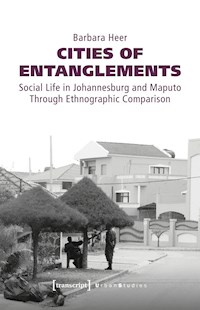
Cover illustration: Barbara Heer, Maputo, 2010
Proofread by Alexa Barnby, Johannesburg
Print-ISBN 978-3-8376-4797-6
PDF-ISBN 978-3-8394-4797-0
EPUB-ISBN 978-3-7328-4797-6
https://doi.org/10.14361/9783839447970
Content
Acknowledgements
IntroductionCities of Entanglements
Navigating Belonging?Entangled Spaces, Entangled Lives in Alexandra Township
Intimate Encounters?Domestic Work in Home Spaces
A Politics of Loss?The Threat of Public Housing in a Johannesburg Suburb
A Politics of Proximity?City Building, Enclosure and Expansion in Maputo
Building Communities?Paternalistic Bonds and Religious Spaces
Spaces of Freedom?Shopping Together, Living Apart
Closing RemarksUrban Entanglements as Blind Fields
Postscript: Entangled ComparersExperiencing Cities through Comparative Ethnography
Bibliography
Acknowledgements
I would like to express my immense gratitude to everyone – the urban dwellers of Maputo and Johannesburg who let me into their lives, research assistants, colleagues, friends and family, and, last but not least, the University of Basel and funding institutions – without whom this book would not have been possible. The PhD project was funded by an initial grant from the Janggen-Pöhn Foundation, a three-year scholarship from the Humer Foundation for Academic Talent, a travel grant from the Swiss–South Africa Joint Research Programme, a one-year scholarship from the Forschungsfond (Funding for Excellent Young Researchers at the University of Basel), and it received funding by the Swiss National Science Foundation for open access publication.
Special thanks go to my research assistants Thabo Mopasi, Nnana Tau and Fernando Tivane. As friends, key informants and often co-researchers, they shaped this ethnography distinctively. I am also very grateful to Cristiana Cuamba, Luversan Gerard, Abigail Mujaji, Dona Alcira and many others who offered me their friendship and hosted me in Maputo and Johannesburg. In Johannesburg, Noor Nieftagodien, and in Maputo, Elísio Jossias, acted as local supervisors. I would like to express my gratitude to them and their respective institutions, the University of the Witwatersrand and the Universidade Eduardo Mondlane.
Special thanks go to my PhD supervisors Till Förster, Ulf Hannerz and Elísio Macamo. I had the pleasure of conducting my PhD in an inspiring research environment at the University of Basel, being based at the Institute of Social Anthropology and the Centre for African Studies. Many thanks go to Veit Arlt, Carole Ammann, Kerstin Bauer, Julia Büchele, Sandra Burri, Michelle Engeler, Piet van Eeuwijk, Divine Fuh, Andrea Kaiser-Grolimund, Kathrin Heitz, Andrea Kaufmann, Rita Kesselring, Lucy Koechlin, Peter Lindenmann, Filomena Mazumdar, James Merron, Brigit Obrist, Silke Oldenburg, Sophie Oldfield, Joschka Philipps, Aïdas Sanago, Fiona Siegenthaler, Regina Stalder and Sandra Staudacher. I also would like to express my thanks to colleagues based in other corners of the world, among them Ana Aceska, Alexa Barnby, Antonádia Borges, Claudia Gastrow, Mark Lewis and Annika Teppo. Finally, many thanks go to my family, my husband Martin and my friends who supported and accompanied me in many ways during these fascinating years of doing fieldwork and writing an ethnography.
IntroductionCities of Entanglements
Imagine yourself walking along a narrow sandy path in a neighbourhood of Maputo. Your walk takes you past unplastered brick houses surrounded by yards in which women grind corn and look after children. Thorn bushes, sheets of corrugated iron and walls of crumbling brick demarcate the boundaries of the home spaces, providing both privacy and protection. Children play in the sand and women sell fruit on little stalls (bancas). Suddenly, you are confronted with a concrete wall made of unplastered cement bricks and about two metres high. Barbed wire tells you that you should not try to trespass. Across the wall you can see the roofs of colourful villas. If there were no wall, you would see a few security guards and domestic workers sitting in the shade of a tree besides an otherwise deserted street. You might see a resident backing out of a driveway in her luxury SUV (sports utility vehicle). Hidden from sight, you can only imagine the ostentatious mansions with their carefully maintained gardens and swimming pools behind the electrified fences (see the photographs at the end of this chapter).
This particular wall is situated in the northern part of Maputo, and separates an area known as Polana Caniço from another area colloquially referred to as Sommerschield II. The anthropologist Fernando Tivane, a research assistant on this project, showed me this wall at the beginning of my fieldwork in Maputo in 2010. For him, as for many other urban dwellers in Maputo, this and similar walls symbolise the stark urban inequalities and the wish of powerful urban groups not to have to see poverty and thus withdraw themselves from it. Such walls are encountered in many cities across the world, especially in the Global South. In societies with a colonial past and continuing inequality under neoliberal capitalism, walls are often built by those with more power to protect themselves and exclude less powerful groups whom they construct as urban ‘others’ (Spivak 1985).
Walls are an omnipresent spatial form used across cities and villages to shape the relations of proximity and distance between those who are inside and those who should remain outside. Besides being about materiality, by physically preventing people from crossing the threshold thus created walls are also about the imaginations of urban dwellers about how people in the city live or should live together – or rather apart. By building walls urban dwellers aim to shape the social worlds they live in. Building walls enables them to construct – spatially and in their imagination – urban lifeworlds which seem disconnected from the surrounding city. For many urban elites in African cities and elsewhere, such apparent enclaves – elite neighbourhoods seemingly disconnected from their surroundings – promise the illusion of residential spaces under control and emptied of the ‘other’, like the urban poor, the criminal, the ‘racial’ or the national other.1 Sometimes this involves the desire to build road closures (see chapter 5), or resistance to public housing for the poor in their neighbourhood (see chapter 4).
Walls are not only a structuring device for urban societies but also become their symbol. As symbols, walls send a clear message about the relationship between those inside and those outside, for example that the wealthier possess the power to insulate themselves from the necessity of sharing and interacting with the poorer (Marcuse 1997b: 109). Walls thus “suggest a particular set of relationships between those on the opposite sides of the boundary: Separation, distance, fear, tension, hostility, inequality, and alienation” (ibid: 103). The contradiction between building walls and the ethics of living together can lead to moral outrage and popular uprising (see chapter 5).
In writing about cities shaped by inequality such as Johannesburg and Maputo, walls have come to symbolise the vexed conviviality of urban elites and less affluent groups. In her seminal work on São Paulo, Caldeira (2000) argues that in what she calls cities of walls, differences become organised through the building of walls, separation and the policing of boundaries. She defines cities of walls as “cities of fixed boundaries and spaces of restricted and controlled access” (ibid: 304), and as cities where the “experiences of separateness” become dominant (ibid: 355). Murray adapts the framework, cities of walls, to Johannesburg and argues, based on a reading of the existing literature, that “spatial strategies of separation, segregation, and isolation operate by marking boundaries and registering differences, imposing partitions and distances, building barriers, multiplying rules of exclusion, designing spaces of avoidance” (Murray 2004: 150). Johannesburg emerges in this narrative as consisting of “disconnected ‘micro-worlds’ cut off from one another” (ibid: 142).
While the framework, cities of walls, can assist us in grasping certain aspects of the way spaces are organised in unequal cities, this book will argue that it constitutes only a partial lens which omits many aspects of urbanity in these cities. This is not least because the focus on walls and the dividing power of segregation reflect the perspectives of urban elites while largely ignoring the perspectives of less affluent urban dwellers. Now imagine yourself a domestic worker. You wake up in the morning in Polana Caniço, and every day you walk to Sommerschield II where you are let into one of the colourful mansions – let’s take the pink one – by your employer, a property owner. You carry out your daily routine, cleaning the house, washing the dirty laundry and maybe looking after the children. During your lunch break you gossip with acquaintances who work in the neighbouring houses about family and neighbourhood life, as well as about how you are treated by your bosses, and you share intimate knowledge about their latest family intrigues. You buy food for your own family with the income you get from this job and you know that your employer trusts you and depends on you. The job is hard, sometimes demeaning and receives little recognition from your boss or your own family, yet it will help you to replace the hedge around your simple house in Polana Caniço with solid bricks one day.
The everyday lives of the family in the pink house and the domestic worker from Polana Caniço are deeply entangled with each other. They depend on each other and they interact with each other daily, even if the urban elites tend to pay little attention to this. Besides the daily encounters between domestic workers and their employers in the intimate space of the elite’s home, urbanity in Maputo and Johannesburg is also characterised by fleeting interactions at shared shopping facilities, by shared experiences of praying together in church and mosque spaces, and by confrontations around increasingly scarce and contested urban land. Such relationships between people and between spaces, which are thought of and felt to be different from each other, I define as entanglements. Entanglements are, based on Nuttall, “a set of relations, some of them conscious but many of them unconscious, which occur between people who most of the time try to define themselves as different” (Nuttall 2009: 12). Such entanglements, based on the shared use of spaces and the interdependencies, exist both inside and outside the walls. They emerge often invisibly in spaces of everyday lives and go unnoticed, not least because their existence often contradicts hegemonic understandings of the city. As entanglements challenge the elites’ desire for segregation, there are social processes at work which make them invisible. In this book, it is therefore often the less powerful urban dwellers who point out the existence of entanglements, while for urban elites, as well as academics, they often constitute blind fields (see chapter 8).
Colonialism and apartheid forced urban dwellers and scholars to think about cities like Johannesburg and Maputo in terms of abstract, homogenising and simplifying categories of difference like Black and White, European and Natives, Cimento and Caniço, suburb and township. Such colonial binaries, enforced with state power and inscribed in space through legislation, continue to be powerful in real terms. Despite all the changes that have taken place, these binaries still influence the way urban dwellers understand their worlds and scholars analyse cities. The binaries, however, also make us blind to what happens at the boundaries, the intersections, the sites of encounter, transgression and multiplication. By drawing our attention to separation and division instead of connection, these binaries cause us to neglect the sites and moments of entanglements where what is thought of as separate comes together, intersects and becomes altered by the other.
The main argument of this book is that entanglements are constitutive of cities. They are as constitutive of cities as walls. Cities of Entanglements presents a comparative urban ethnography of entangled everyday lives in two contemporary African cities which challenges existing approaches that analyse these sites through the lens of segregation. The ethnography roots itself in the way in which people constitute their quotidian lives in adjacent yet socially and spatially segregated neighbourhoods: urban dwellers living in the township of Alexandra and the suburb of Linbro Park in Johannesburg, and residents of the bairro Polana Caniço and the elite neighbourhood of Sommerschield II in Maputo. While acknowledging that the fast-changing cities of Johannesburg and Maputo are shaped by colonial and postcolonial forms of segregation, the book examines the agency and practices of urban dwellers in not only inhabiting divisions, but also overcoming and reformulating them. Despite the many spatial and social boundaries separating the neighbourhoods, they are fundamentally entangled with each other through labour relations, struggles over urban land, and visions of the right way of living together, or rather living apart. In religious spaces, diverging social groups become integrated with each other through faith-based charity. Shopping malls emerge as important spaces of public life in these cities, where urban lives become entangled through chance encounters, competition and fantasies. By exploring such diverse spaces of encounter, the book produces a coherent account of the processes that constitute and transform these urban spaces. Entanglement therefore becomes a means to understand these cities in new ways, highlighting the tentative forming of relationships and linkages across imagined boundaries, even as elites seek to reinstate divisions. This book replaces the framework of cities of walls with the framework of cities of entanglements and develops a new narrative about social life in what have long been treated as divided cities. Adopting a comparative perspective, the book shows how urban entanglements are based on recurring forms of conviviality which take on distinct forms in both cities. Grounded in everyday life in African cities, the book becomes an exploration of how urbanity is changing in unequal cities in a way which resonates beyond the Southern African cases.
The Setting
As mentioned, this book explores sites of encounters where the lives of urban dwellers from two urban areas, comprising four unequal and adjacent neighbourhoods– Polana Caniço and Sommerschield II in Maputo, and Alexandra and Linbro Park in Johannesburg – become entangled. The locality and specificity of these neighbourhoods as well as the diversity of the residents living there stand at the centre of this ethnography, which is why they are briefly introduced here.
Alexandra and Linbro Park are situated in the north-east of Johannesburg, in what is today Region E of the City of Johannesburg. When these neighbourhoods emerged (1912 for Alexandra and the 1930s for Linbro Park), they constituted the outer fringe of the city. Suburbanisation and urban sprawl have drawn them into the midst of the so-called northern suburbs and they are now surrounded by desegregating neighbourhoods, highways and edge cities2 with office complexes, malls and gated communities. Alexandra, with a surface area of approximately eight square kilometres and an estimated population size of 340,000 people (Alexandra Renewal Project 2005), experienced decades of unequal investment in public amenities during apartheid. As a result, infrastructure such as electricity, roads, sanitation and schools is still today insufficient in relation to the high population density. Bounded by the Marlboro industrial area to the north and west, London Road to the south, and the Jukskei River to the east, Alexandra is a complex, dynamic and sometimes violent place, with a history of state oppression and political resistance. Because of its size and history, it hosts a more multifaceted population than the other three neighbourhoods. Descendants of former property owners comprise an old and influential milieu in the township. Many tenant families and hostel dwellers have also been living there for decades. Yet, there is also a large shifting, highly mobile population, many of them with strong connections to their other homes in rural areas or other African countries.
Linbro Park is much smaller in size and population, with a surface area of five square kilometres and only about 1000 inhabitants (own estimation). At the time of the research, it consisted of around 200 large stands between one to two-and-a-half hectares in size, some used for business purposes, but mostly residential, as well as a couple of new warehouses. In the east, the suburb borders on empty veld belonging to Modderfontein where private investors are planning to build a new edge city. To the south, Linbro Park borders on new office parks, and to the west it could almost touch Alexandra were it not for the barrier formed by a landfill site and a national highway (N3).3 Because most of the land is zoned as ‘agricultural holdings’ the area lacks infrastructure like public sewage and stormwater drainage, which is also why the municipality refers to it as a ‘peri-urban’ suburb (City of Johannesburg 2010: 5). The properties are largely owned by members of white milieus.4 Many of them host tenants from racially and ethnically diverse lower and middle-income milieus. Linbro Park is also home to a large number of domestic workers, gardeners and handymen who live and work in Linbro Park.
In the local taxonomy, Alexandra is called either a ‘location’ or a ‘township’. Both terms denote a residential area where during apartheid the non-White population was compelled to live.5 The idea of ‘township’ gains its meaning from the relation to White residential areas, the ‘suburbs’, of which Linbro Park is considered to be one. In everyday language, ‘suburb’ denotes the formerly Whites-only areas with low residential densities, as well as newly built neighbourhoods. In the local taxonomies of places and people, the binary township–suburb is associated with oppositional stereotypes about their residents, lifestyles, housing types, densities, governance structures, crime levels and neighbour relations. While the notion of suburb in contemporary Johannesburg tends to be associated with free-standing houses and middle-class or affluent lifestyles, either predominantly white or increasingly mixed, townships continue to be associated with poverty, high density, crime and black milieus. Although Johannesburg has changed dramatically since the end of apartheid, and the types of neighbourhood have multiplied, this binary is still relevant for academic and everyday understandings of the city.
In Maputo, this book focuses on the neighbourhoods of Sommerschield II and Polana Caniço, which are located north of the inner-city neighbourhoods of Coop and Sommerschield, which adjoin the campus of the Eduardo Mondlane University (UEM). In official municipal documents, the two areas do not exist as separate neighbourhoods but both fall under Polana Caniço A, in district 3 of Maputo. Polana Caniço A is one of the biggest and most densely populated administratively defined neighbourhoods in the city, with a population of about 45,000 inhabitants (according to the neighbourhood secretary in 2010) and covering an area of 222 hectares (Malaulane 2005: 17, Araújo 2006: 7). Within Polana Caniço A, fieldwork took place mainly in Sommerschield II, in an area called Casas Brancas as well as an unplanned section of Polana Caniço which adjoins Sommerschield II.6 The level of urban services in the unplanned section is very low, erosion and natural water drainage making the land challenging for permanent settlement. Polana Caniço may appear to outsiders as a homogenous place, yet the population is considerably diverse. There is a milieu of long-term residents who moved to Maputo at the time of the country’s independence. Then there are milieus of war refugees from southern Mozambique (Gaza, Inhambane and Maputo province) who fled to Maputo in the 1980s (Costa 2007). A third group consists of Swahili Muslims from the northern provinces (mainly Zambézia) who also came to Maputo during the war or more recently. There is also a group of residents who used to live in the city centre until the early 1990s, and then could not afford to continue living there when housing was privatised. There are also fluctuating mobile groups of students, young couples and migrants on the move from the rural areas to the cities and to South Africa.
The adjacent elite neighbourhood of Sommerschield II consists of about 130 to 150 free-standing houses, laid out in an orderly fashion along planned streets. The neighbourhood takes the shape of a triangle, bordered by Julius Nyerere Avenue, the land reserves of the UEM, and the Rua Tenente General Fernando Matavele, behind which the unplanned sections of Polana Caniço have evolved. The layout was designed in such a way that there is only one street, the Rua do Cravo, which leads directly to the adjacent poorer areas of Polana Caniço; the rest of the boundary is constituted by walls. Many of the current homeowners and residents belong to Maputo’s Frelimo elite who draw their power from the ruling party. A newer group comprises expatriates working for embassies, NGOs and transnational companies. They tend to rent their houses from local elites who no longer live there themselves. The third group of residents consists of wealthy members of the Indian merchant community of Maputo (mostly Mozambicans of Indian or Pakistani descent), the majority of them Muslims, while a minority are Christians from Goa. This group can again be subdivided into Indian milieus with a long-term presence in Mozambique and close relations to the Frelimo elite, and a group of more recent arrivals who moved to the neighbourhood only recently, sometimes as tenants.
In the local taxonomy, Polana Caniço is referred to locally as a bairro or subúrbio adjoining the city centre. Bairro or subúrbio and periurbano or periphería, the last two expressions referring to emerging neighbourhoods on the outskirts of the city, all evoke images of informality, low levels of urban infrastructure and economic hardship in Maputo.7 These neighbourhoods comprise what during colonial times was called the City of Reeds (Cidade de Caniço), the ‘informal’ slums and shantytowns of the colonial subjects, the Natives. Caniço, which still today forms part of the name, Polana Caniço, refers to the non-permanent building materials which characterised the houses in these African neighbourhoods in what was then called Lourenço Marques (see also Bertelsen 2014). City of Cement (Cidade de Cimento) referred to the city centre, the spaces of the colonial city which were inhabited by the colonial subjects and assimilados (see below), urbanised according to what was seen as European standards, and associated with whiteness. This old colonial dichotomy becomes disrupted or rather expanded by Sommerschield II. For Maputo’s urban dwellers, Sommerschield II appears to have been urbanised according to European standards with its tarred roads, street lights and fancy mansions, yet it is a new neighbourhood growing outside of the city centre (Cidade). Sommerschield II is therefore ‘neither city nor suburb’ (nem cidade nem subúrbio), as residents would say. Together with other affluent neighbourhoods like Belo Horizonte in Matola and Bairro Triúnfo along the beach, they are sometimes referred to as elite neighbourhoods (bairro da elite), a term which I adopt here. Residents sometimes also describe Sommerschield II as New City (Nova Cidade), associating it with a new type of spatiality, if also associated with the lifeworlds of the City of Cement (Cidade de Cimento) rather than the Caniço. Even though the types of neighbourhood have multiplied in Maputo, and the representations thereof as well, the old binary City of Reeds (Cidade de Caniço) and City of Cement (Cidade de Cimento) still lurks like a shade in the background. The entangled neighbourhoods exemplify and at the same time also transcend and transform colonial dichotomies of space and identity which constitute part of the colonial heritage of Maputo and Johannesburg.
Histories of Changing Cities
Urban entanglements are deeply shaped by the respective city’s history. Before focusing on the ethnography of entangled lives unfolding in these spaces, it is therefore vital to step back and look at the urban histories. In order to compare entanglements across cities, it is important to consider at least three dimensions of urban history, namely, shifting forms of urban citizenship, shifting economic inequalities and shifting patterns of segregation. I understand urban citizenship as based on Lefebvre, who coined the notion ‘right to the city’, as the right of urban citizens to participate in urban space, urban life, urban politics and urban centrality (Lefebvre 2009 [1968], Meyer 2007: 278). Both in Johannesburg and Maputo, urban life has been characterised by shifting forms of exclusionary urban citizenship, which have left their specific impact on urban encounters and entanglements. These entanglements are also shaped by shifting forms and degrees of economic inequality in the two cities. In Johannesburg, urban dwellers refer to such differences mostly with the term ‘class’, using expressions like ‘the poor’ and ‘the rich’. In Maputo, urbanites tend to use euphemisms to speak about such differences, for example sem condiçoes (without possibilities) and os que tem (those who have), while the terms rico (the rich) and pobre (the poor) are avoided as having negative connotations.8 Last but not least, forms of entanglement become shaped by shifting patterns of segregation. By segregation I mean all forms of concentration of a population group in space, whether or not this is imposed by the state or based on so-called voluntary choices by urbanites, and independent of whether the population group is marginalised or powerful in the urban hierarchy.9 Both Maputo and Johannesburg have a history of shifting forms of urban segregation which left their imprint on the contemporary urban form and everyday spatial practices.
For the kind of comparison I propose here, attention to history is vital. The following insights into the urban histories should make the reader aware of the specific contexts shaping the entanglements, as I only refer to some of them during the chapters for reasons of readability. Urban spaces are carriers of the past, shaping the present and the future entanglements, yet they are also changed through urban dwellers’ agency. These sections of the urban histories should also enable the reader to draw her or his own comparative conclusions beyond what I have presented. What is most important, though, is that attention to history makes us aware of the diachronic nature of comparative ethnography (see also Fabian 1983). Ethnographic writing, fixing situations through words on paper, stands in sharp contrast to the fluidity of urban life and urban spaces. Since the time of the fieldwork (2010–2012), all four neighbourhoods have undergone significant changes, reflecting the transience of urban life. Entanglements, spaces and lifeworlds in Maputo and Johannesburg need to be thought of as being always in production, as constantly changing.
Johannesburg
Johannesburg is located on the high interior plateau of South Africa, also called the Highveld, where gold was found in 1886 on what turned out to be the world’s richest goldfields. Unlike Maputo where the need for a transport hub – a port – decided its location, in Johannesburg it was the local geology with its richness in natural resources. Today, it is considered one of the world’s leading financial centres and is South Africa’s economic hub. People who move to Johannesburg usually do so because of work. For the Southern African region and beyond, the city is also a hub for consumer goods that are hard to get in more remote areas of the continent. Today, Johannesburg’s wealth derives mostly from mining, manufacturing and banking; wealth from which large parts of the city’s population are excluded. The city has about 4.4 million inhabitants (Statistics South Africa 2012a, based on census 2011) and is the largest city in South Africa and the Southern African region. The urban conurbation, including Tshwane (Pretoria) and Ekhuruleni (East Rand) metropolitan areas, is one of the largest metropolitan regions on the continent (Tomlinson et al. 2003: 6). Especially since the end of apartheid Johannesburg’s population has increased significantly (by 68.4%, Harrison et al. 2015: 7). While Maputo continues to have a centre-periphery pattern typical of many European cities, Johannesburg tends to resemble an American city with its multi-nodal or polynuclear pattern. Many edge cities have been built from scratch in the last decades. Johannesburg has also merged with surrounding towns that also turned into sub-centres. Despite urban sprawl, it is also a densifying city (ibid: 9), as exemplified by Linbro Park in this book.
The land where Johannesburg was built was not on ‘empty’ or ‘natural’ space; the area had been settled for centuries by Khoikoi, San and, later, Bantu-speaking agriculturalists. Johannesburg was founded within the context of a colonial society produced by forceful conquest, slavery, genocidal extinction of whole population groups and a colonial economy based on forced labour. After the abolishment of slavery by the British in 1834, interaction between black labourers and white employers continued to be tightly regulated by the Masters and Ordinance Act of 1841, which legally ensured the submissiveness of the now ‘free’ workers, for example by punishing servants who disobeyed their masters (Lester, Nel and Binns 2000: 314). The migrant labour system, which brought people from all over Southern Africa to the Johannesburg mines, affected relations of production, family forms and gender relations in rural and urban areas.
The basis for the infamous apartheid geography was already laid in the founding years of the city. Non-Whites were assigned to live in so-called ‘locations’. A class geography which distinguished between the eastern, wealthier areas and the western, poorer areas emerged (Beavon 2004: 53-54). Since then the city has continuously grown through suburbanisation. Property speculators bought up farms around Johannesburg and transformed them into suburbs. In 1912, the investor Papenfus created Alexandra and declared it a ‘freehold’ township, meaning a township where non-Whites were allowed to acquire land (Bonner and Nieftagodien 2008).
Since the city’s early years, African workers were seen as temporary sojourners in the city (Dawson 2006: 126). From 1896 on, African workers had to carry passes in Johannesburg, and their right to be in the city was conditional on their employment at a mine. In addition to race and class, urban society was structured around work membership. Ferguson defines work membership as the legal and social distinction between urban ‘belongers’ with waged employment recognised in their pass book and the urban unemployed who were considered illegal ‘hangers on’ (Ferguson 2013: 229). Africans had to live in barracks or compounds on the mining fields, or in case of domestic workers, on the property of their employers (Beavon 2004: 33). Since its early beginnings, public space in Johannesburg was not accessible to urban dwellers in equal ways. By 1900, under the Kruger government, Natives and Coloured people were banned from using Johannesburg’s pavements (ibid: 40). They had no political rights, received very low wages and even their leisure time was tightly controlled (ibid: 68). In 1911, the Mines and Work Act legally entrenched a colour bar in the mines, meaning that semi-skilled and skilled jobs were reserved for Whites.
During the Great Depression, the gold standard was abandoned, and South Africa could profit from a considerable economic upswing. During the 1930s and 1940s, the central business district (CBD) experienced a building boom, which transformed the city into a little New York (Bremner 2000: 185). Increased incomes for White families, affordable cars, coupled with state subsidies for housing, produced a revolution in suburban space (Mabin 2005b: 11-23). Edwin James Brolin, owner of a plantation between Alexandra and Modderfontein, recognised at that time the economic potential of his land and sold subsections of what became known as Linbro Park (the reversal of the family name Brolin). The enlargement of private space for the White families – from inner-city flats to a large suburban house – was possible because Black urban dwellers were forced to live in cramped shacks, rooms and compounds. Class and race became inscribed in the spatial order of the city (Crankshaw 2008). The suburbs, which seemed socially, spatially and economically so distinct and separate from the Black areas, were profoundly entangled with them and dependent on them. White families could only afford a large house and domestic workers because apartheid kept black wages low and because it limited competition for urban land in suburbs by excluding Black owners from landownership. Looking at Johannesburg through the lens of entanglements also invites a re-reading of the apartheid past, paying attention to such interdependencies (Nuttall 2009: 2).
In many African societies, colonialism was accompanied by racial segregation (Seekings 2008: 1). Apartheid, however, as implemented after the National Party came to power in 1948, stands out as an extreme, unique case with “systematic depth and breadth” (ibid: 2). All the “powers of a modern state were deployed to order society along ‘racial’ lines in ways which went far beyond racism and racial discrimination to generalized social engineering around state-sanctioned racial ideology and legislation” (ibid: 2). The 1950 Population Registration Act introduced the rigid classification of every person into a hierarchically organised, caste-like racial system from which social rights and exclusion were derived.10 One’s racial group determined one’s access to education, work, land, the use of public spaces and sexual relations (see below).
In 1950 the Group Areas Act was introduced, a legal masterpiece for the realisation of the dream of a White city. In the following two decades, all urban zoning schemes were redrawn, adding information to the mutually exclusive occupation and ownership by legally defined racial groups (Christopher 1997: 311, Mabin and Smit 1997: 206). Rezoning provided the legal basis for massive removals. Tens of thousands of people were forcefully relocated from mixed inner-city slums to townships on the urban fringe and to rural Bantustans. The White and Black spaces were kept separate through empty tracts of land, so-called ‘buffer zones’ (Harries 2003: 18). Most freehold townships were destroyed; only Alexandra survived. In 1991, when the laws and racial zoning were repealed, 91.4 per cent of the urban population in the country was living in racially designated zones (Christopher 1997: 319).
Apartheid legislation also operated on the micro-level of everyday encounters and lived spaces. From 1948 onwards many laws (so-called ‘petty apartheid’) were designed to regulate social interaction in public and private spaces and even intimate relations (ibid 2001). The Prohibition of Mixed Marriages Act (1949) and the Immorality Act (1950) forbade marriage and sexual relations across racial boundaries. The Separate Amenities Act (1953) and the Separate Amenities Amendment Act (1960) subjected public facilities to racial segregation. Park benches, public toilets, beaches, graveyards and the like became segregated (Durrheim and Dixon 2005: 2). There were even building laws regulating the distance between the White family’s house and the domestic quarters and demanding separate entrances (Christopher 2001: 139). The everyday experience and use of spaces became closely linked to state-imposed racial categories.
From the 1930s to the 1970s, the city transformed from a mining-based industrial capital to a manufacturing-based economy (Crankshaw 2008, Gelb 1991). The African working class milieus were kept in an inferior economic position by the colour bar, while White milieus profited disproportionally from the economic growth. Immigration at that time was easy for Europeans. When, in 1974, the Portuguese population in Mozambique was expelled by the new socialist regime, many moved to Johannesburg. From the 1970s on, deindustrialisation deeply affected the organisation of the city, the spatial structure and urban dwellers’ spatial practices. Many jobs for so-called ‘unskilled’ workers were lost (Beavon 2006: 59). This led to massive structural unemployment among the Black population, who was kept unskilled under Bantu education. At the same time, edge cities started to develop, as shopping and service-sector work spaces became decentralised and fortified gated communities started to emerge (Crankshaw 2008, Marcuse and Van Kempen 2000: 255). Legal provisions were adopted to allow for ‘sectional titles’ or condominium ownership of property, giving rise to a new form of suburbia, the ‘townhouse complex’ consisting of row houses or free-standing houses behind walls (Mabin 2005b: 25). Real estate became increasingly used as a financial asset, leading to a commodification of real estate (Beauregard and Haila 2000, Mabin 2005b: 22). Gated communities also served as a model for residents in older suburbs; they increasingly sought to close off their neighbourhoods, to put up road closures and fences around their neighbourhoods (Dawson 2006, Dirsuweit and Wafer 2006, Hansen 2006).
Already in the 1960s, the first shopping malls were built outside the Johannesburg CBD. In 1973, Sandton City mall was opened, and its success encouraged massive growth in large malls in the suburbs (Beavon 2006: 53). By the end of the 1980s, the contemporary pattern of retail decentralisation with its focus on large malls had been established and was strengthened in the 1990s by what Beavon describes as a “virtual shopping explosion” (ibid: 3). In the 1980s, with the weakening of the apartheid state, non-White urban dwellers moved into the city centre, while White residents and capital continued to move from the CBD to the Northern Suburbs. The inner city underwent massive transformation, and became a ‘no-go’ zone for many suburbanites (Beavon 2004: 204 ff., Bremner 2000, Czeglédy 2004: 27, Morris 1999a).11 Spatial routines characterising suburban life in Johannesburg still today then emerged: many suburbanites commute from their suburban homes to work in an edge city, shop at a nearby mall and seldom venture into the city centre.
During apartheid, upwardly mobile Black milieus were confined to the townships. When the Black middle-class milieus grew in the 1980s, suburb-like sections were built there for them (Mabin 2005b: 18). Yet, as the grip of the apartheid state was weakening, Black middle class milieus also moved to formerly White suburbs, a process which was accelerated by the repeal of the Group Areas Act in 1991 (ibid: 21, 25). The Population Registration Act was repealed between 1991 and 1994 (Christopher 2002: 405). Desegregation emerged as a process occurring largely along class lines (Crankshaw 2008: 1698). Transformation was discursively framed through the multicultural ideology of the ‘rainbow nation’. The slogan of the ANC “a home for all” exemplified this ideal of the post-apartheid ‘one nation’ (Murray and Shepherd 2007: 7). Yet for many whites the unregulated access to amenities like beaches and parks, informal street trading in inner cities, and co-presence of black urban dwellers as neighbours led to feelings of disorder (Ballard 2002).
The white milieus’ repertoire for dealing with the rearrangement of space, race and belonging in the changing post-apartheid era entailed emigration to other countries, ‘semigration’ into privately secured gated communities and assimilation, the strong expectation of established white milieus that the moving-in black middle class groups had to adapt to their lifestyle (Ballard 2002, 2004a, 2004b, 2005, 2010). Living in proximity to urbanites belonging to different racial categories and economic classes went hand in hand with the desire to create walls (Haferburg 2013, Lemanski 2006a, 2006c, Lemanski and Saff 2010, Morris 1999b), reinforcing and creating insider–outsider distinctions based on race, class, citizenship and other (Bekker and Fourchard 2013, Bénit-Gbaffou 2009, Clarno 2013, Clarno and Murray 2013, Vigneswaran 2014). Yet urban conviviality in contemporary Johannesburg is not all negative and gloomy. For example, in shopping malls and religious spaces mediation across the boundaries of race has been observed (Teppo 2011, Houssay-Holzschuch and Teppo 2009, see also Nuttall 2009). Cities of entanglements seeks to contribute to this growing literature.
An important aspect of contemporary urban segregation in Johannesburg is violence and fear of crime. Since the 1950s, in townships like Alexandra crime and gangs have severely reduced the quality of life for Black urban dwellers (Bonner and Nieftagodien 2008: 106ff.). From around the 1980s on, crime and fear of crime also increased significantly in the White suburbs, related to the weakening control by the apartheid state and the shift in public spending on security from the former White areas to township areas. From the 1990s up to the 2000s, extremely high crime levels made headlines (Dawson 2006: 131). Recently, crime statistics have decreased, but urban dwellers still have a sense that crime is escalating (James and Collins 2011). Crime has severely affected the way white people relate to, conceive of and perceive black urbanites (Allen 2002) and conviviality in general (Vigneswaran 2014). South African society is also marked by high levels of violence in interpersonal and intimate relations (Collins 2013, Schäfer 2005). Life in many informal settlements and townships is shaped by structural and interpersonal forms of violence (Ross 2010). Different milieus are affected by crime in very different ways, and therefore their perceptions of crime also differ greatly (Statistics South Africa 2012b: 2).
At the end of apartheid, townships like Soweto and Alexandra were in a dire state in terms of public infrastructure, not only because of the unequal spending by the apartheid state but also because, with the end of influx control, residential densities increased. Many people from former Bantustans and adjoining countries moved to the city, rented a shack or a room in a township like Alexandra or built their own shack in a newly emerging ‘squatter camp’, inside or outside existing townships. Although large-scale public housing programmes were put in place, there was rapid growth in urban informal settlements (Beavon 2006: 55, South African Cities Network, Turok 2011, 2013: 169). Johannesburg has a low average residential density, but densities are highly unevenly distributed between township areas, the inner city, the suburbs and peri-urban areas (Turok 2013: 171).
The turn to democracy brought upward social mobility for the Black middle-class milieus, supported by affirmative action policies, but not to the same extent for poor milieus (Modisha 2008, Seekings and Nattrass 2005: 308-313). Income inequality within the Black population is nowadays as high as across the entire population (Seekings 2010: 8-9). Although formal unemployment decreased between 1996 and 2011 (from 29.4 to 25%), it is still very high, especially among the youth (Beall, Crankshaw and Parnell 2000a, Harrison et al. 2015: 5, Seekings 2010: 4-6). The informal economy is key for urban dwellers in places like Alexandra (Beall, Crankshaw and Parnell 2000b, Hull and James 2012, Simone 2004b, 2006b), although the expansion of the welfare state shapes their livelihoods considerably (Ferguson 2013). In metropolitan areas, half of the households receive one or more government grant (Gelb 2008: 81, Seekings 2010: 14). Many urban dwellers are waiting for government housing (Oldfield and Greyling 2015).
Post-apartheid Johannesburg is a multifaceted city, rapidly changing not least because of its many connections across the globe and across the region. Johannesburg is entangled with Maputo through the circulation of people, capital, goods and ideologies (Harries 1994, Helgesson 2008, Miller 2008, Ostanel 2012, Peberdy 2000, Rogerson 2011, Vidal 2010). Many South Africans and Mozambicans living in Johannesburg travel to Maputo and Mozambican beaches on holiday. Maputo also attracts South African capital and companies and is influenced by its lifestyles and fashions. Many Mozambicans see John, the name that many Mozambican migrants use to refer to Johannesburg, as a place of job and education opportunities, and as a place with broad and affordable consumption options and reliable health services. Acknowledging the importance that Mozambican workers had and continue to have for building Johannesburg’s wealth, one may speak of a mutual dependency between the two cities. To avoid overemphasising the boundedness of the comparative cases (Abu-Lughod 1991, see the postscript), such entanglements between the two cities should be kept in mind.
Maputo
Maputo is located in Delagoa Bay, in the extreme south of Mozambique’s extended coastline. It is much closer geographically, and in some ways also socially and economically more connected, to South African cities like Nelspruit, Durban and even Johannesburg than to cities in the extreme north of the country like Nampula or Pemba. The city serves as the financial, administrative and cultural centre of the country. Maputo holds the position of the primate city in the country, being considerably larger than the other Mozambican cities, although the importance of secondary cities like Beira is growing (Jenkins 2013: 55). At the time of this research (2010–2012), the municipality of Maputo officially had about 1.2 million inhabitants (Conselho Municipal de Maputo 2011: 8). The Greater Maputo conurbation including the neighbouring city of Matola had about two million inhabitants in 2007 (Jenkins 2013: 109). Like many African cities, Maputo experienced rapid growth following independence and, since the civil war in the 1980s, the population has doubled (Ammering and Merklein 2010). The city centre of Maputo is situated on the northern shore of Delagoa Bay. The suburban areas lie in a half circle around Maputo’s city centre. They are continuously densifying and growing towards the north and west, merging surrounding places into the city. Along the shoreline of the bay, moving north-east, gated communities, new hotels and apartment blocks have come to replace the precarious fishing settlements in an area called Costa do Sol and Bairro Triúnfo. New urban road infrastructure, among them a ring road and a bridge across the bay to Catembe built after the time of fieldwork, will bring new dynamics to the settlement patterns.
Maputo was founded as a fort by the Dutch in 1781 and remained a small and unimportant trading post until the gold boom on the Witwatersrand demanded a transport hub in Delagoa Bay. This led to the foundation of the city, then called Lourenço Marques, at the end of the 19th century. Workers on the South African mines and cotton farms travelled through Lourenço Marques, and South African gold was shipped to the world through the city’s port. In colonial Mozambique, the Portuguese system of forced labour (chibalo) and the introduction of the hut tax made rural livelihoods precarious (Cahen 2012, Mamdani 2000, O’Laughlin 2000). Many men, therefore, migrated to work in South Africa’s mines (Harries 1994, Helgesson 2008), and many others went to Lourenço Marques, where they came to form working-class milieus, employed as dock, railway and domestic workers (Lachartre 2000: 31, Penvenne 1995). The African population came to refer to the city as Xilunguine, meaning the “place of the stranger(s)” (Jenkins 2006: 125). Similar to Johannesburg, women had more difficulty in establishing themselves in the city than men, as they were seen as having to take care of the rural household while the men were temporarily away for chibalo or migrant work. Many women made a living from beer brewing, prostitution and urban agriculture (Morton 2013: 239, Sheldon 2002, 2003).
Colonial citizenship was bifurcated into citizens and subjects (Mamdani 1996) by a set of institutions called Indigenato. The Portuguese immigrants and their descendants had full Portuguese citizenship rights and were governed by the colonial state. The African population was considered ‘Natives’ and fell under so-called customary law. There were, however, also in-between categories, among them the so-called Assimilados (Assimilated). A Native could become recognised as Assimilado if he could prove to the colonial state that he was ‘civilised’.12 The Assimilated, the mixed population (Mestiços) and Asians (Asiáticos) were ranked higher than the Natives in the colonial hierarchy, had identity cards distinct from them and had more rights (O’Laughlin 2000: 13).13 They were exempt from the hut tax and chibalo, they were allowed to live in the City of Cement, could move freely and had access to better schools (Lachartre 2000: 47, based on Honwana 1989: 69-70, Morton 2013: 240). Like apartheid, the Indigenato needs to be understood as characterised by forms of entanglements, and not just as a form of separation. As O’Laughlin argues: “Just as apartheid was a normatively prescribed separation of worlds that were in reality linked by the exploitation of African labour, so also were the worlds of citizen and the indigenous subject never separate in Mozambique” (O’Laughlin 2000: 9).
The social, political and economic changes brought about by Portuguese colonial consolidation and the Indigenato shaped the production of space in Lourenço Marques (Bertelsen 2014: 2756, Mendes 1979). In the first half of the 20th century, differentiation of neighbourhoods according to race and class emerged and soon different residents experienced very different cities (Lachartre 2000: 34, Penvenne 1995: 33). The eastern upper neighbourhoods with the best climate became populated by European milieus (Polana, Ponta Vermelha, Sommerschield), the western neighbourhoods (Alto Maé) were home to working class whites, Mestiço and Assimilado milieus, and the central lower-lying neighbourhoods in the Baixa were mainly home to the Indian population, called Ásiaticos during the Indigenato (Bertelsen 2014: 2756, Lachartre 2000).14 The majority of the population, the Natives, had to live outside the boundaries of the European city in what eventually came to be known as the City of Reeds (Cidade de Caniço) (Morais 2001, Morais, Lage and Bastos Malheiro 2012). While in Johannesburg urban segregation became enacted by racist zoning laws and massive relocations, in Maputo it was rather enacted by a multiplicity of racist laws as well as racist practices and racial inequalities (Grest 1995: 150).15
As in many colonial cities, white anxieties around hygiene and health were fuelled and instrumentalised to legitimate a dual city, giving spatial form to the duality of citizen and subject (Bertelsen 2014: 2756, Eckert 1996, Simone 2004a: 14). The City of Cement (Cidade de Cimento) became associated with whiteness and European lifestyles. Those classified as Natives were banned from urban amenities like bars, theatres and hotels (O’Laughlin 2000: 15). It was forbidden for Africans to walk through the streets of the City of Cement after nine o’clock at night (Lachartre 2000: 46). As in Johannesburg, the presence of Natives in the city was dependent on work membership, meaning that only those with a place of employment registered in their passbook were considered legitimately to be in the city. In the workplaces, an everyday space of encounter, racism and abuse was common.16 The City of Cement was a space of permanent control and risk for the African population (ibid: 48). Many feared and rarely visited the Cidade (Bertelsen, Tvedten and Roque 2014: 2756). The City of Reeds became associated with Blackness, tradition, backwardness, African languages and reed huts (Morton 2013: 240). They were seen as temporary spaces, and many shantytowns were destroyed to make space for the growth of the Cidade de Cimento. Unlike Johannesburg, where the grip of the state on African urban areas was tight (except for freehold townships like Alexandra), in Maputo the shantytowns developed largely unplanned. In the 1950s and 1960s, the Portuguese colonial municipality admired the way apartheid South Africa engineered its apartheid cities, yet it lacked the necessary state capacity to entrench the same draconic control over Africans lives and spaces (Lachartre 2000: 39). This so-called ‘laissez-faire’ attitude was typical of the urbanism transferred from Portugal to Lourenço Marques (Jenkins 2006: 110).
From the 1940s to the 1960s Maputo experienced strong industrialisation as the Salazar regime invested much capital to show to other European powers that it was developing its colonies (Lachartre 2000: 43, Morton 2013: 236, Pitcher 2002: 31). Maputo’s skyline with modernist high-rise buildings emerged at that time. When Portugal held on longer to its colonies than other European colonisers, it became increasingly criticised for it (Morton 2013: 236). Portugal responded with the rhetoric of ‘lusotropicalism’, claiming that the Portuguese assimilated the different races and cultures in their colonies in harmonious racial relations (ibid: 237). Yet, at the same time, political culture in Mozambique became strongly shaped by the Portuguese dictatorship with paramilitary, nationalist propaganda and secret police.
After independence, Frelimo (Frente Libertação de Moçambique) continued Portugal’s modernist and one-party state attitude, although now coupled with a socialist and nationalist ideology. By the early 1980s, the state dominated every economic sector (Pitcher 2002: 44). The socialist Frelimo regime replaced the Indigenato, which the Portuguese had started to dismantle in the 1960s, by an ideology called Homem Novo. Through this they aimed to create a new, modern society based on the decolonisation of the mind and national unity replacing ethnic, racial and religious differences (ibid: 53-54). Citizenship became redefined through loyalty to Frelimo and commitment to the party’s image of the Homem Novo, the modern and rational Mozambican citizen. As in many other socialist contexts, the state did not allow other civic organisations besides the one adhering to Frelimo (Jenkins and Wilkinson 2002: 40). Traditional authorities (regulos) governing bairros became replaced by new neighbourhood structures called dynamising groups (grupos dinamizadores). These were led by Frelimo party secretaries, so that the state and party structures became mixed, which continues today in many bairros. Residents were instructed to report ‘enemies’ and ‘traitors’ to the party structures (Buur 2010: 35, 42, Hall and Young 1997, Harrison 1998, Macamo 2003: 7, Sumich 2013: 100-103).
Independence and the turn to socialism brought massive changes in relation to who lived in the city and where. In 1976, the new president, Samora Machel, proclaimed: “The people will be able to live in their own city and not in the city’s backyard” (quoted from Morton 2013: 232). The white Portuguese population fled the country rapidly, their inner city flats and houses became nationalised, and were given to African privileged milieus like party elites, military veterans and former Assimilados (ibid: 233). Frelimo continued the pattern of work membership, culminating in the infamous ‘operation production’ in the early 1980s, which forcibly removed people considered ‘unproductive’ from what was now called Maputo and subjected them to a new type of forced labour (Buur 2010: 43).
South Africa and what was then Rhodesia were a key force supporting Renamo (Resistência Nacional Moçambicana) which engaged in a long civil war (1977–1992) with Frelimo. The war destroyed national infrastructure, 1.6 million people fled the country and 3.7 million were internally displaced (Chingono 1996, Geffray 1990, Lubkemann 2008, Pitcher 2002: 104). Many war refugees came to settle in Polana Caniço and other neighbourhoods, also on land that had been reserved for public use or was considered unsuitable for housing. Unplanned occupation became the main form of city expansion (Jenkins 2013: 96). Coupled with natural disasters the civil war led to a deep economic crisis in the 1980s. Frelimo eventually decided to embark on the transition to neoliberal capitalism and adopted structural adjustment programmes with long-term negative effects on state capacity, limiting the municipality’s ability to do any form of urban planning (ibid: 97).
Land, however, did not become privatised with the turn to neoliberalism and, still today, continues to belong to the state. The official absence of private landownership distinguishes the Mozambican context, making Maputo unique and distinct for an African city (Jenkins 2001, 2013: 72). Land can officially neither be owned nor sold, people merely receive land use rights (Direito de Uso e Aproveitemento de Terra, short DUAT). Only the buildings on the land are private property. In reality, though, an unofficial and illegal land market developed, which is considered socially legitimate and through which the majority of urban dwellers access land (Jenkins 2001, 2009, Jorge and Melo 2014, Sidaway and Power 1995, Unruh 2005).
Privatisation led to the loss of many jobs and gave rise to the growth in the informal economy (Grest 1995, Jenkins 2006, Kamete and Lindell 2010: 902).17 Post-socialist Mozambique experienced several phases with growth measured by macroeconomic indicators, although poverty also increased. Mozambique’s Human Development Index is extremely low and will probably continue to be so in the light of the debt crisis which started in 2016. Since the state is heavily dependent on international donors, its accountability with regard to the parliament, civil society and the population is undermined (Macamo 2006). Politics still does not mediate between society and the state, many citizens do not see much relevance in the formal government system and there is a low level of trust in the state (Eskemose 2004, Jenkins and Wilkinson 2002: 40, Lindell 2008, Macamo 2001, Seibert 2007). With the official arrival of political pluralism and freedom of association, urban associations without Frelimo allegiance emerged in Maputo, but they are, apart from religious associations, still few in comparison with associational life in Johannesburg.
Neoliberalism coupled with globalisation brought changes to and differentiation of lifestyles and spaces in the city. During privatisation, many inhabitants of flats in the Cidade de Cimento were able to buy them at low prices (Sidaway and Power 1995: 1480). Later, many started to let their flats to well-paying foreigners, and moved to the outskirts of the city where they constructed a suburban house with lots of space (see also Ammering 2010, Jenkins 2013, Nielsen 2014). The privilege of being given a flat was, therefore, key to the social mobility of many of the contemporary middle-class and elite milieus.
The economic and political elites from socialist times could use their position to shape the privatisation process and to secure economic benefits.18 The severe limitations on food and consumption which existed during socialist times came to an end at the end of the 1980s. For urban elites, for whom buying rare consumer goods through the black market was a mark of distinction and a source of danger during the previous dispensation, modern consumer culture became finally accessible. Conspicuous consumption became a sign of modernity and social power among elites (Sumich 2005: 110-111, Veblen 2000 [1899]). In the 1990s and 2000s many bought or rented houses in areas like Sommerschield II. These new elites emerged as important actors in the gentrification of the city, as real estate investors, as consumers of high-end residential space and as buyers at shopping malls (see also Boetius 2001, Hanlon and Mosse 2010, Sumich 2008a, 2008b). Critique of these conspicuous lifestyles of the elite and allegations of corruption and abuse of state resources have become part of everyday conversations and political debates in the city.
The liberalisation and growth of the private sector also enabled the growth of middle class milieus with university education and stable jobs at an international company, international NGO or the state (Bornschein 2009, Groes-Green 2009, Sumich 2008b, Van de Kamp 2016). Although the middle class milieus may still be quantitatively negligible on the national level, in Maputo they have a significant influence on the urban landscape of consumption, housing and leisure. Bars, restaurants, nightclubs, fitness centres as well as increasing numbers of South African chain stores have become the spaces of play and public life of these milieus. For many members of poor milieus living in the city’s bairros visits to such new urban leisure spaces constitute exceptional events. The many markets, barracas (little bars), discos and churches in the bairros are the centre of gravity of the public life of these milieus.
In the post-socialist city, there continues to be categories of citizens whose right to belong is sometimes contested, among them the Indians (former Asiáticos) (Sumich 2013). During colonial times, the intersections of religion (the majority of them Muslims), class (usually merchants), nationality (many were British citizens till the 1960s) and endogenously oriented culture with close kinship ties and transnational practices gave these Indian milieus an intermediary and highly ambivalent position within the colonial and socialist society, with effects on their social position and on the way they were seen by others which still prevail today. Although they had a higher position than the Natives in the colonial hierarchy, the Portuguese imagination constructed them as dirty, degenerated, effeminate, astute and greedy (Zamparoni 2000: 199-200). For the African population, the monhés were important employers, if also demanding and sometimes cruel, as well as givers of credit and providers of consumer goods (Bastos 2009: 49, Zamparoni 2000). During the times of transformation from socialism to neoliberalism, strategic alliances and business partnerships with functionaries and members of the ruling party enabled influential Indian merchants to become part of the new economic elite (Carvalho 2008: 114). To this day, colonial stereotypes shape encounters in workplaces and reappear in religious entanglements (see chapter 6).
Cities of Entanglements
Cities bring together differences in close proximity, at unique scales and unique levels of intensity (Fincher and Jacobs 1998: 1). Urban differences and inequality are a major concern in urban development discourses and academic research. In 2010, UN-Habitat claimed that Southern African cities show the steepest degree of socioeconomic inequality, with extreme levels of poverty. African cities in general are counted as being among the most unequal in the world in socioeconomic terms (UN-Habitat 2010: 14). It is important to note, though, that differences, inequalities and emphasised boundaries characterise cities across space and time. Differences need to be recognised as a sustained feature of cities, of urbanity and of urban spaces (Fincher and Jacobs 1998).




