


0,00 €
Mehr erfahren.
- Herausgeber: transcript Verlag
- Kategorie: Geisteswissenschaft
- Serie: Kultur und soziale Praxis
- Sprache: Englisch
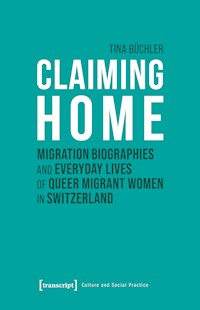
Through biographical narratives, Claiming Home traces how queer migrant women living in Switzerland navigate often contradictory perspectives on sexuality, gender, and nation. Situated between heteronormative and racialized stereotypes of migrant women on the one hand, and the implicitly white figure of the lesbian on the other, queer migrant women are often rendered ›impossible subjects.‹ Claiming Home maps how they negotiate conflicting loyalties in this field and how they, in their own way, claim a sense of belonging and home.
Das E-Book können Sie in Legimi-Apps oder einer beliebigen App lesen, die das folgende Format unterstützen:
Seitenzahl: 1104
Veröffentlichungsjahr: 2022
Ähnliche



















Dedicated to my parents
Tina Büchler (Dr.) is a member of the academic staff at the Interdisciplinary Centre for Gender Studies at the University of Bern. Trained as a social and queer geographer, she is currently a project leader in several research projects focusing on migration, asylum, economic precariousness, intersectionality, and human rights. She is also Co-director of the Graduate School Gender Studies, which brings together doctoral students from different disciplines and faculties who adopt a feminist perspective in their dissertations.
Tina Büchler
Claiming Home
Migration Biographies and Everyday Lives of Queer Migrant Women in Switzerland
This publication is based on a dissertation of the Faculty of Science of the University of Bern entitled “Claiming Home: Migration Biographies and Everyday Lives of Queer Migrant Women in Switzerland,” supervised by Prof. Dr. Doris Wastl- Walter of the University of Bern and co-supervised by Prof. Dr. Sallie A. Marston, University of Arizona/USA.
Published with the support of the Swiss National Science Foundation.
Bibliographic information published by the Deutsche Nationalbibliothek
The Deutsche Nationalbibliothek lists this publication in the Deutsche Nationalbibliografie; detailed bibliographic data are available in the Internet at http://dnb.d-nb.de
This work is licensed under the Creative Commons Attribution-NonCommercial-NoDerivatives 4.0 (BY-NC-ND) which means that the text may be used for non-commercial purposes, provided credit is given to the author. For details go tohttp://creativecommons.org/licenses/by-nc-nd/4.0/ To create an adaptation, translation, or derivative of the original work and for commercial use, further permission is required and can be obtained by contacting [email protected] Creative Commons license terms for re-use do not apply to any content (such as graphs, figures, photos, excerpts, etc.) not original to the Open Access publication and further permission may be required from the rights holder. The obligation to research and clear permission lies solely with the party re-using the material.
© 2022 transcript Verlag, Bielefeld
Cover layout: Maria Arndt, Bielefeld Foreign-language editing and proofread: Clay Johnson Printed by Majuskel Medienproduktion GmbH, Wetzlar Print-ISBN 978-3-8376-5691-6 PDF-ISBN 978-3-8394-5691-0 EPUB-ISBN 978-3-7328-5691-6 https://doi.org/10.14361/9783839456910 ISSN of series: 2703-0024 eISSN of series: 2703-0032
Printed on permanent acid-free text paper.
Contents
1.Introduction
2.Immigration and Sexuality: Policies and Practices in Switzerland
2.1Migration to Switzerland
2.2Lesbians in Switzerland
2.3Queer Migration to Switzerland
3.Sexuality, Migration, Space
3.1Embodied Geographies
3.2Traveling Concepts of Sexualities: Queer Migration Studies
3.3What’s Space Got to Do with It? Geographies of Sexualities
3.4Thinking Sexuality, Migration, and Space Together
3.5Who Are ‘Queer Migrant Women’? Approaching the Research Subject
4.Methodology: Doing Research in an Intersectional Field
4.1Applied Methods
4.2The Sampling Process
4.3Data Corpus, Data Analysis, and Writing Process
4.4Some Thoughts on Positionality
5.Shifting Positions of the Sexual Self
5.1“Now I can say I’m a lesbian”: Becoming a Lesbian in Switzerland
5.2“I was totally shocked”: Differing Sexual (Sub)cultures
5.3“It’s like a stamp”: Rejecting the Lesbian Label
5.4Conclusion
6.Family Matters
6.1Family Relations: The Family of Origin
6.2Queer Families
6.3Conclusion
7.Diasporic Spaces, Intersectional Homing Desires
7.1Negotiating Racism and Xenophobia as an ‘Ausländerin’ in Switzerland
7.2Ambivalent Diasporic Spaces
7.3Queering the Diasporic, Diasporizing the Lesbian
7.4Desiring the Queer Compatriot
7.5“Des Suisses-Suisses on va laisser tomber”:10 Being ‘Other Swiss’ Together
7.6Imagining and Reclaiming the (Parents’) Home Country
7.7Conclusion
8.Sexual Citizenship
8.1Partnership Registration: An Intimate Decision?
8.2Producing and Controlling Sexualities at and within the Border
8.3Conclusion
9.Work
9.1Work as a Site of Recognition, SelfRealization, and Integration
9.2Failing to Connect at Work
9.3“Romeo and Juliet would have killed each other long ago”: Being Excluded from Work
9.4‘Coming out’ at Work
9.5“I’ll just get the degree and then they’ll leave me alone”: Work as a ‘Tradeoff’ in Intrafamilial Negotiations
10.Scales of Identification: The City, the Rural
10.1Living in the Swiss Countryside: Ambivalent Rural Closets
10.2Grabbing the Bull by its Horns: The Rural as the Epitome of Switzerland
10.3Rural Utopias
10.4Conclusion
11.Conclusion and Outlook
Acknowledgments
Résumé
Bibliography
Annex I: List of Research Participants
Annex II: Overview of Collected Data
Annex III: Technical Notes
2.Immigration and Sexuality: Policies and Practices in Switzerland
This chapter aims to establish an understanding of the social, political, and economic context and hence the discursive field the participants in this study entered when they came to Switzerland. Chapter 2.1 gives a brief history of immigration to Switzerland, focusing on the interlinkages between the economic development in and immigration to Switzerland on the one hand and the rise of the discourses around Überfremdung (literally ‘over-foreignization’) on the other. These developments are then differentiated from a feminist perspective. Here, the discussion focuses on dominant ideas about migrant women, which queer migrant women are confronted with as much as their heterosexual counterparts. They are, however, not only targeted by prejudices about migrantwomen, but also face stereotypical ideas about lesbians. Chapter 2.2 accordingly addresses discourses around lesbians in Switzerland. It outlines the history of same-sex relationships and the lesbian movement and discusses recent shifts in the legal and social situation of lesbians and gays in Switzerland.
The combined focus of this chapter (on discourses around migrant women on the one hand and lesbians on the other) is not to suggest that the experiences and positionalities of queer migrant women are ‘close to,’ ‘almost like,’ or ‘a combination of’ the experiences and positionalities of heterosexual migrant women or non-migrant lesbians in Switzerland. Instead, the discussion of these two discursive fields points to the very crux of the matter under discussion, which is that these two histories and identities are generally seen as separate: While to date migrant women have almost exclusively been conceptualized as heterosexual, lesbians have hardly ever been thought of as migrants. Thus, Chapter 2.3 discusses the (limited) discourses, policies, and practices that do specifically address the queer migrant subject position, and summarizes the state of scholarly knowledge about queer migration to Switzerland.
2.1Migration to Switzerland
Looking at the circumstances during different periods of intensified immigration throughout the 20th and early 21st century exposes two dominant aspects of immigration to Switzerland. The first is that Swiss immigration policies, regulations, and practices have chiefly represented instruments to regulate and flexibilize the Swiss labor market (Wicker 2003). Second, the images of immigrants that have emerged from the debates around immigration policies have increasingly revolved around the concept of Überfremdung. In other words, in the past hundred years, immigrants to Switzerland have been welcome as flexible workers, but as people they have predominantly been perceived as a threat to ‘traditional’ Swiss culture and values (Arlettaz and Burkart 1988, Espahangizi 2019, Jost 1998, Kury 2003, Tanner 1998). This sub-chapter focuses on the rise and consequences of discourses of Überfremdung in Switzerland – as intertwined with economic and political developments in Switzerland and Europe – and the shifts they have been subject to across time and space.
2.1.1Migration to Switzerland: Some Basic Facts and Figures
For several centuries, due to its scarce agricultural and natural resources, Switzerland was a nation of emigrants. It was only in the course of industrialization starting in 1850 that it became a sought-after destination for European immigrants. However, it was not until the late 1880s that the number of people entering the country began to outnumber the people leaving it (Hoffmann-Nowotny 1995). Although the immigrant population in Switzerland has not developed in a linear fashion, it has continually increased since the 1980s. In 2007, when the fieldwork of this study was ongoing, 1.7 million foreign nationals lived in Switzerland (of a total population of 7.6 million). Among these, the most sizeable diasporas were from Ex-Yugoslavian countries (19%; the majority of these were from Serbia and Montenegro), Italians (18%), Germans (14%), and Portuguese (12%), followed by French nationals (5%), Turks, and Spaniards (4% each). Overall, 85.3 percent of all immigrants were citizens of European countries (two thirds of whom were nationals of EU-17 countries, not including Eastern or Southeastern European countries); 6.4 percent had immigrated from Asia, 3.9 percent from Africa, and 4 percent from the Americas (BFS1 2009).
In 2013, towards the end of the field phase of this study, the immigrant population amounted to 23.3 percent of the overall population in Switzerland (BFS online 2014). This rate, among the highest in Europe, was foremost the consequence of several periods of intensified immigration triggered by political and economic developments, in particular the rise of industrialization, post-war economic growth, and the establishment of the EU (Riaño and Wastl-Walter 2006). High birth and low mortality rates among immigrants and family reunification further increased the number of immigrants: In 2006 about 43 percent of all immigrants in Switzerland had migrated in the context of family reunification, and 26 percent had entered for employment. The reason for this development was that immigration related to family reunification was controlled much less strictly than employment-related migration (Riaño and Baghdadi 2007). However, importantly, the high rate of non-Swiss citizens in Switzerland was also a consequence of Switzerland’s exceptionally restrictive naturalization practices. Of the 1.7 million immigrants or non-Swiss nationals respectively residing in Switzerland, half had either been born and raised here or had been living in the country for over fifteen years. The low naturalization rate is also a consequence of the ius sanguinis principle practiced in Swiss immigration policy. This means that people who are born to non-naturalized immigrants in Switzerland do not automatically obtain Swiss citizenship, and neither do their children. Immigrants in Switzerland are in principle required to have resided in Switzerland for twelve years before becoming eligible for Swiss citizenship, which represents the longest period in Europe (De Carli 2014). While, in 1998, the Swiss naturalization quota of 1.4 percent was the lowest in Europe, it reached more than 3 percent in 2006 and hence moved close to the average in the European Union (EKM 2012, Riaño and Wastl-Walter 2006). Such low naturalization rates are generally typical for countries with ‘guest worker’ traditions such as Switzerland, Germany, or Austria, which have prioritized the flexibilization of the workforce over assimilation, forming a purposive relationship between immigration and economic development (IUED 2008). Indeed, in contrast to classical immigration nations such as the U.S. or Canada, Swiss policies have worked to discourage rather than encourage the naturalization of its immigrant population. Immigrants tend to be endured as a necessary evil to secure domestic economic standards rather than being encouraged to become fully contributing members of Swiss society (Riaño and Wastl-Walter 2006). Correspondingly, discourses around immigrants have been marked by prejudices and stereotypes, which in turn have been deployed to legitimize restrictive immigration policies and successfully established immigrants as ‘different from the Swiss.’ This anti-immigrant stance has fueled a sense of a unique and separate Swiss national identity (Tabin 2004). However, as the Swiss writer Max Frisch famously remarked with regard to guest workers in the 1960s, “Man hat Arbeitskräfte gerufen, und es kamen Menschen” – “Workers were called, and human beings came.” This fact has continued to haunt debates around immigration legislation and practices in Switzerland in the late 2010s.
2.1.2The Rise of the Discourse around ‘Überfremdung’ in Switzerland
The first significant period of immigration, which started in the late 1870s, brought highly qualified immigrants from the neighboring countries Germany, France, and Austria to Switzerland, who primarily came to support the growing Swiss construction industry. At the same time, there was also a rapidly growing number of less-qualified immigrants, mainly Italian nationals, who also worked predominantly in construction (Hoffmann-Nowotny 1995). At the time, the image of immigrants was positive; they, or their labor respectively, were perceived as indispensable for economic growth and prosperity. Bilateral recruiting agreements with twenty-one countries were established to enable the free movement of labor. Foreign nationals were granted almost equal rights to Swiss citizens (excluding the right to vote), and they could apply for citizenship after only two years of residence (D’Amato 2001, Riaño and Wastl-Walter 2006). This liberal policy further fueled the inflow of immigrants, which reached its peak in 1914. In that year, foreign nationals made up 15.4 percent of the total population, the highest rate in Europe at the time (Arlettaz and Burkart 1988, Riaño and Wastl-Walter 2006). In the face of the onslaught of World War I, nationalists and Swiss trade unions started to oppose the liberal immigration policy and began to frame immigrants as a threat to Swiss traditional values, morale, culture, way of life, and, especially, jobs. It is in this changing political climate that the term Überfremdung (‘over-foreignization’) gained importance, and it proceeded to dominate decades of Swiss policy-making (Arlettaz and Burkart 1988, Jost 1998, Tanner 1998).
The world wars, coupled with the strengthening discourse of Überfremdung, diminished the foreign population by two thirds. During and between the wars, right-wing politicians heated the debate by grounding their arguments in statistical extrapolations rather than facts: While they decried the increase in immigration, the immigrant population was in fact rapidly decreasing due to the economic crisis (Arlettaz and Burkart 1988, Espahangizi 2019, Riaño and Wastl-Walter 2006). This phase is exemplary for Swiss migration scholars’ finding that, overall, the actual historical percentages of immigrants hardly correlate with the levels of xenophobia in Switzerland (Skenderovic 2020, quoted in Binswanger 2020).
In 1934, the Bundesgesetz über Aufenthalt und Niederlassung (ANAG) (Federal Law on Residence and Settlement) came into force. It was to remain in effect until 2006 and hence still provided the main legal framework for immigrants when many of the participants in this study entered Switzerland. The new law introduced three categories of immigrant permits: The Saisonnier status, which allowed for a temporary stay of the duration of a working ‘season’ of nine months and enabled family reunification only after a Saisonnier had worked in Switzerland for three consecutive seasons (this status ceased to exist after the bilateral agreements with the EU came into force in 2002); the Jahresaufenthaltsbewilligung, an annual permit, the extension of which was made contingent on the overall economic situation in Switzerland; and the Niederlassungsbewilligung, allowing for permanent residency in Switzerland. The ANAG marked a paradigm shift on several levels. First, the concept of Überfremdung had now found its way into official language. Article 16 of the ANAG stated: “Officials granting foreigner permits need to take into account the intellectual and economic interests of the country as well as the degree of Überfremdung” (quoted in Riaño and Wastl-Walter 2006:1698). Second, the new legal framework addressed the perceived threat by restricting permanent settlement and by installing legal instruments allowing for a regulation of immigration according to the economic situation in Switzerland. Third, an additional law, the Bürgerrechtsgesetz (BüG) (Citizenship Law), in effect until 2018, moreover significantly restricted access to naturalization; now a minimum of twelve years of residency was required before an immigrant became eligible for Swiss citizenship. In sum, the focus of Swiss immigration policy had shifted from inclusion to exclusion and control (Piguet 2006, Wicker 2003). Crucially, the BüG installed assimilation as a legal requirement for naturalization. Immigrants who were eventually formally eligible for citizenship had to prove that they were “integrated into Swiss society,” “familiar with the Swiss lifestyle, morals, and customs,” “obedient to the Swiss legal system,” and did “not represent a danger to Switzerland’s security” (Art. 14 BüG, quoted in Riaño and Wastl-Walter 2006:1699). These vague formulations opened the door to arbitrariness and discrimination of (changing) stigmatized immigrant groups.
When the economy began to recover after World War II, a fresh need of unskilled and semi-skilled workers arose, triggering a new period of immigration. The new legal framework allowed the government to balance fears of Überfremdung and Swiss employers’ need for labor by framing immigration as a temporary phenomenon. A new agreement with Italy, for instance, determined that Italian nationals would need to obtain temporary permits for ten consecutive years or ‘seasons’ before becoming eligible for permanent residency. From this context, the figure of the Gastarbeiter (guest worker) emerged, who was conceptualized as a Wanderer (‘traveler’) rather than an Ein-Wanderer (immigrant, literally ‘in-traveler’ (Baghdadi 2011, Wicker 2003).
Between 1963 and 1967, rising inflation and growing numbers of immigrants prompted the government to issue a number of decrees instructing the private sector to reduce their immigrant workforce. At the same time, Switzerland officially acknowledged for the first time that immigrant workers had become an integral part of the Swiss economy and that established workers should be assimilated. This resulted in measures facilitating permanent residence and family reunification for Italian immigrants (Piguet 2006). However, due to the lack of collaboration of the private sector with the governmental regulations, increasing migration related to family reunification, and high birth rates among immigrants, this package of measures failed to reduce the immigrant population. In the ensuing revival of the myth of an impending Überfremdung, the issue of family reunification was a particularly contested issue. As in many other European countries, family reunification was subsequently subjected to a number of limitations, first in the 1970s and then in the 1990s (Riaño and Wastl-Walter 2006).
Since in the eyes of many citizens the government had failed to address immigration and its associated perceived threats adequately, starting in 1965 a series of Volksinitiativen against Überfremdung were launched to force the government into action (such ‘peoples’ initiatives’ are initiated by interest groups and are directly voted on by the general public). Among these, the Schwarzenbach-Initiative of 1970, launched by James Schwarzenbach, was the most radical. It demanded a reduction of the immigrant population to ten percent in each single Swiss canton, which, if successful, would have entailed the deportation of 300’000 immigrants residing in Switzerland at the time. The initiative generated a record turnout of 75 percent and was rejected by only 54 percent of the voters. The threat emanating from this initiative and the debate it generated in the media affected immigrants and their families deeply. Indeed, the psychological pressure and sense of being unwelcome that these debates generated still found expression in several family stories told by some of the women who took part in this study, forty years later.
It can even be said that during this post-war period, Switzerland spearheaded the development of modern right-wing populism. As Swiss migration scholar Damir Skenderovic noted in an interview with the online magazine Republik:
Schwarzenbach as a right-wing populist leader figure, as well as the Nationale Aktion, the Republikanische Bewegung, and all the other small parties in their ideological environment indisputably played a leading role in European if not global right-wing populism. Switzerland formed the avant-garde of right-wing populism […]. (Skenderovic 2020, quoted in Binswanger 2020, my translation)
Skenderovic identifies two crucial ingredients of these historical right-wing discourses in Switzerland that continue to shape right-wing populism internationally to this date: The first is making immigration the absolute center of the political agenda and taking a xenophobic stance; the second is taking an (allegedly) anti-establishment stance. Skenderovic argues that Switzerland was able to take on this leading role in European right-wing populism because it was seemingly less fraught with a fascist past, which allowed “blood and soil” ideas to spread quite unresisted within Switzerland. This stood in contrast to other European countries, where racism and xenophobia were much more strongly tabooed in the years after World War II. This discrepancy becomes particularly evident in the differing degrees of usage of the term Überfremdung post-war: While the term was tabooed in post-war Germany, it continued to be used and strengthened in Switzerland (Skenderovic 2020, quoted in Binswanger 2020).
Following the Schwarzenbach initiative, a number of ‘stabilization policies’ were introduced that built on quotas and temporary permits. These (and many more policies to be introduced up to the 1990s) were largely a concession to the 46 percent of the population who had voted for the Schwarzenbach initiative. Taking into account the Schwarzenbach supporters seemed to be rewarded by the clear rejection of another anti-immigrant initiative against Überfremdung in 1972. At this time, xenophobia was generally on the decrease, which may be connected to the fact that due to the recession, Switzerland had stopped guest worker recruitment and discontinued temporary permits, effectively exporting unemployment to the workers’ countries of origin (Riaño and Wastl-Walter 2006, Wicker 2003). For the first time, pro-immigrant initiatives were launched, advocating facilitated naturalization and the abandonment of the Saisonnier




