


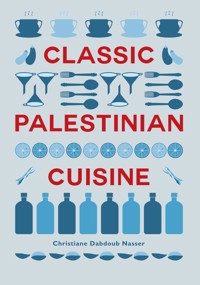
Erhalten Sie Zugang zu diesem und mehr als 300000 Büchern ab EUR 5,99 monatlich.
- Herausgeber: Saqi Books
- Kategorie: Lebensstil
- Sprache: Englisch
Classic Palestinian Cuisine is a collection of over one hundred mouth-watering dishes, such as ful m'dammas (broad bean salad), kidreh (rice with mutton) and djaj mahshi (stuffed chicken), characteristic of the culinary culture of the Mediterranean. Christiane Dabdoub Nasser's delightful tips and anecdotes, from coring marrows to buying the perfect cabbage for stuffing, vividly bring to life the smells and flavours of Palestinian cookery, as practiced in kitchens across the region for generations.
Sie lesen das E-Book in den Legimi-Apps auf:
Seitenzahl: 248
Veröffentlichungsjahr: 2014
Das E-Book (TTS) können Sie hören im Abo „Legimi Premium” in Legimi-Apps auf:
Ähnliche



















CLASSIC PALESTINIAN CUISINE
CLASSIC PALESTINIAN CUISINE
Christine Dabdoub Nasser
SAQI
CONTENTS
Introduction
Salads
Soups
Vegetables and Vegetable Dishes
Rice Dishes
Stews
Mahashi
Meat Dishes
Poultry
Bread and Dough
Sweets and Desserts
Jams
Refreshments
Menus
Acknowledgments
Index
INTRODUCTION
Traditional Palestinian cuisine offers a rich variety of dishes characteristic of the eastern regions of the Mediterranean.
At a crossroads between East and West and a strategic post on the trading routes for centuries, Palestine has had its share of invasions and occupations by foreign forces. If such a tumultuous history has marked the national psyche, it has certainly served to enrich the Palestinian experience, conferring upon it the cosmopolitanism that distinguishes it from neighbouring Arab cultures, while strengthening the base that roots it deeply within the civilisations common to this geographic area. Modern-day Palestine is identified with a variety of lifestyles that cover a wide range, from nomadic migration to urban sophistication.
The establishment of many foreign communities who settled in the Holy Land in the aftermath of the Crimean War in 1855 has also contributed to the present character of Palestinian cuisine, especially in urban centres such as Jerusalem, Jaffa, Ramallah and Bethlehem. In its most recent history, especially during the last fifty years, the demographic changes that have swept the area have influenced culinary trends both directly and indirectly and although the scope of such influences is still to be determined, it cannot be dismissed or underestimated.
Palestinian cuisine, as an expression of this diversity and manifold social and cultural make-up, has shouldered the tides through integration rather than rigid resistance. Staple Palestinian dishes, based primarily on rice as a main ingredient, are a dramatic expression of this osmosis, as rice has always been an imported commodity. The cuisine of the Bethlehem area has evolved more dramatically than that of other cities, the main reason being its close proximity to Jerusalem, quite the international city since the second half of the nineteenth century, but also because Bethlehem has been exposed to outside influences in its own right. Still, due to the many villages that dot the landscape towards the south and which have close ties to the city, Bethlehem has managed to maintain rustic attributes and to happily reconcile the rural with the urban, the sophisticated with the earthy, in a way that distinguishes it markedly from Jerusalem. The testimony of a nineteenth-century pilgrim to the Holy Land still holds true:
Finally, here is the city, lying in the hills and surrounded by green valleys. The white houses, vain and bright in the fading light of the setting sun, are reflections of marble against the intensity of the deep blue sky. Low walls of dry stones happily delineate the hilly slopes into terraces and gardens, cultivated in a manner henceforth unfamiliar to Jerusalem.
L’Abbé Landrieux, In the Land of Christ
Lamb holds a place of honour at every festive occasion. Throughout the year, in both affluent and modest circles where every occasion necessarily gives rise to celebration, the slaughtering of a lamb is one important component capturing whole categories of cultural and social symbols that gird the fabric of daily life. Lambs are slaughtered for weddings; the occasion of the birth of a son; recovery from a long and serious illness; the return of a long-absent family member or friend; the building of a new home; and even the acquisition of a new car. The celebration of Easter and Adha, two major feasts based on the concept of sacrifice for Christians and Muslims alike, are a culmination of this tradition and the extended family meets around the festive table where lamb occupies the centre place. In the last three decades this practice has somewhat weakened due to several factors: urbanisation and the consequent changes in perceptions and lifestyles; economic considerations which are closely tied to a dramatic rise in the cost of living; and health awareness. However, it still persists in conservative strongholds and, more particularly, in the northern villages of Palestine where adherence to traditional practices was one of the few means of cultural expression under Israeli hegemony during the last fifty years. It also remains constant during such solemn occasions as the loss of a family member or neighbour. If the consumption of lamb has receded in favour of leaner beef or white meat, especially chicken, it still remains the basic ingredient in the rich regional cuisine and no Palestinian would ever consider honouring a guest with anything but lamb.
Samneh baladieh, or clarified butter, is another feature particular to Palestinian cuisine. During the spring season, the only time of year when the hills and grazing grounds are green and the ewes have just given birth, ewe’s milk and ewe’s-milk cheese are sold door-to-door. Samneh is strained butter that has been boiled with cracked wheat, nutmeg and turmeric, a bittersweet spice that gives it its musky flavour and a distinctive bright yellow colour. It is one of those ingredients that cannot be bought off the shelves but has to be obtained through a network of contacts among the nomadic bedouins who breed the sheep and make the butter. The month of April witnesses the stir of housewives inquiring about prices and quality, and those who have a sure source of supply warrant their stock for the whole year before passing on the information to others. Again, due to dramatic hikes in prices and health considerations its use has been greatly reduced in favour of healthier sources of fat and many cooks use it in small amounts for flavour.
When the milk is churned to extract the butter, the by-product, laban mkheed, is also processed for year-round storage. This buttermilk is left to drip through cheesecloth for a few days. The resulting pasty cheese is then kneaded with salt, cumin and turmeric, shaped into balls and dried over a wooden board in a dark room for a few days then stored in cloth bags. Individual balls of laban jmeed, as it is called in its new state, are diluted as needed for sauces for many traditional dishes. Bedouins in the Bethlehem area substitute the cumin with fenugreek, a highly aromatic, somewhat bitter, spice.
Last but not least, it is the careful use of spices that will ultimately impart character to any cooking. The range of spices and herbs used in Palestinian cuisine has multiplied through the generations, but it is the repeated use of basic ingredients such as allspice, cinnamon, cumin and cardamom that gives Palestinian cuisine its own stamp. However, whether driven by strict adherence to traditional practices or strongly tempted to experiment and innovate in search of a personalised style, Chef Escoffier’s adage to ‘stay simple’ cannot be truer than when applied to the use of spices.
Simplicity can be certified through the quality of the spices. Careful selection – a reliable ‘attar or spice vendor is as important to secure as a good butcher – and shopping in limited quantities according to your needs for no more than two months are essential. Spices should be bought whole, as grains, sticks or roots, and preserved in tightly closed containers away from any source of light or heat. Then they can be moulded, chipped or grated as needed. Luckily, buying spices in jars off a supermarket shelf is a luxury a Palestinian housewife can do without! The same goes for herbs; it is very useful to have a herb patch in the back garden or plant some select favourites in containers by the kitchen. Nothing equals the aroma of freshly picked herbs in a salad.
The inevitable bowl of home-pickled olives dominates every meal at every table. The olive tree is the centrepiece of every garden, however small, and is a blessed provider, needing little care and as little water. It is also an indispensable source of nutrition for every family: four trees in my garden are more than sufficient to provide for the needs of my family of six and the constant flow of family and guests for a whole year.
Formerly, preparations for the olive harvest stretched over many days of intensive work and involved the whole community, men, women and children:
It was a busy time of year, perhaps the busiest of all, and the whole town was astir with preparations. For the men, it was an occasion for getting together, exchanging general views and speculating over the yield of this year and the profit. For the women, it involved a somewhat more strenuous effort. They would start their long day with the first light when the men and children were still asleep and before the usual morning bustle distracted them from their labour. Only late after sunset, following the return of the men from town and the communal sharing in the frugal evening meal, they could pick up their sewing or embroidery.
When came the day for the harvest the whole household was up before dawn. Their eyes still swollen with sleep, the children huddled at the kitchen table sipping their tea. The women served breakfast to everyone including the jaddadeh, the hired hands; the hot bread from the tabun, lavishly smothered with the last olive oil of the year, quickly disappeared into hungry mouths.
Christiane Dabdoub Nasser, Farha
The uprooting of every olive tree, practised systematically in order to advance the Israeli settler movement on Palestinian soil, is an open wound that is meant to continually deplete the symbiotic attachment of the people to the land. Today’s harvests are but a caricature of former years and a brutal reminder of the history of a whole nation and its relationship to the land.
Up until fifteen years ago, it was still possible to tell the time of year from the vegetable and fruit market stalls. Nowadays, a youngster is more likely to guess the distance between Mars and Venus than the time of year to which a certain vegetable or fruit belongs. It often happens that I still wonder over a display of cucumbers right in the middle of winter when the weather is at its coldest. Mangoes in summer? Forget it. Modern agricultural techniques have erased such nostalgic moments forever.
Today, the true harbingers of the passage of the seasons are a few remaining fallahat who come into the towns to sell their produce out of baskets they bring in on their heads. They are tenacious peasant women who still believe in tilling their small plot according to norms inherited from their forefathers and can count on several private customers in Bethlehem, Ramallah, Hebron or Nablus. There are so few of them, however, that their name constantly circulates among the few lucky households who book them months ahead for special vegetables and fruits delivered to their doorstep. In the Bethlehem area, fresh produce comes mostly from the villages south of Bethlehem, namely Aroub, Battir, Hussan and Artas, and it carries the magic baladi label.
Baladi, from balad, country, refers to the produce of the land grown according to ‘authentic’ methods. In agricultural terms, it refers to products that grow in rainwater and where traditional know-how guarantees the use of natural fertilisers and a minimal use of pesticides and insecticides in order to ensure optimal flavour. It also distinguishes Palestinian produce from its Israeli counterpart, which has invaded Palestinian markets during the Occupation and has led Palestinian farmers to emulate the Israeli example of mass production. The stamp of baladi is the local equivalent to the ‘organic’ label so much sought after among well-to-do circles in post-industrial societies.
It has been mostly due to the parsimony and conventional practices of traditional housewives that the baladi label has survived the last thirty years, and their menus are still largely determined by the natural cycle of the seasons. Unfortunately, however, this distinction has brought on the inevitable dictates of the basic rule of supply and demand, and the constant hike in prices of baladi products has been frustrating to every conscientious housewife keen on maintaining the tradition. It has also led to a racket which caters for culinary snobbery: concerned environmentalists have recently discovered that Palestinian farmers have been using four times the legal amount of pesticides and insecticides in order to secure a lucrative harvest. The concept of baladi has thus become relegated forever to a bygone age!
But all ills can still have their good side. A housewife feels much less frustrated at the unannounced visit of cousins from America because she does not have to depend on the casual visit of Umm Issa bringing in fresh lettuce and string beans from her plot at Artas. Nor has she to look out for the sporadic calls of Ahmad down the street promoting the excellence of his prunes and apples from Battir. No one has to rush to the garden to check if by any chance there is a bunch of betuni left on the trellis. There is a vendor of fruits and vegetables round every corner; failing that, the local supermarket is sure to fill in your needs with frozen products. All thanks to modernity!
This book is an introduction to traditional dishes adapted to the tastes of a wide public avid for new culinary experiences and keen on maintaining a healthy balanced diet. The recipes should be considered as guidelines and once a recipe has been tried and repeated, it is up to each cook to venture further and experiment towards a more personalised version of a favoured dish.
It is, however, worthwhile noting that when it comes to individual kitchens, what elevates plain home cooking to a gourmet feat is nafs and no cook can pretend to any accomplishment without it. A derivative of nafas, meaning ‘soul’, this essential element refers to the generosity of heart that accompanies the preparation of every meal shared with family and friends.
Finally, cooking is not just about food but also about people. There is a whole chain of men and women whose labour contributes to the final serving of a meal yet it is in the kitchen that the magic occurs. This collection of recipes is a tribute to all the Palestinian women who have embraced tradition while looking towards renewal and whose cooking is a reflection of the inherent connection between permanence and transition in a dynamic culture.
SALADS
The most important principle in concocting a successful salad is fresh prime produce. This is where door-to-door selling by the women from the villages is really missed: to have a fresh tomato for breakfast right off the bush is a luxury one can only look back on. Fortunately, many products are still cultivated the traditional way and some select local vegetable and fruit stores sell them on a regular basis. But going traditional also means limiting oneself to seasonal produce and facing the challenge of inventiveness and resourcefulness.
Herbs are used profusely, especially mint, parsley, thyme, rosemary and coriander. Many of them grow wild and, like thyme and rosemary, can grow in rocky areas, but most homes prefer to grow their own herbs. A typical garden must feature a lemon tree, a grapevine trellis, a herb patch and the ubiquitous jasmine with its white, very fragrant flowers. The notion of cultivation for home consumption underlies every garden design and can be explained by two factors, the one practical and the other cultural. Given the perennial rationing of water and sporadic periods of severe water shortage, a garden for aesthetic enjoyment is a luxury that very few can afford. The other explanation is the vestige of an essentially fallahin culture that has persisted in spite of the dramatic demographic changes of the last fifty years and the rise in urbanisation, and has perpetuated the notion of cultivation for private home consumption in the urban centres and their peripheries.
Garlic and onion are essentials in the preparation of most salads and their use, quite typical of the Mediterranean basin, might be considered somewhat heavy-handed by western standards. It is best to use the quantities indicated in the recipes before deciding on reducing – or increasing – the quantities, then they can be adjusted to individual tastes if it is still considered necessary.
Olive oil is an essential ingredient in most salads. Not only is it an indispensable source of nourishment, it also moisturises dry and pasty salads such as hummos, and attenuates the sharpness of others such as m’tabbal, which is based on grilled aubergines.
The salads presented in the following section fall under three categories according to the method of preparation: raw, cooked or dip-like. For some, preparation is simple and quick but many are elaborate and require some fine chopping that is time-consuming. Do not even think of using a food processor or any other mechanical device for the chopping since the outcome is sure to be a parody of the real thing. In spite of the time and pain invested, once served these salads are the epitome of refinement, flavour and enjoyment!
Mezze refers to the assortment of sample dishes offered as a first course at formal meals, and includes a whole array of salads accompanied by relishes and hot appetisers. This tradition of assorted hors d’oeuvres is typical of most countries of the Mediterranean basin where mezze is consumed leisurely over hours of nibbling and sampling and dipping with bread. Such meals are associated with easy living, languid after-meal siestas or long summer evenings stretched out by endless puffs on the nargileh; they also disguise the time and effort invested in the preparation of a respectable mezze worthy of the name!
The intensification of travel since the sixties and sustained exposure to different cultures and different foods have brought on inevitable developments that have, for the most, further enriched the local appetisers. New ingredients have been added and new dishes introduced but the base remains unquestionably Palestinian and no display deserves the title of mezze without the presence of de rigueur plates such as hummos, m’tabbal, beetroot salad or fried aubergines with labaneh and pine nuts.
A good mezze should balance out an assortment of raw and cooked vegetable salads, grain salads and mou’ajjanat, pastry-based hot hors d’oeuvres. The variety can be substantial enough to stand as a full meal. Unfortunately, what average local restaurants usually offer is but a meagre representation of what can come out of a home kitchen where nafs and good ‘fingertips’ can whip up a variety of dishes that remain unknown to the passing visitor. To the hostess, the advantage of serving mezze at a seated or buffet dinner is that the various plates are all served at once, allowing her to enjoy the company of her guests without having to hover through a major part of the meal.
Most of the quantities indicated for each salad are enough for four persons, which makes it practical to include them within an assortment of mezze.
AUBERGINE SALAD
— Salatet el-raheb —
Raheb means monk. Since the origin of this salad’s name remains unknown, salatet el-raheb is believed to have been imported from Syria or Lebanon. This recipe can be accomplished by grilling the aubergines either on a stove top or in the oven. I very much prefer to put them in an old-fashioned aluminium pan – the first method.
3 large aubergines (about 900 g/2 lb) 3 tomatoes, red and firm Salt and pepper to taste
For the dressing 3–4 garlic cloves 1 hot pepper ½ cup olive oil 3 tbs freshly squeezed lemon juice Salt and pepper to taste A few mint leaves to garnish
First wash and dry the aubergines without removing the stems, then place them in a pan and grill them on high heat on top of the stove. It is possible to brown them in the oven for some 40 minutes but they do not acquire the same smoky flavour and are therefore less tasty. Turn them on all sides until the skin becomes hard and blackened, ten minutes for each side, making sure not to pierce them in the process so as to preserve the liquid. Set aside to cool.
Meanwhile, wash and dry the tomatoes and cut them up into small cubes.
Peel the aubergines carefully. The skin comes off quite easily; however, make sure that none of it remains with the now soft interior. Mash the pulp and add the salt and pepper.
Serve in a deep plate and spread the chopped tomatoes over the surface.
Wash the hot pepper and remove the stem and seeds. Peel the garlic. Mash them both with a dash of salt with a heavy pestle and mortar. It is possible to use a food processor, but you have to transfer the mashed garlic and pepper to a pestle to continue. Add the oil gradually, all the time working the mixture and alternating with the lemon juice. The sauce should be smooth. Add salt and pepper to taste and spoon out over the tomatoes. Garnish with whole mint leaves around the edges to form a crown.
AUBERGINES AND MARROWS WITH LABANEH AND PINE NUTS
Easy to prepare and quick to enjoy, this plate is refreshing, wholesome and has a crunchy bite to it! It can be served as an hors d’oeuvre on individual plates for a seated three- or four-course dinner or to add a note of earthy simplicity to a mezze variety.
Baladi aubergines, the most flavoursome coming from the area south of Bethlehem, renowned for its water springs and rich soil, are tender and have a very thin skin but are of short duration. Rihawi aubergines, so called because this variety is largely grown in the Jericho area, are available all year round and are quite tasty.
2 medium rihawi aubergines, or 500 g (1 lb 2oz) baladi 6–8 marrows, preferably baladi ½ cup oil for frying 200 g (7 oz) labaneh About 60 g (2 oz) pine nuts A few lettuce leaves
If you are using the big variety, wash them and wipe dry, peel them if you prefer, although for this salad it is not necessary, then cut them into 1½ cm (½ in) slices. If you are using the baladi, which are small, long and thin, do not peel them, just cut them lengthways once or twice, depending on their thickness and the way you prefer them. Sprinkle them with salt and leave them to sit for half an hour before frying them. Wash and wipe dry the marrows and cut them lengthways into four slices each.
For the frying, you can use the oil of your choice; for years I was using corn or sunflower seed oil, saving the olive oil for salads and dressings. Lately however, because of the inherent toxins released by the different oils at high temperature, I reverted to olive oil. Fry the marrows first, turning them over once after the first side is slightly brown. Place them on kitchen paper to absorb some of the frying oil. Fry the aubergines in the same way and when you are through, discard the remaining oil. Let the vegetables cool to room temperature.
Spread the fried slices in one layer on a large flat serving plate; you can use a bed of lettuce, alternating the aubergines with the marrows. Spoon some labaneh on top of each slice, sprinkle them with the fried pine nuts and serve.
Tips
The aubergines and marrows, fried ahead of time, will have more time to drain any excess oil if you change the kitchen paper at least once. This will give you nice and crisp, non-greasy vegetables.
AUBERGINES WITH TAHINEH
— M’tabbal —
Large and pulpy, Jericho eggplants, beitinjan rihawi, are ideal for frying or grilling. They are quite sharp when grilled, and intensify the flavour of many salads that accompany meat dishes; the word m’tabbal is the masculine passive form of ‘spicy’. The pungent flavour of the dish is due to the combination of grilled aubergines and garlic.
Together with the hummos, it is a basic component of the mezze. It can be eaten as a dip and goes very well with barbecued meat and kubbeh.
3 large rihawi aubergines⅓ cup tahineh⅓ cup unflavoured yoghurt ¼ cup lemon juice 2–3 garlic cloves 1 tbs finely chopped hot pepper (optional) Salt and pepper to taste Olive oil for serving, quantity according to taste Parsley, cherry tomatoes and thin slices of lemon for garnish
First wash and dry the aubergines without removing the stems, then put them in a pan and grill them on a high heat on top of the stove. Turn them on all sides until the skin becomes hard and blackened, less than ten minutes for each side, making sure not to pierce them in the process. Set aside to cool.
It is possible to brown the aubergines in the oven for some 40 minutes but they do not acquire the smoky flavour that makes this dish such a special treat.
In a glass bowl, work the tahineh with the lemon juice, adding two tablespoonfuls of water if necessary to obtain a soft paste. Add the yoghurt and mix well. Crush the garlic then add it with the finely chopped hot pepper to the tahineh. Remember that the hot pepper is meant to add an extra edge to the salad and can be dispensed with.
Peel the aubergines carefully. The skin comes off quite easily; however, make sure that none of it remains with the now soft interior. Mash the pulp and add the salt and pepper. Add the tahineh mixture to the aubergines and mix well. The resulting salad is soft and slightly creamy.
Spread it on a large plate and with the back of a spoon make a circular groove for the oil. Decorate the edges with parsley leaves, lemon slices and cherry tomatoes and sprinkle with olive oil at the last minute before serving.
AUBERGINES WITH YOGHURT
— Beitinjan b’laban —
This salad is a variation of the m’tabbal with a marked difference in the flavour. The combination of the fried aubergines with the yoghurt, which gives it a smooth light texture, makes it an excellent side dish to accompany kubbeh b’suniyeh.
3 large rihawi eggplants ½ cup vegetable oil 2 garlic cloves, crushed ¾ tsp salt 750 ml (1¼ pts) unflavoured yoghurt
Wash and wipe dry the aubergines, peel them, then cut them into 1cm (½ in) slices. Sprinkle them with salt and leave them to sit for half an hour before frying them. For the frying, you can use the oil of your choice, corn or sunflower oil or even olive oil. Fry the aubergines in a deep pan a few at a time and put them on kitchen paper to soak up some of the frying oil. You get better results if you fry them thoroughly on one side and turn them over only once. Discard the remaining oil.
I always fry them a few hours ahead, which gives me the chance to change the kitchen paper and have less greasy aubergines. It is possible to fry a large quantity and freeze some in a sealed container for later use. They keep very well for up to two weeks.
To prepare the dressing, measure out the yoghurt, add the crushed garlic and the salt then fold the mixture with the aubergine slices and stir gently, making sure not to crush them. Serve immediately. This salad wilts very quickly, which is why it is wise to season just a portion for immediate use. The fried aubergines keep very well for two to three days and the yoghurt dressing can be preserved in the refrigerator in an airtight container for 24 hours.
AVOCADO SALAD
It is fresh, nourishing and quick to prepare! It is also as quick to disappear into hungry mouths!
4 medium avocados Whole lemon peeled Garlic cloves 2 tbs chopped peppers, medium hot 1 tsp salt
Peel the avocados and cut in half, removing the seed. Put the halves in a food processor and add the peeled garlic, the chopped peppers and the peeled lemon cut up in pieces and from which the seeds have been removed. Mix at high speed until you get a smooth soft paste. Served in a bowl, with crackers or kmaj bread on the side. This dip adds an exotic touch to the mezze.
BEETROOT WITH GARLIC
— Salatet banjar —
This salad is important to include in a mezze display as it adds a different dimension to the variety. The parsley, with its bitter aroma, offsets the sweet flavour of the beets quite adequately.
7–8 raw beetroot 2 garlic cloves 1½ tsp salt 1 tbs olive oil ¼ cup lemon juice A small bunch parsley, about ½ cup
Put the washed beetroot in a pan full of hot water, bring to the boil and leave to cook, covered, for about 40 minutes. Once they are cooked rinse them out with cold water and pare them. You can dice them on a wooden board or slice them, as you prefer; the parsley has to be chopped by hand so it stays fresh all through the meal. Parsley chopped in a food processor looks limp immediately.
Crush the garlic with the salt with a pestle and mortar; gradually add the olive oil until it becomes soft and creamy. Add to the beetroot and add the lemon juice and parsley. Stir well and serve in a fresh bowl.
CHICKPEA DIP
— Hummos —
Hummos is a staple food and can be eaten at any meal of the day. A substantial addition to a brunch, minced meat and pine nuts sprinkled over hummos can turn it into a delightful dish.
500 g (1 lb 2oz) chickpeas, washed and pre-soaked ¾ cup tahineh⅓ cup lemon juice 2–3 garlic cloves 1 hot pepper (optional) 1½ tsp salt Pepper to taste
To serve 2 tbs of finely chopped parsley ½ cup whole chickpeas, cooked ¼ cup olive oil Dash of cumin
For the meat 400 g (14oz) minced meat 2–3 tbs of olive oil ¾ tsp salt ½ tsp pepper




