


4,49 €
Mehr erfahren.
- Herausgeber: Claire press
- Kategorie: Sachliteratur, Reportagen, Biografien
- Sprache: Englisch
Discover the remarkable life of Clint Eastwood…
From drifter cowboy to master director, Clint Eastwood has stood at the center of American cinema for more than seven decades. His squinting gaze and quiet resolve defined generations of moviegoers, but behind the legend is a far more complex story—of discipline, reinvention, and a relentless refusal to be anything but himself.
This book traces Eastwood’s journey from a restless Depression‑era childhood to his rise as a global icon in Sergio Leone’s spaghetti westerns, his transformation into the tough moral conscience of 1970s America, and his later emergence as one of Hollywood’s most respected filmmakers. Along the way, it explores the private battles, political turns, and late‑career masterpieces that reshaped how the world sees him.
Discover a plethora of topics such as
Breaking into Hollywood and surviving early rejection
Trailblazing on television with Rawhide
The birth of an icon through Sergio Leone’s westerns
Dirty Harry and the moral turmoil of 1970s America
Redemption through Unforgiven and his evolution as a director
The maverick patriot of American Sniper and beyond
And much more!
If you want a concise and compelling portrait of Clint Eastwood—the man, the myth, and the craftsman—simply scroll up and click the “Buy now” button for instant access!
Das E-Book können Sie in Legimi-Apps oder einer beliebigen App lesen, die das folgende Format unterstützen:
Veröffentlichungsjahr: 2025
Ähnliche



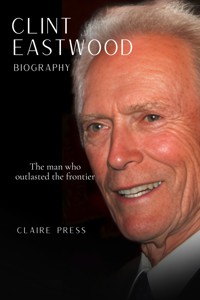
Clint Eastwood
Biography
The man who outlasted the frontier
CLAIRE PRESS
Table of Contents
Copyright3
Preface4
Introduction6
Chapter 1: Breaking into Hollywood12
Chapter 2: Trailblazing on Television18
Chapter 3: The Birth of an Icon24
Chapter 4: Dirty Harry’s America30
Chapter 5: The Independent Western37
Chapter 6: Politics and Personal Battles44
Chapter 7: Redemption through Art51
Chapter 8: The Master Craftsman57
Chapter 9: The Maverick Patriot64
Chapter 10: The Eternal Outlaw70
Conclusion76
Copyright
All rights reserved.
Copyright © 2025 by Claire Press.
Preface
I decided to write this book when I realized how one man could live through every transformation in American cinema and still remain entirely himself. Clint Eastwood has not only survived Hollywood’s shifting eras but defined them, shaping the image of independence that millions still look to for meaning.
His life asks a question larger than celebrity: how does a person preserve conviction in a world built on illusion? This is an unauthorized biography, drawn from decades of published interviews, archival journalism, studio records, documentaries, public appearances, and firsthand accounts from colleagues and longtime collaborators.
Together, these sources reveal an artist who quietly documented the moral and cultural evolution of his country across seven decades. My goal was not to glorify success or inventory scandals, but to understand how discipline, solitude, and belief in work shaped the man behind the myth.
His story reflects both the grit of twentieth-century America and the stillness that came after it. In these pages, you will not find a legend carved in stone, but a craftsman still in motion, chasing meaning through the lens. This book is my invitation to walk alongside Clint Eastwood as he turns silence, once again, into legacy.
Introduction
Few figures in American culture have lived as both cowboy and philosopher quite like Clint Eastwood, a man whose silence shaped generations and whose grit outlasted the eras that made him. From the postwar optimism of 1950s Hollywood to the restless uncertainty of the twenty-first century, he stood apart. Eastwood’s defining expression—half squint, half reflection spoke for a country forever torn between toughness and doubt. Every role he played, every film he directed, circled one question: what does it take to remain true to yourself when the world keeps changing its shape?
Clinton Eastwood Jr. was born on May 31, 1930, in San Francisco, California, into a world barely clinging to stability. The Great Depression was at its height, and his parents, Clinton Sr. and Ruth Eastwood, did what so many Americans did then they kept moving. The family traveled up and down California’s coast, following industrial jobs that never lasted long. By the time Clint reached adolescence, he had lived in more towns than he could count. He later described that transient childhood as his first lesson in independence. You learned early, he said, that no one owed you comfort.
He was tall even then, rawboned, quiet. At Oakland Technical High School, teachers saw him as self-contained, a boy more comfortable watching than speaking. His size made him an athlete; his silence made him a mystery. Friends called him “Samson” for his strength, though he carried none of the arrogance that name suggested. He was not a scholar, but he was disciplined. Odd jobs supported him after graduation in 1948: caddying, pumping gas, loading lumber. Each one taught him the dignity of getting things done. In a world of motion, Eastwood’s defining lesson was stillness. It would become the secret to his appeal.
The Korean War arrived before he could build a direction. Drafted into the U.S. Army in 1951, Eastwood was assigned to Fort Ord in Monterey, a training base along the California coast. There he worked as a swimming instructor, teaching recruits endurance in rough water. The irony did not escape him years later: he was preparing soldiers for a war he would never see, survival lessons without the politics. Fort Ord would change him in ways more permanent than he realized. The landscape tidal, wide, and unhurried fit his temperament. He discovered there that discipline was not about authority but precision.
It was on a rare day off that his life nearly ended. Returning to the base aboard a Navy AD-1 Skyraider, he survived when the plane crashed into the Pacific after running out of fuel. He swam more than two miles through cold, churning water to reach shore. The event barely made a dent in official records, but to Eastwood it was pivotal. Years later, he would describe the experience not as terror but as a kind of awakening. “You swim,” he said. “You don’t panic. You just keep going.” That refusal to dramatize, that quiet pragmatism, would later define both the man and the legend.
Fate intervened again at Fort Ord when a Hollywood connection spotted him. An assistant from Universal Studios, visiting recruits, noticed the tall young instructor’s composure and raw charisma. The studio was scouting fresh faces for its emerging roster of contract players. Soon after, Eastwood was invited to a screen test. He was twenty-two, untrained and unpolished, with a voice that critics later said sounded like dry gravel sliding across asphalt. It was not refinement that impressed them. It was presence. He had the rare gift of command without motion.
Hollywood in the early 1950s was beginning to fragment. The old studio system that produced neatly defined stars was losing its grip. Television was stealing audiences, and actors who didn’t fit the traditional mold like Marlon Brando and James Dean were redefining masculinity through anger and vulnerability. Eastwood belonged to a different school: stoic, careful, skeptical of noise. If Brando symbolized rebellion, Eastwood would become its disciple of restraint.
Before he ever stood in front of a camera, he studied performance through observation. He watched the world instead of talking to it. That distance was not detachment but attention. Growing up amid constant relocation had taught him to read people quickly, to measure them in pauses and gestures. When acting finally entered his life, it fit him effortlessly. Film, after all, rewarded those who could speak loudly without saying much at all.
His early work was uncertain. His first auditions were met with polite shrugs. Studio casting directors liked his looks but not his diction—they called it awkward, stiff, even strange. But Eastwood persisted, viewing rejection not as judgment but as training. He took jobs wherever he could find them, learned from his mistakes, and returned every time a little sharper. His parents’ instability had trained him well for an industry built on uncertainty.
Looking back, the story of Clint Eastwood’s early years feels less like destiny and more like evolution. Nothing was granted easily. Each turn in his path each new town on the road, each small job, each brush with danger required steadiness. That steadiness would become the hallmark of his art: the calm before eruption, the quiet before decision. Where others built their fame on visibility, he built his on restraint.
The man who would one day embody America’s moral contradictions began his life with none of the rewards they promised. He worked quietly, saved his money, and learned how to take orders while waiting for something larger than orders to call his name. Success would come slowly, then all at once, in the shape of a cowboy’s hat and a television camera lens. But before the star rose, there was only the man learning what to endure and when to move.
Hollywood would mistake his silence for mystery. Those who knew him better recognized it as calculation. He was not reinventing manhood yet; he was simply surviving it.
Before Clint Eastwood became a star, he was just a survivor who understood that calm could be its own kind of power.




