


4,49 €
Mehr erfahren.
- Herausgeber: Claire press
- Kategorie: Sachliteratur, Reportagen, Biografien
- Sprache: Englisch
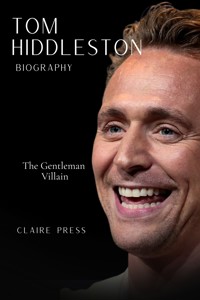
Discover the remarkable life of Tom Hiddleston...
From classically trained stage actor to global superstar, Tom Hiddleston has become one of the most compelling performers of his generation. Best known to millions as Loki in the Marvel Cinematic Universe, he built his career on intelligence, discipline, and a deep love of storytelling that began long before Hollywood came calling.
Behind the charming interviews and red-carpet smiles lies a thoughtful, intensely serious craftsman. This book traces Hiddleston’s journey from his school days and early grief, through rigorous training and small television roles, to his breakout as a Shakespearean lead and his transformation into an international icon. Along the way, it explores how he balances blockbuster fame with theater, prestige television, and a fiercely guarded private life.
Discover a plethora of topics such as
Early Life in London and Family Influences
RADA, Stage Work, and the Making of a Classical Actor
Enter Loki: Marvel, Global Fame, and Fan Culture
Shakespeare Onscreen and Onstage: From Henry V to Coriolanus
The Night Manager and the Pursuit of Serious Drama
Humanitarian Work, Public Image, and Life Beyond the Cameras
And much more!
So if you want a concise and informative book on Tom Hiddleston, simply scroll up and click the "Buy now" button for instant access!
Das E-Book können Sie in Legimi-Apps oder einer beliebigen App lesen, die das folgende Format unterstützen:
Veröffentlichungsjahr: 2025
Ähnliche





Tom Hiddleston
Biography
The Gentleman Villain
Claire Press
Table of Content
Copyright
The God of Mischief
Chapter 1: A House of Science and Art
Chapter 2: The Dragon School
Chapter 3: Etonian Ambitions
Chapter 4: The Cambridge Footlights
Chapter 5: RADA and the Grind
Chapter 6: Wallander and the Mentor
Chapter 7: The Loki Effect
Chapter 8: The Hollow Crown
Chapter 9: High-Profile Heartbreak
Chapter 10: Loki's Legacy and Beyond
The Man in the Arena
Author’s Note
Copyright
All rights reserved.
Copyright © 2025 by Claire Press.
The God of Mischief
On the sweltering afternoon of July 20, 2013, the air inside the San Diego Convention Center was heavy, thick with the scent of stale popcorn, recycled air-conditioning, and the palpable, vibrating anxiety of six thousand five hundred souls. Outside, the California sun beat down on the pavement with a relentless fury, baking the sprawling lines of fans who had camped out for days on the hard concrete, sleeping in shifts on grass verges and subsisting on energy drinks and adrenaline. They were the faithful, the pilgrims of pop culture who had journeyed to this concrete Mecca not for a religious epiphany, but for a glimpse of the modern pantheon: the superheroes and villains of the Marvel Cinematic Universe.
Inside the cavernous, hangar-like expanse of Hall H—the "Holy of Holies" of geek culture—the atmosphere was bordering on hysterical. The audience had already sat through hours of panels, enduring previews for lesser films and polite applause for B-list stars. But as the clock ticked toward the evening, a distinct electrical charge began to ripple through the room. They were waiting for Thor: The Dark World. They were waiting for the heroes.
Kevin Feige, the baseball-capped architect of this multibillion-dollar mythology, stood at the podium, attempting to introduce the footage. He was mid-sentence when the audio system screeched, a harsh, discordant tear in the fabric of the presentation. The lights in the vast auditorium flickered and died, plunging the thousands into a sudden, confused darkness.
A voice, rich with contempt and amplified to a deity-like volume, boomed from the void.
"Humanity… look how far you've fallen."
A spotlight slashed through the gloom, illuminating a figure standing center stage. He was clad in green leather and gold armor, a heavy, stifling costume that weighed nearly forty pounds. On his head sat the iconic curved golden horns; in his hand, he gripped a scepter that glowed with a menacing blue light.
It was not Tom Hiddleston, the polite, Cambridge-educated actor from Wimbledon who held doors open for strangers and quoted T.S. Eliot in interviews. It was Loki.
The roar that erupted from the crowd was physical, a wall of sound that hit the stage with the force of a tidal wave. It was a primal scream of recognition and adoration, a sound usually reserved for rock stars or messiahs. In that moment, the boundaries between reality and fiction dissolved. The man on stage did not smile. He did not wave or break character to offer a humble "thank you" for the reception. Instead, he stood perfectly still, surveying the sea of screaming faces with a look of imperious, sneering disgust.
"Lining up in the sweltering heat for hours," he purred, his voice dripping with disdain, projecting to the back of the hall with the perfect enunciation of a man trained at the Royal Academy of Dramatic Art. "Huddling together in the dark… like beasts!"
The audience cheered even louder, embracing the insult as a benediction.
For Hiddleston, this was a high-wire act of immense daring. He had flown into San Diego from London, smuggling his costume in pieces to avoid detection, a secret operation worthy of a spy thriller. Backstage, moments before his entrance, he had stood in the dark, sweating profusely in the leather armor, his heart hammering against his ribs. He was terrified. If he walked out there and the joke didn't land, if he looked silly rather than menacing, he would be a laughingstock. He was an actor playing a god in a room full of people who took their gods very seriously.
But as he strode across the stage, pacing like a panther in a cage, the fear evaporated, replaced by the sheer, intoxicating power of performance. He realized he was not just at a comic book convention; he was at the Globe Theatre. The audience was his groundlings, and he was delivering a soliloquy.
"I am Loki of Asgard," he announced, spreading his arms wide, "and I am burdened with glorious purpose."
He commanded the room with a Shakespearean gravity that turned a marketing stunt into a piece of theater. He taunted them, teased them, and manipulated them. When he demanded, "Stand back, you mewling quim," reusing a controversial line from The Avengers, the shock in the room was palpable, followed instantly by delighted laughter. He was dangerous, unpredictable, and utterly mesmerizing.
Then came the crescendo. He silenced the room with a single gesture, raising a finger to his lips. He looked out at the thousands, his eyes glinting in the spotlight.
"Say my name," he whispered.
"Loki!" the crowd screamed back.
"Say my name," he roared, louder this time.
"LOKI!"
"SAY MY NAME!"
"LOKI!"
He smiled then, a wicked, triumphant grin that chilled the blood. "It seems I have an army," he murmured. "Feast your eyes!"
With that, he introduced the film footage and vanished into the darkness as abruptly as he had appeared, leaving the audience breathless and reeling.
Backstage, as the adrenaline crashed and the lights came up, Tom Hiddleston slumped against a wall, peeling off the heavy leather layers, soaked in sweat but exhilarated. He had done it. He had taken a character who was written to be hated—a fratricidal, genocidal maniac—and transmuted him into an icon of adoration.
This moment in Hall H was the apotheosis of the "Loki Effect." It marked the point of no return for the thirty-two-year-old actor. Before this day, he was a rising star, a respected talent who had held his own against Anthony Hopkins and Kenneth Branagh. After this day, he was a phenomenon. He had demonstrated a rare alchemy: the ability to fuse the rigors of classical training with the visceral energy of pop culture. He had proven that a villain could be the hero of the story if played with enough pathos and charm.
But the moment also carried a warning. As he wiped the greasepaint from his face, returning to the persona of the gentle, self-effacing Englishman, the shadow of the horned helmet lingered. He had created a myth so potent that it threatened to eclipse the man. The world didn't just want Tom Hiddleston anymore; they wanted the God of Mischief. They wanted the chaos, the danger, and the glorious purpose.
As he was driven away from the convention center, watching the fans still chanting his character’s name, Tom might have reflected on the strange journey that had brought him here. It was a path that wound through the playing fields of Oxford, the dormitories of Eton, and the rehearsal rooms of London. It was a story of a boy who learned to hide his sensitivity behind a mask, only to find that the mask had become the most famous face in the world. The sweltering heat of San Diego was a long way from the damp chill of Wimbledon, but in the roar of the crowd, Tom Hiddleston had finally found his kingdom. The only question now was whether he could survive the weight of the crown he had just placed upon his own head.
Chapter 1: A House of Science and Art
For Thomas William Hiddleston, the world was never a singular stage; it was a series of overlapping theaters, each requiring a different script, a different costume, and a different modulation of voice. Born on February 9, 1981, in the genteel, leafy calm of Westminster, London, he arrived into a family that was itself a study in contrasts, a living Venn diagram where the empirical rigors of science overlapped with the chaotic beauty of the arts. It was a duality that would come to define him, forging a chameleon-like ability to inhabit contradictory worlds with equal ease.
To understand the man who would one day bring a Shakespearean gravity to a comic book villain, one must first navigate the complex genealogy that produced him. On one side stood the towering figure of his father, Dr. James Norman Hiddleston. A physical chemist and the managing director of a biotech company, James was a man of the empirical world, a Scot whose character was hewn from the granite of Greenock, a shipbuilding town on the River Clyde. The Hiddleston lineage was one of stoic determination and hard-won upward mobility. Tom’s grandfather, Alexander, had labored as a plater in the shipyards, helping to construct the vessels that carried the empire’s trade, while his grandmother Margaret had worked in the munition factories during the war. They were practical people, grounded in the realities of labor and industry, who instilled in their son a ferocious work ethic and a belief in the power of education to alter one's destiny.
James Hiddleston embodied this drive. He had climbed the ladder of British society not through inheritance but through intellect, his career in the pharmaceutical industry taking him from the lecture halls of university to the boardrooms of Oxford. He was a man who dealt in facts, in formulas, and in the measurable outcomes of the scientific method. In the Hiddleston household, accuracy was a virtue, and emotional indulgence was viewed with a skeptic’s eye.
On the other side of the equation was Tom’s mother, Diana Patricia Servaes. If James was the anchor, Diana was the sail. A former stage manager and arts administrator, she hailed from a lineage that was steeped in the Establishment and the performing arts. Her grandfather was Vice-Admiral Reginald Servaes, a naval officer who had served as the flag captain on the HMS London. But the bloodline grew even more colorful further back; her great-grandfather was Sir Edmund Vestey, the baronet and food tycoon who built a global empire on refrigerated shipping.
It was from Diana that Tom inherited his emotional intelligence and his appreciation for the ephemeral. She was the one who introduced her children—Tom, his elder sister Sarah, and his younger sister Emma—to the magic of the theater, taking them to the Royal Shakespeare Company and the National Theatre long before they could fully comprehend the iambic pentameter washing over them. She nurtured a love for opera and cinema, creating an atmosphere where creativity was not just tolerated but celebrated.
For the young Tom, growing up in a comfortable home in Wimbledon, this dichotomy was the air he breathed. He was a sensitive, observant child, possessing a sponge-like quality that allowed him to absorb the distinct energies of his parents. At the dinner table, the conversation might swing from the molecular structure of a new drug compound to the blocking of a scene in a Chekhov play. He learned early on that there were two languages spoken in the house: the language of the head, spoken by his father, and the language of the heart, spoken by his mother. To survive and thrive, he had to become fluent in both.
This "house of science and art" was not always a place of seamless harmony. The friction between James’s rigorous pragmatism and Diana’s artistic sensibilities created a complex domestic weather system. Like many children who grow up in the space between divergent parental personalities, Tom developed a heightened sense of empathy, a radar for emotional shifts. He learned to be the diplomat, the mediator, the boy who could discuss rugby scores with his father and analyze a film with his mother. It was his first acting role, played out not under the lights of the West End, but on the carpets of a suburban living room.
His sister Sarah, who would go on to become a journalist in India, and Emma, who would follow Tom into the acting profession, completed the trio. They were a close-knit unit, creating their own worlds of make-believe to amuse themselves. Tom was often the ringleader in these games, his imagination fueled by the movies he devoured. He didn't just watch films; he studied them. He would spend hours mimicking the voices he heard on television, delighting in the way he could change his identity simply by altering his pitch or his accent. It was a parlor trick, certainly, but it was also a survival mechanism, a way of trying on different skins to see which one fit best.
Life in Wimbledon was idyllic in the traditional English sense—tennis lessons, walks on the Common, and the steady rhythm of a middle-class upbringing. But the Hiddlestons were a family on the move, driven by James’s career. When Tom was still a young boy, the family relocated to Oxford, the city of dreaming spires.




