


4,49 €
Mehr erfahren.
- Herausgeber: Claire press
- Kategorie: Sachliteratur, Reportagen, Biografien
- Sprache: Englisch
Discover the remarkable life of Liam Neeson
Liam Neeson’s journey from a quiet boy in Ballymena to one of cinema’s most respected actors is a story of faith, discipline, and astonishing resilience. Known for his towering screen presence and quiet intensity, Neeson has played everything from haunted historical figures to unlikely action heroes. Yet behind the fame lies a far deeper narrative—of a man shaped by conflict, conscience, and devastating personal loss.
Raised in Northern Ireland during years of mounting tension, Neeson learned early what endurance and moral courage meant in real life. Boxing rings and school stages became his first arenas of discipline, long before film sets and red carpets. From the Irish theatre circuit to Hollywood, he built his career slowly, guided less by ambition than by an insistence on truth in every role.
This book explores the life of Liam Neeson from his earliest days to his emergence as a symbol of strength and grace.
Discover a wealth of topics such as
Roots in Ballymena
Finding the Stage
First Steps into Film
The Weight of Conscience
The Reluctant Warrior
The Strength to Endure
…And much more!
If you want a concise and insightful look at the life of Liam Neeson—his faith, his losses, and the art that made him endure—simply scroll up and click the “Buy now” button for instant access!
Das E-Book können Sie in Legimi-Apps oder einer beliebigen App lesen, die das folgende Format unterstützen:
Veröffentlichungsjahr: 2025
Ähnliche

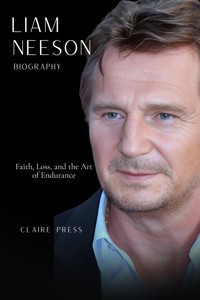
Liam Neeson Biography
Faith, Loss, and the Art of Endurance
CLAIRE PRESS
Table of Content
Copyright3
Preface4
Introduction6
Chapter 1: Roots in Ballymena10
Chapter 2: Finding the Stage16
Chapter 3: First Steps into Film23
Chapter 4: A Quiet Ascent30
Chapter 5: The Weight of Conscience36
Chapter 6: Stage and Stardom42
Chapter 7: Myth and Modernity48
Chapter 8: After the Fall55
Chapter 9: The Reluctant Warrior61
Chapter 10: The Strength to Endure68
Conclusion74
Copyright
All rights reserved.
Copyright © 2025 by Claire Press.
Preface
I decided to write this book when I wondered how one man could move through such deep private loss and still stand before the world as a symbol of dignity. Liam Neeson’s quiet strength, his ability to embody courage without vanity, seemed to hold a kind of truth that went beyond his profession.
This is an unauthorized biography, drawn entirely from public sources: decades of interviews, film archives, profiles, news accounts, recorded speeches, and historical records. Every story, every quotation, was examined not for gossip but for insight into the man who has spent a lifetime balancing faith, discipline, and grief.
My goal was not to glorify an actor’s fame, but to understand how a boy from Ballymena became one of the last performers whose humanity could not be separated from his craft. I have followed his journey across continents and decades, tracing how silence, patience, and endurance shaped both his life and his art. This is a study of survival and grace in an age that rewards noise. It asks readers to slow down, to look, to listen. This book is my invitation to walk beside Liam Neeson, through darkness and light, in search of what it truly means to endure.
Introduction
Liam Neeson’s life reads like his best performances: marked by quiet resilience, moral gravity, and unexpected transformation. His journey began in the modest town of Ballymena, County Antrim, where the winds carried the rhythms of old faith and the hard edges of division. Born in 1952 to Barnard “Barney” Neeson, a school caretaker, and Katherine “Kitty” Brown, a school cook, he grew up in a home defined by simplicity and discipline. His early life was shaped by the dual forces that would later define his art: endurance and conscience. Northern Ireland in the 1950s and 60s was a place of beauty shadowed by unrest, a country learning to live with tension in its bones. For a sensitive boy who noticed everything, those years left a permanent mark.
At school, Neeson’s size made him a boxer, but his mind made him a thinker. In the ring, he learned control—how to measure space, patience, and timing. Those instincts would later serve him in front of a camera, where silence often spoke louder than speech. Acting came to him by chance, first as a classroom task, then as a revelation. On stage he found what boxing never offered: the freedom to express fear and gentleness without shame. That discovery, made in his teens, changed the course of his life.
His path took him from student stages at Queen’s University Belfast to the Lyric Players Theatre, and then to Dublin’s Abbey Theatre, where he began to refine his craft with dedication and modesty. For years, he was a working actor, not a star, learning to see every role as a test of truth. Then, in 1981, Excalibur gave him his first taste of international cinema. Hollywood came slowly after that, and when it did, it did not find him eager to please. In an era of glitter and speed, Neeson stood apart—quiet, grave, and deliberate.
The 1990s turned him into something more than an actor. Steven Spielberg’s Schindler’s List in 1993 revealed a depth that astonished even those who had followed his rise. His Oskar Schindler was complex, tormented, and human—a reflection of the same dualities that had shaped him since Ballymena. Fame arrived, but he wore it lightly. To him, work was still labor, not glory.
Then came loss. The tragic death of his wife, Natasha Richardson, in 2009 altered the rhythm of his life. Grief could have broken him, but instead it deepened him. He kept working—not to escape, but to endure. The Taken films, which began the year before her accident, became a surprising outlet for resilience. Millions around the world saw in his characters a reflection of survival and purpose, a man still fighting to protect what mattered.
Neeson’s career has spanned theatre, historical epics, and action hits, but its heart has always been moral inquiry. What does it mean to be good? Where does strength end and compassion begin? Across decades of shifting culture—from the art-house seriousness of the 80s to the blockbuster machine of the 2000s to the modern streaming age—he remained a figure of gravity. He never chased fame’s flash or softened his instincts for the market. Instead, he offered audiences something harder to define but hugely rare: sincerity.
From Ballymena’s classrooms to global stages, Neeson’s story is not about reinvention for its own sake. It is about finding grace inside struggle, and power within restraint. His life, like his performances, reminds us that greatness often comes not from noise, but from quiet certainty of purpose.
Chapter 1: Roots in Ballymena
Before the fame and the film cameras, Liam Neeson was a boy in Ballymena who fought with his fists and dreamed with his heart. He was born on June 7, 1952, in County Antrim, the third of four children to Barnard "Barney" Neeson, the local caretaker for Ballymena Boys’ School, and Katherine "Kitty" Brown, who worked as a school cook. Their lives were modest, defined by routine and duty. Liam grew up in a small house that felt safe and modest, where faith, work, and decency were unspoken rules rather than loud declarations. The Neesons were an ordinary Catholic family living in a largely Protestant town during a time when difference was both noticed and quietly weighed.
The Ballymena of the 1950s was a town living between two times: the postwar years of austerity and the early tremors of Northern Ireland’s unrest. Streets were lined with linen mills, small shops, tight communities, and undercurrents of unspoken tension. For a boy like Liam, who listened more than he spoke, every glance told a story. He learned early the art of measuring people—the same instinct that would later help him read a scene, a room, or a character. His father’s quiet endurance shaped his understanding of strength. His mother’s warmth and unshakeable Catholic faith gave him emotional gravity. It was she who passed to him a belief in the sanctity of work and kindness, small things done well.
At St. Patrick’s Primary School, Liam discovered two things that would anchor him: a fascination with figures of moral courage and a growing love for stories that revealed it. He admired Martin Luther King Jr., whose words about peace and justice found their way even into the divided air of Ballymena. This admiration reflected something stirring within the boy—a yearning to understand the difference between courage and violence, strength and cruelty. Outside of the classroom, he found a second education in the boxing ring.
He began boxing at the age of nine, coached in the small gyms of County Antrim. For nearly a decade, he competed across Northern Ireland, collecting trophies and bruises with equal measure. Boxing taught him control, patience, and endurance. It also offered a shape to his restless energy. But each fight carried unease, too. He knew the excitement of the ring, the rush of the crowd’s cheers, but afterward, when he sat alone, he often asked himself what it was all for. That quiet questioning made him unlike many boys his age, who took pride only in winning. Even then, Liam was grappling with what strength really meant.




