


4,49 €
Mehr erfahren.
- Herausgeber: Claire press
- Kategorie: Sachliteratur, Reportagen, Biografien
- Sprache: Englisch
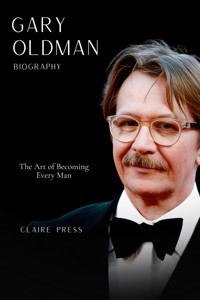
Discover the extraordinary life of Gary Oldman…
For more than four decades, Gary Oldman has been the ultimate acting chameleon. From explosive punk icons to haunted spies and towering statesmen, he has vanished into roles with such conviction that the man himself often disappeared from view. Yet behind those transformations lies an incredible true story of grit, survival, and reinvention.
Born into a working‑class London family and shaped by his father’s absence, Oldman climbed from council‑estate poverty to the radical British stage, forging a style built on empathy rather than ego. He burst onto the screen with electric turns as Sid Vicious and Joe Orton, then stormed Hollywood as a feared “character actor,” redefining villains and misfits in films like Léon, Bram Stoker’s Dracula, and Air Force One.
Off camera, he battled alcoholism, endured public and private turmoil, and then rebuilt his life in sobriety—emerging as a calm, fiercely prepared elder statesman of his craft. From Sirius Black and Commissioner Gordon to his Oscar‑winning Winston Churchill and his late‑career triumph in Slow Horses, Oldman’s journey is one of continual transformation.
Discover a plethora of topics such as
East End Beginnings
The Stage of Becoming
Sid and Substance
Hollywood Outsider
Churchill and Afterglow
Legacy in Motion
And much more!
So if you want a concise and informative book on Gary Oldman, simply scroll up and click the "Buy now" button for instant access!
Das E-Book können Sie in Legimi-Apps oder einer beliebigen App lesen, die das folgende Format unterstützen:
Veröffentlichungsjahr: 2025
Ähnliche




Gary Oldman
Biography
The Art of Becoming Every Man
CLAIRE PRESS
Table of Content
Preface 4
Introduction 6
Chapter1: EastEndBeginnings 9
Chapter2: The Stage of Becoming 15
Chapter3: Sid and Substance 21
Chapter4: HollywoodOutsider 28
Chapter5: Blood and Transformation 34
Chapter 6: The Calm After Storms 40
Chapter 7: Prestige and Paradox 46
Chapter 8: Churchill and Afterglow 53
Chapter 9: Reinvention in Reflection 60
Chapter 10: Legacy in Motion 67
Conclusion 73
Copyright
All rights reserved.
Copyright © 2025 by Claire Press.
Preface
I decided to write this book when I realized how one man could inhabit so many lives with such conviction and still remain, at his core, a mystery. Gary Leonard Oldman has spent more than four decades vanishing into other people’s histories and heartbreaks, building a career on empathy rather than ego.
This is an unauthorized biography, drawn entirely from public sources: decades of interviews, feature profiles, documentaries, correspondence, public lectures, archival footage, and the recollections of collaborators who witnessed the precision and volatility that define his work. My goal was not to catalogue fame or controversy, but to trace the thread between the shy boy from Deptford and the actor who became cinema’s ultimate shape-shifter.
Each performance in this story is placed in sharp relief against the world that shaped it, from the crumbling council estates of postwar London to the global machinery of modern Hollywood. What emerges is a portrait of a man who never stopped asking what truth looks like when it hides behind a mask. This book invites you to walk beside him, through every transformation, to discover the artist who taught us that becoming others is sometimes the only way to find oneself.
Introduction
Before Gary Oldman was known as cinema’s ultimate chameleon, he was a restless boy from South London with a voice that would one day echo through Hollywood. He was born on March 21, 1958, in New Cross, a district bisected by the sounds of dockyards and buses, to Kathleen and Leonard Oldman. His father, a sailor turned welder, left when Gary was seven, disappearing into the distance like a figure swallowed by smoke. The absence shaped him long before he could understand it. It taught him what silence meant and what imagination was for.
His mother worked tirelessly to hold the household together. Kathleen’s small wages stretched across rent, uniforms, and the endless repairs of life. The family lived in the scrappy post-war estates of South London, those concrete blocks that held more stories than bricks. Poverty was not romantic. It was constant improvisation. Gary would later say that acting felt natural because he had watched endurance performed daily by the ordinary people around him. The weight of working-class survival became part of his instinct.
Music was his first escape. As a boy he fell under the spell of The Beatles. Their records spun within those small rooms like openings into another life. He studied their accents and gestures, already learning the art of mimicry. That curiosity widened into cinema. At thirteen, he saw Malcolm McDowell in The Raging Moon (1971) and felt the world tilt. McDowell played a man confined by a wheelchair, both angry and alive. For Oldman, it was not just a performance but a revelation. Here was proof that emotion could be art, that the inner world of a man could fill a screen. In that dark theater he sensed a path flicker within him.
He left school at sixteen, feeling both clever and lost. He worked in sports shops, selling tennis rackets and cricket balls, watching customers more than he spoke to them. Observation became his first discipline. Every face was a lesson, every habit a detail to be borrowed later. Acting was already in motion, though he had not yet called it that.
When he finally auditioned for the Royal Academy of Dramatic Art, he was rejected. They advised him to pursue another career. Such rejection might have ended most young dreams, but for Oldman it only clarified his purpose. Determination was his revenge. He turned to Rose Bruford College in Sidcup, where tuition was cheaper and ambition less polished. There, between 1976 and 1979, he immersed himself in movement, voice training, and theory. His instructors noticed an intensity uncommon in students his age—a mix of discipline and agitation that seemed to come from a deeper urgency.
By the time he graduated with a BA in Acting, he was known not just for talent but for his seriousness. He joined fringe theatre companies in London, drawn to radical and political productions that mirrored the unrest of Britain’s streets. The stages were small, audiences smaller, but each performance taught him what would guide an entire career: honesty mattered more than glamour.
Gary Oldman’s beginnings did not produce confidence. They produced necessity. Out of hardship and hunger, he forged not pride but compulsion—a need to disappear into someone else.
Chapter1: EastEndBeginnings
In the backstreets of South London during the 1960s, Gary Leonard Oldman learned early that silence could keep you safe. Raised amid the cracked pavements and shouting pubs of Deptford, he absorbed everything around him—the clatter of factories, the thin laughter of neighbors, the smell of ale and diesel in the air. Life was tough but familiar. The city’s rhythm, raw and unpredictable, became the backdrop for his imagination. It was a place where a small boy could observe entire worlds without ever leaving the street corner.
Gary was born on March 21, 1958, to Leonard and Kathleen Oldman. Leonard was a sailor turned welder who drank too much and came home less and less. When Gary was seven, his father left for good. The memory stayed fixed in him: the sound of the door shutting, the growing quiet that followed. For a child, silence can be confusing. It is both punishment and protection. He would later say that he never learned anger from his father, only absence. That absence became the shape of his drive.
Kathleen carried the family alone. She worked two jobs, first as a housekeeper and then at a print factory, determined to keep food on the table for Gary and his two sisters. Nights were long; exhaustion was normal. Yet in that constant struggle, Gary saw a fierce dignity. His mother was small and gentle, but she carried herself with a quiet will that would later echo in many of his performances. The women in his early life—his mother, his teachers, his neighbors—became the first characters he studied. Each movement, each hesitation, each flash of humor stayed in him like lines in a script.
At West Greenwich Community School, Gary stood apart. He was bright in English and literature but indifferent to authority. Teachers saw intelligence wrapped in restlessness. He could memorize entire passages from plays or poems, then turn around and flout the rules for the thrill of it. Discipline felt foreign to him, a thing imposed from above. Perhaps that was the lingering shadow of his father’s abandonment, a private rebellion against being controlled. He once said that imagination was his first refuge and the only power that felt truly his.




