


4,49 €
Mehr erfahren.
- Herausgeber: Claire press
- Kategorie: Sachliteratur, Reportagen, Biografien
- Sprache: Englisch
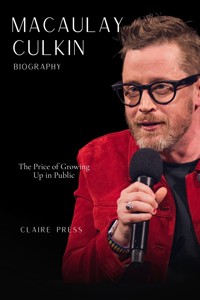
Discover the remarkable life of Macaulay Culkin
Macaulay Culkin’s face is etched into the memory of an entire generation. As the star of Home Alone, he became the world’s most famous child—an icon of Christmas, mischief, and 1990s nostalgia. But behind the bright lights and box-office records was a boy growing up in public, fighting to reclaim a life that was never really his own.
Born into a cramped New York apartment and pushed onto the stage by an ambitious father, Culkin went from anonymous child actor to global sensation almost overnight. This book traces his extraordinary journey: the rise, the fractures within his family, his quiet retreat from Hollywood, and his unexpected return on his own terms. Far from a simple “child star gone wrong” tale, it is the story of a man who transformed spectacle into survival, and fame into something he could finally live with.
Discover a plethora of topics such as
Born in the Spotlight
Home Alone Explosion
Family Fallout
Arrests and Reinventions
Bunny Ears and Balance
Fatherhood and Fulfillment
And much more!
If you want a concise and revealing look at Macaulay Culkin’s life—from overexposed child actor to self-possessed adult—simply scroll up and click the “Buy now” button for instant access!
Das E-Book können Sie in Legimi-Apps oder einer beliebigen App lesen, die das folgende Format unterstützen:
Veröffentlichungsjahr: 2025
Ähnliche




Macaulay Culkin Biography
The Price of Growing Up in Public
CLAIRE PRESS
Table of Contents
Copyright4
Preface5
Introduction7
Chapter 1: Born in the Spotlight12
Chapter 2: Scene-Stealing Beginner18
Chapter 3: Home Alone Explosion24
Chapter 4: Burden of Fame30
Chapter 5: Family Fallout36
Chapter 6: Love and Lost Youth42
Chapter 7: Arrests and Reinventions48
Chapter 8: Toy Stories and Comedy Troops54
Chapter 9: Bunny Ears and Balance60
Chapter 10: Fatherhood and Fulfillment66
Conclusion72
Copyright
All rights reserved.
Copyright © 2025 by Claire Press.
Preface
I decided to write this book when I realized that Macaulay Culkin’s story was not about fame itself but about what happens after the lights go out, how a boy turned cultural symbol could quietly rebuild a life the world never expected him to have. His face was stamped on every poster of a generation, yet the man behind it remained half-hidden, as if choosing to live where memory could not reach him.
This is an unauthorized biography, drawn from decades of published interviews, court filings, archival journalism, documentaries, podcast recordings, public appearances, and conversations he himself has put into the world. Every page is built from evidence in plain sight, pieced together to understand a man who learned to transform spectacle into silence and survival.
My goal was not to retell gossip or measure success by fame, but to understand how childhood stardom shaped an adult determined to live on his own terms. It is neither a defense nor an exposé; it is a portrait of endurance, humor, and reclamation. So come closer. This book traces the long, curious journey of a performer who discovered that the greatest role he would ever play was simply being himself.
Introduction
One of the world’s most recognizable child faces grew up watching himself on every screen but almost lost himself behind them.
For anyone coming of age in the early 1990s, the face of Macaulay Culkin is an image etched in collective memory. The wide blue eyes, the snow-lit house, the scream framed between two small hands—it was innocence, rebellion, and Christmas joy captured in one moment.
Home Alone, released in November 1990, became a cinematic ritual, a movie that children stretched across generations would come to know by heart. Its young star became a kind of cultural property, wrapped in affection he could not refuse and expectations he could not possibly meet. Beneath the laughter, his life revealed the darker truth of child fame in America: the price of being everyone’s favorite son when you are barely old enough to tie your own shoes.
Macaulay Culkin was born in New York City on August 26, 1980, the third of seven children squeezed into a tiny apartment on the Upper East Side. His father, Kit Culkin, once an aspiring stage actor, carried the ghosts of Broadway ambition, while his mother, Patricia Brentrup, managed the chaos that comes with raising a large family with limited income. Macaulay’s very birth took place amid hustle and strain. There was never quite enough money, never enough space, but there was always theater. The Culkin household might have been poor in comfort but rich in dreams.
His films—Rocket Gibraltar in 1988, Uncle Buck in 1989, and the unforgettable Home Alone—arrived just as American cinema was recalibrating its relationship to family entertainment. The 1980s had given rise to commercial franchises built on innocence and merchandising: E.T., Gremlins, Back to the Future. John Hughes, the writer and director who discovered him, understood the delicate line between sentiment and rebellion that made a child protagonist resonate with adult audiences.
When the movie shattered box-office records, grossing hundreds of millions worldwide, Macaulay’s life spun at an impossible velocity. Photo shoots replaced school. Private jets replaced playgrounds. In a culture hungry to romanticize celebrity youth, the Culkin family became tabloid material overnight. Yet behind the flashbulbs was a boy who watched adults remake his childhood into myth. Hollywood could not imagine him aging. Every time he grew taller or his voice deepened, the illusion cracked a little. For the studios, he was the perfect Christmas ornament—shiny, unchanging, and profitable. For the child himself, it was a kind of imprisonment dressed as wonder.
His early career coincided with the last gasp of an era when studios could truly manufacture stars. The 1990s would soon see that machinery break down under its own weight. The very industry that made him would later find it impossible to protect him.
Interviews captured the irony: a child seemingly wise beyond his years, joking with adults twice his age, his wit both charming and uneasy. Audiences laughed because they recognized something uncanny in him. He was a mirror held up to the absurd dream factory that had built him.
As the decade wore on, the cost of that dream revealed itself. His parents’ marriage fractured under pressure and money. The legal fights over his earnings turned the court system into another stage. The child of the world’s most popular family comedy became a headline in a brutal domestic spectacle played for the same audience that once cheered his adventures on screen. By the mid-1990s, Macaulay withdrew completely from acting.
To the tabloids, his disappearance signaled tragedy, the inevitable fall of another child star. To him, it was liberation. In the silence that followed, he began to build what most people his age took for granted: friendships, education, love, and privacy.
In adulthood, he reemerged into a culture that had finally learned to question its obsession with fame. The rise of social media and digital irony made room for a new kind of self-aware celebrity, one that could parody and critique the image machine from inside. Macaulay understood this space intuitively. His Pizza Underground band, his podcast Bunny Ears, and his later creative projects all reflected that blend of humor and distance.
Yet beneath the jokes and eccentricity was something deeper: a man who had fought to reclaim the right to define himself. He learned that laughter could be both weapon and medicine. He transformed the very culture that had once devoured him into his canvas, turning absurdity into art.
The story of Macaulay Culkin is not about loss. It is about balance: between laughter and pain, privacy and performance, memory and renewal. His journey from a tiny New York apartment to Hollywood superstardom and back to quiet fatherhood is a portrait of what survival looks like in the age of spectacle. He stands now as proof that the child who once lit up the Christmas screen did not vanish. He grew up. He found peace not in the applause but in the silence that follows it.
Chapter 1: Born in the Spotlight
Before cameras ever found him, Macaulay Culkin’s story began in a crowded New York apartment brimming with ambition and noise.
He was born on August 26, 1980, in Manhattan, the third of seven children to Christopher Cornelius “Kit” Culkin and Patricia Brentrup. The Culkin clan lived on the Upper East Side in a narrow railroad apartment, the kind of place where the kitchen doubled as a hallway and privacy was a rare luxury. Space was scarce, but energy was not. Children laughed, argued, and rehearsed made-up plays while the city hummed beyond thin walls. For a boy who would one day be recognized everywhere, Macaulay’s world began in a crushed maze of rooms that forced everyone to overlap, compete, and perform.
His father, Kit, had once tasted the world he wanted for his son. As a younger man, he had worked as a stage actor and understudy for key productions on Broadway, standing in the wings of celebrated plays. That nearness to fame became both blessing and ghost for him. When his own career slowed, he carried both pride and frustration home each night, convinced his children could fulfill the dream he felt slipping away. His mother, Patricia, managed the daily storm of laundry, laughter, and chaos, while holding a steady job to keep the lights on. Kit thought about art; Patricia thought about dinner and rent. Together they kept the household moving forward on stubborn love and minimal funds.
New York City in the early 1980s was an odd laboratory for ambition. The entertainment world was bursting with opportunities, especially for children who could charm a camera. Agencies scouted commercials, theatre workshops multiplied, and television sought young faces for a growing stream of family movies and sitcoms. Inside that mix, the Culkin family’s financial struggles sharpened their drive. The rent kept climbing, neighborhood corners grew rougher, and food sometimes felt like a daily challenge. Kit began to see performing not only as artistic expression but as survival. He still held some contacts from his days in the theater. He began calling old acquaintances, looking for a way in for his children.




