


4,49 €
Mehr erfahren.
- Herausgeber: Claire press
- Kategorie: Sachliteratur, Reportagen, Biografien
- Sprache: Englisch
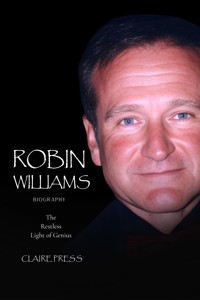
Discover the extraordinary life of Robin Williams…
Robin Williams burst into the world of entertainment like a supernova—brilliant, uncontainable, and unforgettable. His lightning-fast improvisations, boundless empathy, and unmistakable voice shaped a generation and redefined what comedy could be. But behind the laughter lived a man wrestling with joy, fear, tenderness, and a restless search for belonging.
From his childhood spent navigating loneliness with imagination, to his meteoric rise as Mork from Ork, to the profound dramatic roles that earned him an Academy Award, Robin’s journey was an intricate dance between light and shadow. This book explores the many layers of the man the world adored—his genius, his vulnerability, and the private battles he carried with remarkable grace.
You’ll discover insights on topics such as:
- Roots in Two Worlds
- The Student Hurricane at Juilliard
- Mork from Another Planet
- Finding the Deeper Voice
- The Oscar and the Weight
- The Final Curtain
So if you want a concise and emotionally rich biography of Robin Williams, simply scroll up and click the “Buy now” button for instant access!
Das E-Book können Sie in Legimi-Apps oder einer beliebigen App lesen, die das folgende Format unterstützen:
Veröffentlichungsjahr: 2025
Ähnliche




Robin Williams
Biography
The Restless Light of Genius
Claire Press
Table of Contents
Copyright
Preface
Introduction
Chapter 1: Roots in Two Worlds
Chapter 2: The Student Hurricane
Chapter 3: Mork from Another Planet
Chapter 4: Finding the Deeper Voice
Chapter 5: A Genie and a Doubt
Chapter 6: The Oscar and the Weight
Chapter 7: Shadows in the Mirror
Chapter 8: The Final Curtain
Chapter 9: Echoes of Laughter
Chapter 10: The Light That Remains
Conclusion
Copyright
Copyright © 2025 by Claire Press
All rights reserved.
Cover design by Claire Press. No part of this book may be reproduced in any form or by any electronic or mechanical means, including information storage and retrieval systems, without written permission from the author, except for the use of brief quotations in a book review.
Preface
I decided to write this book when I realized how one man could turn his deepest pain into a language that made millions of strangers feel understood. Robin Williams fascinated me because his life was an act of translation—transforming isolation into warmth, fear into laughter, and imagination into refuge.
This is an unauthorized biography, built from decades of interviews, archived footage, press profiles, stage performances, public records, and the words of those who knew him best. Every detail is drawn from the public life he shared so openly and the quieter evidence of what it cost him. My goal was not to glorify or mourn Robin Williams, but to explore how a singular soul fought to balance light and darkness in a world that demanded constant brightness.
His story is not only about genius or tragedy, but about the fragile, universal need to belong—to be seen, to be loved, and to matter. What follows is the journey of a man who carried the burden of other people’s happiness until it became both his gift and his undoing. This book invites you to walk beside him, through the laughter and the silence, and discover the real heartbeat behind the legend.
Introduction
Robin Williams lived like lightning—brilliant, unpredictable, and gone too soon, but his energy still crackles through every memory he left behind. Even now, years after his death, his voice can still be heard in a thousand forms: a genie set free, a teacher whispering “carpe diem,” a doctor who treats despair with laughter, a comic on stage chasing the next laugh like oxygen. To remember him is to feel movement, a pulse that refuses to rest. Robin was never still for long, not in life, not in art, not even in grief.
He was born with both tenderness and velocity, raised between comfort and solitude. The boy from Chicago and Marin County grew up learning the strange mathematics of loneliness, how humor could turn isolation into connection. In silence, he created worlds. In noise, he found belonging. That act of transformation became the through-line of his life. He was never simply chasing laughter for laughter’s sake. He was chasing relief, the moment when understanding replaced pain, when joy felt possible again for himself and everyone watching.
Robin carried contradiction inside him with the delicacy of a tightrope walker. Off stage, he was quiet, courteous, sometimes shy. On stage, he became a force of nature, his mind racing faster than anyone could keep up. The speed frightened people at first. They assumed it came from mania alone, but those who knew him best understood it was something deeper. His hyperactivity was empathy in motion. He could feel a crowd’s rhythm like a heartbeat and would change his tempo to match their need. That was his genius and his burden, the inability to turn it off.
By the time television and film discovered him, the world was ready for his kind of revolution. The late 1970s were an age of political fatigue and cultural reawakening. America was emerging from decades of war and scandal, searching for sincerity but desperate for escape. Robin offered both. As “Mork from Ork,” the alien who arrived simply to observe human folly, he held up a mirror to a nation ready to laugh at itself again. The energy was contagious. He wasn’t just a comedian but a barometer of feeling, translating confusion and fear into a language of joy.
Yet behind every eruption of laughter was a man still negotiating what it meant to exist at that speed. Fame arrived like a shockwave. Hollywood was not built for slow introspection in that era. It demanded output, spectacle, profit. Robin gave it all three, often at the expense of calm. The very things that made him extraordinary, his intuition, his compassion, his unfiltered imagination made the life of a traditional celebrity impossible. He could improvise better than almost anyone alive, yet he struggled to improvise safety within a system that consumed creativity as fuel.
Through it all, his need for purpose kept expanding. He evolved from television whirlwind to film actor, from the anarchic comedian of Good Morning, Vietnam to the aching humanist of Good Will Hunting. Critics sometimes doubted the sincerity of his dramatic performances, as if kindness itself were theatrical. But those who watched him closely could see how the serious roles allowed him to reveal what he had always hidden behind humor: the cost of feeling everything. His art was an attempt at balance, a dialogue between the world’s noise and his own silence.




