


4,49 €
Mehr erfahren.
- Herausgeber: Claire press
- Kategorie: Sachliteratur, Reportagen, Biografien
- Sprache: Englisch
Discover the untold story of Pamela Anderson...
Pamela Anderson exploded into global fame as the face of Baywatch and one of the most photographed women in the world. Her image defined an era, but behind the slow‑motion run and glossy magazine covers is a far more complex story—of childhood vulnerability, brutal public scrutiny, radical reinvention, and, ultimately, hard‑won peace.
Drawing on decades of interviews, public records, and Pamela’s own words, this book follows her from shy Canadian girl to cultural icon and outspoken activist. You’ll see how she navigated the highest peaks of celebrity and some of its darkest costs, and how she finally reclaimed the narrative that had long been written for her.
Discover a wealth of topics such as
Growing up on Vancouver Island and the early experiences that shaped her
Playboy, Baywatch, and the making of a 1990s sex symbol
Marriage to Tommy Lee, the stolen tape, and the heavy price of fame
Illness, reinvention, and turning notoriety into activism
Politics, Julian Assange, and life between Hollywood and Europe
Homecoming, motherhood, and the woman revealed in Love, Pamela
And much more!
So if you want a concise and compelling book on Pamela Anderson, simply scroll up and click the “Buy now” button for instant access!
Das E-Book können Sie in Legimi-Apps oder einer beliebigen App lesen, die das folgende Format unterstützen:
Veröffentlichungsjahr: 2025
Ähnliche














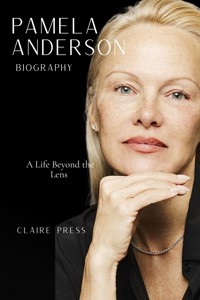
Pamela Anderson
Biography
A Life Beyond the Lens
CLAIRE PRESS
Table of Content
Copyright
Preface
Introduction
Chapter 1: Caught by the Camera
Chapter 2: The Playmate and the Beach
Chapter3: Love on Fast Forward
Chapter4: Running Through Fire
Chapter5: Activist in the Flesh
Chapter6: Reality and Return
Chapter7: Love, Politics, and Refuge
Chapter8: Revisiting the Myth
Chapter9: Homecoming to Herself
Chapter10: Still Wild, Still True
Conclusion
Copyright
All rights reserved.
Copyright © 2025 by Claire Press.
Preface
I decided to write this book when I realized that Pamela Anderson’s story was never really her own—it had been told through flashes, gossip, and stolen glances, but rarely through understanding. How does a woman who became one of the most photographed faces on earth reclaim her humanity after decades of being defined by image? This is an unauthorized biography, built from public materials that trace those answers: thousands of interviews, magazine archives, court records, documentaries, televised appearances, and her own writings and reflections.
Each fragment has been carefully shaped into a narrative that connects the girl from Vancouver Island to the cultural phenomenon who learned to turn vulnerability into power. My goal was not to recycle scandal or revive nostalgia, but to understand how evolution, heartbreak, and courage created one of popular culture’s most misunderstood figures.
Hers is not the story of a perfect icon, but of a survivor who kept reinventing herself until truth became her greatest performance. She has lived inside the world’s gaze and found meaning beyond it. This book is my attempt to walk alongside her—for every reinvention, every silence, every flash of grace—and discover the woman she finally let herself become.
Introduction
Before she was a global icon, Pamela Denise Anderson was a shy girl from a small Canadian island who learned early that beauty could open doors and cages at the same time. She was born on July 1, 1967, in Ladysmith, British Columbia, during Canada’s centennial celebrations. The fireworks that night seemed prophetic, though no one in the modest hospital room could have imagined what her name would one day mean to millions.
Her parents, Barry and Carol Anderson, worked hard but lived close to the edge of poverty. Barry repaired furnaces; Carol worked shifts as a waitress, juggling family duties with exhaustion. Their house, set near the rugged coast of Vancouver Island, was small but warm. Pamela and her younger brother Gerry learned early the rhythm of instability—days of laughter followed by arguments over bills and long silences after. That unpredictability shaped her. It made her sensitive, watchful, someone who paid attention to tone and detail the way an actor studies a face before turning it into art.
Vancouver Island itself was her first escape and education. Surrounded by ocean, mountains, and endless sky, Pamela grew up aware of her smallness in the world. She climbed trees, swam in cold rivers, and loved animals with a fierce protectiveness that would follow her into adulthood. Yet within this beauty was a current of fear. She would later speak of the trauma she experienced as a child and how it carved into her an early understanding of vulnerability. These contradictions—light and dark, wonder and wariness—became the emotional chords of her life.
School brought structure and a glimpse of safety. At Highland Secondary in Comox, she excelled in gymnastics and field sports. Classmates remembered her as quiet yet magnetic, the girl others gravitated toward without knowing why. She was gifted at drawing and had a natural curiosity about fashion. Teachers described her as polite but distracted, as if imagining a bigger world behind the classroom windows. Pamela often hid her shyness under humor, deflecting attention rather than seeking it.
Her first job was far from glamour. As a teenager she worked as a fitness instructor, teaching aerobics in a small studio where attendance rarely filled the room. The work demanded confidence she did not yet feel, but each class taught her presence. Standing in front of strangers, leading them through movement, she discovered control through motion. It was a lesson she would return to repeatedly in her career—the idea that command over one’s body could become a kind of voice.
Even before fame, Pamela’s spark was visible. Friends from her youth recall moments when the world seemed to pause around her. At community events or small-town fairs, people noticed her charisma. She was not boastful; it was a quiet magnetism, the kind that made everyone else lean in. The island was not a place that valued dreams beyond its shores, yet Pamela’s imagination was already outgrowing its limits.
In those years, she did not chase visibility. The idea of fame seemed foreign, almost absurd. She loved movies, but she watched them more for story than aspiration. Still, there were glimmers of what was coming. She cut and styled her own hair, dabbled with makeup, and experimented with camera poses. There was joy in transformation, in the possibility of becoming someone else, even for a moment. That small thrill would later become her art and defense combined.
By the late 1980s, Pamela was living a modest life in Vancouver. She had drifted there on instinct, like many island dreamers seeking something undefined. She worked part-time jobs, met photographers shooting commercials, and learned to navigate the city’s pace. There were still no grand ambitions. That would come unexpectedly at a single football game in 1989.
On that day, the BC Lions were playing at BC Place Stadium in Vancouver. Pamela joined friends in the crowd, wearing a blue Labatt’s Beer T-shirt. During a break in the game, a cameraman panned to her face, projecting it onto the Jumbotron above the field. The crowd erupted. Her smile filled the massive screen, radiant and unguarded, the kind of moment publicity machines spend lifetimes chasing but never replicating. Within weeks, Labatt’s executives called her. They wanted her to appear in advertisements as the “Blue Zone Girl.”
The event was so unlikely that it read like a myth, but it was the exact kind of coincidence that often defines great cultural stories. For Pamela, it was both invitation and test. The girl who had spent her youth blending into the background was suddenly the center of attention. Her photograph appeared everywhere across Canada, turning her into a local celebrity almost overnight. People approached her in grocery stores. Men stared; women whispered; friends alternated between awe and concern. She thanked everyone politely, still unsure what any of it meant.
Inside, she was fascinated and frightened. The camera had given her visibility, but she could already sense its hunger. Attention had a cost. And yet she could not resist the pull of the unknown. When Playboy magazine contacted her later that year, offering to fly her to Los Angeles for a test shoot, she hesitated only briefly. Her life up until then had been survival and adaptation; this was something else entirely.
Pamela Anderson did not plan for fame. It found her like a flash of light and would follow her for decades. The girl from the island, quiet and observant, was about to step into the world’s imagination and discover how easily admiration can turn into possession.
The girl who never imagined fame was about to be discovered by accident, and everything would change overnight.




