


19,99 €
Mehr erfahren.
- Herausgeber: John Wiley & Sons
- Kategorie: Fachliteratur
- Sprache: Englisch
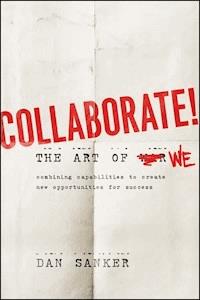
The hands-on guide for the new way to compete: Collaboration
The 21st Century's counterpart to Sun Tzu’s The Art of War, Dan Sanker's Collaborate: The Art of We gives a new generation of pioneering business enthusiasts a practical guide to capture tomorrow's opportunities. Globalization, technological advances, and cultural changes have opened the door for a new winning formula that combines traditional competition with contemporary collaborative business practices. Readers will change their mindsets and learn practical tools to tap into talent, overcome organizational obstacles, and create dramatic incremental value by collaborating between organizations.
While most businesses are battling it out for crumbs of market share, the author gives inside examples of emerging leaders who are staking claim to larger pieces of the economic pie. Intellectual honesty and proof-of-concept permeate throughout; even the book's own foreword was entrusted to a collaborative group of over 35 individual participants, a first of its kind and one more concrete example of the power of collaboration.
Sanker provides a comprehensive guide to collaboration from conception to implementation and analysis. He brings collaboration to life by:
- Exploring the opportunities created by dynamic online social tools being used by winning leaders
- Delving into examples from a plethora of traditional companies like Disney and McDonald's
-
Inviting readers behind the curtains to see the inner workings of collaborative emerging growth companies like CaseStack, the author’s company
Sie lesen das E-Book in den Legimi-Apps auf:
Seitenzahl: 298
Veröffentlichungsjahr: 2011
Ähnliche


















CONTENTS
Foreword
Preface
Introduction
1: What Collaboration Is and Isn’t
What Collaboration Is and What It Isn’t
The CaseStack Collaboration Experience: A Case Study
2: Dawn of the Knowledge-Based Collaborative Era
Where We’ve Been: From Industrial Revolution to Information Economy
Where We’re Going: The Knowledge-Based Economy
The New Economy Demands Innovation
A Bigger Piece of the Pie—Or an Entirely New Pie
Success in the Global Economy
If You Can’t Beat ’Em, Join ’Em
Internal Collaboration
Collaboration with Competitors
Collaboration with Customers
Collaboration and Competition
Outsourcing as a Collaborative Venture
3: The Collaboration Payoff
Collaborate for Efficiency, Productivity, and Sustainable Innovation
Business Benefits of Collaboration
4: Risks of Collaboration
Data Security
Intellectual Property
Legal and Antitrust Issues
Reputational Risks
Tight Time Constraints
Project Importance Not Worth the Effort
Little Chance of Significant Improvements or Achievements
Lack of Necessary Authority or Support
Lack of Sufficient Diversity
Misaligned Reasons for Participation
A Collaboration of Bad Guys
5: Collaboration Essentials
Increasing the Capabilities of Others
Shared Risks, Rewards, and Responsibilities
Essentials for Collaboration Success
6: Stages of Collaboration
The Stages of Collaboration: An Overview
Getting Started
Implementing the Plan
Evaluating the Outcome
7: Setting Up for Success
Assembling the Team
Defining and Aligning the Goal
Developing an Action Plan and Agreeing on a Working Process
8: Strategies for a Successful Collaboration
Keys to Successful Collaboration
How to Establish and Maintain Trust
Keeping the Communication Channels Open
Using Conflict Productively
Maintaining Commitment to the Project
Using Brainstorming to Generate High-Quality Ideas
Rules Help People Open Up
Getting Consensus on Decisions
9: The Role of Technology and Social Media in Collaboration
A Little History
The Collaborative Benefits of Cloud Computing
Mobility and Collaboration
The Collaborative Nature of Social Networking
Information Overload or Filter Failure?
A Look at the Tools
What Tools Do You Need?
Issues to Consider
Collaboration at GE
The Mayo Clinic
Collaboration and Organizational Culture
10: Fostering a Collaborative Culture in Your Organization
First Things First: Leadership
Best Practices
Afterword
References
About the Author
Index
Praise for Collaborate: The Art of We
“‘Too many cooks spoil the broth’—not if you read this book and follow Dan’s example. Done right, collaboration is the key to harnessing the benefits of open innovation—be it on an individual, corporate, or even national level.”
—Martin Ihrig The Wharton School, University of Pennsylvania; and I-Space Institute, LLC
“Every innovation stems from some external spark. The more you collaborate, the greater the chances of this happening. Dan gets this. Read this book and learn how you can MAKE this happen instead of waiting for it to happen TO YOU.”
—Matthew Graczyk CEO, Coupeez Inc.
“Dan lives by the rules of servant leadership that build the open, honest, and trusting foundation for collaboration. Sharing that in the book transforms his conduct into a world-changing pursuit.”
—Jeff Amerine Gravity Ventures
Copyright © 2012 by Dan Sanker. All rights reserved.
Published by Jossey-Bass
A Wiley Imprint
One Montgomery Street, Suite 1200, San Francisco, CA 94104-4594—www.josseybass.com
No part of this publication may be reproduced, stored in a retrieval system, or transmitted in any form or by any means, electronic, mechanical, photocopying, recording, scanning, or otherwise, except as permitted under Section 107 or 108 of the 1976 United States Copyright Act, without either the prior written permission of the publisher, or authorization through payment of the appropriate per-copy fee to the Copyright Clearance Center, Inc., 222 Rosewood Drive, Danvers, MA 01923, 978-750-8400, fax 978-646-8600, or on the Web at www.copyright.com. Requests to the publisher for permission should be addressed to the Permissions Department, John Wiley & Sons, Inc., 111 River Street, Hoboken, NJ 07030, 201-748-6011, fax 201-748-6008, or online at www.wiley.com/go/permissions.
Limit of Liability/Disclaimer of Warranty: While the publisher and author have used their best efforts in preparing this book, they make no representations or warranties with respect to the accuracy or completeness of the contents of this book and specifically disclaim any implied warranties of merchantability or fitness for a particular purpose. No warranty may be created or extended by sales representatives or written sales materials. The advice and strategies contained herein may not be suitable for your situation. You should consult with a professional where appropriate. Neither the publisher nor author shall be liable for any loss of profit or any other commercial damages, including but not limited to special, incidental, consequential, or other damages. Readers should be aware that Internet Web sites offered as citations and/or sources for further information may have changed or disappeared between the time this was written and when it is read.
Jossey-Bass books and products are available through most bookstores. To contact Jossey-Bass directly call our Customer Care Department within the U.S. at 800-956-7739, outside the U.S. at 317-572-3986, or fax 317-572-4002.
Wiley also publishes its books in a variety of electronic formats and by print-on-demand. Some material included with standard print versions of this book may not be included in e-books or in print-on-demand. If the version of this book that you purchased references media such as CD or DVD that was not included in your purchase, you may download this material at http://booksupport.wiley.com. For more information about Wiley products, visit www.wiley.com.
Library of Congress Cataloging-in-Publication Data
Sanker, Dan, 1965–
Collaborate : the art of we / Dan Sanker.
p. cm.
Includes bibliographical references and index.
ISBN 978-1-118-11472-8 (cloth); 978-1-118-18055-6 (ebk.);
978-1-118-18056-3 (ebk.); 978-1-118-18057-0 (ebk.)
1. Strategic alliances (Business) 2. Teams in the workplace.
3. Business networks. 4. Cooperativeness. I. Title.
HD69.S8S257 2012
658.4′022—dc23
2011043161
To Jane, Julian, and Jon, for putting up with my endless hours on my laptop when I should have been doing something more fun. I think this topic will be important to my boys, our associates, our investors, our customers, our partners—and, frankly, to our society.
FOREWORD
As far as we know, this is the first book foreword to be written as a collaborative effort—possibly proving that Tom Clancy was wrong when he said, “Collaboration on a book is the ultimate unnatural act.” A book foreword is usually an introductory section in which a “prominent person” discusses the author, the book, and the topic. From this book’s title alone, a reader can infer that the author, Dan Sanker, believes that the prominence of any individual is dwarfed by the prominence of the group. As a result, he has used a creative approach: asking people who he believes have helped him become a better practitioner of the art of collaboration to collaboratively write the book’s foreword. It was something of an example of what folks in the technology industry refer to as “dogfooding”—meaning “eating your own dog food,” as when a company actually uses the products that it makes. Other, more elegant people have referred to it as “ice-creaming” or “drinking your own champagne.” Regardless, the team’s goal was to collaboratively deliver a foreword that discussed the usual topics that publishers in the industry suggest:
The author’s qualifications for writing the bookThe special contributions the book makes to the fieldThe readers who will be interested in the book and whyThe ultimate significance of the bookInstead of the foreword being written by a great big muckety-muck, it has been developed in collaboration by a team using a wiki that the author popped up in about ten minutes.
It seems that most of us started with a somewhat negative impression of the highfalutin’ concept of collaboration. We thought of many examples of times when we were part of insincere corporate efforts that started with the notion of empowerment. Some of these seemed more like phony empowerment. Workplace participation can mean a lot of things, but regrettably, the promise of democratic involvement in the workplace is all too often a disguise for the same old authoritarian institutional structures. Very few organizations actually allow associates to really shape meaningful matters of policy. As a result, employees who are promised participatory opportunities usually become disenchanted. The concept is great—an alternative to the dehumanizing concept of the division of labor wherein workers or individuals are treated like robots. But it has to go beyond giving lip service to the idea and be real.
Many people have seen their companies or organizations invest in the latest and greatest in collaboration gadgets and gizmos, but most still feel that nobody is getting much from collaboration efforts. There are tales of investment, rollouts, training, upgrading, meetings, and more to achieve the nirvana promised by the collaborative model. There are anecdotes about costly investments in Microsoft SharePoint servers and IBM QuickPlace applications that, at the end of the process, usually become solely the province of a select group of technorati. It’s all enough to give the word “collaboration” a bad rep, along the lines of “We tried that once, but it seemed like waste of time.” We’ve also seen collaborative exercises that do seem to generate some results, only to end up with some of the worst collaborators getting involved and derailing progress.
On the flip side, we all have this inherent sense that collaboration is one important key to innovation in the world we are currently living in. Throughout history we see the big bodacious ideas coming from collaborative efforts.
Any business leaders who use historical references as a guidepost for their own personal and professional development can easily see how collaboration has shaped our world. History does tend to repeat itself. For example, we considered some of the world’s most influential people and found elements of collaboration almost everywhere that something actually worked. Would America exist as we know it without the Federalist Papers, which were created in collaboration among (as generally attributed) Alexander Hamilton, James Madison, and John Jay? The Federalist Papers are a series of eighty-five articles or essays promoting the ratification of the United States Constitution, without which the structure of America’s founding papers would be substantially different.
Collaboration is the basis for much of the foundational arts and sciences. It is often speculated that Shakespeare, like most playwrights of his period, did not always write alone, and many of his plays are considered collaborative or were revised after their original composition. Leonardo Da Vinci made his sketches individually, but he collaborated with other people to flesh out the finer details. For example, his sketches of human anatomy were a collaboration with Marcantonio della Torre, an anatomist from the University of Pavia. Their collaboration is important because it marries the artist with the scientist. Similarly, Marie Curie’s husband stopped his original research and joined Marie in hers. They went on to collaboratively discover radium, which overturned established ideas in physics and chemistry.
In the world of business, Jack Welch practiced collaboration at GE, championing the usefulness of constructive disagreement in reaching creative decisions. He had inherited a culture of what he called “superficial congeniality,” in which people didn’t tell each other the truth. Like Andy Grove at Intel, Welch recognized that conflict was inevitable in dealing with novel and complex decisions and that conflicting views contained information that needed to be harvested and incorporated into decisions. Before Grove and Welch, Lee Iacocca collaborated with designer Michael Leone and the Gaffoglio Family of metal crafters to customize what became known as “Iacocca Silver” Mustangs. Using the same collaborative methodologies, Iacocca headed the Statue of Liberty-Ellis Island Foundation, which raised funds to renovate and preserve the Statue of Liberty.
Lou Gerstner is credited with turning IBM around in the 1990s. He described the turnaround as difficult and often wrenching for an IBM culture that had become insular and balkanized. He moved the culture in a more collaborative direction. The company is currently home to over 426,000 employees, with revenues approaching $100 billion and assets exceeding $113 billion. It is arguable whether IBM would still exist without Gerstner’s collaborative changes.
Some have said that Oprah Winfrey may be the world’s most powerful woman. But she didn’t do it on her own. She has worked in collaboration on innumerable projects over her career. Oprah’s Angel Network has raised over $80 million to improve access to education, protect basic rights, create communities of support, and empower people to become leaders. Even Nelson Mandela, himself an incredible collaboration champion, praised Winfrey for overcoming her disadvantaged youth to become a benefactor for others.
Rosa Parks is known for her act of defiance that became an important symbol of the modern civil rights movement. She collaborated with civil rights leaders, including Martin Luther King, Jr., helping launch him to national prominence. Without the collaborative beginnings of the civil rights movement, our society might not look anything like it does today.
Then there are the dramatic innovations that we all use every day. For example, many of you will be reading this book on a device that wouldn’t exist without an early collaboration between Steve Jobs and Steve Wozniak. Wozniak’s engineering talent and Jobs’s ingenuity and marketing instincts started it all. Even the group writing this foreword used tools that wouldn’t exist if Mark Zuckerberg hadn’t formed the now-controversial collaboration with a few other important contributors in the early days of Facebook. And it is likely that none of us can go for long without using a search engine created in collaboration between Sergey Brin and Larry Page.
Dan’s book opens the door for everyone to become an innovator. Dan introduces an idea that is much needed and will have a ripple effect in today’s economic climate. Collaboration will help entrepreneurs get started, increase innovative technology, and help cut rising costs for everyone in the supply chain. The book allows readers to see every industry as a part of a whole. When two or more businesses put their cutthroat competitive ideals aside and come together, they can create new markets that could not have existed before.
Today’s global economy is getting ever faster, and the way business is conducted must be as efficient as possible. This book is timely because collaboration is no longer just a good idea. It is absolutely essential for businesses to thrive and grow in this time of economic survival of the fittest. Each chapter helps takes “collaboration” from a nice word to a powerful growth strategy. In a most entertaining and persuasive fashion, Dan exposes the false choice between being a shrewd competitor and a community builder. This book turns the conventional idea of competition on its head: it’s not about how many people you can defeat, but rather about how many people you can help win. It will shake the foundation of the business community. While most companies box it out in the same old ring, Dan shows us that the key to winning is lifting one another up. Dan and his book are definitive proof that collaboration is the only way to reach full potential, as a business, as a professional, and even as a human being. The real-life case studies presented here help us internalize how this kind of collaboration really works.
We all have a deep sense that collaborative environments deliver results. What we struggle with are ways to make collaboration a real and constructive thing in our organizations. The book is the tool that helps business leaders quickly and easily jump into game-changing mode and prepare themselves to capture tomorrow’s business opportunities.
It is a real pleasure to see that Dan has captured a portion of his collaborative model and life experiences on paper for others to learn and grow from. His professional successes as an entrepreneur and leader in numerous organizations qualify him as an expert on the subject. As we have worked directly with Dan over the years, it’s always been easy to leave each discussion motivated with a new perspective, renewed to try something innovative, and ready to face stubborn challenges. Now we’ve got the book!
Jeff Amerine
Robert Angstadt
Vatche Artinian
John F. Attanasio
Maggie Gorman Bell
Elizabeth K. Boch
Dan Borengasser
John Byrnes
Christopher Chomyn
Susan Gilliland Collier
Robert Decker
Greg B. Fleishman
Eric Freeman
Mark Goldstein
Matthew Graczyk
Carolyn Hughes
Kathryn Hunt-Miller
Dr. Martin Ihrig
Mark Jacobs
Steve Kampff
Abigail Kiefer
Dr. Thomas L. Lagö
Rich Lawrence
Jim Lollis
Kieron Loy
Michael D. Matteo, Jr.
Yasmine Omari
Shan Pesaru
Jim Phillips
Markita Rogers
Steven K. Rust
Damon Schechter
Michael Sevart
Jim Shankle
Aaron Stahl
Mark Stallcup
Kathryn Ullrich
Tom Verry
Eric Wolfe
Jay Wren
PREFACE
I was doing a guest lecture for an MBA class a few years ago when a student asked what I thought was the most important building block to a company’s success. My initial answer was “People—finding great people.” The student’s facial reaction was probably a lot like mine when I was in business school and some gray-haired CEO said something just like that. People—what?!
I could tell by her expression that she thought it was an insincere answer (which it was not). She also asked what I thought was our company’s competitive advantage, to which I responded, “The people, process, and technology to create collaborative solutions.” All the students’ facial expressions were pretty similar: Collaboration—what?! They brushed it off as a similarly insincere answer (which, again, it wasn’t).
That began my writing project!
I am the CEO and founder of CaseStack, a full-service logistics company that offers warehousing, transportation, and an award-winning tech platform. We’ve been fortunate to win a lot of recognition over the years for being part of a select group with attributes including fastest-growing company, best place to work, best technology, greenest, and many more. And lots of people have been trying to figure out our secret sauce, so I thought I would try to take away the mystery: collaboration is that sauce. If you are like many of the people we have worked with over the years, you too may have a quizzical look on your face upon reading that word. Therein lies the reason for the book: too many quizzical looks on too many faces. That translates into too many lost opportunities.
It’s my hope that this book makes my point. To put it in simple terms, collaboration is not some new-fangled idea, but it very much is newly important and enabled because of cultural and economic changes that are occurring related to technology and globalization. For the most part, we’ve all grown up and been trained in one primary business interaction methodology; competition. Ironically, my premise is that you will crush your competition if you develop and have access to another tool: collaboration.
Given that belief, it should come as no surprise that our company, CaseStack, is a successful experiment in collaboration. Ever since our founding in 1999, we have focused our efforts on collaboratively improving technology and customer-facing activities rather than making significant investments in buildings or trucks. More recently, even our hardware is cloud-based; that is, it resides on the Web rather than on our physical premises. Our cloud-based technology has been recognized many times for its ease of use, security, and functionality. Many of our key business partners could easily be misconstrued as competitors, but they are actually our closest allies. Our warehouse partners have integrated with us to the point that we often feel like we are the same company, and each partner has the highest certifications available in the industry. Our people work in their facilities; their people frequently use offices in ours. In addition, our most important service platforms have been developed with very large retailers who are not customers, vendors, or even partners in a legally documented sense; rather, they are co-collaborators. We’ll talk more about this, but for now, suffice it to say we all have these common goals: cutting costs, increasing efficiency, and improving service. All parties are doing what they are best at, and in aggregate we are able to deliver at the lowest possible cost with the highest possible service quality. Through collaboration, we have built a completely non-asset-based company in a traditionally asset-heavy industry, and our growth has proven the concept successful. I hope that, in the pages ahead, you will discover the nuances and power of collaboration: work with us and each other, and win.
Acknowledgment
I want to extend a special thanks to Susan Gilliland Collier for all of her help in contemplating and developing my thoughts about collaboration and its vast opportunities.
Lesen Sie weiter in der vollständigen Ausgabe!
Lesen Sie weiter in der vollständigen Ausgabe!
Lesen Sie weiter in der vollständigen Ausgabe!
Lesen Sie weiter in der vollständigen Ausgabe!
Lesen Sie weiter in der vollständigen Ausgabe!
Lesen Sie weiter in der vollständigen Ausgabe!
Lesen Sie weiter in der vollständigen Ausgabe!
Lesen Sie weiter in der vollständigen Ausgabe!
Lesen Sie weiter in der vollständigen Ausgabe!
Lesen Sie weiter in der vollständigen Ausgabe!
Lesen Sie weiter in der vollständigen Ausgabe!
Lesen Sie weiter in der vollständigen Ausgabe!
Lesen Sie weiter in der vollständigen Ausgabe!
Lesen Sie weiter in der vollständigen Ausgabe!
Lesen Sie weiter in der vollständigen Ausgabe!




