


Erhalten Sie Zugang zu diesem und mehr als 300000 Büchern ab EUR 5,99 monatlich.
- Herausgeber: GABAL Verlag
- Kategorie: Fachliteratur
- Serie: Dein Business
- Sprache: Englisch
«Teams who work together with ease and efficiency can change the world.» This notion is as challenging as it is promising, with lone wolves, paralyzing perfectionism, blocked projects, and obstructive hierarchies often getting in the way. What if there was one simple question that could radically simplify collaboration? Regardless of whether you're an intern or a team leader, the question «How can we bring Flow into this?» can be applied to all areas of collaboration, immediately creating a clear focus and setting things in motion. When everyone is «in Flow,» everything moves forward. With 10 ready-to-use tools, you can enhance your personal workflow, as well as the Flow in your team and across your entire organization – both right away and with lasting impact. These tools have been tested in real-world situations with over 3,000 people and are already being used successfully in organizations of all sizes.
Sie lesen das E-Book in den Legimi-Apps auf:
Seitenzahl: 281
Veröffentlichungsjahr: 2025
Das E-Book (TTS) können Sie hören im Abo „Legimi Premium” in Legimi-Apps auf:
Ähnliche


















For Inge, Eveline, and Silvia
and all the people in office organizations who believein transformation, who move forward fearlessly anddecisively, and bring everyone along for the journeywith humor.
Nadja Schnetzler
Laurent Burst
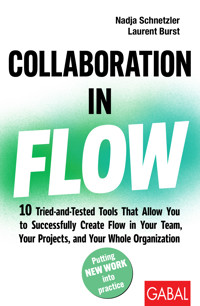
COLLABORATIONINFLOW
10 Tried-and-Tested Tools That Allow Youto Successfully Create Flow in Your Team,Your Projects, and Your Whole Organization
External links were checked at the time of the book's publication.
The publisher has no control over any changes that may occur afterward. Therefore, the publisher assumes no liability.
Bibliographic Information from the German National Library
The German National Library lists this publication in the German National Bibliography.
Detailed bibliographic data can be accessed online at http://dnb.d-nb.de.
ISBN: 978-3-96740-545-3
Translation: Brandon Axley | www.translategermany.com
Editing: Anja Hilgarth, Herzogenaurach
Cover Design: Laurent Burst, Zug, and Nadja Schnetzler, Biel
Author Portrait: Ella Mettler, Zurich | www.ellamettler.com
Typesetting: zerosoft, Timisoara
Layout: Das Herstellungsbüro, Hamburg | www.buch-herstellungsbuero.de
© 2025 GABAL Verlag GmbH, Schumannstraße 155, D-63069 Offenbach,
[email protected]; Nadja Schnetzler, Biel/Schweiz, [email protected], Laurent Burst, Zug/Schweiz, [email protected]
All rights reserved. Reproduction, even partial, is only permitted with the written consent of the publisher. The publisher reserves the right to text and data mining according to § 44b UrhG, which is hereby prohibited for third parties without the publisher's consent.
www.gabal-verlag.de
www.gabal-magazin.de
www.facebook.com/gabalbuecher
www.x.com/gabalbuecher
www.instagram.com/gabalbuecher
Contents
Introduction: Collaboration in Flow
How We Discovered Flow: From «Excellent Collaboration» to «Collaboration in Flow»
The Journey to «Flow»
Discovering Flow as the Key
Focus and Structure of This Book
Part 1: The Essentials of Collaboration in Flow
The Worst Flow Blockers in the Workplace
How Conflicts Stop Flow
Flow Blockers and Their Impact
One Particularly Distinct Flow Blocker: «Playing Office»
The Magical Solution: Flow
Why Flow Fades Away
The World of Work as a Machine – Or a Flock of Birds
A Complete Focus on Flow
Purpose and Other Flow Bringers: The Foundation for More Flow
The Flow Bringer «Calm, Time, and Focus»
Overarching Flow Bringers: Purpose, Focus, Clarity, Team, and Joy
Part 2: The Flow Toolbox at Work
The Universal Tool: The Flow Question
Talking About Flow – Rather Than Secondary Issues
Putting on the Flow Glasses
Recognizing Flow Blockers and Taking Action
Tool 2: Write & Listen
Frustrating Scenes
How the «Write & Listen» Tool Works
How «Write & Listen» Enhances Flow
How Discussions Can Hinder Flow – And How to Avoid This
What Do Users Say About This Tool?
Tool 3: Listen & Decide
Depressing Decision-Making Incidents
Why Decisions Often Just Don’t Happen
Listen & Decide Module 1: The Yes-No-Other Decision-Making
Listen & Decide Module 2: Slider Decision-Making
Listen & Decide Module 3: The «Write & Listen» Survey
Core Aspects of «Listen & Decide»
What Do Users Say About This Tool?
Tool 4: Flow Management (Kanban)
Scenes with a Lack of Flow Management
Using Visible Signals to Support Flow
The Basics of Flow Management
Applying the Flow Management Tool (Kanban)
Additional Flow Accelerators in Flow Management
Using Flow Management for Team Flow
What Do Users Say About This Tool?
Tool 5: Get-It-Done Session
Counterproductive Meeting Culture and Project Management
Get-It-Done Sessions as the Ultimate Flow Bringer
How to Implement the Tool
What Do Users Say About This Tool?
Tool 6: My Operating Manual
A Blocking Cultural Backpack
Getting to Know Myself and Others Better: The Pros and Cons of Diversity
My Operating Manual: A Mini-Investment with a Lasting Impact
What Do Users Say About This Tool?
Tool 7: Team Agreement
Misunderstandings and Friction
Culture Eats Strategy For Breakfast
Team Agreement: Making Team Culture Explicit
Developing a Team Agreement in a Mini-Workshop
What Do Users Say About This Tool?
Tool 8: Address Tensions
Frustrating Tensions
Using the «Address Tensions» Tool at Work
What Do Users Say About This Tool?
Tool 9: Flow Feedback
Giving Constructive Feedback Is Easier Said Than Done!
Creating Connection and Stabilizing Relationships with Flow Feedback
The Goal: Constructive Feedback
What Do Users Say About This Tool?
Tool 10: Flow Team Meeting
Creating Flow Together Is Not So Simple
Ensuring the Purpose and Clarity of a Team Meeting
Flow Team Meeting Formats
Procedure for a Flow Team Meeting
What Do Users Say About This Tool?
Part 3: Case Study Flow Transformation: How an Entire Governmental Agency of 500 People Achieved Flow
«Let’s Go – with Flow!»
Conversation with Inge Hubacher, Agency Director
Glossary: Terms Explained
About the Authors
Gratitude
Introduction
Collaboration in Flow
«We discover the knowledge of excellent collaboration and make it accessible to everyone. We enable people and organizations to find and pursue their purpose.»
Everything we
– the authors of this book –
do is measured by these two
statements, by our purpose.
How We Discovered Flow: From «Excellent Collaboration» to «Collaboration in Flow»
We wrote the two sentences in the quote on page 9 by hand on a Post-it in 2018 and stuck it to one of the windows in a Bauhaus building in Dessau. We had just finished co-building a start-up and, after three intense years, returned to our place of inspiration as a duo for the first time to reflect on what we wanted to pursue together next. Sitting on two Marcel Breuer-designed chairs in front of the enormous window fronts, we used the inspiring atmosphere to define our next area of focus.
Since that moment in 2018, we have tried out many ideas around this purpose with a variety of clients, experimenting with different methods and processes. Due to the COVID-19 pandemic, we shifted almost all our activities to online workshops in 2020, which gave us the opportunity to transform entire organizations through interactive online workshops with hundreds of participants. Throughout this journey, we have drawn on our more than 30 years of knowledge in collaboration, continuously refining and testing tools that help teams achieve great things together on a large scale.
The question of what «excellent collaboration» truly means has driven us for a long time, motivating us every day. Now, we’ve finally found the key that best sums up the topic for us: Flow.
To us, excellent collaboration is collaboration in Flow. This book is the manifestation of a core part of our purpose, one that is dear to our hearts: sharing what we learn about Flow-based collaboration with as many people as possible.
In doing so, we aim to contribute to making meaningful collaboration possible every day for everyone in all kinds of organizations.
The Journey to «Flow»
For three decades, we have been engaged with the topic of collaboration. In every context in which we’ve worked, the goal has been to bring people together and support them in quickly becoming teams that achieve great things together.
We have seen, guided, and supported a wide range of teams. At BrainStore, the idea factory that develops innovations for companies worldwide, we worked mostly with ad-hoc teams – groups that came together for a few days to develop ideas for a new product, service, or process. These teams brought together people from diverse backgrounds: employees from the company itself, consumers, topic experts, and always young people whose refreshing ideas inspired the entire group to think in new ways. At BrainStore, our role was to transform these groups into collaborative teams from the very first minute.
The BrainStore crew itself was also a highly diverse team, composed of permanent employees and several hundred active freelancers. Most people in this team were young, motivated, and often had limited professional experience. In this environment, we learned how to highlight and harness everyone’s abilities so that each person could do what they loved and excelled at.
In many of BrainStore’s client innovation projects, the goal was not only to develop good ideas but also to bring these ideas to life and implement them. This required finding the right people within the client’s company who were willing to address a challenge together. The priority for these teams was to create a space where innovation could be implemented in an agile and experimental manner. This space needed to operate differently from the rest of the organization, and we provided these implementation teams with tools to move forward flexibly and quickly.
Later, as founders of a media start-up (republik.ch), we had the opportunity to build a team from the ground up. Our task was to ensure that different professional groups could connect in new ways and work together on a journalism project, bringing journalists, software developers, and business professionals together so that the skills and knowledge of each could Flow into the new organization. The diversity of individuals was connected in such a way that the organization’s purpose remained at the center instead of a specific preferred approach of any one of these different groups.
As facilitators of transformation processes in organizations of various sizes, we have continuously refined our extensive toolbox over these 30 years, adapting it to current contexts and ensuring its tools can be used by others.
For our own collaboration, we developed a strong set of principles that we also share with the teams with which we work:
We always do exactly what brings Flow and contributes to the purpose.
We know that work flows best when it’s enjoyable and that, together, it’s possible to create an environment that makes work enjoyable for everyone, no matter the organization.
We are convinced that teams, regardless of their composition, can find solutions that restore Flow to all challenges and obstacles.
We know that the ingredients for good collaboration are universal and can work in any type of organization, whether a start-up, hierarchical corporation, mid-sized company, project team, association, or club.
We experiment and try things out continuously. What works stays in the toolbox, and what doesn’t is adapted or discontinued.
This means our toolbox has evolved from practice and continues to be developed through practice. When we discover something that inspires us, we test it and adapt it so it brings Flow to our clients’ work environment. And that’s exactly what we recommend to teams as well: Test things out, adapt, and keep developing!
Our drive is not only to understand what makes collaboration great but also to share everything we discover with everyone. That’s why we are always looking for ways to simplify our tools, allowing every person in any team to benefit immediately from our knowledge and put it to practice.
Discovering Flow as the Key
The concept of Flow has been a significant part of our work for many years in two specific areas: First, since 2008, we have focused intensely on Kanban, a methodology from the Toyota Production System (TPS). Developed by Toyota founder Taichi Ohno, it’s a set of practices designed to increase Flow in production. This powerful methodology was later adopted by pioneers in the software industry: Toniane Demaria, Jim Benson, and David Anderson. They started visualizing the Flow of tasks a team needs to monitor while programming (What needs to be done? What are we currently working on? Where are there bottlenecks? What is complete?).
Today, this visualization technique is applied in countless contexts and helps teams better understand the nature of their work. It enables them to make well-informed, collaborative decisions about priorities, approaches, and quality criteria for the tasks they manage together (see Tool 4: Flow Management [Kanban]).
Second, we became aware of the concept of Flow from the research of Hungarian-American psychologist Mihály Csíkszentmihályi. He uses the term Flow to describe moments when we as humans feel «in the Flow,» specifically when we are positively challenged. Csíkszentmihályi describes Flow moments as follows: People in Flow are fully immersed in an activity that motivates them; they forget everything around them, have razor-sharp focus, and experience the process as a joyful play where they feel in control. Csíkszentmihályi found that Flow experiences often occur when people are learning something new, engaging in sports, or involved in creative activities – places where we step into something novel that engages our whole being, stretching us beyond our comfort zone without overwhelming us. According to Csíkszentmihályi, when in a state of Flow, we navigate new challenges with ease and joy.
This establishes two essential conditions for successful collaboration:
Keeping an eye on the Flow
of the work
; in other words, ensuring tasks are completed at a good pace and with the desired quality.
Ensuring that the people doing the work
also feel in Flow themselves
.
We first began to understand the deeper potential behind the concept of Flow at the start of a major client project.
At that time, we were given the exciting task of designing a training and transformation project for an organization of 500 people, where all 90 teams would receive and apply tools for better collaboration in their daily work.
It was important to us to refine our tools for this project and explain them in a way that made them clear and accessible so that everyone in the organization could use them to immediately improve the collaboration within the team.
We selected the eight most effective collaboration tools we wanted to share with everyone in the organization. When we looked more closely at the course topics, we searched for a common thread or a theme that could tie everything together. As we described what «excellent collaboration» meant to us, we realized that «Flow» was the unifying factor.
The concept of Flow brings all essential aspects of collaboration under one roof:
How can work be completed at a steady pace?
How can progress be made on initiatives that align with purpose and shared goals?
How can people feel connected to their work and their colleagues?
How can work be enjoyable and provide a sense of accomplishment?
How can people focus on their core tasks rather than on distractions?
How can everyone in the organization participate and contribute without being bogged down by hierarchy?
We thought, «Let’s test how the 500 people in this organization respond if we talk about Flow.» And sure enough, a few days after our kickoff event, the head of the organization told us: «Wherever I go, everyone is talking about Flow – at the coffee machine, in the hallways, and in meetings. I’m really impressed.»
You can read the detailed story behind this transformation in the chapter «Let’s Go – with Flow! How an Entire Governmental Agency of 500 People Achieved Flow.»
Focus and Structure of This Book
This book explains what Flow-based collaboration is and how you can foster more Flow in your collaboration with others.
We introduce 10 tools that we have simplified so that anyone can use them, without any prior knowledge.
These tools have been tested thousands of times in practice and are used daily in various organizations.
In a case study in the book’s final chapter, we also demonstrate how to use and combine the Flow mindset and tools. When everyone in an organization has the knowledge, awareness, and skills to contribute to the organization’s Flow every day, it transforms the entire operation!
We know and use many other tools to foster excellent collaboration as a team. For example, in our work, we often use tools such as agile sprints, Design Thinking, or OKRs (Objectives and Key Results), which you may have heard of. Leadership and self-leadership – both in hierarchical and non-hierarchical contexts – are also key topics we continually address in our work.
In this book, however, we focus on the tools we’ve developed or adapted specifically for Flow.
The form of these tools, as you encounter them here, has emerged through many rounds of development. Over 3,000 people have used our tools at various stages of evolution, and we’ve simplified them further with each use. Among those involved in this field research are:
about 70 students, teachers, and a school psychologist at a Montessori school in Sarajevo,
1,700 employees of a large Swiss insurance company,
countless teams of three to 20 people from start-ups, non-governmental organizations, family businesses, associations, foundations, mid-sized companies, and large corporations, and
all 500 employees of a Swiss employment agency.
The tools in our Flow Toolbox can be used individually or in combination. They are suitable for short sequences in a meeting, for structuring an entire meeting or workshop, and even for sustainably building a team culture that ensures that everyone and everything is in Flow.
If you’d like to start right away, the universal tool for restoring Flow is what we call the Flow Question. When something is stuck or not flowing smoothly, you can ask yourself: «What can I – or we together – do to reactivate Flow?»
The Write & Listen tool serves as a foundational element throughout all the other tools and is frequently used in combination with them. «Write & Listen» ensures that the team continuously and consistently addresses the Flow – both on an individual level and as a team. This tool is often combined with the Listen & Decide tool.
Flow Management (Kanban) is also used in combination with other tools, such as the Get-it-done Session. The Flow Team Meeting includes nearly all the tools we introduce in this book.
Of course, all tools can be combined with elements already in use by your team, as the toolbox can be adapted to fit any needs.
In the final chapter, we write about how an entire organization utilized Flow Tools to achieve a complete transformation in their collaboration: «Let’s Go – with Flow! How an Entire Governmental Agency of 500 People Achieved Flow.» In this case study, you’ll learn how the employment agency for the Canton of Bern in Switzerland used Flow Tools to bring a whole new approach to collaboration, both within teams and across team boundaries, for all 500 people in the organization. We also discuss the key levers and additional activities that made this transformation possible and how the entire office was able to enter a state of Flow.
To summarize: In this book, we introduce simple, efficient, and reliable tools that help you create Flow in your team. It doesn’t matter if you’re a team member, team leader, intern, or part of an ad-hoc team – using these tools will immediately impact your collaboration. We know this because we have tested these tools in real work environments with thousands of people across many organizations.
Happy exploring!
Nadja and Laurent
PS: If you have questions or want to share an experience with us, please email us at [email protected] – we’re always glad to hear any feedback.
Part 1
The Essentials of Collaboration in Flow
This book puts a pair of Flow Glasses on your nose. With these Flow Glasses, you’ll only see what’s relevant for achieving Flow. It doesn’t matter whether you’re an employee, a member of a club, a start-up founder, a project manager, or a company executive – anyone can put on the Flow Glasses!
Before we begin, a note: Are you someone who doesn’t want to read a whole book but just wants to understand the core principle? Like a TLDR: Too long, didn’t read? If so, read this chapter and the universal tool «The Flow Question.» It will change your perspective on work and collaboration, giving you a pair of Flow Glasses you can take with you to work starting tomorrow. With the Flow Glasses, you can improve your own Flow, your team’s Flow, and ultimately the Flow of the entire organization.
Why, then, is the book considerably longer? Because we have carefully selected the tools that most effectively support Flow in everyday work. These tools are simple, efficient, reliable, and, on top of that, enjoyable. And it’s far more effective to use Flow Bringers than to allow yourself to be bogged down by Flow Blockers.»
The Worst Flow Blockers in the Workplace
In most companies and organizations, Flow is constantly blocked, often bringing work and progress toward shared goals nearly to a standstill.
People in organizations, unfortunately, grow accustomed to things not flowing, tasks not moving forward, and to feeling either overwhelmed or completely underutilized in their work.
How Conflicts Stop Flow
When new people join an organization, different work styles often collide unconsciously, leading to conflict. And conflicts completely bring Flow to a halt. These examples of typical workplace situations illustrate this:
Example 1:
Zoey’s team faces an important milestone. Next week, there will be a presentation that will determine whether the project, on which everyone has been working intensively for two years, will move to the next phase. There is still much to do, but a conflict over the direction for the next stage is paralyzing the team. This conflict is not only stalling the project but also negatively affecting team relationships. Various team members respond differently: Some are insecure and don’t dare to contribute fresh ideas, while others are frustrated and let it show. Some even feel they aren’t being accepted within the team. The conflict consumes the energy needed to clearly define the next project stage, which would make the presentation even stronger. Zoey has to move forward with a presentation she doesn’t fully believe in.
Example 2:
Benjamin is new to the team and has brought with him enthusiasm and ideas. He was hired as a recognized expert in his field. His manager is not even aware that she regards many of the ideas he brings up in team meetings as competition and usually blocks them, sometimes with comments like, «You don’t have enough experience in the organization yet to understand why we simply can’t implement that.» After a few months, Benjamin has stopped suggesting new ideas, which then leads to reprimands: «We hired you to help us innovate, and yet you hardly say a word in meetings.» Benjamin is now unsure what to do.
Example 3:
Ella is a pragmatic, creative writer who can quickly produce well-crafted concepts based on input from various people. However, her strength does not lie in meticulous text editing. Her manager, a perfectionist, rarely gets past the first three paragraphs when reading Ella’s work. His belief that a perfect text should be expected leads him to try to «train» Ella to perfection, and he also prevents her from working with someone else to edit the texts: «This is the least I should expect from you.» As a result, Ella spends weeks getting the texts to her manager’s standards, which leaves her with less time to do what she does best. To her, editing feels like lost and pointless time.
Example 4:
Aaron has been a team leader for only a few weeks. Previously, he was never allowed to make decisions and had to ask others about even the smallest of details. Now, he’s in a position where he suddenly has to make decisions every day. Feeling overwhelmed, he asks his manager for advice on almost every decision. As a result, he delays and postpones important decisions that the team needs. His team members also often have to wait unnecessarily long before they can finally start their tasks.
Example 5:
Fernando is frustrated. To focus, he needs quiet. In his company’s open-plan office, he’s constantly interrupted and distracted by colleagues. Additionally, he spends more than half his time in meetings. He feels as though he rarely gets to work on a task for more than 10 minutes at a time.
Example 6:
Emily opens her email program in her home office and feels like closing her laptop right away: Her manager has assigned her 10 new tasks. All are urgent, and Emily already has four issues she’s trying to resolve. She realizes she’ll need more time than expected. In the team meeting, she tells her manager and team members that she’s over capacity. Her manager responds, «Oh, come on, we’re all busy. You can handle it. You just need to prioritize correctly.» Emily is seeking support but instead feels overwhelmed and pressured to somehow juggle everything that’s been thrown her way.
Example 7:
The team has just received a new assignment via customer service. Various aspects of the task are unclear, so the team members decide to ask Barbara, the account manager, to clarify with the client. Barbara, feeling stressed, saying, «I think the assignment is clear. Just go ahead; I can’t bother the client again about this.» The team proceeds with the work despite the lack of clarity and hands the materials over to Barbara a week later for the client. The client contacts Barbara, expressing confusion over several aspects. The outcome: The team must spend significant time making corrections. More than a week has been unnecessarily lost.
Flow Blockers and Their Impact
We have asked hundreds of people in various organizations what brings them Flow at work and what disrupts it. The following list shows the most significant Flow Blockers:
Flow Blockers
Constant distractions and interruptionsPostponing and delayingPerfectionismLack of clarity and misunderstandingsTensions and conflictsFear and insecuritySenselessnessOverload, too much at onceRevisiting tasks repeatedlyNon-functional or poorly functioning tools«Playing office»All of these Flow Blockers hinder people who genuinely want to do a good job, causing them significant frustration. Flow Blockers, therefore, have considerable effects on work, people, collaboration, and the entire organization.
Constant distractions and interruptions.
This is the
most commonly
mentioned Flow Killer! People constantly interrupted by calls, emails, spontaneous visitors at their desk, or too many meetings cannot focus on tasks that require attention. Noise, constant notifications on mobile devices, and messages on various chat channels are also sources of interruption and distraction, increasing the risk of drifting entirely away from the current task.
Postponing and delaying
. This Flow Blocker is usually rooted in insecurity, lack of clarity, or fear. It leads to indecision, pushing tasks back, involving more people, or initiating further clarifications – all of which can result in delays or even standstills.
Perfectionism
. Many people are accustomed to revisiting and refining their work so often that it becomes flawless or guaranteed not to offend anyone. This leads to delays and frustration among others involved. Achieving perfection is extremely time-consuming. It doesn’t take much to reach a quality level of 80 percent; however, reaching the final 20 percent usually requires four times as much time as the initial 80 percent, unnecessarily slowing the Flow.
Lack of clarity and misunderstandings.
At work, lack of clarity and misunderstandings arise daily, as everything is constantly changing. They become Flow Blockers when they are not addressed, when questions are shut down with statements like «We’ve already discussed this,» or when information is withheld. Unclarity and misunderstandings lead to massive costs, as much work ends up discarded. This also reduces motivation, which leads to additional costs.
Tensions and conflicts
. Tensions within ourselves and with others are a daily occurrence. If we don’t address them, they can lead to irritations and escalate into conflicts. In our everyday work, we may feel a discomfort that stifles communication and makes collaboration difficult or even impossible. Tensions and conflicts are among the most powerful Flow Killers.
Fear and insecurity
. We frequently face situations that overwhelm us, expose us to uncertainty, or cause us to feel fear of something or someone. When we can’t count on the support of others in these situations, this fear can paralyze us, preventing us from realizing our potential. We often feel uncomfortable, resort to unhelpful behaviors, such as self-censorship, or withdraw as much as possible. Acting out of fear and insecurity usually prevents us from doing what we know is right.
Senselessness
. Too many tasks or jobs lack meaning or fail to convey their purpose to the person performing them. This includes tasks where the person knows they won’t make an impact or produce results. Those who don’t see the purpose of their work cannot contribute meaningfully to the overall mission and therefore experience no personal Flow.
If the organization wants everyone to contribute to and support its purpose, it should ensure that people engage in work that makes an impact and that they consider meaningful.
Overload / Too much at once
. Flow is lost when we try – or are forced – to do too many things at once. Switching from one task to another without finishing any of them disrupts productivity. If we can’t focus or are not allowed to prioritize where and how long to invest our energy, this can lead to complete shutdown and even burnout.
Revisiting tasks repeatedly
. There are times when reworking is necessary due to changed circumstances since the initial assignment. But there are also many cases where a lack of attention and communication at the start leads to multiple revisions or even restarts, which could have been avoided. This leads to personal frustration and disrupts Flow.
Non-functional or poorly functioning tools
. If people can’t rely on their computer, software, office setup, printer, supply chain, and more, they not only lose productivity but also experience a major personal Flow disruption. These tools are just as important as a craftsperson’s tools. After all, who has ever heard of a kitchen crew winning a Michelin star with blunt knives? The cost of topnotch tools is insignificant compared to the saved work hours and increased motivation they bring.
One Particularly Distinct Flow Blocker: «Playing Office»
Many things that sound professional and are done with the best intentions in companies often contribute little to Flow – or even prevent it – because they are massive distractions. These behaviors stem from learned habits or beliefs about how a business «should operate.» Often, these beliefs or actions arise from insecurity. Flow is more likely when people feel secure enough to bring their whole, authentic selves to work, willing to question processes, challenge norms, and take new approaches.
«Playing office,» which is based on the commonly used German expression Firma spielen, means doing things simply because it seems like they «should» be done a certain way in a particular position, without considering whether these actions are actually useful or contributing to Flow.
In the process, we lose sight of our true goals: completing our work, moving initiatives forward, and acting with a balanced, intuitive approach. «Playing office» feels and looks like normal work – but instead of increasing Flow and serving the organization’s purpose, it holds everyone back, stalling both people and progress.
Typical statements that indicate someone is «playing office» include:
«This decision needs to be made by the board, and they will meet in about three months at the earliest.»
«This mistake cannot happen again – we need a checklist to ensure it doesn’t happen in the future.»
«I’m not clear on the strategy. My manager sent a roughly 80-slide PowerPoint presentation three weeks ago, and I still don’t understand what my role in it could be.»
«The heads of Human Resources and Communications don’t get along. We can’t start this important project because they refuse to work together.»
«My manager told me to only take on tasks explicitly listed in my job description, so I’m unable to assist you with that.»
«This software has been malfunctioning for weeks, and I’m not permitted to use an alternative that would work; as a result, this project is on hold until IT resolves the issue.»
«While this idea sounds good, it also seems far too simple. Let’s commission some studies to determine its feasibility.»
This kind of behavior creates cognitive dissonance for everyone involved. We hear things that sound important and are taken seriously by everyone; at the same time, the subsequent actions do not produce the desired results. Instead, they generate distraction, confusion, and frustration. We might not always be able to articulate it in this way, yet we sense that what we would do based on common sense either isn’t permitted, seems impossible, or simply isn’t valued.
By asking the Flow Question instead, we set everything and everyone in motion – without pressure or stress. The greatest efficiency arises naturally when we focus on Flow. Flow captures the essence of collaboration: Work flows, gets done, and is enjoyable. Everyone is engaged, yet not overwhelmed; we are learning, progressing together, and experiencing shared successes. Each person can fully contribute their skills and knowledge.
When we focus on Flow, we concentrate on the core of the work, allowing all distractions to disappear.
The Magical Solution: Flow
The Greek philosopher Heraclitus coined the term πάντα ῥεῖ, «Panta Rhei,» meaning «everything flows.» Another famous saying attributed to him is, «You can’t step into the same river twice.» His thought was that if you step into a river for the second time, it is no longer the same river, as the water you stepped into previously has already flowed onward. Heraclitus also wrote, «Everything flows, and nothing remains. There is only an eternal becoming and changing.»
In the workplace, everything is also constantly moving and evolving, and as soon as we look around, many things have already changed. We live in a world where everyone and everything is changing at a breathtaking pace. What worked perfectly yesterday may no longer work tomorrow.




