


Erhalten Sie Zugang zu diesem und mehr als 300000 Büchern ab EUR 5,99 monatlich.
- Herausgeber: Carcanet Classics
- Kategorie: Geisteswissenschaft
- Sprache: Englisch
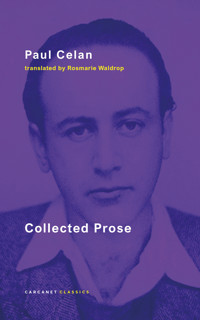
Paul Celan (1920–70) stands as one of the greatest post-war European poets, a writer whose painful struggle with the possibilities and limitations of German, his native language, has helped to define the response of poetry in the aftermath of the Holocaust. Celan's prose is as thought-provoking as, and less familiar than, his poetry. The writings and aphorisms on poetry and art illuminate the sources of his language: he explores the condition of being a stranger in the world, the necessity – and limitation – of discourse, enlarging our understanding of the poet and his vocation. A spare and reluctant prose writer, Celan speaks with a quiet authority that insists on the centrality of poetry in the modern world. Rosmarie Waldrop's translation remains true to the poetic rhythms of Celan's prose; her introduction sets the pieces in context.
Sie lesen das E-Book in den Legimi-Apps auf:
Seitenzahl: 60
Veröffentlichungsjahr: 2026
Das E-Book (TTS) können Sie hören im Abo „Legimi Premium” in Legimi-Apps auf:
Ähnliche
















i
ii
iii
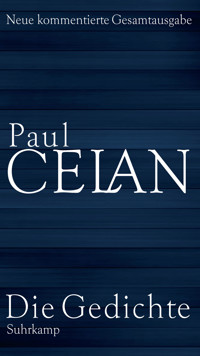
Paul Celan
translated by Rosmarie Waldrop
Collected Prose
CARCANET CLASSICS
Contents
vi
Introduction
Celan’s prose writings make a slim volume. For Celan, whose poems moved ever closer to silence, prose was too noisy a medium. Not for him, the ‘buntes Gerede’. It is indeed fortunate that various occasions prodded him to write these texts. They are invaluable for defining the place from which Celan writes.
The text to which Celan himself gives most importance is ‘Conversation in the Mountains’. He cites it in ‘The Meridian’ as his counterpart to Büchner’s Lenz — and as an encounter with himself. It is a text which addresses more directly than Celan’s poems the condition of being Jewish, of being a stranger. A stranger not only in the social and cultural world: there is a veil between him and nature, between him and everything. He always finds himself face to face with the incomprehensible, inaccessible, the ‘language of the stone’. And his only recourse is talking. This cannot be ‘literature’. Literature belongs to those who are at home in the world. He can only talk in a simple — deceptively simple — way: circular, repetitive, insisting on the very gap between him and the world, between him and nature. He can only hope that out of his insistence will come a new language which can fill the gap and include the other side. ‘Reality must be searched for and won.’
Small wonder that Celan refuses to talk ‘technique’, that he is contemptuous of the professionals of ‘literature’ stirring up their ‘flurries of metaphor’. Craft is a prerequisite for him, like cleanliness, not worth discussing. He admits exercises, but only ‘in the spiritual sense’. Here we are at the core of Celan’s relation to writing. It was not a game for him, not experiment, not even ‘work’. Writing, as he tells us in ‘The Meridian’, meant putting his existence on the line, pushing out into regions of the mind where one is exposed to the radically viiistrange, the terrifying other, the uncanny. And at the moment when existence is actually threatened, when his breath fails, when silence literally (if momentarily) means death — at this moment a poem may be born. If so, it pulls us back from the ‘already-no-more’ into resuming breath and life.
For this moment, this death-in-life when our breath is taken away, yet turns and re-turns, Celan coins the word Atemwende — a crucial word which appears here for the first time, before he makes it the title of one of his books. Language is breathing for Celan, is life, is ‘direction and destiny’; and the poem, that which takes our breath away, yet gives it back and allows us to live. Just as, on a smaller scale, the constant Atemwende we know, the constant alternation of inhaling and exhaling, allows us to practise the encounter with both air and its absence, the condition of our life and the ‘other’ which will eventually end it.
Celan’s prose is a poet’s prose. It often progresses by sound association and puns which must suffer in translation. The ‘Wände und Einwände’ of reality is more vivid, with its image of walls, than my ‘objects and objections’. Because ‘boat’ and ‘messenger’ do not have the punning connection of ‘Boot’ and ‘Bote’, I had to have my boat carried by the tide to make for a similar progression to ‘tidings’. Elsewhere I had to introduce an extra sentence to get both the image and the meaning of the German, thus losing the pregnant formulation. But I think I have succeeded in the more important task of staying as true as possible to the varying rhythms. The repetititve and incantatory ‘Conversation in the Mountains’, for instance, could not be more different from the groping complexity of ‘The Meridian’, which forever qualifies what is said, while holding on to its anchor: the phrase ‘Ladies and gentlemen’, the situation of speaking, of addressing a ‘you’. ix
The arrangement of the texts follows Volume Three of Paul Celan’s Gesammelte Werke, edited by Beda Allemann and Klaus Reichert (Frankfurt: Suhrkamp, 1983), which divides the works into two chronological sections of ‘prose’ and ‘speeches’, leaving the introductory notes to Celan’s translations of Blok and Mandelstam for an appendix in Volume Five.
Titles which are not by Celan appear in parentheses; notes added by the editors, in italics.
Rosmarie Waldropx
Prose
2
Edgar Jené and The Dream about The Dream
I am supposed to tell you some of the words I heard deep down in the sea where there is so much silence and so much happens. I cut my way through the objects and objections of reality and stood before the sea’s mirror surface. I had to wait until it burst open and allowed me to enter the huge crystal of the inner world. With the large lower star of disconsolate explorers shining above me, I followed Edgar Jené beneath his paintings.
Though I had known the journey would be strenuous, I worried when I had to enter one of the roads alone, without a guide. One of the roads! There were innumerable, all inviting, all offering me different new eyes to look at the beautiful wilderness on the other, deeper side of existence. No wonder that, in this moment when I still had my own stubborn old eyes, I tried to make comparisons in order to be able to choose. My mouth, however, placed higher than my eyes and bolder for having often spoken in my sleep, had moved ahead and mocked me: ‘Well, old identity-monger, what did you see and recognize, you brave doctor of tautology? What could you recognize, tell me, along this unfamiliar road? An also-tree or almost-tree, right? And now you are mustering your Latin for a letter to old Linnaeus? You had better haul up a pair of eyes from the bottom of your soul and put them on your chest: then you’ll find out what is happening here.’
Now I am a person who likes simple words. It is true, I had realized long before this journey that there was much evil and injustice in the world I had now left, but I had believed I could shake the foundations if I called things by their proper names. I knew such an enterprise meant returning to absolute naїveté. This naїveté I considered as a primal vision purified of the slag of centuries of hoary lies about the world. I remember 4a conversation with a friend about Kleist’s Marionette Theatre




