


11,99 €
Mehr erfahren.
- Herausgeber: Forum
- Kategorie: Geisteswissenschaft
- Sprache: Englisch
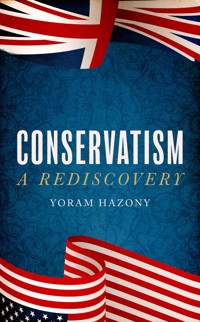
The idea that conservatism amounts to little more than being in favour of free market capitalism and a small state—widely held for decades—is seriously mistaken. Award-winning political theorist Yoram Hazony argues that the best hope for Western democracy is to return to a genuine conservatism that is distinct from the hollow promises of contemporary economic and social liberalism. He explains how this great Anglo-American conservative tradition – rooted in empiricism, faith and the nation – emerged and developed in England in the thought of men like Richard Hooker and Edmund Burke, and later inspired American figures ranging from the Federalists to Lincoln. He analyses how this tradition was corrupted and subverted from the 1960s onwards by the right's misconceived embrace of 'fusionism' and liberalism, and how it can be revived today to respond to an era of progressive hegemony. Reflecting on his own first-hand experiences - and the importance of personal behaviour, piety and virtue in rebuilding the culture and politics of conservatism – Hazony makes a powerful counter-cultural case for a revivified conservatism that no-one dissatisfied with the current state of the political right can afford to miss.
Das E-Book können Sie in Legimi-Apps oder einer beliebigen App lesen, die das folgende Format unterstützen:
Seitenzahl: 698
Veröffentlichungsjahr: 2022
Ähnliche




















CONSERVATISM
First published in the United States of America by Regnery Gateway 2022
First published in Great Britain by Forum, an imprint of Swift Press 2022
Copyright © Yoram Hazony 2022
The right of Yoram Hazony to be identified as the Author of this Work has been asserted in accordance with the Copyright, Designs and Patents Act 1988.
A CIP catalogue record for this book is available from the British Library
ISBN: 9781800752337
eISBN: 9781800752344
Dedicated with love to Isaac and Linda Hazony
CONTENTS
INTRODUCTION: IS CONSERVATIVE REVIVAL POSSIBLE?
PART ONE: HISTORY
CHAPTER I: THE ENGLISH CONSERVATIVE TRADITION
1. What Is Conservatism?
2. John Fortescue and the Birth of Anglo-American Conservatism
3. Richard Hooker and Protestant Conservatism
4. The Greatest Conservative: John Selden
5. Edmund Burke and the Challenge of Liberalism
6. Principles of Anglo-American Conservatism
CHAPTER II: AMERICAN NATIONALISTS
1. The Federalists, America’s Nationalist Conservatives
2. A Distinct American Nation of British Heritage
3. Continuity with the British Constitution
4. Executive Power Vested in One Man
5. The Supreme Court and the Constitution
6. Economic Nationalism
7. Nationalist Immigration Policy
8. Alliance with Britain
9. Alliance between Religion and State
10. Opposition to Slavery
11. The Federalists and Modern American Nationalism
PART TWO: PHILOSOPHY
CHAPTER III: THE CONSERVATIVE PARADIGM
1. Paradigm Blindness
2. The Premises of Conservatism
3. Rationalism and Empiricism
4. Mutual Loyalty
5. Honor
6. Hierarchy
7. Cohesion and Dissolution
8. Traditional Institutions
9. Political Obligation
10. Freedom and Constraint
11. Tradition and Truth
CHAPTER IV: GOD, SCRIPTURE, FAMILY, AND CONGREGATION
1. God and Scripture
2. Why There Is No Alternative to God and Scripture
3. The Traditional Family
4. The Community or Congregation
CHAPTER V: THE PURPOSES OF GOVERNMENT
1. The National Interest or Common Good
2. The Government of the Family
3. The State as a Traditional Institution
4. Eight Purposes of National Government
5. Religion as a Purpose of Government
6. The Balance of Purposes in the State
PART THREE: CURRENT AFFAIRS
CHAPTER VI: LIBERAL HEGEMONY AND COLD WAR CONSERVATISM
1. From Christian Democracy to Liberal Democracy
2. Russell Kirk and the Conservative Revival
3. Friedrich Hayek’s Liberalism
4. Leo Strauss’s Liberalism
5. William Buckley, Frank Meyer, and “Fusionism”
6. What Cold War Conservatives Contributed to Liberal Hegemony
CHAPTER VII: THE CHALLENGE OF MARXISM
1. The Collapse of Liberal Hegemony
2. The Marxist Framework
3. The Attraction and Power of Marxism
4. The Flaws That Make Marxism Fatal
5. The Dance of Liberalism and Marxism
6. The Marxist Endgame and Democracy’s End
CHAPTER VIII: CONSERVATIVE DEMOCRACY
1. Conservative Democracy as an Alternative
2. Liberalism vs. the Bible
3. Anglo-American Conservatism Revisited
4. What Would Conservative Democracy Be Like?
5. Experiments in Conservative Democracy
PART FOUR: PERSONAL
CHAPTER IX: SOME NOTES ON LIVING A CONSERVATIVE LIFE
1. Princeton Tories
2. Ronald Reagan and the Conservative Revival at Princeton
3. Stevenson Hall
4. George Will, Irving Kristol, and Conservative Ideas
5. A Conservative Life
CONCLUSION: ON BEING A CONSERVATIVE PERSON
Acknowledgments
Notes
INTRODUCTION
Is Conservative Revival Possible?
For three generations, Western nations have lived in the shadow of the World Wars. The depths of the trauma have never been fully examined, nor its consequences entirely mapped. But we know that within a few years after the end of the Second World War, political life in these countries underwent an unprecedented revision. By the 1960s, the old Protestant nationalism that had animated the generation of Franklin Roosevelt and Dwight Eisenhower had been set aside, and Enlightenment liberalism became the new framework within which American political life was conducted. America was given what was, in effect, a new liberal constitution that guaranteed the civil liberties of blacks and other minorities, but also banned prayer and Bible-reading from the schools and lifted earlier legal restrictions on divorce, pornography, immigration, and abortion. Academics and intellectuals even gave a new name to the regime—which they now called “liberal democracy.”1
In the decades that followed, many Americans and Europeans came to believe that in liberalism, they had discovered the final political theory: a regime so obviously desirable that competition among political ideologies had in effect come to an end. Soon, liberalism would be adopted by all nations. The reign of liberal ideas would last forever.
No one believes this anymore.
Five years of political upheaval—from 2016 to 2020—was all it took to shatter the hegemony of Enlightenment liberalism. Suddenly, the conflict among competing political visions was fiercely alive once more.
On the one hand, the appeal of a revived nationalist conservatism was given dramatic expression by the 2016 election of Donald Trump’s “America First” administration in the United States, by Britain’s departure from the European Union, and by the rise of nationalist conservative governments in Eastern Europe, Italy, India, Brazil, and other countries.
At the same time, an updated Marxism (calling itself “Progressivism,” “Anti-Racism,” or “Woke”) launched an astonishingly successful bid to seize control of the institutions that had been, until only recently, responsible for the development and circulation of liberal ideas in America, Britain, and beyond. Indeed, by the summer of 2020, most of the important news media, universities and schools, big tech and other major corporations, and even the government bureaucracy and the military had adopted a policy of accommodating the new Marxism and advancing its agenda.
Meanwhile, in 2018, a rising China anointed the chairman of the Communist Party, Xi Jinping, ruler for life. Persecution of religious and political dissidents followed, reaching a climax with the effective annexation of Hong Kong, until recently a symbol of Enlightenment liberalism in Asia, in 2020. These events put an end to the long-standing myth that economic prosperity would bring a liberal political order to China. Instead, Americans abruptly found themselves facing the bleak reality of an imperialist China pursuing an increasingly credible campaign to overthrow the liberal Western nations as the dominant power in world affairs.2
The hegemony of liberal ideas, which was supposed to last forever and to be embraced by all nations, has come to an end after only sixty years.
What will happen next?
Many commentators have compared the crumbling of the liberal regime in America to Weimar Germany in the decade before Hitler’s rise to power.3 And indeed, on the far reaches of the political right, new racialist movements (calling themselves “white identitarians”) have begun to press their claims, while an assortment of other radicals have taken to mentioning the advantages of dictatorship. So far, these views have remained without much influence. But the collapse of institutional liberalism and an ascendant Marxism could change that, providing fuel for a reaction drawing on authoritarian precedents from the last century.
Yet despite these grim historical parallels, America may have the resources to overcome these challenges. Many Americans still possess a strong intuitive commitment to the Anglo-American constitutional tradition. This includes the great majority of nationalist conservatives who supported the Trump presidency. To be sure, their insistence on the centrality of the nation in political life means that they oppose many aspects of the liberal consensus of recent decades—including large-scale immigration; the offshoring of American manufacturing capabilities to China in the name of free trade; the empowerment of international bodies such as the UN, EU, and WTO at the expense of independent national states; and wars aimed at bringing liberalism to the Middle East. They propose government action against the progressive cartels that dominate big business, the media, universities, and schools, and they seek policy changes that may assist in reversing the dissolution of the family and the decline of religious tradition. But nationalist conservatives support a democratic regime and peaceful transitions of power, as well as customary Anglo-American protections for property rights, freedom of speech, and free exercise of religion. These characteristics make national conservatism a powerful force with great potential for political revival and restoration in the coming years, whether on its own or in alliance with anti-Marxist liberals. In fact, with the collapse of liberal hegemony in America, nationalist conservatism offers the best hope for restoration of political stability and health.
But there are also significant difficulties standing in the way of any kind of revived political conservatism in the English-speaking world right now. In this regard, two things especially stand out.
First, many of today’s “conservatives” know very little about what it would take to actually conserve anything—that is, to propagate beneficial ideas, behaviors, and institutions across generations. It is true that Cold War conservatives accomplished crucial things: Intellectuals such as William F. Buckley Jr. and political figures like President Ronald Reagan in the United States and Prime Minister Margaret Thatcher in Britain led the effort to defeat Soviet Communism abroad and socialism at home, a struggle that reached its successful conclusion in the late 1980s. More recently, British conservatives succeeded in restoring the national independence of their country as well. These are resounding historical achievements, not to be taken for granted.
Yet during these very same years—when American and British conservatives frequently held positions of power in every branch of government, appeared often in the major media, and wrote many bestselling books—the political and religious traditions that had granted stability and continuity to these countries for centuries were being severely damaged or overthrown entirely. This shocking destruction of the Anglo-American cultural inheritance has involved the suppression or stigmatization of many of the most important ideas and institutions around which life in Britain and America had been built, including God and Scripture, nation and congregation, marriage and family, man and woman, honor and loyalty, the sabbath and the sacred, among others. This has been possible, in no small part, because with each new step in this ongoing cultural revolution, self-proclaimed “conservatives” have been found who were willing quickly to pronounce the battle lost and to encourage their colleagues to accept the new order and move on. This is not only due to excessive political pragmatism or weakness of character, although these have played a role. There is also, at this point, an astonishing degree of ignorance. Many well-intentioned conservatives really do not know, anymore, why one would need to preserve and strengthen these things.
Which brings us to the second remarkable fact about contemporary conservatism: the extraordinary confusion over what distinguishes Anglo-American conservatism from Enlightenment liberalism (or “classical liberalism” or “libertarianism” or, for that matter, from the philosophy of Ayn Rand). Indeed, for decades now, many prominent “conservatives” have had little interest in political ideas other than those that can be used to justify free trade and lower taxes, and, more generally, to advance the supposition that what is always needed and helpful is a greater measure of personal liberty. And if anyone has tried to point out that these are well-known liberal views, and that they have no power to conserve anything at all, he has been met with the glib rejoinder that What we are conserving is liberalism, or that Conservatism is a branch or species within liberalism, or that Liberalism is the new conservatism.
For the most part, these comments are made out of ignorance, although on rare occasions it does seem as though there may be other motives involved. At any rate, it is now clear that this confusion concerning the content and purposes of political conservatism has paralyzed the conservative impulse in the English-speaking world, rendering it weak and ineffective. For the truth—which at this point cannot be repeated frequently enough—is that Enlightenment liberalism, as a political ideology, is bereft of any interest in conserving anything. It is devoted entirely to freedom, and in particular to freedom from the past. In other words, liberalism is an ideology that promises to liberate us from precisely one thing, and that thing is conservatism. That is, it seeks to liberate us from the kind of public and private life in which men and women know what must be done to propagate beneficial ideas, behaviors, and institutions across generations and see to it that these things really are done.
To the extent that Anglo-American conservatism has become confused with liberalism, it has, for just this reason, become incapable of conserving anything at all. Indeed, in our day conservatives have largely become bystanders, gaping in astonishment as the consuming fire of cultural revolution destroys everything in its path.
So that I should not be misunderstood, I must emphasize that the liberty of the individual is a fine thing, both good in itself and worthwhile for its beneficial effects, when taken in the right proportion. It has, and will always have, an important place in a broader theory of political conservatism.
But under the present conditions of permanent revolution and cultural devastation, the most important thing to remember about individual liberties is that, in and of themselves, they have no power to make anything stable or permanent. This is why the great triumph of liberal ideas after the Second World War has left nothing stable and permanent in its wake. Even its most important achievement—the desegregation of the American South and the putative end of racially based laws and social norms in America—now seems to have been achieved superficially, without arriving at a settlement that could endure the test of generations.
If we care about making anything stable and permanent, we must have other tools at our disposal besides the lists of individual freedoms and proscribed forms of discrimination that liberals have been so busy compiling and attempting to impose on the world since the 1940s.
We must have other tools at our disposal, and these will have to be conservative tools, not liberal ones.
However, to have such conservative tools at their disposal, democratic nations will have to let go of their postwar obsession with liberalism. They will have to turn to other, older philosophies, which are concerned with how things are propagated in time, and to learn from them again. Indeed, if a conservative politics is to play a significant role in democratic nations again, conservative ideas, behaviors, and institutions are going to have to be rediscovered. This will involve rediscovering the history and philosophy of conservatism, both of which have by now been largely forgotten. And it will mean rediscovering the practice of conservatism—which is not only the practice of conservative government but also, especially, the practice of being a conservative person and leading a conservative life.
Is it possible for a society whose traditions have grown so faint to revive them? Is it possible for individuals who have grown up in a liberal society obsessed with personal freedoms to become strong conservative men and women and to do what a conservative calling demands of them?
I believe it is possible because I have seen it happen many times over the course of my life. It is possible for individuals to discover that they have been on the wrong course, repent, and set out on a new and better course. And this is possible, too, for families and congregations, tribes and nations.
In fact, the sudden rise of the new Marxists presents an opportunity for a conservative revival unlike any we have seen in our lifetimes. To be sure, we are witnessing a spectacular and horrifying historical event. The potential for tragedy is obviously very great. But the extremity of this event can permit a process of rethinking that has been impossible until now. Many will now find that they are ready for the rediscovery that I have described: the rediscovery of a conservative life.
An important principle of Anglo-American conservative thought is this: When faced with the disastrous consequences of a particular course of action, we must retrace our steps and restore, as much as possible, the conditions that existed prior to setting out on this course. This is what happened in 1660, when Matthew Hale proposed the restoration of the English monarchy. It is what happened in 1787, when George Washington proposed the restoration of the forms of the traditional English constitution in America. It is what happened in 1863, when Abraham Lincoln proposed that the evil of slavery, that unspeakable digression from the course of English constitutional history, would be abolished. America and Britain have arrived at another such juncture, and they will have to retrace their steps and return to their historic path.
If such a repentance, and such a return to the right path, has taken place time and again in history, why should it not be attempted again? There is nothing to be lost in making the attempt—and everything to be gained by it.
In the political arena, conservatism refers to a standpoint that regards the recovery, restoration, elaboration, and repair of national and religious traditions as the key to maintaining a nation and strengthening it through time. In this book, I will be concerned primarily with one conservative political tradition, that of Anglo-American conservatism. This is a tradition already powerfully described by John Fortescue in the fifteenth century, by Richard Hooker in the sixteenth century, and by John Selden, Matthew Hale, and others in the seventeenth century. But it is most familiar to us today for the crucial role it played in the revolutions of the late eighteenth century—when this conservative tradition was upheld by statesmen such as Edmund Burke in Britain and by the Federalist Party of George Washington, John Jay, John Adams, Gouverneur Morris, and Alexander Hamilton in America. This Anglo-American conservatism continued to be an important strand in the politics of the English-speaking peoples into the twentieth century. And it is crucial to us now because it holds the key to understanding what made these nations strong and successful both in political affairs and in almost every other matter.
I will occasionally use the term national conservatism, which is associated with the American statesman Daniel Webster, to describe Anglo-American conservatism where it has placed an especial emphasis on national independence and on the loyalties that bind the nation’s constitutive factions to one another.4 There is a certain redundancy built into this expression because Anglo-American conservatism has long placed the idea of the nation—at first the English nation, and later the British and American nations—at the center of political life. But the “nationalist” aspect of Anglo-American conservatism does become more pronounced during periods when the integrity of the nation is directly challenged by an excessive internationalism, localism, or individualism. This was the case, for example, when England was threatened with absorption into the Spanish Empire in the 1580s, when the Americans sought to establish themselves as a single independent nation in the 1780s, and with the rise of internationalist utopianism in the 1910s. In the same way, the conservative movement in America and Britain after the mid-2010s is rightly called a “nationalist” conservatism, since it seeks to return the national interest, or the common good of the nation, to the center of political discourse, aft er decades in which the freedom of the individual became the overriding principle in all spheres of life.5
For those who have not come across my work before, it may be relevant to say a few words about how I came to think about this subject.
I grew up in a liberal college town, Princeton, New Jersey; and I studied at two liberal universities, Princeton and Rutgers. But my father’s house was steeped in the sense that the society around us had veered off course. In the evenings, my father and I would watch the 10:00 p.m. news together on a New York station, Channel 5, WNEW. Each night, the broadcast included a live debate about national affairs between two local Jewish personalities, the conservative Martin Abend and the liberal Sidney Offi t. (It is rumored that these Abend-Offit debates were the inspiration for the legendary “Point, Counterpoint” sketches with Dan Aykroyd and Jane Curtin on Saturday Night Live.)6
My father never failed to side with Martin Abend in these debates. He thought Sidney Offit didn’t have any idea what was involved in maintaining a nation, and that he consistently advocated a loosening of what my father called America’s “moral fiber”—that thing which holds people together as a nation, prevents them from harming themselves and others too badly, and gives them the strength to band together and defeat adversity of every kind. The Roman Empire had fallen, my father said, because it had lost its internal unity, and with it the ability to continue fighting. The United States, he said, was headed in the same direction. Without a restoration of its “moral fiber,” America wasn’t going to make it.
I thought my father was right then, and I still think so now.
My father had been trained as a physicist. He had strong opinions about almost everything reported on the nightly news. But he didn’t read books or magazines about political matters, and he didn’t suggest that I read any myself. It was my Uncle Dov and Aunt Rina, living in Cleveland, who bought me a subscription to Commentary magazine when I was fifteen years old. That same year, I asked the rabbi of our synagogue, Melvin Glatt, if he would allow me to join his Talmud class for adults. These were slender threads, but in following where they led, I began what has turned out to be a lifelong project of rediscovering two important traditions—Anglo-American conservatism and the Jewish biblical and rabbinic tradition—and restoring them to their proper weight and significance in my own life and in the lives of others.
The most important influence on my road to a conservative life was that of my Uncle Isaac and Aunt Linda. After finishing high school, I went to Israel for a year, where I spent my sabbaths and holidays with them and with their children, Meir, Racheli, Shlomi, Rivkaleh, Zehavaleh, and Reuven. I cannot imagine where I would be if my aunt and uncle had not opened their home to me, and to a young woman named Julie whom I met in college, and to so many of our friends from Princeton. This book is dedicated to them in gratitude and love.
My wife Yael and I have done everything together since we met a few weeks after starting college in 1983. The story of my coming to a conservative life is inseparable from who she was and is. I have said a bit more about her in the personal recollections included in the last part of the book. Those who want to know more about Julie and me are welcome to skip to the end.7
In what follows, I will share with you some of what I have learned from many years of studying and thinking about Anglo-American conservatism. I offer a picture of what political conservatism is and what it is for. My aim is to help the reader understand what a conservative revival, so badly needed right now, would entail. In other words, my aim is to give conservatives a clear sense of what their responsibilities are.
At the same time, I am hopeful that this book will be useful for anti-Marxist liberals. It is liberalism, aft er all, that has failed so spectacularly in recent years. I suspect that more than a few liberals will be interested in knowing why.
This book is divided into four parts:
Part One: History, written with the historian Ofir Haivry, offers an introduction to Anglo-American conservatism as a historical phenomenon. Chapter 1, “Th e English Conservative Tradition,” traces the emergence of conservative political theory in the works of great conservative statesmen and thinkers such as John Fortescue, Richard Hooker, John Selden, Matthew Hale, and Edmund Burke. This chapter presents early English conservatism as arising out of a struggle to defend political traditionalism and empiricism in the face of three competing theories: (i) the royal absolutism of the Stuarts, (ii) Puritan revolution, and (iii) rationalist liberalism.
Chapter 2, “American Nationalists,” describes the revival of the Anglo-American conservative tradition in the United States in the 1780s. This chapter describes the Federalist Party of George Washington, John Jay, John Adams, Gouverneur Morris, and Alexander Hamilton as the force that actually established America as a cohesive and independent nation. This party was the forerunner of today’s nationalist conservatives, developing a political program based on the existence of a distinct American nation of British heritage, the continuity of the traditional British constitution and common law in America, a strong national government, economic nationalism, a nationalist immigration policy, alliance with Britain, and an alliance between religion and state. The American Federalist Party was also a political home for opponents of slavery. Bitterly opposed to Jeffersonian liberalism, America’s early nationalist conservatives paved the way for Henry Clay’s Whigs and the Republican Party of Abraham Lincoln.
Part Two: Philosophy provides the theoretical foundations for understanding the historical British and American conservatism described in Part One. In Chapter 3, “The Conservative Paradigm,” I describe the premises that underpin conservative philosophy, showing why loyalty, hierarchy, honor, cohesion, and constraint are crucial for a realistic understanding of human nature and human societies, and how these things permit ideas, behaviors, and institutions to propagate across generations. I also examine how the liberal political framework systematically blinds its adherents to these crucial aspects of political reality.
In Chapter 4, “God, Scripture, Family, and Congregation,” I discuss a number of institutions of the Anglo-American conservative tradition. I argue that Anglo-American conservatism cannot be upheld without recognizing their centrality, and recommend revising our assessment of their nature and significance in light of the conservative paradigm presented in the preceding chapter.
In Chapter 5, I discuss “The Purposes of Government” as these are understood in the Anglo-American conservative tradition. This is a tradition that sees the national interest or the common good as irreducible to a single principle such as individual liberty. Instead, a balance among various principles—I suggest nine such principles—is needed to understand what government is for and what it should do.
Part Three: Current Affairs turns to the condition of Anglo-American conservatism in our generation and to the tasks that lie ahead. Conservatives face a triple challenge today: They must fight an aggressive new Marxist movement at home and deter an imperialist China abroad, while at the same time freeing themselves from the shackles of liberal dogma. In Chapter 6, “Liberal Hegemony and the Cold War Conservatism,” I discuss the causes of America’s transition from Christian democracy to liberal democracy in the decades following the Second World War, and I examine the relationship between liberals and conservatives within William F. Buckley Jr.’s coalition of Cold War conservatives. Focusing on the thought of Russell Kirk, Friedrich Hayek, Leo Strauss, and Frank Meyer, I argue that although this Cold War coalition was successful in its struggle against Communism abroad and socialism at home, it also did much damage to the conservative element in American politics. By “fusing” together a public liberalism with a private conservatism, Cold War conservatives set a course that, within a generation, had removed almost everything that wasn’t strictly derived from liberalism from the political agenda of the American right, and had cemented this “conservatism” into place as a bulwark helping to prop up the hegemony of liberalism throughout the democratic world.
In Chapter 7, “The Challenge of Marxism,” I examine how the liberal hegemony in America destroyed itself and paved the way for an updated Marxism—a process that reached a dramatic climax in 2020 with the triumph of a racialist “woke” ideology in big business, the media, the universities, and government bureaucracy. A return to a society that is capable of constraint and conservation would mean the abandonment of the 1960s-era theory of liberal democracy, and the adoption of a political standpoint that should be called conservative democracy. I describe this form of government in Chapter 8, “Conservative Democracy.”
In Part Four: Personal, which consists of Chapter 9, I provide “Some Notes on Living a Conservative Life.” This chapter includes autobiographical material and a discussion of the conservative revival at Princeton University when I was a student there during the 1980s. I have decided to include this material because it sheds light on two subjects not much discussed today:
First, I think it is worth revisiting the connection between Ronald Reagan and Margaret Thatcher and the nationalist and religious conservatism of those years. Today Reagan and Thatcher are often described as if their principal concern were economic liberalism. But many of us, including the circle that founded the university’s conservative student publication, The Princeton Tory, were animated primarily by the traditionalist, nationalist, and religious aspects of the Reagan-Thatcher movement. In this chapter, I describe how I understood this connection then, emphasizing the crucial role played for us by writers such as George Will (then an eloquent defender of precisely those nationalist conservative views that he now opposes), Irving Kristol, and Dennis Prager.
Second, and more important, I think it may be helpful to use my own experiences—including my marriage to Julie and the birth of our first daughter while we were still students—as a basis for discussing the relationship between conservative political ideas and a conservative life. A large part of the damage that has been done to political conservatism since the 1960s has been due to the acceptance, by conservatives, of the liberal myth that politics can address itself to the public sphere alone, while avoiding having a significant influence on our private lives. As a result, many young people now mistakenly believe that it will do no great harm if they continue to lead a dissolute, liberal life in private while expressing conservative opinions in their public activism (where it “really matters”). This is a destructive view and a false one.
In university, my friends and I didn’t just become a local chapter for disseminating general ideas of a conservative character. We wanted to become conservative people, leading a conservative life. In fact, many of us did just that. I’ve told a part of that story here. Perhaps knowing something about my experiences in those days can be useful to those—both young and old—who are considering taking up a conservative life at this time.
In this book, I have made the case for Anglo-American conservatism as I understand it. And I have contrasted this kind of conservatism with what I see as its principal rivals in the democratic world today: Enlightenment liberalism and a renewed Marxism. I know that some readers will feel that I should have made room to discuss additional intellectual trends that have bearing on my subject. For example, there are many writers who believe that conservatism should be based on something like the Catholic natural law teaching, itself a form of philosophical rationalism. Because of the interest in this philosophical tradition among my friends and colleagues, it would perhaps have been helpful to include a chapter stating why I am not an adherent of the rationalist natural law teaching of Thomas Aquinas. But I have not done so, not for lack of interest but because the book is already long enough, and an adequate treatment of this question would have taken me too far afield. I hope to address this important question on another occasion.
Similarly, the liberalism I discuss in this book is the Enlightenment liberalism that became the dominant political paradigm in America and Europe aft er the Second World War and continues to strongly influence political affairs to this day. I know that in academia, especially, there are those who have criticized the Enlightenment rationalism upon which liberalism was originally founded, and who do not see it as a suitable basis for their own liberal views. In fact, many scholars consider liberalism as having moved beyond Enlightenment rationalism by the mid-1990s. For this reason, some of my liberal colleagues may feel that my criticism of Enlightenment liberalism in this book amounts to “beating a dead horse.”
Here I must disagree—for the simple reason that this horse is still very much alive. Despite the severe blows it has sustained in recent years, a large and vocal contingent of politicians, academics, and journalists continues to defend 1960s-style Enlightenment liberalism in the public sphere. Enlightenment liberalism remains a powerful paradigm, and throughout the democratic world, many still regard it as the only viable alternative to neo-Marxism and authoritarianism. This suggests that liberal political theory has not yet broken with Enlightenment rationalism to the extent that many academics suppose. But this, too, is, a subject that I will have to leave for another time.
PART ONE
History
CHAPTER I
The English Conservative Tradition
1. What Is Conservatism?
Aconservative is a traditionalist, a person who works to recover, restore, and build up the traditions of his forefathers and to pass them on to future generations. Political conservatism is a political standpoint that regards the recovery, restoration, elaboration, and repair of national and religious traditions as the key to maintaining a nation and strengthening it through time. This means that political conservatism is not, like liberalism or Marxism, a universal theory, which claims to prescribe the true politics for every nation, at every time and place in history. There can be a political conservatism in Germany or Russia, in China or Arabia, and the conservatives of these nations may be very different in their views from those that we find in the English-speaking countries. And this is as it should be. For while there are certainly principles of human nature that are true of all men, and therefore natural laws that prescribe what is good for every human society, nevertheless, these principles and laws are the subject of unending controversy. This is because the great variety of human experience, and the weakness of the operations of the human mind that are used to generalize from this experience, are such as to produce endless variation in the ways we describe man’s nature and the laws that are conducive to his good. In these matters, each nation and tribe tends to believe that it knows what is best, in keeping with its own experience and its own unique way of understanding things. And so the conservatives of each nation and tribe will have views of their own, which will be similar to the views of conservatives from another nation or tribe only in a limited degree.
My concern in Chapters 1–2 of this book is not, therefore, to say anything about the generality of mankind, or to attempt to construct some kind of universal conservative theory. Rather, I would like to understand the emergence and principles of a single conservative worldview, that of the Anglo-American conservative tradition. This tradition is important to the English-speaking peoples because it is the key to understanding what made these nations powerful and successful, both in political affairs and in almost every other matter. And it is important to other nations that have been influenced by the British and the Americans in various ways.
The emergence of a distinctive Anglo-American conservative tradition can be identified with the words and deeds of a series of towering political and intellectual figures, among whom we can include Sir John Fortescue, Richard Hooker, Sir Edward Coke, John Selden, Edward Hyde (Earl of Clarendon), Sir Matthew Hale, Sir William Temple, Jonathan Swift, William Murray (Lord Mansfield), Sir William Blackstone, Josiah Tucker, and Edmund Burke in Britain; and George Washington, John Jay, John Adams, Gouverneur Morris, and Alexander Hamilton in America. Living in different periods, these individuals nevertheless shared common ideas and principles and saw themselves as part of a common tradition of English, and later Anglo-American, constitutionalism. Scots such as David Hume, Adam Smith, and Adam Ferguson and French-speakers such as Montesquieu and Vattel obviously contributed much to this tradition as well.1
A political-traditionalist outlook of this kind was regarded as commonplace in both England and America up until the French Revolution, and only came to be referred to as “conservative” during the nineteenth century, as it lost ground first to liberalism and then to Marxism. Because the word conservative dates from this time of decline, it is often wrongly asserted that those who defended the Anglo-American tradition in the period after the French Revolution—men such as Burke, Adams, and Hamilton—were the “first conservatives.”2 But one has to view history in a peculiar and distorted way to see these men as having founded the tradition they were defending. In fact, neither the principles they upheld nor the arguments with which they defended them were new. They inherited their ideas from earlier thinkers and political figures such as Fortescue, Hooker, Coke, Selden, Hale, and Blackstone. These men, the intellectual and political forefathers of Burke, Adams, and Hamilton, are conservatives in the same way that John Locke is a liberal. In their day, the term was not yet in use, but the ideas it designates are easily recognizable in their writings, their speeches, and their deeds.
Where does the tradition of Anglo-American conservatism begin? Any date one chooses will be somewhat arbitrary. Even the earliest surviving English legal compilations, dating from the twelfth century, are recognizable as forerunners of this conservative tradition. But I will begin on what seems indisputable ground—with the writings of Sir John Fortescue, which date from the late fifteenth century. Fortescue occupies a position in the Anglo-American conservative tradition somewhat analogous to Locke’s in the later liberal tradition: Although not the founder of this tradition, he is nonetheless its first truly outstanding expositor, and the model in light of which the entire subsequent tradition developed.
2. John Fortescue and the Birth of Anglo-American Conservatism
The civil war now known as the Wars of the Roses consumed England’s leadership and wealth for more than thirty years, until it was finally brought to an end by the rise of Henry VII and the House of Tudor in 1485. Sir John Fortescue had served for almost two decades as chief justice of the King’s Bench, the English Supreme Court, when he was deposed, together with the royal family, in 1461. Thereafter, he went into exile with the court of the young prince Edward of Lancaster, the “Red Rose” claimant to the English throne, who had escaped to France to avoid capture by the “White Rose” King Edward IV of York. Fortescue appears to have been named chancellor, or prime minister, of this government in exile.
While in France, Fortescue composed several treatises on the constitution and laws of England, whose purpose was to explain why the English form of government, now threatened with extinction, was worthy of preservation by a new generation whose memory of its splendor was fast receding. Foremost among these works was a small book entitled In Praise of the Laws of England. Although it is often mischaracterized as a work on law, anyone picking this book up will immediately recognize it as an early great work of English political philosophy. Far from being a sterile rehearsal of existing law, it is written in dialogue form—between the chancellor of England and the young prince he is educating so that he may wisely rule his realm—and offers a theorist’s explanation of the reasons for regarding the English constitution as the best model of political government known to man. (Those who have been taught that it was Montesquieu who first argued that, of all constitutions, the English constitution is the one best suited for human freedom may be surprised to find that this argument is given clear and compelling expression by Fortescue nearly three hundred years earlier, in a work with which Montesquieu was probably familiar.)
Fortescue wrote in the decades before the Reformation and was a firm Catholic. But every page of his work breathes the spirit of English nationalism—the belief that through long centuries of experience, and thanks to a powerful ongoing identification with Hebrew Scripture, the English had succeeded in creating a form of government more conducive to human freedom and flourishing than any other known to man. According to Fortescue, the English constitution provides for what he calls “political and royal government,” by which he means that English kings do not rule by their own authority alone (that is, “royal government”), but together with the representatives of the nation in Parliament and in the courts (that is, “political government”). In other words, the powers of the English king are limited by the traditional laws of the English nation in the same way—as Fortescue emphasizes—that the powers of the Jewish king in the Mosaic constitution in Deuteronomy are limited by the traditional laws of the Israelite nation.3 This is in contrast with the Holy Roman Empire and with France, which were governed by Roman law, and therefore by the maxim that “what pleases the prince has the force of law,” thus allowing absolute government.4 Among other things, the English law is described as providing for the people’s representatives, rather than the king, to determine the laws of the realm and to approve requests from the king for taxes.5
In addition to this discussion of what later tradition would call the separation of powers and the system of checks and balances, Fortescue also devotes extended discussion to the guarantee of due process under law, which he explores in his discussion of the superior protections afforded to the individual under the English system of trial by jury, with its rejection of torture in judicial proceedings.6 Crucially, Fortescue consistently connects the character of a nation’s laws and their protection of private property to economic prosperity, arguing that limited government bolsters such prosperity, while an absolute government leads the people to destitution and ruin. In another of his writings, The Difference Between an Absolute and a Limited Monarchy (also known as The Governance of England, ca. 1471), he starkly contrasted the well-fed and healthy English population living under their limited government with the French, whose government was constantly confiscating their property and quartering armies in their towns—at the residents’ expense—by unilateral order of the king. The result of such arbitrary taxation and quartering is, as Fortescue writes, that the French people have been “so impoverished and destroyed that they may hardly live. . . . Truly, they live in the most extreme poverty and misery, and yet they dwell in one of the most fertile parts of the world.”7
Like later conservatives, Fortescue does not believe that either Scripture or human reason can provide a system of laws suitable for all nations. We do find him drawing frequently on the Mosaic constitution and the biblical “Four Books of Kings” (I–II Samuel and I–II Kings) to assist in understanding the political order and the English constitution. Nevertheless, Fortescue emphasizes that the laws of each realm reflect the historic experience and character of each nation, just as the English common law is in accord with England’s historic experience. Thus, for example, Fortescue argued that a nation that is self-disciplined and accustomed to obeying the laws voluntarily rather than by coercion is one that can productively take part in determining the way it is governed. This, Fortescue proposed, was true of the people of England, while the French, who were of undisciplined character, could be governed only by the harsh and arbitrary rule of absolute royal government. On the other hand, Fortescue also insisted, again in keeping with biblical precedent and later conservative tradition, that this kind of national character was not set in stone, and that such traits could be gradually improved or worsened over time.8
Fortescue was eventually permitted to return to England, but his loyalty to the defeated House of Lancaster meant that he never returned to power. He was to be chancellor of England only in his philosophical dialogue in In Praise of the Laws of England. His book, however, went on to become one of the most influential works of political thought in history. With the accession of Henry Tudor VII to the throne, it became a kind of Tudor manifesto circulating in a small number of copies. First printed in the reign of Henry VIII, Fortescue’s In Praise of the Laws of England spoke in a resounding voice to that period of heightened nationalist sentiment, in which English traditions, now inextricably identified with Protestantism, were pitted against the threat of invasion by Spanish-Catholic forces aligned with the Holy Roman Emperor.9 In this environment, Fortescue was quickly recognized as England’s most important political theorist, paving the way for him to be read by centuries of law students in both England and America and by educated persons wherever the broader Anglo-American conservative tradition struck root.
3. Richard Hooker and Protestant Conservatism
In the 1530s, King Henry VIII led his people in what became the first modern movement for national independence. Regarding themselves as restoring England’s ancient freedom, Henry and his advisers cut the ties that bound the English government to the pan-European bureaucracy of the pope and the German emperor, established the king as the head of the Church of England, translated the Bible into English, and dissolved the monasteries that were seen as hotbeds of papist sentiment.10 Henry’s campaign for English independence was followed by aggressive Protestant reforms under the brief rule of his son Edward VI; and then by a desperate attempt to lead the country back into Europe’s Catholic political and religious order by Henry’s daughter Mary, whose husband, Philip II of Spain, regarded himself as divinely appointed to return England to obedience.
The stability, strength, and cohesion of Britain as an independent, Protestant nation was secured during the forty-five-year reign of Henry’s daughter Elizabeth, who ascended to the throne in 1558. It was Elizabeth who eventually defeated Philip’s armada and attained a religious “settlement” that established the Anglican church, while tolerating Catholics and Protestant dissenters as long as they remained discreet in their practices. Yet Elizabeth’s remarkable achievements were threatened by Protestant radicals, who chafed at her willingness to offer Catholics a degree of accommodation and at her nationalist religious policies which stubbornly refused to conform the Church of England to internationally accepted standards for what reformation should look like.
It was under these conditions that Richard Hooker, a minister to the English legal profession as master of the Temple Church until 1591, took it upon himself to present a theoretical framework for the independent national state that had emerged in England under the Tudors, while at the same time seeking to limit the autocratic tendencies that accompanied their struggles to secure the nation against foreign invasion and internal dissolution. The result was one of the most remarkable works of modern political theory, his eight-volume Of the Laws of Ecclesiastical Polity. Among its achievements was its theory of political conservatism, which defended a vision of national particularism within the context of the effort to secure general political, religious, and moral norms.
In disputing the radical proposals of his Puritan opponents, Hooker argued that almost any order is better than no order at all, and that the burden of proof was on those who proposed to abandon existing custom. Moreover, it is not enough to show that a proposed reform would be better in the abstract, because real human beings respond poorly to sudden social and legal changes. As Hooker wrote: “When the people see things suddenly discarded, annulled, and rejected that long custom had made into matters of second nature, they are bewildered, and begin to doubt whether anything is in itself naturally good or evil, rather than being simply whatever men choose to call it at any given moment. . . . Thus, whenever we change any law, in the eyes of the people it cannot help but impair and weaken the force that makes all laws effectual.”11 He therefore concludes, “If the newer laws are only slightly more beneficial, we should generally conclude that to endure a minor sore is better than to attempt a dangerous remedy.”12
But of course, the political order Hooker sought to defend—an independent nation and an independent church—was itself the product of the dramatic changes undertaken during Henry’s reign. Thus, while arguing forcefully against undertaking revolutionary change in the name of abstract theories, Hooker refused to treat the existing order as sacrosanct: Laws are “instruments to rule by, and . . . instruments must always be designed not merely according to their general purpose, but also according to the particular context and matter upon which they are made to work. The end for which a law is made may be permanent, but the law may still need changing if the means it prescribes no longer serve that end.”13 This conservative view of political order diverged sharply from that of Hooker’s Puritan opponents, who sought to bring down the current regime and to replace it with a perfected political order that they believed could be directly derived by reasoning from Scripture.14
The crux of Hooker’s debate with the Puritans was thus a disagreement about epistemology: Protestant radicals believed that by their understanding of nature and revelation, they had attained certain knowledge of God’s will, which applies in all times and places. Hooker, on the other hand, remained deeply skeptical as to what human beings can know with certainty. He excoriated those who believed that they had put their finger on the “cause of all the world’s ills”15 and had “a comprehensive solution to all these problems.”16 In the end, the statesman must proceed with humility, attempting to gain guidance from the sources available to him and proceeding in “whichever way greatest probability leads.”17
These considerations brought Hooker to a defense of established laws and customs, which he regarded as an expression of accumulated experience gained over many lifetimes. Of course, ancient beliefs and customs may be mistaken. But they are far less likely to steer us wrong than judgments that have become fashionable only recently. As Hooker puts it, we may not “lightly esteem what has been allowed as fit in the judgment of antiquity, and by the long continued practice of the whole Church; from which unnecessarily to swerve, experience has never as yet found it safe.”18
It is this suspicion of claims to universally valid knowledge that leads Hooker to nationalism. Where we are unable to obtain certainty by examining nature and revelation, the best way to proceed is by experiment, with each nation maintaining its own customs and practices until a repair is obviously required. Such a procedure will not please the revolutionaries, who insist that all questions have certain and universally valid answers. But it will uphold laws and a way of life that is suited to the history and character of a particular people. Indeed, in their agitation for the English to embrace the ways of the other reformed churches in Geneva or the Netherlands, the Puritans were committed to as rigid an internationalism as the Catholics,19 whereas the Church of England, as a national church, could accept that different practices are appropriate for different countries. As Hooker put it:
[The Puritans] have not yet proved that just because foreign churches have done well, it is our duty to follow them, or that we must forsake our own course (otherwise well suited to us) just because it differs from that of other churches. . . . These churches surely cannot think that they have discovered absolutely the best ceremonies that the wit of man could ever devise; rather, if they recognize that they are naturally partial to their own ceremonies simply because they are their own, it is only fair for them to recognize that we too will be partial to our own. Thus we are released from the burden of being forced either to condemn them or imitate them. . . . This we can do without in any way criticizing our reformed brethren abroad; on the contrary, we approve their practices as well as our own.20
This argument follows Fortescue in recognizing that the laws and customs suitable to one nation may not be appropriate for another. But Hooker goes a step further, rejecting the Puritan claim that we can bring peace among nations by adopting a universal political theory. On the contrary, the Puritan pursuit of a single international church meant that “each church, if it found it differed in any way from its neighbors, could hardly help but accuse them of disobeying the will of Christ.”21 It was just this kind of intolerance of diverse customs that had set Europe “aflame with conflict in all its leading nations at once.”22 Indeed, it was precisely the moderation and self-restraint of the English church that had brought peace to the land:
[God] used His providential hand to restrain the eager affections of some, and settle their resolutions on a more calm and moderate course, so that it might not happen in England as it has in many other wide and flourishing dominions—that is, that one part of the people should become enraged, and act as only desperate men do, seeking only the utter oppression and extinction of their adversaries.23
Hooker’s impact on the conservative tradition has been vast. He provided the theoretical underpinnings for the moderate, skeptical, and tolerant nationalism that has become one pillar of Anglo-American conservatism, and he exerted great influence, as well, on the theory of a balance of powers among the king, Parliament, and Church as discussed in Book VIII of his Laws. A generation later, Hooker’s students in Parliament would ally themselves with John Selden in his clashes with King James I over the character of the English constitution.
4. The Greatest Conservative: John Selden
I turn now to the decisive chapter in the formation of the modern Anglo-American conservative tradition: the great seventeenth-century battle to defend the traditional English constitution against three different ideological opponents: (i) the political absolutism of the Stuart monarchs, (ii) the growing strength of the Puritan revolutionaries, and (iii) the first advocates of what we know as Enlightenment rationalism. This part of the story is dominated by John Selden, perhaps the most important figure in Anglo-American conservatism.24
In 1603, Queen Elizabeth died childless and was succeeded by her distant relation, the king of Scotland, James Stuart. The Stuart kings had little patience for English theories of a balanced constitution as described by Fortescue and Hooker. In fact, James, himself a thinker of some ability, had four years earlier penned a political treatise of his own in which he had explained that kings rule by divine right and that the laws of the realm are, as the title of his book suggested, a Basilikon Doron (Greek for “Royal Gift”).25 In other words, the laws are the king’s freely given gift, which he can choose to make or revoke as he pleases. James was too prudent a man to openly press his absolutist theories on his English subjects, and he insisted that he meant to respect their traditional constitution. But the English, who had bought thousands of copies of the king’s book when he ascended to their throne, were never fully convinced. Indeed, the policies of James and, later, his son Charles I constantly rekindled suspicions that the Stuarts’ strategy was a creeping authoritarianism that would eventually leave England as bereft of freedom as France.
When eventually this question came to a head, most members of the English Parliament and common lawyers proved willing to risk their careers, their freedom, and even their lives in the defense of Fortescue’s “political and royal rule.” Among these were eminent names such as Sir John Eliot and the chief justice of the King’s Bench, Sir Edward Coke. But in the generation that bore the full brunt of the new absolutist ideas, John Selden stood above all others. The most influential common lawyer of his generation, he was also a formidable political philosopher and polymath who knew more than twenty languages. Selden became a prominent leader in Parliament, where he joined the older Coke in a series of clashes with the king, in which Parliament denied the king’s right to imprison Englishmen without showing cause, to impose taxes and forced loans without the approval of Parliament, to quarter soldiers in private homes, and to wield martial law in order to circumvent the laws of the land.
In 1628, Selden played a leading role in drafting and passing an act of Parliament called the Petition of Right, which sought to restore and safeguard “the divers rights and liberties of the subjects” that had been known under the traditional English constitution. Among other things, it asserted that “your subjects have inherited this freedom, that they should not be compelled to contribute to any tax . . . not set by common consent in Parliament”; that “no freeman may be taken or imprisoned or be disseized of his freehold or liberties, or his free customs . . . but by the lawful judgment of his peers, or by the law of the land”; and that no man “should be put out of his land or tenements, nor taken, nor imprisoned, nor disinherited nor put to death without being brought to answer by due process of law.”26
In the Petition of Right, then, we find the famous principle of “no taxation without representation,” as well as versions of the rights that would eventually be enumerated in the Third, Fourth, Fifth, Sixth and Seventh Amendments of the American Bill of Rights—all declared to be ancient constitutional English freedoms and unanimously approved by Parliament. Although not mentioned in the Petition explicitly, freedom of speech had likewise been reaffirmed by Coke as “an ancient custom of Parliament” in the 1590s and was the subject of the so-called Protestation of 1621 that landed Coke, then seventy years old, in the Tower of London for nine months.
In other words, Coke, Eliot, and Selden risked everything to defend the same liberties that we ourselves hold dear from the encroachment of an increasingly authoritarian regime. But they did not do so in the name of liberal doctrines of universal reason, natural rights, and “self-evident” truths. They explicitly rejected these doctrines because they were conservatives, not liberals. Let us try to understand this.
Selden saw himself as an heir to Fortescue, and in fact was involved in republishing In Praise of the Laws of England in 1616.27 His own much more extensive theoretical defense of English national traditions appeared in the form of short historical treatises on English law and in a series of massive works (begun while Selden was imprisoned on ill-defined sedition charges for his activities in the Parliament of 1628–1629) examining political theory and law in conversation with classical rabbinic Judaism, of which the most famous was his monumental Natural and National Law (1640). In these works, Selden sought to defend conservative traditions, including the English one, not only against the absolutist doctrines of the Stuarts, but also against the claims of a universalist rationalism, according to which men could simply consult their own reason to determine the best constitution for mankind. This rationalist view had begun to collect adherents in England among followers of the great Dutch political theorist Hugo Grotius, whose On the Law of War and Peace (1625) suggested that it might be possible to do away with the traditional constitutions of nations by basing the political order solely on the rationality of the individual.28
Then as now, conservatives could not understand how such a reliance on alleged universal reason could be remotely workable, and Selden’s Natural and National Law includes an extended attack on such theories in its first pages. There, Selden argues that everywhere in history, “unrestricted use of pure and simple reason” has led to conclusions that are “intrinsically inconsistent and dissimilar among men.” If we were to create government on the basis of pure reason alone, this would not only lead to the eventual dissolution of government, but to widespread confusion, dissention, and perpetual instability.29 Indeed, following Fortescue, Selden rejects the idea that a universally applicable system of rights is even possible. As he writes in an earlier work, what “may be most convenient or just in one state may be as unjust and inconvenient in another, and yet both excellently as well framed as governed.”30




