


35,99 €
Mehr erfahren.
- Herausgeber: John Wiley & Sons
- Kategorie: Fachliteratur
- Serie: The Jossey-Bass Nonprofit Guidebook Series
- Sprache: Englisch
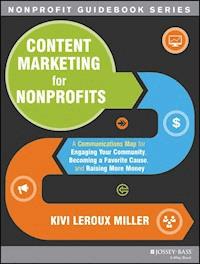
Nonprofits are communicating more often and in more ways than ever before . . .but is anyone paying attention? In her follow-up to The Nonprofit Marketing Guide: High-Impact, Low-Cost Ways to Build Support for Your Good Cause, Kivi Leroux Miller shows you how to design and implement a content marketing strategy that will attract people to your cause, rather than begging for their attention or interrupting them with your communications. Youll learn how to plan, create, share, and manage relevant and valuable content that inspires and motivates people to support your nonprofit in many different ways. Inside: * Eye-opening look at how nonprofit marketing and fundraising is changing, and the perils of not quickly adapting * Up-to-date guidance on communicating in a fast-paced, multichannel world * How to make big-picture strategic decisions about your content, followed by pragmatic and doable tactics on everything from editorial calendars to repurposing content * Real-world examples from 100+ nonprofits of all sizes and missions This book is your must-have guide to communicating so that you keep the supporters you already have, attract new ones, and together, change the world for the better.
Sie lesen das E-Book in den Legimi-Apps auf:
Seitenzahl: 557
Veröffentlichungsjahr: 2013
Ähnliche



















Contents
Foreword
Preface
Acknowledgments
About the Author
Part One: Finding a New Path: The Power of Content Marketing
Chapter One: Hearing the Call of the Wild
The End of the Target Audience
Participants, Supporters, and Influencers: Your PSIs
Seismic Shifts Affecting Your Marketing Strategy
Media Shifts: More Channels, More Choices, More Power to Decide
Demographic Shifts: The Four Generations of Your PSIs
How Each Generation Views Philanthropy
How Media and Demographic Shifts Affect Communications Choices
Why You Need to Respond to These Shifts
The Inner Angel–Inner Bookkeeper Problem
Why It Matters: Your PSIs Decide Relevance, Not You
Chapter Two: Understanding This Trek
The Theory of Change for Nonprofit Content Marketing
How to Stop Interrupting and Start Attracting
How Inbound and Outbound Communications Work Together
Communications at VolunteerMatch before and after Content Marketing
Nonprofit Communications with and without a Content Strategy
Focusing Less on Channels and More on Reactions
Example: Remaking a Newsletter Using Content Marketing
The Power of Becoming a Favorite Nonprofit
Finding Your Nonprofit’s Marketing Maturity Level
Why It Matters: Favorite Organizations Win
Chapter Three: Planting Your Flag at the Destination
Why Are You Communicating in the First Place?
Starting Your Goals Discussion: The Relative Importance of Short-Term Fundraising
Fundraising Communicators versus Community- or Brand-Building Communicators
Aligning Your Goals with What Defines Success
Measuring Content Marketing Progress: Are We There Yet?
Measuring Exposure versus Engagement
Five Ways to Measure Marketing
Setting SMART Objectives
Why It Matters: Goals Get You Moving
Part Two: Who Will Go with You: Redefining Your Marketing Relationships
Chapter Four: Making Friends on the Trail
Why People Give, Volunteer, and Advocate
What Supporters Want from You
What Volunteers Want from You
What Advocates Want from You
What Influencers Want from You
Reaching Overlooked Program Participants
How Your Needs and Theirs Come Together
Leaving Content Cairns for People at Different Stages
Why It Matters: They Are Your Partners, Not Your Audience
Chapter Five: Deciding on Your Trail Name
Picking Your Content Personality or Voice
Customizing Your Voice with Tone and Style
Taking on Big, Serious Issues in a Funny Voice
Bringing Out Your Personality in Social Media
No Matter Your Personality, Add the Three G’s
Why It Matters: You Need Them to Recognize You
Chapter Six: Carrying the Load
The Role of the Nonprofit Communications Director
Helping Staff Understand the Basics
Creating a Culture Where Everyone Is a Marketer
Facilitating a Board Retreat on Marketing
An Easy Way Others Can Help: Storytelling Stringers
Supporting Your Team with a Marketing Bank
Creative Briefs and Job Requests
Dealing with Resistance
Why It Matters: You Can’t Do It as Well Alone
Part Three: Envision the Journey: Preparing Your Content Marketing Plan
Chapter Seven: Mapping It Out
Identifying Big Events and Milestones
Identifying Your Primary Calls to Action
Identifying Your Major Story Arcs
The Big Picture Communications Timeline for Lillian’s List
Why It Matters: You Have to Get Your Story Straight
Chapter Eight: What You’ll Talk About
Developing Your List of Core Topics or Themes
Three Kinds of Content: Evergreens, Perennials, and Annual Color
Reliable Evergreens: Content with Staying Power
Perennial Favorites: Long-Term Content You Actively Tend
Annual Color: Short-Term, Splashy Content
Combining Your Priorities with Their Interests
Putting Some Cheese Sauce on That Broccoli
Why It Matters: Good Conversation Requires Substance
Chapter Nine: Building Your Itinerary
You, the Media Mogul
Why You Need an Editorial Calendar
Finding the Right Tracking Process
Organizing Your Editorial Calendar
Using Spreadsheets and Calendars Together
Planning Ahead: How Far Out Should You Look?
Letting Your Editorial Calendar Evolve
Planning a Reasonable Amount of Content
Selecting Communications Channels: The Big Six
Finding the Right Frequency of Communications
Producing Good Content Takes Time, So Choose Wisely
Still Not Sure? Start Here
How Much to Map, How Much to Merge
Using Editorial Meetings for Final Calendar Decisions
Why It Matters: You Need a Dynamic Plan
Chapter Ten: Conserving Energy on the Trail
Making One-Third of Your Content Repurposed
It’s Not Cheating; It’s Media Mogul Genius
Determining What’s Ripe for Repurposing
Five Favorite Ways to Repurpose Content
Seventeen More Ways to Repurpose Your Content
Repurposing Challenge: Getting More Mileage from an Awards Program
Using Technology to Reheat and Remix
Why It Matters: Repurposing Saves Lots of Time
Chapter Eleven: Handling Surprises along the Way
Preparing for Serendipity and Surprises
Little Bets: Getting Creative and Other Experiments
Letting a Little Bet Grow into a Way of Life
Newsjacking: Taking Advantage of the Headlines
How the Firelight Foundation Newsjacked the Facebook IPO
Crisis Communications: Responding to Bad News
Why It Matters: You Really Can Predict the Unpredictable
Part Four: Set Out on Your Trek: Implementing Your Content Marketing Strategy
Chapter Twelve: Living in the Moment
The Six R’s: How to Be Relevant
Bringing the Six R’s Together
Why It Matters: We Pay Attention Only to What’s Relevant
Chapter Thirteen: Your Swiss Army Knife
Eleven Favorite Types of Articles
Focusing on Results
Giving Your Supporters a Role in the Story
Telling a Posthole Story
Dressing Up Your Dogs
Writing the Headline First
Why It Matters: Don’t Struggle, Do What Works
Chapter Fourteen: Foraging and Filtering
Reasons to Shine a Light on the Good Work of Others
Finding Content to Curate
Sharing Curated Content
Always Give Credit—You’re a Curator, Not a Thief!
Using Conversation as the Content, Both Created and Curated
Curating User-Generated Content
Lessons on Curating User-Generated Content
Why It Matters: They Are Smarter Than You Are
Chapter Fifteen: The Best Trail Mix Recipe Ever
Why Nonprofits Need Metaphors
Coming Up with the Right Metaphor for Your Organization
Twenty-Five Metaphors for Your Nonprofit
Twelve Worn-Out Metaphors Your Nonprofit Should Avoid
Using Humor in Nonprofit Communications
Why Funny Works
Connecting with Humor
Why It Matters: Creativity Pays Off with Greater Engagement
Chapter Sixteen: High Tech on the Trail
The Right Technology Is Part of Your Staffing Strategy
Some of My Favorite Tech Tools
Why It Matters: They Expect a Good Experience
Part Five: The Right Provisions for the Journey: What You Need to Know about the Channels You Choose
Chapter Seventeen: Websites
What’s Different about This Communications Channel
Seven Ways to Make Your Content Work Here
Seven Mistakes to Avoid
Five Great Examples to Learn From
Chapter Eighteen: Blogs
What’s Different about This Communications Channel
Seven Ways to Make Your Content Work Here
Seven Mistakes to Avoid
Five Great Examples to Learn From
Chapter Nineteen: Email
What’s Different about This Communications Channel
Seven Ways to Make Your Content Work Here
Seven Mistakes to Avoid
Five Great Examples to Learn From
Chapter Twenty: Print Newsletters
What’s Different about This Communications Channel
Seven Ways to Make Your Content Work Here
Seven Mistakes to Avoid
Five Great Examples to Learn From
Chapter Twenty-One: Facebook
What’s Different about This Communications Channel
Seven Ways to Make Your Content Work Here
Seven Mistakes to Avoid
Five Great Examples to Learn From
Chapter Twenty-Two: Twitter
What’s Different about This Communications Channel
Seven Ways to Make Your Content Work Here
Seven Mistakes to Avoid
Five Great Examples to Learn From
Chapter Twenty-Three: Google+
What’s Different about This Communications Channel
Seven Ways to Make Your Content Work Here
Seven Mistakes to Avoid
Five Great Examples to Learn From
Chapter Twenty-Four: Video
What’s Different about This Communications Channel
Seven Ways to Make Your Content Work Here
Seven Mistakes to Avoid
Five Great Examples to Learn From
Chapter Twenty-Five: Images
What’s Different about This Communications Channel
Seven Ways to Make Your Content Work Here
Seven Mistakes to Avoid
Five Great Examples to Learn From
Chapter Twenty-Six: Pinterest
What’s Different about This Communications Channel
Seven Ways to Make Your Content Work Here
Seven Mistakes to Avoid
Five Great Examples to Learn From
Chapter Twenty-Seven: Mobile Devices
What’s Different about This Communications Channel
Seven Ways to Make Your Content Work Here
Seven Mistakes to Avoid
Five Great Examples to Learn From
Conclusion: Don’t Go If You Won’t Have Fun
Nonprofits Included in This Book
References
Index
Figures and Tables
Figures
1.1
Distribution of New Donors by Age in Two Origin Channels: 2010 Medians
2.1
Theory of Change for Nonprofit Marketing
3.1
How Nonprofit Communicators Describe Their Positions and Goals
3.2
Average Total Donations by Age Group
3.3
Number of People in the United States Aged Fifty-Five to Eighty-Five, 2000–2050, by Generation
3.4
Donor Pools by Generation
3.5
Volunteer Rates by Age Group, 1974–2010
3.6
Most Important Goals for Nonprofit Communications Strategies in 2013
3.7
Ranking Acquisition versus Retention among the Top Three Goals
4.1
What Motivates People to Get Involved in a Social Issue or Cause?
4.2
Engagement Pyramid
7.1
Big Picture Communications Timeline
7.2
Big Picture Communications Timeline: Events out of Your Control
7.3
Big Picture Communications Timeline: Events within Your Control
7.4
Big Picture Communications Timeline: Main Calls to Action
7.5
Big Picture Communications Timeline: Story Arcs
7.6
Lillian’s List Timeline
8.1
Big Picture Communications Timeline: Core Topics by Content Category
8.2
Big Picture Communications Timeline: Core Topics by Content Category and Time of Year
9.1
Content Plan Spreadsheet Page for Nonprofit Marketing Guide
9.2
Editorial Calendar for Nonprofit Marketing Guide
9.3
How Nonprofits Ranked Communications Channels in 2013
9.4
Very Important Communication Channels for Nonprofits with Large and Small Budgets
9.5
Types of Content Nonprofits Expect to Produce in 2013
11.1
Life of a News Story
11.2
How to Newsjack
12.1
Washington Humane Society’s Hurricane Sandy Email
Tables
1.1
Generations by Birth Year
1.2
How Each Generation Relates to Nonprofits
2.1
Nonprofit Communications with and without a Content Marketing Strategy
3.1
Most Popular Goal Combinations for Nonprofit Communicators in 2013
8.1
Tabby Cat Rescuers Core Topics by Content Category
9.1
Sample Editorial Calendar for a Monthly Email Newsletter
9.2
Relative Importance of Communications Channels to Nonprofits
10.1
The Archie Bray Foundation’s Email Open and Click Rate, December 27, 2011
10.2
The Archie Bray Foundation’s Email Open and Click Rate, November 8, 2012
10.3
The Archie Bray Foundation’s Email Open and Click Rate, December 12–13, 2012
10.4
The Archie Bray Foundation’s Email Open and Click Rate, December 31, 2012
Additional Praise forContent Marketing for Nonprofits
Kivi helps leaders think clearly and strategically about nonprofit communications as a whole, telling the organization’s story with a consistent voice and message, and being intentional about the goals of communications and marketing. Kivi’s work is applicable to nonprofits of all sizes, urban and rural. Her methods and guidance are clear, straightforward, and can be readily implemented by an organization’s staff team.
—Suzanne Wilcox, organizational development director, Montana Nonprofit Association
Marketing has changed. Interrupting people with ads, spamming inboxes, or sending direct mail doesn’t work like it used to. Now, you have to capture people’s attention, earn their trust, and be invited into their lives all while competing against countless other entities vying for their attention. Great content matters more now than it ever has before. Kivi has put together a comprehensive guide for those new to marketing as well as seasoned veterans that will help you successfully reach your constituents and future supporters through great content. Pay attention to what Kivi has to say. You’ll be a better marketer for it!
—Frank Barry, director of digital marketing, Blackbaud
Content marketing is a brand-new world for the nonprofit sector, which traditionally has relied on target marketing for communicating with its donors and other supporters and would-be supporters. Brand-new worlds can often be scary, especially if you try to go it alone. In authoring this book, Kivi has offered herself up as your intrepid guide. Whether your organization is young and wiry, or steadfastly entrenched in the “but we’ve always done it this way” sand trap, she talks—and walks—you through this new and vital approach to nonprofit communications. Her clean writing and authoritative-but-accessible style pull it all together in a way that feels like sipping tea and talking shop with a savvy friend and colleague.
—Margaret Battistelli Gardner, editor-in-chief, FundRaising Successmagazine
Kivi’s fabulous book is a must-read for fundraisers! We all know that fundraising has changed. And our donor communications strategies must keep evolving, too. Successful fundraisers have got to master this new art of continued, interesting communications to our donors. We have so many new ways to keep in touch with them—but what to do and how to do it? What to say? Thank goodness for this book because Kivi gives us the answers. She shares a clear blueprint for keeping our donors informed, interested, connected, and most of all—happy with us. If we follow her recipe, then we will be rewarded with the holy grail of fundraising—long-term sustainable gifts and contributions that you can count on year after year. Thank you, Kivi!
—Gail Perry, author ofFired-Up Fundraising: Turn Board Passion into Action
The web changed the way all of us find, review, use, and share content. This book is a critical piece for all organizations looking to create content that appeals to the community, generates the kind of attention and brand awareness that nonprofits need, and ultimately supports conversion of readers to supporters and donors. Every nonprofit communications, marketing, and online engagement staffer should have this book!
—Amy Sample Ward, coauthor ofSocial Change Anytime Everywhere
Content marketing is a jungle full of tigers, snakes, and slimy little creatures that want to suck your blood. Content marketing is also a great tool for making a lot of impact without spending a lot of money. This book will help you navigate and survive the content marketing jungle—successfully.
—Jeff Brooks, TrueSense Marketing and author ofThe Fundraiser’s Guide to Irresistible Communications
This book is what you’ve been waiting for! It is filled with a-ha moments and is a smart, fun roadmap to transform your nonprofit communications.
—Lori L. Jacobwith, master storyteller and founder of the Ignited Online Fundraising Community
This book includes Professional content that can be accessed from our website when you register at www.josseybass.com/go/leroux using the password professional.
Please also visit the author’s website for this book at ContentMarketingforNonprofits.com for additional examples, exercises, worksheets, and updates. You can also use this website to pass along your thoughts about the ideas in this book and to connect with other readers.
Copyright © 2013 by John Wiley & Sons, Inc. All rights reserved.
Cover design by Michael Cook
Cover image by © Serkorkin/iStockphoto
Published by Jossey-Bass
A Wiley Brand
One Montgomery Street, Suite 1200, San Francisco, CA 94104-4594—www.josseybass.com
No part of this publication may be reproduced, stored in a retrieval system, or transmitted in any form or by any means, electronic, mechanical, photocopying, recording, scanning, or otherwise, except as permitted under Section 107 or 108 of the 1976 United States Copyright Act, without either the prior written permission of the publisher, or authorization through payment of the appropriate per-copy fee to the Copyright Clearance Center, Inc., 222 Rosewood Drive, Danvers, MA 01923, 978-750-8400, fax 978-646-8600, or on the Web at www.copyright.com. Requests to the publisher for permission should be addressed to the Permissions Department, John Wiley & Sons, Inc., 111 River Street, Hoboken, NJ 07030, 201-748-6011, fax 201-748-6008, or online at www.wiley.com/go/permissions.
Limit of Liability/Disclaimer of Warranty: While the publisher and author have used their best efforts in preparing this book, they make no representations or warranties with respect to the accuracy or completeness of the contents of this book and specifically disclaim any implied warranties of merchantability or fitness for a particular purpose. No warranty may be created or extended by sales representatives or written sales materials. The advice and strategies contained herein may not be suitable for your situation. You should consult with a professional where appropriate. Neither the publisher nor author shall be liable for any loss of profit or any other commercial damages, including but not limited to special, incidental, consequential, or other damages. Readers should be aware that Internet websites offered as citations and/or sources for further information may have changed or disappeared between the time this was written and when it is read.
Jossey-Bass books and products are available through most bookstores. To contact Jossey-Bass directly call our Customer Care Department within the U.S. at 800-956-7739, outside the U.S. at 317-572-3986, or fax 317-572-4002.
Wiley also publishes its books in a variety of electronic formats and by print-on-demand. Some material included with standard print versions of this book may not be included in e-books or in print-on-demand. If the version of this book that you purchased references media such as CD or DVD that was not included in your purchase, you may download this material at http://booksupport.wiley.com. For more information about Wiley products, visit www.wiley.com.
Library of Congress Cataloging-in-Publication Data
Leroux Miller, Kivi, 1969–
Content marketing for nonprofits: a communications map for engaging your community, becoming a favorite cause, and raising more money / Kivi Leroux Miller.—First edition.
pages cm.—(The Jossey-Bass nonprofit guidebook series)
Includes bibliographical references and index.
ISBN 978-1-118-44402-3 (paper); ISBN 978-1-118-72238-1 (ebk.); ISBN 978-1-118-72237-4 (ebk.)
1. Nonprofit organizations—Marketing. I. Title.
HD62.6.L46 2013
658.8—dc23
2013013519
The Jossey-Bass Nonprofit Guidebook Series
The Jossey-Bass Nonprofit Guidebook Series provides new to experienced nonprofit professionals and volunteers with the essential tools and practical knowledge they need to make a difference in the world. From hands-on workbooks to step-by-step guides on developing a critical skill or learning how to perform an important task or process, our accomplished expert authors provide readers with the information required to be effective in achieving goals, mission, and impact.
Other Titles in the Jossey-Bass Guidebook Series
Foreword
A few years ago, I gave a speech on fundraising at a conference. Midway through the presentation, I mentioned my work at Network for Good to the more than one hundred nonprofit professionals in attendance. This prompted a man in the middle of the room to raise his hand.
“Do you have a question?” I asked.
“I have a Network for Good Donate Now button on my organization’s home page,” he declared.
I smiled. How lovely to have a fan and client of my organization in the crowd. I thanked him and launched back into my presentation.
But he raised his hand again. So I called on him once more.
“You know that button?” he said. “It doesn’t work.”
This was certainly not what I wanted to hear. Embarrassed, I apologized. I said to the man—and everyone else in the room—that I was anxious to fix the problem and would get to the bottom of why people could not make donations from his website as soon as I finished my speech.
“I’ll call my chief technology officer,” I assured him.
Just as I was about to resume speaking, the man waved his hand once more. I wondered if I should pinch myself. The situation was becoming eerily reminiscent of a bad dream. With trepidation, I called on him one last time.
“You don’t get it,” the man told me. “You can click and make a donation on my website. The problem is, no one clicks on the button.”
Ah. This wasn’t broken technology. This was broken fundraising.
I have grown to love that man because our exchange makes for a good story, and it captures nonprofits’ biggest marketing challenge, which is getting people to care. In addition, his broken button shows both the opportunities and limits of the great technological changes that are roiling our world and our sector. The number of tools and the amount of noise around us grow by the day. We see shiny objects everywhere, and we imagine they might fix our problems and magically enhance our work. Whether they fulfill that promise or not, we tend to attribute our success or failure to the technology.
I hear three schools of thought about technology and the changes unfolding around us. One is wildly optimistic: we are more connected than ever, and this is creating an opportunity to reimagine and revolutionize every industry. Technology has transformed music, publishing, and banking. Philanthropy is next—and when it goes digital, we will unleash the generosity inherent in us all on an unprecedented scale. Another view is wary: our text-messaging, smartphone-wielding selves are losing the ability to focus and reflect deeply. The traditional conversation has changed into mediated connection, leading to our isolation from each other. Small, inconsequential digital actions do little to change our relationships with our causes or the face of marketing and fundraising. The third view is cynical. It’s best summed up by a wonderful question posted on Reddit recently: If someone from the 1950s suddenly appeared today, what would be the most difficult thing to explain to him or her about life now? My favorite response was this: I possess a device, in my pocket, that is capable of accessing the entirety of information known to man. I use it to look at pictures of cats and get into arguments with strangers. This school of thought says we’re using technology in a way that really makes no difference, and so there is nothing new under the sun when it comes to our work.
So which is right? All of the above. It’s up to us which scenario proves true in our situation. That’s because the broken button is not about what the technology can or can’t do. It’s about what we do or don’t do. That’s the good news and the bad news. You—the very person reading these words right this minute—get to determine whether or not your button or Facebook page or YouTube channel performs—and whether today’s technological changes will prove trying or transformative to your cause.
How do you do that? That’s the very question this book sets out to answer. It explains the way technology has changed our work. It delves into the way our constituencies expect more of us. And then it describes how to embrace these new realities and turn them to our benefit by focusing on better content that drives deeper engagement.
In other words, this book decodes how you get people to click on your button. It’s not by having a higher powered button—it’s by having better content around the button and leading to the button.
If I had to sum up why this book matters, I’d say it’s because of what it makes possible. It shows how to inject soul into your use of technology so your constituencies enter a world of unleashed generosity—and not just cute pictures of cats.
You can do these things. When you read this book, you learn it’s not that hard. And even if it were difficult, you’d have to do it anyway. You have no choice. Your relevance and survival hinges on what you say—and what others say about you. People will click a donate button, “like” a page, or show up in real life to volunteer only when you tell, share, and spread compelling stories (activities also known as content marketing).
So turn the page and read this story on how to make that happen.
Katya Andresen
Author, Robin Hood Marketing: Stealing Corporate Savvy to Sell Just Causes
Preface
I wrote my first book, The Nonprofit Marketing Guide: High-Impact, Low-Cost Ways to Build Support for Your Good Cause, because there wasn’t a good handbook or survival guide for nonprofit communications directors, especially at smaller organizations. I also knew many nonprofit executive directors doing it all on their own, and I wanted to create something for them too.
My intent in this second book is not to update The Nonprofit Marketing Guide but to advance the conversation about what it means to be a good communications director today and how to use one of the biggest marketing trends—content marketing—specifically in the nonprofit sector.
If you are new to nonprofit marketing or work for a very small organization, I suggest you start with the first book and use this one more as a crystal ball for what your future will hold someday. If you’ve been at nonprofit marketing for awhile or you work for a large or well-funded nonprofit, I hope this book will become a trusted guide that you can turn to for both direction and inspiration. Fundraising professionals, especially those interested in donor retention, will find more content specifically for them in this book than in the first.
What Is Content Marketing?
Content marketing isn’t just a new buzzword for the same old communications your nonprofit has always produced. It’s a different way of thinking not only about why and how you communicate but, more importantly, about how your program participants, the supporters of your work, and the influencers in your community use, interact with, and in many ways, help you coproduce your communications.
All those communications pieces you’ve been creating for years—newsletter articles, direct mail letters, press releases, web pages—are content. What’s different now is that instead of just pushing that content in front of people, we want to use the content we create to pull them to us, attracting them to our cause, rather than interrupting them with it.
Here’s how I define content marketing for nonprofits:
Content marketing for nonprofits is creating and sharing relevant and valuable content that attracts, motivates, engages, and inspires your participants, supporters, and influencers to help you achieve your mission.
If you take an objective look at what many nonprofits share through their communications today, you might conclude that reporting on all of your nonprofit’s past activities (the narrative equivalent of summarizing last month’s to-do list) while also promoting its upcoming activities (which usually means asking people to do something for you) is what works.
The problem is, it really doesn’t. I’m not sure it was ever all that effective, and in today’s world, it definitely doesn’t cut it. To connect with and engage participants and supporters, you need to do more than summarize your work. You need to put those people front and center in your communications strategy, building relationships with them much like you would with friends, so that you become one of their favorite nonprofits.
It’s a Long Trek
Throughout this book I compare content marketing to a long backpacking trip into the backcountry. It’s a little wild out there, but you’ll be prepared for most of it!
In part 1 you’ll get a fuller sense of what this journey involves and the benefits of getting started with content marketing. In part 2 you’ll look at the people going on the trek with you and redefine your marketing relationships.
In part 3 you’ll plan out the journey with several communications documents, making sure you are ready from start to finish. In part 4 you’ll look at making it happen, and how to put one foot in front of the other as you implement your content strategy.
Finally, in part 5, you’ll get trail-tested advice on how to use the most popular communications channels and tactics for nonprofits today.
Stop, Think, and Discuss
In the chapters in parts 1 through 4, you’ll find lots of boxes with questions that will encourage you to stop, think about, and discuss what you’ve read and how you can apply it to your nonprofit. Please also stop by ContentMarketingforNonprofits.com, where I will be sharing more exercises and worksheets that support the content in this book.
One final heads-up: the chapters in part 1 are stat-heavy. If you are not a numbers person, don’t worry—the rest of the book isn’t as data dense. Also note that marketing data do shift frequently, so if you need the most up-to-date numbers, check the chapter references for the websites of my sources or visit my website for this book at ContentMarketingforNonprofits.com. Many of the reports I quote are updated annually and sometimes more often.
Let’s get started!
June 2013
Kivi Leroux Miller
Acknowledgments
When I set out to write this book, I knew from the start that I wanted it to be a community production. I set a goal of including at least 100 nonprofits in the book in one way or another as positive examples for you to learn from. The official count is 118. Some are examples I have admired from afar, some have provided an anecdote via one of my many surveys, and some have granted me an extensive interview—whatever the method, I offer my most sincere thanks to all who shared information with me. This really is your book.
If part 5 of the book becomes your favorite, and for many it will, you have Nonprofit Marketing Guide’s community engagement manager, Kristina Leroux, to thank for it. Kristina did most of the research for these chapters, compiling tips and examples for you to learn from. She also helped me find and fill gaps throughout the book, managed the permissions and graphics, proofread the book several times, and has always been there when I need her, which is just about every day. I love working with my little sister!
I am also very grateful for the generous community of nonprofit marketing and fundraising bloggers, many of whom are quoted directly in the book and who all contributed in their own way by helping me stretch my own thinking. I am especially grateful to Tom Ahern, Katya Andresen, Frank Barry, Jeff Brooks, John Haydon, Beth Kanter, Kerri Karvetski, Gail Perry, and Nancy Schwartz. If you read them—and you should—you will likely recognize their influence on me.
Special thanks also to the fine women who worked behind the scenes on this book, including my editor Alison Hankey, developmental editor Nathinee Chen, and reviewers Katya Andresen, Jocelyn Harmon, and Maddie Grant, whose wisdom guided major changes between the first and final drafts.
Finally, I am blessed with a wonderful husband, Edgar, and two spirited daughters, Ava and Jianna, who only whined for a little while when I said I was writing a second book. As the manuscript grew, so did their self-reliance and patience with their mom.
My gratitude and love to you all.
About the Author
Kivi Leroux Miller is president of Nonprofit Marketing Guide.com and author of The Nonprofit Marketing Guide: High-Impact, Low-Cost Ways to Build Support for Your Good Cause.
Through training, coaching, and consulting, Kivi helps small nonprofits and small communications departments at larger organizations make a big impression with smart, savvy marketing and communications. She teaches a weekly webinar series and writes the top-ranked blog on nonprofit communications at Nonprofit Marketing Guide.com. Thousands of nonprofits in all fifty US states, across Canada, and in more than thirty countries have participated in Kivi’s online and in-person trainings.
Lesen Sie weiter in der vollständigen Ausgabe!
Lesen Sie weiter in der vollständigen Ausgabe!
Lesen Sie weiter in der vollständigen Ausgabe!
Lesen Sie weiter in der vollständigen Ausgabe!
Lesen Sie weiter in der vollständigen Ausgabe!
Lesen Sie weiter in der vollständigen Ausgabe!
Lesen Sie weiter in der vollständigen Ausgabe!
Lesen Sie weiter in der vollständigen Ausgabe!
Lesen Sie weiter in der vollständigen Ausgabe!
Lesen Sie weiter in der vollständigen Ausgabe!
Lesen Sie weiter in der vollständigen Ausgabe!
Lesen Sie weiter in der vollständigen Ausgabe!
Lesen Sie weiter in der vollständigen Ausgabe!
Lesen Sie weiter in der vollständigen Ausgabe!
Lesen Sie weiter in der vollständigen Ausgabe!
Lesen Sie weiter in der vollständigen Ausgabe!
Lesen Sie weiter in der vollständigen Ausgabe!
Lesen Sie weiter in der vollständigen Ausgabe!
Lesen Sie weiter in der vollständigen Ausgabe!
Lesen Sie weiter in der vollständigen Ausgabe!
Lesen Sie weiter in der vollständigen Ausgabe!
Lesen Sie weiter in der vollständigen Ausgabe!
Lesen Sie weiter in der vollständigen Ausgabe!
Lesen Sie weiter in der vollständigen Ausgabe!
Lesen Sie weiter in der vollständigen Ausgabe!
Lesen Sie weiter in der vollständigen Ausgabe!
Lesen Sie weiter in der vollständigen Ausgabe!
Lesen Sie weiter in der vollständigen Ausgabe!
Lesen Sie weiter in der vollständigen Ausgabe!
Lesen Sie weiter in der vollständigen Ausgabe!
Lesen Sie weiter in der vollständigen Ausgabe!
Lesen Sie weiter in der vollständigen Ausgabe!
Lesen Sie weiter in der vollständigen Ausgabe!
Lesen Sie weiter in der vollständigen Ausgabe!
Lesen Sie weiter in der vollständigen Ausgabe!
Lesen Sie weiter in der vollständigen Ausgabe!




