


20,99 €
Mehr erfahren.
- Herausgeber: John Wiley & Sons
- Kategorie: Fachliteratur
- Sprache: Englisch
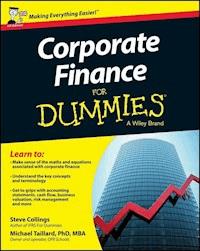
The maths, the formulas, and the problems associated with corporate finance can be daunting to the uninitiated, but help is at hand.
Corporate Finance For Dummies, UK Edition covers all the basics of corporate finance, including: accounting statements; cash flow; raising and managing capital; choosing investments; managing risk; determining dividends; mergers and acquisitions; and valuation. It also serves as an excellent resource to supplement corporate finance coursework and as a primer for exams.
Inside you’ll discover:
- The tools and expert advice you need to understand corporate finance principles and strategies
- Introductions to the practices of determining an operating budget, calculating future cash flow, and scenario analysis - in plain English
- Information on the risks and rewards associated with corporate finance and lending
- Easy–to–understand explanations and examples
- Help to pass your corporate finance exam!
Sie lesen das E-Book in den Legimi-Apps auf:
Seitenzahl: 594
Veröffentlichungsjahr: 2013
Ähnliche














Corporate Finance For Dummies®
Published by: John Wiley & Sons, Ltd., The Atrium, Southern Gate, Chichester, www.wiley.com
This edition first published 2013
© 2013 John Wiley & Sons, Ltd, Chichester, West Sussex.
Registered office
John Wiley & Sons Ltd, The Atrium, Southern Gate, Chichester, West Sussex, PO19 8SQ, United Kingdom
For details of our global editorial offices, for customer services and for information about how to apply for permission to reuse the copyright material in this book please see our website at www.wiley.com.
All rights reserved. No part of this publication may be reproduced, stored in a retrieval system, or transmitted, in any form or by any means, electronic, mechanical, photocopying, recording or otherwise, except as permitted by the UK Copyright, Designs and Patents Act 1988, without the prior permission of the publisher.
Wiley publishes in a variety of print and electronic formats and by print-on-demand. Some material included with standard print versions of this book may not be included in e-books or in print-on-demand. If this book refers to media such as a CD or DVD that is not included in the version you purchased, you may download this material at www.dummies.com. For more information about Wiley products, visit www.wiley.com.
Designations used by companies to distinguish their products are often claimed as trademarks. All brand names and product names used in this book are trade names, service marks, trademarks or registered trademarks of their respective owners. The publisher is not associated with any product or vendor mentioned in this book.
Limit of Liability/Disclaimer of Warranty: While the publisher and author have used their best efforts in preparing this book, they make no representations or warranties with the respect to the accuracy or completeness of the contents of this book and specifically disclaim any implied warranties of merchantability or fitness for a particular purpose. It is sold on the understanding that the publisher is not engaged in rendering professional services and neither the publisher nor the author shall be liable for damages arising herefrom. If professional advice or other expert assistance is required, the services of a competent professional should be sought.
For general information on our other products and services, please contact our Customer Care Department within the U.S. at 877-762-2974, outside the U.S. at (001) 317-572-3993, or fax 317-572-4002. For technical support, please visit www.wiley.com/techsupport.
For technical support, please visit www.wiley.com/techsupport.
A catalogue record for this book is available from the British Library.
ISBN 978-1-118-74350-8 (paperback); ISBN 978-1-118-74348-5 (ebk); ISBN 978-1-118-74347-8 (ebk)
Printed in Great Britain by TJ International, Padstow, Cornwall
10 9 8 7 6 5 4 3 2 1
Corporate Finance For Dummies®
Visit www.dummies.com/cheatsheet/corporatefinanceuk to view this book's cheat sheet.
Table of Contents
Introduction
About This Book
Foolish Assumptions
Icons Used in This Book
Beyond the Book
Where to Go from Here
Part I: Getting Started with Corporate Finance
Chapter 1: Introducing Corporate Finance
Considering Corporate Finance and the Role of Money in the World
Identifying What Makes Corporate Finance Unique
Serving as an intermediary
Analysing interactions between people
Recognising How Corporate Finance Rules Your Life
Becoming Proactive about Corporate Finance
Chapter 2: Navigating the World of Corporate Finance
Visiting the Main Attractions in Finance Land
Investigating the incorporated entity
Discovering depository institutions
Covering yourself: Insurance companies
Spotting securities firms
Understanding underwriters
Finding out about funds
Obtaining other loans: Financing institutions
Buying and selling shares: Stock markets
Setting the rules: Regulatory bodies
Banking on the Bank of England
Governing policy: HM Treasury
Meeting the Inhabitants of Finance Land
Starting at entry-level positions
Researching the analysts
Checking the auditors
Assessing loss adjusters
Taking in the view from the top: Executives and managers
Making money: Traders
Taking financial responsibility: Treasury officers
Considering other finance positions
Visiting the Finance Land Information Resources
Using Internet resources
Reading print resources
Hunting out human resources
Chapter 3: Raising Money for Business Purposes
Raising Capital
Acquiring Debt to Raise Funds
Asking the right people for money
Making sure the loan pays off in the long run
Looking at loan terms
Selling Equity to Raise Cash
Selling shares to the public
Looking at the different types of shares
Part II: Reading Financial Statements as a Second Language
Chapter 4: Seeing What You’re Worth with the Balance Sheet
Introducing the Balance Sheet
Knowing the Weights on the Balance Scale
Assessing Your Assets
Considering current assets
Finding out about fixed assets
Investigating intangible assets
Gathering the rest: Other assets
Looking at Liabilities
Calculating current liabilities
Exploring long-term liabilities
Valuing the Company: Shareholders’ Funds
Ordinary shares
Treasury shares
Share premium
Profit and loss reserves
Revaluation reserve
Making Use of the Balance Sheet
Chapter 5: Getting Paid with the Profit and Loss Account
Adding Income and Subtracting Costs: What’s on the Profit and Loss Account
Calculating profitability: Gross profit
Finding the costs of doing business: Operating profit
Accounting for other costs and revenues: Earnings before interest and taxes
Considering tax and interest to arrive at net profit
Including earnings per share
Completing the picture: Supplemental notes
Putting the Profit and Loss Account to Good Use
Chapter 6: Easy Come, Easy Go: Understanding the Cash Flow Statement
Piecing Together a Puzzle of Cash Flows
Earning or spending cash: Operating activities cash flows
Buying and selling: Investing activities cash flows
Raising capital: Financing activities cash flows
Combining the three types of operations to find net change in cash
Using the Cash Flow Statement
Chapter 7: Making Financial Statements Useful with Ratio Analysis
Being Able to Pay the Bills: Liquidity Ratios
Current ratio
Acid test ratio
Analysing Efficiency with Activity Ratios
Trade debtors’ days
Days sales in trade debtors
Trade debtors turnover
Trade creditors ratio
Days sales in stock
Stock turnover
Stock turnover in days
Operating cycle
Working capital
Turnover (sales) to working capital
Fixed asset turnover
Measuring Profit Generation and Management with Profitability Ratios
Return on capital employed (ROCE)
Net profit margin
Net asset turnover
Gross profit margin
EBITDA/capital employed
Return on assets
Operating profit margin
Operating asset turnover
Return on operating assets
Return on total equity
Return on investment
Evaluating a Company’s Debt Management with Debt Ratios
Interest cover
Fixed charge coverage
Debt to equity ratio
Chapter 8: Measuring Financial Wellbeing with Special-Use Ratios
Focusing on Earnings and Dividends with Investor Ratios
Return on equity
Earnings per share
Dividend per share
Price to earnings ratio
Earnings yield
Dividend payout ratio
Dividend yield
Book value per share
Dividend cover
Generating Earnings from Interest: Ratios for Banks
Earning assets to total assets ratio
Net interest margin
Loan loss coverage ratio
Equity to total assets ratio
Deposits times capital
Loans to deposits ratio
Using Ratios to Measure Operating Asset Management
Operating ratio
Percentage earned on operating property
Operating revenue to operating property ratio
Long-term debt to operating property ratio
Part III: Placing Valuations on the Price Tags of Business
Chapter 9: Determining Present and Future Values: Time Is Money
Losing Value over Time
Increasing prices, decreasing value: Inflation
Maintaining your curiosity: Interest rates
Predicting Future Value
Making simple interest easy
Building an understanding of compound interest
Calculating the Present Value
Taking a closer look at earnings
Discussing discounted cash flows
Chapter 10: Looking to the Future with Capital Budgeting
Understanding Capital Budgeting
Rating Your Returns
Looking at costs
Reckoning your revenue
Calculating the accounting rate of return
Making the most of the internal rate of return through modification
Netting Present Values
Totting up NPV over time
Managing the project’s value
Determining the Payback Period
Managing Capital Allocations
Assessing the equivalent annual cost
Considering liquid assets
Looking at a Piece of Project Management
Doing the value schedule calculations
Carrying out the budget calculations
Chapter 11: Bringing on Your Best Bond Bets
Exploring the Different Types of Bonds
Considering corporate bonds
Gauging government gilts
Receiving periodic interest with coupon bonds
Forgoing periodic payments with zero-coupon bonds
Figuring out deep discounted bonds
Sizing up asset-backed securities
Having the best of two worlds with convertible bonds
Using callable bonds to capitalise on interest rates
Looking at the pros and cons of puttable bonds
Getting the gist of registered bonds
Counting on forgiveness with catastrophe bonds
Looking at Bond Rates
Reading Bond Information
Understanding Bond Valuation
Chapter 12: Being Savvy When Shopping for Shares
Exchanging Shares: Where to Buy and Sell
Looking at the Different Types of Orders
Making market orders
Controlling prices with stop and limit orders
Pondering pegged orders
Counting on time-contingent orders
Comparing Long and Short Stocks
Buying long
Using margin trading
Selling short
Classifying Shares: Chips, Caps and Sectors
Dipping into chips
Capitalising on market caps
Selecting by sectors
Knowing Where the Market Stands: Bulls versus Bears
Watching Stocks and Shares Indices
Calculating the Value of Stocks and Shares
Surveying equity valuation models
Checking out corporate analysis
Evaluating industry performance
Factoring in stock market fluctuations
Mulling over macroeconomics
Chapter 13: Measuring Valuations of the May-Be: Derivatives
Introducing the Derivatives Market
Buying or Selling – Then Again, Maybe Not: Options
Managing risk
Generating revenue
Valuing
Customising the Contract with Forwards
Managing risk
Generating revenue
Valuing
Adding Some Standardisation to the Contract with Futures
Managing risk
Generating revenue
Valuing
Exchanging This for That and Maybe This Again: Swaps
Managing risk
Generating revenue
Valuing
Part IV: Walking in a Risk Management Wonderland
Chapter 14: Managing the Risky Business of Corporate Finances
Understanding that Risk Is Unavoidable
Investigating Interest Rate Risk and Inflation Risk
Minimising Market Risk
Evaluating the Risk of Extending Credit
Understanding Off-Balance-Sheet Risk
Factoring in Foreign Exchange Risk
Describing transaction risk
Tackling translation risk
Considering other foreign exchange risks
Identifying Operating Risk
Looking at Liquidity Risk
Chapter 15: Through the Looking Glass of Modern Portfolio Theory
Delving into Portfolio Practicalities
Surveying portfolio management strategies
Looking at modern portfolio theory
Understanding passive versus active management
Hypothesising an Efficient Market
Risking Returns
Looking at the trade-off between risk and return
Diversifying to maximise returns and minimise risk
Considering risk aversion
Measuring risk
Optimising Portfolio Risk
Chapter 16: Entering the Science Lab: Financial Engineering
Creating New Tools through Financial Engineering
Making Securities from Just about Anything
Realising that you can securitise everything
Slicing securities into tranches
Looking at Hybrid Finances
Meeting the mixed-interest class of hybrids
Circling around single asset class hybrids
Becoming a financial Frankenstein: Index-backed CDs
Bundling Assets
Making a bundle with multi-asset bundles
Unbundling securities
Appealing to a Large Market with Exotic Finances
Owning options
Seeking out swaps contracts
Living with exotic loans
Engineering Your Portfolio to the Max
Examining the fundamentals of portfolio engineering
Finding out about flash crashes
Moving into Computational Finance
Changing the face of trading
Offering online banking
Looking at logic programming
Chapter 17: Assessing Capital Structure
Making More Money than You Borrow
Calculating the Cost of Capital
Measuring cost of capital the WACC way
Factoring in the cost of debt
Looking at the cost of equity
Discussing dividend policy
Choosing the Proper Capital Structure
Part V: Understanding Financial Management
Chapter 18: Assessing Financial Performance
Understanding the Importance of Analysing Financial Success
Using Common-Size Comparisons
Looking at vertical common-size comparisons
Handling horizontal common-size comparisons
Considering cross comparisons
Providing Context by Performing Comparatives
Contrasting over time
Comparing against industry competitors
Determining the Quality of Profits
Tackling accounting concerns
Thinking about sources of cash flows
Assessing Investment Performance
Employing conventional evaluations of success
Perusing portfolio manager evaluations
Chapter 19: Forecasting Finances Is Easier than Predicting the Weather
Seeing with Eyes Analytical
Collecting data
Finding an average
Measuring data distribution
Understanding probability
Viewing the Past as New
Finding trends and patterns
Looking at regression
Seeing the Future Unclouded: Forecasting
Using statistics and probability
Seeking a precedent: Reference class forecasting
Evaluating forecast performance
Chapter 20: Spelling out the ABC of M&A
Getting the Lowdown on M&A
Differentiating Between the M and the A
Joining together: Mergers
Purchasing a company: Acquisitions
Taking control: Buyouts
Considering other forms of integration
Clearing up the Mess: Divestitures
Identifying Motives for M&A
Discovering diversification
Expanding geographically
Benefiting from economies of scale
Enjoying economies of scope
Integrating up, down and all around
Eliminating competitors
Seeking manager compensation
Gaining synergies
Measuring What a Business Is Worth to You
Assessing a price
Choosing an evaluation method
Financing M&A
Part VI: The Part of Tens
Chapter 21: Ten Things You Need to Know about International Finance
Understanding that Trade Imbalances Don’t Exist
Revealing that Purchasing Power Is Different to Exchange Rate
Examining Eurobonds (which Aren’t Necessarily from Europe)
Sorting the Muddled Relationship of Interest and Exchange Rates
Spotting the Spot Rate and Other Currency Transactions
Diversifying Can’t Completely Eliminate Risk Exposure
Cross-Listing Allows Companies to Tap the World’s Resources
Outsourcing as a Taxing Issue
Complicating Your Life with Politics
Knowing Your Neighbours: Cultural Understanding Is Vital
Chapter 22: Ten Things You Need to Understand about Behavioural Finance
Making Financial Decisions Is Rarely Entirely Rational
Executing Sound Financial Decisions Involves Identifying Logical Fallacies
Getting Emotional about Financial Decisions Can Leave You Crying
Stampeding in Finance Can Get You Trampled
Letting Relationships Influence Finances Can Be Dangerous
Satisficing Can Optimise Your Time and Energy
Explaining Life in the Improbable: Prospect Theory
Accepting that People Are Subject to Behavioural Biases
Analysing and Presenting Information Is Fraught with Problems
Measuring Irrationality in Finance Is Rational Behavioural Finance
About the Authors
Cheat Sheet
Connect with Dummies
Part I
Getting Started with Corporate Finance
For Dummies can help you get started with lots of subjects. Visit www.dummies.com to learn more and do more with For Dummies.
In this part . . .
Bone up on the basics of corporate finance and become proactive with your corporate finance know-how.
Navigate your journey through the complex world of corporate finance, stopping off at the major organisations and visiting the major roles involved along the way.
Get to grips with how companies raise money by incurring debt and by selling equity.
Chapter 1
Introducing Corporate Finance
In This Chapter
Understanding the meaning of money
Looking at the study of corporate finance
Seeing the role corporate finance plays in your life
Making corporate finance work for you
Corporate finance is more than just a measure of money. In fact, as you discover in this chapter – where we talk about the nature of money, how it applies to corporate finance and how it connects to you and your life – money is somewhat incidental to finance. When you’re discussing corporate finance, you’re looking at the whole world in a brand new way that measures it and what it contains so as to make the information useful to people. You can calculate things in terms of corporate finance that you simply can’t measure accurately in any other way.
Part of the role of this chapter is also to introduce you to the book as a whole. Therefore, as part of helping you become proactive with your corporate finance know-how, we clue you into other chapters to allow you to follow your personal interests quickly and easily.
Considering Corporate Finance and the Role of Money in the World
Corporate finance is the study of relationships between groups of people that quantifies the otherwise immeasurable. (Corporate finance can also refer to a department, such as the corporate finance department in an investment bank that deals with advice given to companies about financial arrangements.) To understand how this rather wordy definition makes any sense at all, you have to take a quick look at the role of money in the world.
Lesen Sie weiter in der vollständigen Ausgabe!
Lesen Sie weiter in der vollständigen Ausgabe!
Lesen Sie weiter in der vollständigen Ausgabe!
Lesen Sie weiter in der vollständigen Ausgabe!
Lesen Sie weiter in der vollständigen Ausgabe!
Lesen Sie weiter in der vollständigen Ausgabe!
Lesen Sie weiter in der vollständigen Ausgabe!
Lesen Sie weiter in der vollständigen Ausgabe!
Lesen Sie weiter in der vollständigen Ausgabe!
Lesen Sie weiter in der vollständigen Ausgabe!
Lesen Sie weiter in der vollständigen Ausgabe!
Lesen Sie weiter in der vollständigen Ausgabe!
Lesen Sie weiter in der vollständigen Ausgabe!
Lesen Sie weiter in der vollständigen Ausgabe!
Lesen Sie weiter in der vollständigen Ausgabe!
Lesen Sie weiter in der vollständigen Ausgabe!
Lesen Sie weiter in der vollständigen Ausgabe!
Lesen Sie weiter in der vollständigen Ausgabe!
Lesen Sie weiter in der vollständigen Ausgabe!
Lesen Sie weiter in der vollständigen Ausgabe!
Lesen Sie weiter in der vollständigen Ausgabe!
Lesen Sie weiter in der vollständigen Ausgabe!
Lesen Sie weiter in der vollständigen Ausgabe!
Lesen Sie weiter in der vollständigen Ausgabe!
Lesen Sie weiter in der vollständigen Ausgabe!
Lesen Sie weiter in der vollständigen Ausgabe!
Lesen Sie weiter in der vollständigen Ausgabe!
Lesen Sie weiter in der vollständigen Ausgabe!
Lesen Sie weiter in der vollständigen Ausgabe!




