


20,99 €
Mehr erfahren.
- Herausgeber: John Wiley & Sons
- Kategorie: Fachliteratur
- Sprache: Englisch
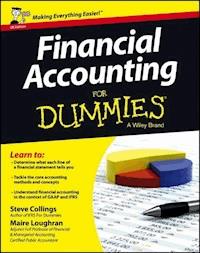
Your plain–English guide to financial accounting for students and trainees.
Financial Accounting For Dummies provides students who are studying finance, accounting and business with the basic concepts, terminology, and methods to interpret, analyse, prepare and evaluate financial statements. Covers concepts accountants and other business professionals use to prepare reports; mergers and acquisitions purchase and pooling; free cash flow; and financial statement analysis.
Whether you′re a student on your way to earning a degree, working towards your ACCA qualification, or a trainee just starting out in your accounts career, Financial Accounting For Dummies gives you a wealth of information to grasp the subject.
- This UK version is adapted to take in UK accounting practice and international reporting standards
- Provides a firm grounding in interpreting, analysing, preparing and evaluating corporate financial statements
- Includes easy–to–understand explanations and real-life examples to consolidate learning
Sie lesen das E-Book in den Legimi-Apps auf:
Seitenzahl: 548
Veröffentlichungsjahr: 2013
Ähnliche












Financial Accounting For Dummies®
Published by: John Wiley & Sons, Ltd., The Atrium, Southern Gate, Chichester, www.wiley.com
This edition first published 2013
© 2013 John Wiley & Sons, Ltd, Chichester, West Sussex.
Registered office
John Wiley & Sons Ltd, The Atrium, Southern Gate, Chichester, West Sussex, PO19 8SQ, United Kingdom
For details of our global editorial offices, for customer services and for information about how to apply for permission to reuse the copyright material in this book please see our website at www.wiley.com.
The right of the author to be identified as the author of this work has been asserted in accordance with the Copyright, Designs and Patents Act 1988
All rights reserved. No part of this publication may be reproduced, stored in a retrieval system, or transmitted, in any form or by any means, electronic, mechanical, photocopying, recording or otherwise, except as permitted by the UK Copyright, Designs and Patents Act 1988, without the prior permission of the publisher.
Wiley publishes in a variety of print and electronic formats and by print-on-demand. Some material included with standard print versions of this book may not be included in e-books or in print-on-demand. If this book refers to media such as a CD or DVD that is not included in the version you purchased, you may download this material at http://booksupport.wiley.com. For more information about Wiley products, visit www.wiley.com.
Designations used by companies to distinguish their products are often claimed as trademarks. All brand names and product names used in this book are trade names, service marks, trademarks or registered trademarks of their respective owners. The publisher is not associated with any product or vendor mentioned in this book.
Limit of Liability/Disclaimer of Warranty: While the publisher and author have used their best efforts in preparing this book, they make no representations or warranties with the respect to the accuracy or completeness of the contents of this book and specifically disclaim any implied warranties of merchantability or fitness for a particular purpose. It is sold on the understanding that the publisher is not engaged in rendering professional services and neither the publisher nor the author shall be liable for damages arising herefrom. If professional advice or other expert assistance is required, the services of a competent professional should be sought.
For general information on our other products and services, please contact our Customer Care Department within the U.S. at 877-762-2974, outside the U.S. at (001) 317-572-3993, or fax 317-572-4002. For technical support, please visit www.wiley.com/techsupport.
For technical support, please visit www.wiley.com/techsupport.
A catalogue record for this book is available from the British Library.
ISBN 978-1-118-55437-1 (hardback/paperback) ISBN 978-1-118-55434-0 (ebk)
ISBN 978-1-118-55435-7 (ebk) ISBN 978-1-118-55436-4 (ebk)
Printed in Great Britain TJ International, Padstow.
10 9 8 7 6 5 4 3 2 1
Financial Accounting For Dummies®
Visit www.dummies.com/cheatsheet/financialaccountinguk to view this book's cheat sheet.
Table of Contents
Introduction
About This Book
Conventions Used in This Book
What You’re Not to Read
Foolish Assumptions
How This Book Is Organised
Part I: Getting Started with Financial Accounting
Part II: Looking at Some Accounting Basics
Part III: Bonding with the Balance Sheet
Part IV: Investigating Income and Cash Flow
Part V: Analysing the Financial Statements
Part VI: Tackling More Advanced Financial Accounting Topics
Part VII: The Part of Tens
Icons Used in This Book
Where to Go from Here
Part I: Getting Started with Financial Accounting
Chapter 1: Seeing the Big Picture of Financial Accounting and International Accounting
Knowing the Objective of Financial Accounting
Preparing financial statements
Showing historic performance
Providing results for the annual accounts
Getting to Know the Users of Financial Statements
Identifying the most likely users
Recognising their needs
Providing information for decision making
Understanding the Key Characteristics of Financial Accounting Information
Relevance
Reliability
Comparability
Consistency
Understandability
Setting out qualitative characteristics under the IASB’s Conceptual Framework
Understanding the Limitations of Financial Accounting
Considering Your Ethical Responsibilities
Following the accountant’s code of conduct
Having integrity
Maintaining objectivity
Achieving independence and objectivity
Introducing the Conceptual Framework of Financial Accounting
Chapter 2: Making a Career in Financial Accounting
The Making of a Financial Accountant
Getting educated
Aiming for chartered or chartered certified status
Looking at some alternative qualifications
Keeping up to date with changes in IFRSs
Considering Your Employment Opportunities
Working for a practice or setting up in practice
Working for a company
Working in public finance
Looking at the Future of Financial Accounting
Examining the evolution of financial accounting
Factoring in the changing nature of business
Chapter 3: Introducing the Primary Financial Statements
Understanding How Healthy a Business Actually is
Reporting Assets and Liabilities in the Balance Sheet
Understanding the structure of a balance sheet
Studying the balance sheet components
Seeing an example of a balance sheet
Posting Profit or Loss: The Income Statement/Profit and Loss Account
Studying the income statement components
Seeing an example of an income statement
Showing Us the Money: The Statement of Cash Flows
Seeing how companies raise and spend cash
Taking a look at each section of the statement of cash flows
Seeing a statement of cash flows
Looking at the differences between a UK cash flow statement and an IFRS one
Chapter 4: Acronym Alert! Setting the Standards for Financial Accounting
Walking through the Origins of Number Crunching
Understanding the Role of the Professional Bodies
Getting to grips with the Financial Reporting Council
Taking a look at the International Accounting Standards Board (IASB)
Perusing the Code of Ethics for Professional Accountants
Following Regulatory Issues
Introducing the London Stock Exchange
Monitoring accountancy firms in the UK
Recognising Big Brother: The Financial Reporting Council
Getting to know the Financial Reporting Council (FRC)
Understanding generally accepted accounting practice (GAAP) in the UK
Looking at IFRSs
Part II: Looking at Some Accounting Basics
Chapter 5: Doing the Books: The Process behind Financial Accounting
Shedding Some Light on Bookkeeping
Analysing the Effect of Business Transactions
Seeing how the fundamental accounting equation works
Getting familiar with accounts
Defining debits and credits
Seeing how debits and credits work
Getting to Grips with Journals
Using journals to record cash transactions
Recording credit transactions
Finding out about other journals
Seeing examples of common journal entries
Bringing It All Together in the Ledger
Realising what a ledger is
Posting transactions to the ledgers
Viewing an example of a general ledger
Recognising the purpose of the trial balance
Chapter 6: Taking a Butcher’s at Accounting Methods Under UK GAAP and IFRS
Distinguishing between Key Accounting Methods
The cash basis
The accruals basis
Sorting through Standards for Other Types of Accounting
Management accounting
Not-for-profit accounting
Government accounting
International accounting (IFRS)
Considering the Conceptual Framework and Other Principles
The objective of financial reporting
Characteristics of financial statement information
Elements of the financial statements
Financial statement measurements
Part III: Bonding with the Balance Sheet
Chapter 7: Looking at Assets
Homing in on the Historic Cost Convention
Keeping Track of Non-Current (Long-Term) Assets
Meeting the tangibles: Property, plant, and equipment (PP&E)
Investigating intangible assets
Learning about Current Assets
Short-term investments
Inventory
Trade receivables
Loans receivable
Prepaid expenses
Cash
Studying the Asset Section of the Balance Sheet
Chapter 8: Grappling with Liabilities
Seeing How Businesses Account for Liabilities
Keeping Control of Current Liabilities
Trade payables/creditors
Sundry creditors
Payroll and income taxes
Deferred income
Other short-term liabilities
Planning for Long-Term Obligations
Managing long-term debt
Anticipating contingent liabilities
Accounting for Bond Issuances
Understanding the basics
Accounting for bonds sold at face value
Addressing interest payments
Getting and amortising a premium
Reporting a bond discount
Redeeming and converting bonds
Chapter 9: Examining the Equity Section
Distinguishing between Different Types of Business Entities
Sole trader
Partnership
Limited liability partnership
Limited companies
Sifting Through Share Capital
Recording Retained Earnings
Spotting Reductions in Shareholders’ Funds
Paying dividends
Buying back shares
Getting to grips with share splits
Seeing Increases in Shareholders’ Funds
Boning up on bonus issues
Rifling through a rights issue
Seeing a Sample Equity Section of the Balance Sheet
Part IV: Investigating Income and Cash Flow
Chapter 10: Understanding Profit or Loss
Presenting the Profit and Loss Account in One of Two Ways
Figuring out format one
Working through format two
Seeing an example IFRS income statement
Defining Different Types of Businesses
Peeking at service providers
Selling goods to Joe Public
Manufacturing a product
Examining Income Statement Sections
Revenue and other income
Contra revenue accounts
Cost of sales
Gross profit
Distribution and administrative expenses
Heading toward the bottom line
Earnings per share
Watching Out for Unusual Income Statement Items
Discontinued operations
Exceptional items
Arriving at the Final Product
Chapter 11: Figuring Out the Statement of Cash Flows under UK GAAP and IFRS
Understanding the Difference between Cash and Profit
Seeing how non-cash transactions affect profit
Distinguishing costs from expenses
Getting to Grips with the Statement of Cash Flows
Walking through the Cash Flow Sections
Knowing about net cash from operating activities
Gaining an understanding of investing activities
Finding out about financing activities
Getting a heads up on the different headings in a UK GAAP cash flow statement
Recognising Methods for Preparing the Statement of Cash Flows
Using the direct method
Using the indirect method
Interpreting the Statement of Cash Flows
Looking at Two Sample Statements of Cash Flows
Chapter 12: Discovering and Understanding Depreciation
Discovering How Depreciation Affects All Financial Statements
Mastering Costs
Defining costs and expenses in the world of business
Making sense of the matching principle
Identifying the different types of costs
Learning which items are depreciated
Distinguishing between Depreciation Methods
Walking through the straight-line method
Running through the reducing balance method
Seeing how the methods compare
Pro-rating the depreciation charge
Preparing a Depreciation Schedule
Chapter 13: Dealing with and Accounting for Inventory
Discovering How the Valuation of Inventory Affects the Accounts
Seeing How Service Organisations Deal with Inventory
Classifying Inventory
Accounting for the purchase of goods
Accounting for the manufacturing of goods
Getting to Know Inventory Valuation Methods
First-in, first-out (FIFO)
Last-in, first-out (LIFO)
Weighted average
Comparing inventory assumptions
Preparing an Inventory Worksheet
Doing It Right Under IFRS: Knowing the Restrictions
Part V: Analysing the Financial Statements
Chapter 14: Using Ratios and Other Tools
Learning about Liquidity
Conquering the current ratio
Putting the acid test to work
Working with working capital
Grasping the gearing ratio
Measuring Profitability
Explaining trend analysis
Going through the gross profit ratio
Focusing on return on investment
Homing in on return on equity
Exploring the Cash Position
Calculating debtor/receivables days
Working out creditor/payables days
Inventory turnover
Analysing Financial Statements
Using horizontal analysis
Comparing with vertical analysis
Chapter 15: Delving into the Disclosures
Touching on How Corporate Governance Works
Recognising How Companies Work in the UK
Reviewing the Notes to the Financial Statements
Knowing how the notes interact with the accounts
Explaining significant accounting policies
Looking for information about important events
Putting the Onus on the Preparer
Chapter 16: Reporting to Shareholders
Seeing Why Private and Public Companies Treat Annual Reports Differently
Fulfilling Three Purposes
Serving a marketing and PR function
Stating financial performance and goals
Meeting regulatory requirements
Reading the Annual Report to Shareholders
Meeting the chair of the board of directors
Highlighting key financial information
Promoting company achievements
Looking into the future
Getting to know key management and board members
Making Sense of Other Sections in the Annual Report
Glancing at Form 10-K
Looking at the report of the auditors
Part VI: Tackling More Advanced Financial Accounting Topics
Chapter 17: Accounting for Business Combinations
Explaining What Constitutes a Merger or Acquisition
Dealing with a Business Combination
Post 2008: The acquisition method
Grappling with goodwill
Knowing what to do with goodwill under IFRSs
Reviewing Issues Affecting Mergers and Acquisitions
Understanding contingent considerations
Saying farewell to management: Golden goodbyes
Accounting for acquisition-related costs
Identifying other issues
Dealing with Investments in Other Companies
Considering simple investments
Utilising the equity method
Consolidating financial statements
Classifying Types of Reconstructions
Chapter 18: Accounting for Income Taxes
Identifying Accounting Profit versus Taxable Profit
Figuring out accounting profit
Taking a look at taxable profit
Explaining why the two types of profits differ
Taking Advantage of Tax Losses
Identifying loss carrybacks
Understanding loss carryforwards
Presenting a Side-by-Side Comparison of Book Values and Tax Calculations
Taking Deferred Tax Liabilities or Assets to the Balance Sheet
Seeing the Difference between UK GAAP and IFRS for Deferred Tax
Chapter 19: Accounting for Leases
Reviewing Lease Basics
Identifying the advantages of leasing
Introducing the lessor and lessee
Accounting by the Lessee
Looking at operating leases
Walking through finance leases
Presenting a finance lease in the financial statements
Accounting by the Lessor
Operating leases
Finance leases
Sale and leaseback transactions
Chapter 20: Reporting Changes in Policies and Estimates and Correcting Errors
Coping with Accounting Changes
Reporting changes in accounting policies
Changing a company’s estimates
Correcting Errors
Looking at common types of errors
Letting cancelling errors lie
Restating the financial statements
Part VII: The Part of Tens
Chapter 21: Ten Financial Accounting Shenanigans
Reporting Revenue in the Wrong Period
Massaging the Figures: Reporting Fictitious Income
Getting Income Classification Wrong
Failing to Record Liabilities
Reporting Liabilities in the Wrong Period
Inflating Asset Values
Changing Accounting Policies Inappropriately
Failing to Disclose Related-Party Transactions
Capitalising Expenses Inappropriately
Hiding Reportable Contingencies
Chapter 22: Ten Industries with Special Accounting Standards
Airlines
Finance Companies
Franchisors
Oil and Gas Companies
Government Contractors
Healthcare Entities
Film Production Companies
Not-for-Profit Organisations
House Builders
Computer Software
Introduction
Accountancy is known as the language of business because it communicates financial and economic facts about a business to all sorts of interested parties – both internal (employees of the company) and external (people not employed by the company in question). External users include investors, creditors, banks and regulatory agencies such as HM Revenue and Customs and the stock markets.
Focusing on the external users of accounting information, this book is about financial accounting. Financial accounting serves the needs of external usersby providing them with understandable, materially correct financial statements. Three financial statements exist: the income statement (often termed the profit and loss account in the UK and also known internationally as the statement of comprehensive income or statement of profit or loss), balance sheet (known internationally as the statement of financial position) and the cash flow statement (known internationally as the statement of cash flows). This book is a step-by-step guide on how to prepare all three.
You also find out the purposes of the financial statements:
To report on the financial position of the company – what types of assets the company owns and what types of liabilities it owes.
To show how well the company performs over a period of time, which is referred to as an accounting period. You measure performance by seeing whether the company made or lost money during the accounting period.
A lot of people considering starting out in the world of accountancy are often afraid they won’t do well in their accountancy studies because they haven’t done well in maths. Forget about the maths – that’s why you have a computer and a calculator! Financial accounting is less about adding and subtracting and more about using logic-based skills. Added to the mix is the importance of gaining a working understanding of the standards set in place by authoritative accountancy bodies.
The reason I’ve written this book is to breathe some life into the subject of financial accounting and make it more understandable to students, trainee accountants and those seeking a career change into the world of accountancy.
About This Book
This book, like all For Dummies books, is written so that each chapter stands on its own. I always assume that whatever chapter you’re reading is the first one you’ve tackled in the book. Therefore, you can understand the concepts I explain in each chapter regardless of whether it’s your first chapter or your last.
However, certain terms and concepts are relevant to more than one subject in this book. To avoid writing the same explanations over and over, whenever I refer to a financial accounting term, method or other type of fact that I fully explain in another chapter, I give you a brief overview and direct you to the chapter where you can get more information. For example, I may suggest that you ‘flick to Chapter 13’ (which, by the way, discusses the statement of cash flows).
Also, in this book I break financial accounting down to its lowest common denominator. I avoid using jargon that only accountants with several years’ experience already under their belts will understand. Please keep in mind that the list of financial accounting topics and methods I present in this book isn’t exhaustive. I simply can’t cover every possible transaction and event related to preparing financial accounting data and statements. This book is meant to give a basic introduction to the world of financial accounting in a down-to-earth, easy-to-understand and light-hearted manner.
Conventions Used in This Book
Following are some conventions I use that you need to bear in mind while reading this book:
I introduce new terms in italic with an explanation immediately following. For example, liquidity refers to a company’s ability or lack thereof to meet current financial obligations. To put it even more simply, does the company have enough cash to pay its bills?
Many accounting terms have acronyms (which you’ll soon be bandying about with your fellow novice accountants after you gain some familiarity or experience with the topic). The first time I introduce an acronym in a chapter, I spell it out and place the acronym in brackets. For example, I may discuss the Association of Chartered Certified Accountants (ACCA).
I use bold text to highlight key words in bulleted lists.
All web addresses are in monofont typeface so that they’re set apart from the rest of the text.
What You’re Not to Read
It would be great if you read every word of this book, but I realise that people lead busy lives and sometimes just want to get the specific information they need. So if you’re short on time, you can safely skip the following without jeopardising your understanding of the subject at large:
Material marked with a Technical Stuff icon: These paragraphs contain extra financial accounting information that, while useful, isn’t critical to your understanding of the topic at hand.
Sidebars: These grey-shaded boxes contain asides that I think you’ll find interesting but that, again, aren’t vital to understanding the fundamental concepts of a certain accountancy topic.
Foolish Assumptions
I assume you don’t have more than a basic understanding of accountancy, and I’m guessing you’re one of the following people:
A financial accounting student who just isn’t getting it by reading (and rereading) the relevant textbook.
A non-accountancy student currently enrolled in either business or another course who’s considering changing direction to go down the accountancy route.
A business owner (particularly someone operating a small business with a relatively small/modest turnover) who wants to attempt preparing her own financial statements or just wants to have a better understanding about the financial statements prepared by the in-house or external accountant.
A brand-new accountant working in financial accounting who needs a plain-English refresher of accountancy concepts.
How This Book Is Organised
To help you find the financial accounting facts you need, this book is organised into parts that break down the subject of financial accounting into easily digestible portions that all relate to one another.
Part I: Getting Started with Financial Accounting
This part introduces you to the world of financial accounting. You receive an initiation into the purpose, constraints and responsibilities of financial accountants; various financial accounting career options; and the sorts of professional courses you need to pursue these careers. I also provide an overview of the three financial statements. For the business owner, it provides information about the education, training, certification and experience of the stranger who comes into your business asking about private accountancy-related facts.
Part II: Looking at Some Accounting Basics
In this part, I lay the foundation of the basics of financial accounting that you’re likely to come across in your day-to-day working life as a financial accountant or as an accountancy student. You discover how to enter accounting transactions into a company’s books through the use of journal entries. You also find out about the general ledger, which is the place where accountants record the impact of transactions taking place in a business during a particular accounting period. Finally, you find out about the two different methods of accounting, the cash-based method and the accruals-based method – though I concentrate on the accruals method because this is the one financial accountants use.
Part III: Bonding with the Balance Sheet
This section contains three chapters, each explaining a different section of the balance sheet. The three sections of the balance sheet are assets, liabilities and equity, and together they show the financial position of a company. Assets are resources a company owns, liabilities are what a company owes and equity is the difference between assets and liabilities, which equals the total of each owner’s investment in the business.
Part IV: Investigating Income and Cash Flow
This part looks at the income statement and the statement of cash flows. The income statement shows a company’s revenue and expenses, the end result of which shows whether a company made or lost money during the accounting period. The statement of cash flows shows the cash received by a company and the cash paid by a company during the accounting period. It tells users of the financial statements how well the company is managing its sources and uses of cash.
Part V: Analysing the Financial Statements
After all your hard work preparing the financial statements, in this section you find out about key measurements that users of the financial statements perform to gauge the effectiveness and efficiency of the business. I provide the complete picture on a company’s annual report, which informs the shareholders about the company’s operations for the past year. And you get an overview of corporate governance and interpretations of the explanatory notes and other information found in most companies’ annual reports.
Part VI: Tackling More Advanced Financial Accounting Topics
Here, I delve into other financial accounting topics, like accounting for income taxes and leases. Knowing about these topics makes your financial accounting experience well-rounded, preparing you in case you decide to continue on your journey through the world of accountancy and, perhaps, enrolling on one of the chartered qualification courses.
Part VII: The Part of Tens
I wrap up the book by explaining ten financial statement deceptions to look out for when preparing financial statements. These include ways to inflate income by understating expenses and hiding unfavourable information from the users through use of accountancy lingo. I also provide some helpful information about industries that may deviate from generally accepted accounting practice (GAAP) while doing their bookwork and preparing their financial statements.
Icons Used in This Book
Throughout the book, you see the following icons in the left-hand margin:
Text accompanied by this icon contains useful hints that you can apply during your studies (or on the job) to make your studies (or work) a bit easier and more successful.
When you see this icon, get those brain cells in gear, because it sits next to information you want to commit to memory.
Looking for what not to do in the world of financial accounting? Check out paragraphs next to this icon because they alert you to what can trip you up during your studies or working in the field.
This icon includes information that enhances the topic under discussion but isn’t necessary to understand the topic.
This icon shows you that a financial accounting concept is demonstrated by working through an example.
Where to Go from Here
Each chapter stands on its own, so no matter where you start, you won’t feel like you’ve missed anything fundamental beforehand. Your motivation for purchasing this book will probably dictate which chapters you want to read first and which you’ll read only if you have some spare time in the future.
If you’re an accountancy student, flip to the chapter explaining a topic you’re a little confused with after reading your textbook. Business owners can get a good overview of the financial accounting process by starting with Chapters 1 and 3; these two chapters explain the nuts and bolts of financial accounting and its concepts. Otherwise, check out the table of contents or index for a topic that interests you, or jump in anywhere in the book that covers the financial accounting information you’re wondering about.
Part I
Getting Started with Financial Accounting
Go to www.dummies.com/extras/financialaccounting for online bonus content.
In this part . . .
Understand why financial accounting is so important to many different individuals and businesses.
Come to grips with the key characteristics of financial accounting.
Chart a career in financial accounting.
Get a handle on the primary financial statements.
Go to www.dummies.com/extras/financialaccounting for online bonus content, including an extra Part of Tens chapter: ‘Ten Differences Between Some National Standards and IFRS’.
Chapter 1
Seeing the Big Picture of Financial Accounting and International Accounting
In This Chapter
Knowing why financial accounting matters
Meeting the stakeholders
Introducing key financial accounting characteristics
Getting to know IFRSs
Accepting ethical responsibilities
I assume that you have a very good reason for buying this book; most people don’t randomly buy a title like . The chances are you’re embarking on your first accountancy course and want to be sure you do well in it, but it might be the case that you’re a business owner wanting to get a better grip on the way your financial statements are prepared or to improve your bookkeeping. Whatever your reasons, this chapter is your key to the car to start the journey on the road of financial accounting.
Lesen Sie weiter in der vollständigen Ausgabe!
Lesen Sie weiter in der vollständigen Ausgabe!
Lesen Sie weiter in der vollständigen Ausgabe!
Lesen Sie weiter in der vollständigen Ausgabe!
Lesen Sie weiter in der vollständigen Ausgabe!
Lesen Sie weiter in der vollständigen Ausgabe!
Lesen Sie weiter in der vollständigen Ausgabe!
Lesen Sie weiter in der vollständigen Ausgabe!
Lesen Sie weiter in der vollständigen Ausgabe!
Lesen Sie weiter in der vollständigen Ausgabe!
Lesen Sie weiter in der vollständigen Ausgabe!
Lesen Sie weiter in der vollständigen Ausgabe!
Lesen Sie weiter in der vollständigen Ausgabe!
Lesen Sie weiter in der vollständigen Ausgabe!
Lesen Sie weiter in der vollständigen Ausgabe!
Lesen Sie weiter in der vollständigen Ausgabe!
Lesen Sie weiter in der vollständigen Ausgabe!
Lesen Sie weiter in der vollständigen Ausgabe!
Lesen Sie weiter in der vollständigen Ausgabe!
Lesen Sie weiter in der vollständigen Ausgabe!
Lesen Sie weiter in der vollständigen Ausgabe!
Lesen Sie weiter in der vollständigen Ausgabe!
Lesen Sie weiter in der vollständigen Ausgabe!
Lesen Sie weiter in der vollständigen Ausgabe!
Lesen Sie weiter in der vollständigen Ausgabe!
Lesen Sie weiter in der vollständigen Ausgabe!
Lesen Sie weiter in der vollständigen Ausgabe!
Lesen Sie weiter in der vollständigen Ausgabe!
Lesen Sie weiter in der vollständigen Ausgabe!




