


20,99 €
Mehr erfahren.
- Herausgeber: John Wiley & Sons
- Kategorie: Fachliteratur
- Sprache: Englisch
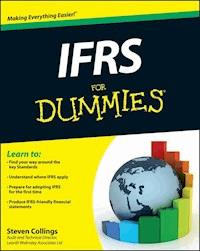
The easy way to get a grip on International Reporting Standards
IFRS For Dummies is your complete introduction to IFRS and international accounting and balancing standards. Combining all the facts needed to understand this complex subject with useful examples, this easy-to-read guide will have you on top of IFRS in no time.
In plain English, it helps you make sense of IFRS and your understanding of: what they are and where they apply; how to adopt IFRS for the first time; how IFRS affects the key components of your financial statements; how to disclose information in financial statements; and much more.
- Covers what to do if you're applying IFRS for the first time
- Explains complicated material in plain English
- Helps you make sense of this principles-based set of standards that establish broad rules for financial reporting
If you're an accountant, student, or trainee in need of accessible information on IFRS, this hands-on, friendly guide has you covered.
Sie lesen das E-Book in den Legimi-Apps auf:
Seitenzahl: 611
Veröffentlichungsjahr: 2012
Ähnliche












IFRS For Dummies®
Visit www.dummies.com/cheatsheet/ifrsuk to view this book's cheat sheet.
Table of Contents
IFRS For Dummies®
by Steve Collings
IFRS For Dummies®
Published byJohn Wiley & Sons, LtdThe AtriumSouthern GateChichesterWest SussexPO19 8SQEngland
E-mail (for orders and customer service enquires): [email protected]
Visit our Home Page on www.wiley.com
Copyright © 2012 John Wiley & Sons, Ltd, Chichester, West Sussex, England
Published by John Wiley & Sons, Ltd, Chichester, West Sussex
All Rights Reserved. No part of this publication may be reproduced, stored in a retrieval system or transmitted in any form or by any means, electronic, mechanical, photocopying, recording, scanning or otherwise, except under the terms of the Copyright, Designs and Patents Act 1988 or under the terms of a licence issued by the Copyright Licensing Agency Ltd, Saffron House, 6-10 Kirby Street, London EC1N 8TS, UK, without the permission in writing of the Publisher. Requests to the Publisher for permission should be addressed to the Permissions Department, John Wiley & Sons, Ltd, The Atrium, Southern Gate, Chichester, West Sussex, PO19 8SQ, England, or emailed to [email protected], or faxed to (44) 1243 770620.
Trademarks: Wiley, the Wiley Publishing logo, For Dummies, the Dummies Man logo, A Reference for the Rest of Us!, The Dummies Way, Dummies Daily, The Fun and Easy Way, Dummies.com and related trade dress are trademarks or registered trademarks of John Wiley & Sons, Inc. and/or its affiliates in the United States and other countries, and may not be used without written permission. All other trademarks are the property of their respective owners. Wiley Publishing, Inc., is not associated with any product or vendor mentioned in this book.
Limit of Liability/Disclaimer of Warranty: The contents of this work are intended to further general scientific research, understanding, and discussion only and are not intended and should not be relied upon as recommending or promoting a specific method, diagnosis, or treatment by physicians for any particular patient. The publishe, the author, AND ANYONE ELSE INVOLVED IN PREPARING THIS WORK make no representations or warranties with respect to the accuracy or completeness of the contents of this work and specifically disclaim all warranties, including without limitation any implied warranties of fitness for a particular purpose. In view of ongoing research, equipment modifications, changes in governmental regulations, and the constant flow of information relating to the use of medicines, equipment, and devices, the reader is urged to review and evaluate the information provided in the package insert or instructions for each medicine, equipment, or device for, among other things, any changes in the instructions or indication of usage and for added warnings and precautions. Readers should consult with a specialist where appropriate. The fact that an organization or Website is referred to in this work as a citation and/or a potential source of further information does not mean that the author or the publisher endorses the information the organization or Website may provide or recommendations it may make. Further, readers should be aware that Internet Websites listed in this work may have changed or disappeared between when this work was written and when it is read. No warranty may be created or extended by any promotional statements for this work. Neither the publisher nor the author shall be liable for any damages arising herefrom.
For general information on our other products and services, please contact our Customer Care Department within the U.S. at 877-762-2974, outside the U.S. at 317-572-3993, or fax 317-572-4002.
For technical support, please visit www.wiley.com/techsupport.
Wiley also publishes its books in a variety of electronic formats. Some content that appears in print may not be available in electronic books.
British Library Cataloguing in Publication Data: A catalogue record for this book is available from the British Library
ISBN: 978-1-119-96308-0 (pbk); ISBN 978-1-119-96652-4 (ebk); ISBN 978-1-119-96653-1 (ebk); ISBN 978-1-119-96654-8 (ebk)
Printed and bound in Great Britain by TJ International, Padstow, Cornwall
10 9 8 7 6 5 4 3 2 1
About the Author
Steve Collings, FMAAT FCCA, is the audit and technical director at Leavitt Walmsley Associates, a firm of Chartered Certified Accountants based in Sale, Manchester in the United Kingdom. Steve trained and qualified with the firm, for which he is also Senior Statutory Auditor. He qualified with the Association of Accounting Technicians in 2000 and then went on to qualify as an Associate Chartered Certified Accountant (ACCA) in 2005. In 2010, he became a Fellow of the Association of Chartered Certified Accountants (FCCA). Steve also holds the Diploma in IFRS from ACCA which he obtained in 2008, as well as their Certificates in IFRS and Certificates in International Standards on Auditing.
Steve specialises in financial reporting and auditing issues, and has been writing professionally for several years. He is the author of The Interpretation and Application of International Standards on Auditing (published by John Wiley & Sons, Ltd. in March 2011) and of other publications on the subjects of UK accounting standards, International Financial Reporting Standards and International Standards on Auditing. He is also the author of several articles which have been published in the various accounting media, primarily AccountingWEB.co.uk. Steve also lectures to professional accountants on financial reporting, auditing and Solicitors Accounts Rules.
Steve won Accounting Technician of the Year at the British Accountancy Awards in November 2011.
Author’s Acknowledgments
Many people believe that writing and producing a book is a one-person project. Believe me, it is anything but! I have been writing about accounting and auditing issues for many years now but writing IFRS For Dummies has proved to be one of the biggest (but best) challenges I have faced. My most sincere thanks and gratitude must therefore go to the Commissioning Editor, Claire Ruston, who helped to get this project off the ground. There has not been one instance where I have not enjoyed writing this book, and it has been an absolute pleasure to write.
Every author of a book needs a strong and supportive publishing team behind them and I feel honoured to have people like Steve Edwards (my project editor), Charlie Wilson (my development editor), and Caroline Fox (my technical reviewer) to have worked with during the writing of this book. My heartfelt thanks and gratitude must go to these guys as well as the other guys on the publishing team who have helped to bring this book to market.
The support I have received from my family and friends over the years does not go unnoticed, especially when deadlines are approaching and the pressure kicks in (you all know who you are). My thanks also must go to Les Leavitt, my friend and colleague, who has shown a huge amount of enthusiasm and support for this project and accommodated my deadlines in with work projects.
Finally my thanks go to you, the reader who has picked up this book. I sincerely hope you find it informative, helpful and a good reference guide to the world of IFRS. Keep it close to hand to guide you through complex issues on IFRS and IAS.
Dedications
I am fortunate to know so many influential and special people, both in my personal and professional life, and to name every individual who has influenced my career and writing would be impossible. For every member of my family and each one of my friends (many of whom feature in the illustrative examples in this book), this book is for you. I would also like to dedicate this book to all my peers in the world of financial reporting (particularly Roger Bryant, Lisa Weaver, Clare Finch and Annette Smyth).
Publisher’s Acknowledgements
We’re proud of this book; please send us your comments through our Dummies online registration form located at www.dummies.com/register/.
Some of the people who helped bring this book to market include the following:
Commissioning, Editorial, and Media Development
Project Editor: Steve Edwards
Commissioning Editor: Claire Ruston
Assistant Editor: Ben Kemble
Development Editor: Charlie Wilson
Copy Editor and Proofreader: Kim Vernon
Technical Editor: Caroline Fox
Production Manager: Daniel Mersey
Publisher: David Palmer
Cover Photos: © iStock/CGinspiration
Cartoons: Rich Tennant (www.the5thwave.com)
Composition Services
Project Coordinator: Kristie Rees
Layout and Graphics: Claudia Bell, Corrie Neihaus, Julie Trippetti
Proofreader: Melissa Cossell
Indexer: Sharon Shock
Brand Reviewers: Rev Mengle and Jennifer Bingham
Publishing and Editorial for Consumer Dummies
Kathleen Nebenhaus, Vice President and Executive Publisher
Kristin Ferguson-Wagstaffe, Product Development Director
Ensley Eikenburg, Associate Publisher, Travel
Kelly Regan, Editorial Director, Travel
Publishing for Technology Dummies
Andy Cummings, Vice President and Publisher
Composition Services
Debbie Stailey, Director of Composition Services
Introduction
Welcome to IFRS For Dummies. This book introduces you to the complex world of international financial reporting that’s now gathering faster pace as International Financial Reporting Standards (IFRS) become more prevalent around the globe. Many countries still use their own domestic accounting standards, such as UK Generally Accepted Accounting Practice (GAAP) and US GAAP. However, many countries are also considering the switchover from their own national standards to IFRS.
If you’re a student accountant, you may have financial reporting papers on your syllabus that examine IFRS. If you’re an accountant in practice, you may have a client, or a number of clients, that choose to, or already, report under IFRS. And if you work for a company that’s considering becoming listed, the company may be mandated to prepare its financial information using IFRS.
The method of preparing financial reports has evolved considerably over the last few years and this evolution has led to an increasing demand for more transparent reports to meet the needs of investors, analysts, employees, tax authorities and other stakeholders – users of the financial statements. The principles contained in IFRS and International Accounting Standards (IAS) recognise these needs.
About This Book
I’ve writtenIFRS For Dummies to convey the complex world of international financial reporting in an easy-to-understand, fun and down-to-earth manner. I look at the way the standards work and the objectives each standard is trying to achieve, and illustrate the standards in operation by looking at practical examples to demonstrate how an IFRS or IAS works in real life. I believe the only way to show people how something works is to put it into practice.
This book has a practical approach. In other words, chapters don’t run in order of each IAS or IFRS, but instead each chapter is self-contained. You may read the book from cover to cover, or you may jump to the chapters you consider are more relevant than others; whichever method suits you, I advise that you have a quick glance at each chapter in isolation to make sure that you don’t miss any important points that may apply to your circumstances.
Conventions Used in This Book
Because the world of financial reporting is complicated and some points throughout the book are more important than others, I’ve set up a few conventions to help you on your way through this book:
I use italics to emphasise key points and terms.
I use bold type to highlight keywords. Such terminology is vital to ensure correct application of the standards.
I alternate pronouns between chapters.
The double underlining you find in illustrative statements of financial position (balance sheets) and statements of comprehensive income (income statements) shows a final monetary amount; for example, net assets. Single underlining demonstrates that I’m completing a calculation.
Numbers in brackets are negative numbers that you subtract from totals or sub-totals.
The currency unit used in this book is the dollar (simply a currency unit; not a US or other specific dollar), other than when I make a country-specific reference.
What You’re Not to Read
Throughout this book, I include information that may be of interest to some readers but may not be appropriate to others. The grey boxes (sidebars) contain information that you can ignore without incurring any serious consequences. But I do encourage readers to digest the information contained in the sidebars – they explain some country-specific issues, illustrate why an accounting standard was introduced and show you how a standard interacts with other standards, legislation or taxation issues.
Foolish Assumptions
While writing this book I kept in mind some assumptions about you, the reader, and what I want you to get out of this book:
I assume that you’ve knowledge of double-entry concepts and that you’re comfortable with some accounting jargon, such as depreciation, amortisation, net assets, retained earnings and so on. The Glossary at the back of the book defines terms I use; and if you need a basic grounding, take a look at Bookkeeping For Dummies by Paul Barrow and Lita Epstein (Wiley).
I assume that some of you have worked in some areas of accountancy, whether it be in industry, commerce or general practice. I also assume that you’ve had some sort of involvement in the preparation of financial statements, even if limited to areas such as accruals and prepayments.
I assume that some readers of this book may never have worked in accountancy, but may be considering a career change or starting out in accountancy and be enrolled on an accountancy course (whether for professional qualifications or at degree level). If so, this book is very much for you.
I assume that you’ve a knowledge of the importance of accounting standards. Although I don’t assume that you’ve detailed knowledge of how IFRS and IAS work, I’ve worked on the premise that you know why accounting standards exist and why they’re important in the preparation of financial information.
I assume that the main reason for you reading this book is to gain a basic understanding of IFRS and IAS. I’ve kept in mind the fact that students may read this book to help them in their financial reporting papers, which examine IFRS and IAS. I’ve considered that professional accountants may want to broaden their understanding of IFRS and IAS. Therefore, my assumptions have led me to write this book at an introductory–intermediate level of understanding, rather than striving to make users of this book technical experts in what is a hugely complex subject.
How This Book Is Organised
IFRS For Dummies is split into five major parts. Each part looks at a different area in the world of financial reporting under IFRS and IAS. I divide each part into chapters that relate to the part’s theme; each chapter then sub-divides into individual sections. You can see how this division works by referring to the Table of Contents at the start of the book.
Part I: Concepts and Basic Standards
This part introduces you to the world of IFRS. I look at who creates the standards and how, and which countries have decided to take the plunge and adopt IFRS as their framework for financial reporting. What you start to see quite soon in IFRS For Dummies is that the standards are very much principles-driven, and for this reason I also look at why you must stick to the principles to keep people like the auditors and tax people happy, but I also look at instances in which you may depart from a principle. Finally, I take you through how to prepare financial statements under IFRS and look at some of the simpler standards in an attempt to ease you into the book.
Part II: Looking at the Key Components of Financial Statements
In this part, I examine some important characteristics of the financial statements: assets, liabilities, income, equity and expenses. I examine how you account for various assets and liabilities and when you account for income in the financial statements. And in this part, you also get an insight as to what a company’s equity is made up of and how equity arrives in the financial statements.
Part III: Consolidating and Investing
This part looks at some of the more complicated areas of financial reporting. Many companies own other companies, or have an investment in other companies, and they have to prepare consolidated financial statements for their subsidiary companies, or deal with the complex accounting for companies they’ve invested in but aren’t subsidiaries. This part considers what gives rise to a subsidiary, an associate or a joint venture as well as how the parent or the investor must account for them.
Part IV: Disclosing Information in the Financial Statements
If you’ve ever read a set of financial statements, or been involved in the preparation of general purpose financial statements, you know that companies have to make extensive disclosures in addition to the usual primary financial statements such as the statement of comprehensive income (income statement), statement of financial position (balance sheet), statement of cash flows (cash flow statement) and the statement of changes in equity. In this part, I take you through some of the most important disclosure issues, covering related parties, segmenting information and earnings per share. And I give you an idea as to why users place a huge amount of emphasis on disclosure notes.
Part V: The Part of Tens
One characteristic of For Dummies books that distinguishes them from other books is the Part of Tens. IFRS For Dummies contains three chapters, each of which considers ten ‘need-to-know’ points. I tell you about ten pitfalls you must avoid, and ten of the most important disclosure requirements you need to know about when preparing financial statements under IFRS. Finally, because nothing stands still in the world of accountancy, I take a look at ten future IFRS developments to keep an eye on to make sure that you’re up to speed.
Part VI: Appendixes
Here I include some additional material you may find useful. First, I give guidance on websites and books to check out for further information on IFRS. Then, I take a look at IFRS for SMEs – the mini IFRS for small and medium-sized organisations. And finally, I include a handy glossary offering simple-to-grasp definitions for key IFRS terminology.
Icons Used in This Book
As you go through each chapter, you see various icons I use to help you understand the book and its contents more succinctly:
This icon marks warnings that you must heed; failing to do so may land you in hot water.
Signals a friendly reminder of points that you must keep in mind. I use this icon quite a lot in this book, primarily because in the real world many standards interact with other standards. The knowledge I impart here is important.
This icon indicates that the text to follow is somewhat technical, and if you’re struggling to grasp the detail, you can move on.
A key feature of IFRS For Dummies is the examples I use to bring technical issues to life. When you see this icon, you know that I’m about to show you how to apply a particular concept.
This icon helps you identify a time-saving mechanism or something that helps in your accounting studies or professional life.
Where to Go from Here
You can use this book in many different ways. Some readers may choose to start from the beginning and work their way through it at their own pace, and doing so is a good way to get a sound understanding of how IFRS works.
Some of you may already have some knowledge of IFRS and just simply want to refresh your memory on certain issues, or simply look up a particular subject. I’ve structured this book in such a way that you can skip straight to the relevant section. For example, if you’re not sure about consolidated financial statements, you can simply jump to Part IV. If you’ve just adopted IFRS for the first-time (or are about to), you may want to understand about first-time adoption and the process you’ve got to go through; in this case, flick over to Chapter 3.
I’ve written this book for you – to guide you through the murky world of IFRS, and I try to make it a fun subject even though it’s a crucially important topic. I’ve really enjoyed writing this book and I sincerely hope that you find it provides useful insights and helps you in your day-to-day working life.
Part I
Concepts and Basic Standards
In this part . . .
Financial reporting has become increasingly complicated over the years. Many trainee and professional accountants find the sheer size of the accounting standards, as well as trying to figure out just exactly what the standards want you to do, problematic.
In this part, I introduce you to the conceptual framework and examine some of the more basic standards. Understanding how and why the standards are created is crucial in actually understanding the world of financial reporting. I start with the basics, introducing you to the standard-setting process, and then move on to how a company develops its accounting policies and how a first-time adopter of IFRS deals with the switchover from domestic accounting standards to IFRS.
Chapter 1
Introducing IFRS
In This Chapter
Seeing how standards are set, and amended
Rolling out IFRS globally
Presenting IFRS financial statements
Many organisations use International Financial Reporting Standards (IFRS) and International Accounting Standards (IAS) in preparing their general purpose financial statements – the year-/period-end statements prepared for : shareholders and external stakeholders like employees, tax authorities, banks and financiers. The IFRS and IAS tell accountants and other preparers of financial statements how to account for transactions and events, and what to disclose, within the accounts.
Lesen Sie weiter in der vollständigen Ausgabe!
Lesen Sie weiter in der vollständigen Ausgabe!
Lesen Sie weiter in der vollständigen Ausgabe!
Lesen Sie weiter in der vollständigen Ausgabe!
Lesen Sie weiter in der vollständigen Ausgabe!
Lesen Sie weiter in der vollständigen Ausgabe!
Lesen Sie weiter in der vollständigen Ausgabe!
Lesen Sie weiter in der vollständigen Ausgabe!
Lesen Sie weiter in der vollständigen Ausgabe!
Lesen Sie weiter in der vollständigen Ausgabe!
Lesen Sie weiter in der vollständigen Ausgabe!
Lesen Sie weiter in der vollständigen Ausgabe!
Lesen Sie weiter in der vollständigen Ausgabe!
Lesen Sie weiter in der vollständigen Ausgabe!
Lesen Sie weiter in der vollständigen Ausgabe!
Lesen Sie weiter in der vollständigen Ausgabe!
Lesen Sie weiter in der vollständigen Ausgabe!
Lesen Sie weiter in der vollständigen Ausgabe!
Lesen Sie weiter in der vollständigen Ausgabe!
Lesen Sie weiter in der vollständigen Ausgabe!
Lesen Sie weiter in der vollständigen Ausgabe!
Lesen Sie weiter in der vollständigen Ausgabe!
Lesen Sie weiter in der vollständigen Ausgabe!
Lesen Sie weiter in der vollständigen Ausgabe!
Lesen Sie weiter in der vollständigen Ausgabe!
Lesen Sie weiter in der vollständigen Ausgabe!
Lesen Sie weiter in der vollständigen Ausgabe!




