


Erhalten Sie Zugang zu diesem und mehr als 300000 Büchern ab EUR 5,99 monatlich.
- Herausgeber: The History Press
- Kategorie: Geisteswissenschaft
- Sprache: Englisch
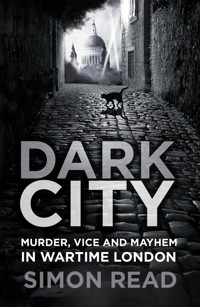
The blackout went into effect three days before the declaration of war and transformed nocturnal London into a criminal's paradise. As the city pulled together in the face of terrible adversity, the bomb-ravaged streets became the stalking grounds for killers, rapists, looters and gangs. The number of bodies retrieved during the Blitz made it impossible for the authorities to autopsy them all, providing cover to those who worked with blades, guns and more sinister tools. Scotland Yard – its resources stretched to the limit – did its best to tackle a rogues' gallery born of bombs and blackout, and crimes that continue to fascinate from history's darkest corners. In Dark City, award-winning crime writer Simon Read paints a vivid picture of the other side of wartime London, from the Blackout Ripper and the Acid Bath Murders, to the notorious Rillington Place killer and his house of corpses.
Sie lesen das E-Book in den Legimi-Apps auf:
Seitenzahl: 399
Veröffentlichungsjahr: 2019
Das E-Book (TTS) können Sie hören im Abo „Legimi Premium” in Legimi-Apps auf:
Ähnliche


















This book is for Hazel Elelman, my grandmother, with love.
History is the story of the world’s crime.— Voltaire
First published in 2010 by Ian Allan Publishing,this edition published in 2019 by The History Press
The History Press
The Mill, Brimscombe Port
Stroud, Gloucestershire, GL5 2QG
www.thehistorypress.co.uk
© Simon Read, 2010, 2019
The right of Simon Read to be identified as the Author of this work has been asserted in accordance with the Copyright, Designs and Patents Act 1988.
All rights reserved. No part of this book may be reprinted or reproduced or utilised in any form or by any electronic, mechanical or other means, now known or hereafter invented, including photocopying and recording, or in any information storage or retrieval system, without the permission in writing from the Publishers.
British Library Cataloguing in Publication Data.
A catalogue record for this book is available from the British Library.
ISBN 978 0 7509 9157 5
Typesetting and origination by The History Press
Printed and bound in Great Britain by TJ International Ltd
eBook converted by Geethik Technologies
Contents
Acknowledgements
Preface
1 What the Psychic Saw
2 A Skeleton in the Cellar
3 Murder in the Dark
4 A Secret Life
5 Secrets to the Grave
6 The Luton Sack Murder
7 Dreams of Molls and Mobsters
8 The Cleft-Chin Murder
9 A Body of Lies
10 The Killer Inside
11 The Man Downstairs
12 An Innocent Man
13 The Vanishing
14 Acid and Blood
15 Body of Evidence
Afterthought
Bibliography and Sources
About the Author
Acknowledgements
I’d like to thank Mark Beynon and the fine people at The History Press for approaching me with the idea for this book and commissioning me to write it. Working on Dark City was great fun, as it gave me a chance to delve once more into my favourite period in history.
My family, as always, was incredibly supportive. I put my father, Bill, to work as a research assistant. Together, we sifted through countless pages of official documents at the National Archives. It presented a special opportunity for my dad, who got to read police reports written by his own father, the arresting detective in the infamous Cleft-Chin Murder case. I’m also grateful to my agents Rivers Scott in Britain and Ed Knappman in the United States, and the staff at the National Archives for their assistance. I have to thank Tony, Phil and Mike (as always) for the music.
Finally, love and thanks to my wonderful wife, Katie, who patiently played audience to my manuscript readings and offered advice when I got stuck.
Preface
Christmas shoppers crowded narrow Birchin Lane in the early afternoon hours of Friday, 8 November 1944, their collars turned up against the wet fog that hung heavy over the city. They paid scant attention to the black Vauxhall that turned into the street shortly after 2.30 p.m. and came to a stop outside Frank Wordley’s jewellery store at number 23. Three young men, one of them carrying an axe, clambered out of the vehicle and approached the store’s front window.
Pearls and diamonds arranged neatly in display cases glittered through the glass. The axe blade smashed the window and littered the pavement in a crystalline shower of broken glass. The men grabbed what they could, as stunned passersby stopped and stared. They hurried back to the car, their arms filled with pearl necklaces and sparkling rings valued at more than £2,000. The engine roared to life and the car peeled away from the pavement. It moved at high speed toward the end of the lane, where the robbers planned to escape via Lombard Street. While frantic pedestrians leapt clear of the vehicle, Captain Ralph Binney – a 56-year-old Royal Navy Officer – stepped into the street, blocking the car’s progress and motioned for the driver to stop.
In the Vauxhall, Binney loomed large in the windscreen, only to disappear when the car slammed into him. The two front wheels rolled over the captain before the car came to a stop. As outraged onlookers ran towards the vehicle, the driver threw the Vauxhall in reverse and backed over Binney’s stricken form, but a crowd charging from the rear forced the driver to accelerate forward and run the still-conscious Binney over yet again. This time, the captain’s coat caught on the car’s chassis. The Vauxhall picked up speed and dragged the frantically struggling Binney beneath it.
Horrified onlookers watched helplessly as the car screamed into Lombard Street. From underneath the vehicle, Binney could be heard screaming for help. Another motorist gave chase and followed the thieves over London Bridge and into Tooley Street. As the Vauxhall shot past the terminus for London Bridge Station, Binney was thrown clear of the car, slid across the street and slammed into the kerb. The pursuing motorist stopped to help the stricken man – who had been dragged for more than a mile – as the thieves’ car disappeared from view. An ambulance was on scene within minutes and rushed the captain to Guy’s Hospital, where he died 3 hours later from his extensive injuries. ‘Both his lungs,’ noted Home Office Pathologist Dr Keith Simpson, who performed the autopsy, ‘had been crushed and penetrated by the ends of broken ribs when the car ran over him.’
The Vauxhall was found abandoned not far from where Captain Binney had been thrown free. Scotland Yard launched a massive manhunt, believing the thieves-turned-killers were members of the Elephant Boys, a loosely organised gang of thugs that stamped about the Elephant and Castle area of South London. Detectives scoured the bomb-ravaged neighbourhoods of Bermondsey and other blue-collar enclaves in pursuit of their prey, staking out rough-and-tumble pubs and various hotspots known to be frequented by the area’s more shady operators. A break in the case finally came when informants notified police that three men had started keeping a low profile in the wake of the much-publicised crime. They were getaway driver Ronald Hedley, a 26-year-old member of the Elephant Boys, and fellow gang associates Thomas Jenkins and his younger brother Charles Henry Jenkins, known amongst his associates as ‘Harry Boy’.
Sent to trial at the Old Bailey in March 1945, Hedley was found guilty of murder, sentenced to hang, but later reprieved; Thomas Jenkins received an eight-year sentence for manslaughter. ‘Harry Boy’ Jenkins, then 20, went free after witnesses failed to place him at the scene of the crime. He would hang three years later after taking part in another smash-and-grab robbery in which a motorcyclist, following Captain Binney’s example, was fatally shot while trying to stop Jenkins and his cohort.
‘At the end of 1944,’ noted one crime historian, ‘Captain Binney was an omen of post-war lawlessness.’ But the case also exemplifies the worst of wartime London.
The lights went out on Thursday, 31 August 1939. The night-time blackout, put into effect three days before the declaration of war, turned London’s once familiar streets into a foreign landscape. Venturing out in the dark became a hazardous undertaking; in the pitch black one never knew when a lamppost or letterbox might cross their path. As the months dragged on, surface air-raid shelters and canvas sandbags became constant obstacles – even crossing the street posed a dangerous undertaking.
Buses and taxis manoeuvred blacked-out city streets with their headlamps covered, resulting in more-than-occasional mishaps with pedestrians. By the following autumn, pontoon bridges stretched the Thames and pillboxes lined Victoria Embankment. Children, who had not yet been evacuated overseas or to the countryside, played amongst ruins and searched for shrapnel and other souvenirs of war. Large, zeppelin-shaped barrage balloons hovered above the city’s battered skyline.
‘Total war,’ the author J. B. Priestley wrote in 1940, ‘is war right inside the home itself, emptying clothes cupboards and the larder, screaming its threats through the radio at the hearth, burning and bombing its way from roof to cellar.’
The steadfastness of Londoners in the face of bombardment and deprivation has become the stuff of legend – and, certainly, the legacy of London’s indomitable spirit is well deserved. But in a city where death was always near and a tidy sum could be made on the most basic household item, many gave in to their baser instincts. Rationing, blackouts and the severe limitations under which the police worked all came together to create a criminal’s paradise. The black market thrived and the sex trade flourished. Racketeers and con artists plied their trade; murderers and thieves stalked darkened streets. Despite working under the limitations of fuel rationing and mandatory radio silence, and the loss of men to military service and air raids, police did their utmost to keep pace with crime.
Being born to a generation far removed from the realities of blackouts, bombs and rationing, I have long been fascinated by wartime London. Today, the conditions under which the great city’s population lived seem almost alien. Whenever I visit London and wander its streets at night, I often imagine what it must have been like to manoeuvre through the darkness, the air raid sirens howling and the searchlights weaving their patterns across the sky. Coupled with this fascination is my enthusiasm for crime stories and tales of detection.
In 1946, George Orwell sat down and penned an essay lamenting The Decline of the English Murder. The country’s so-called ‘golden years’ for killing had long since passed, he wrote, arguing the Victorian age – the years spanning 1850 to 1925 – represented a high watermark for the ultimate in crime. Jack the Ripper, Dr Crippen and other notorious fiends, had set, in Orwell’s estimation, the standard by which all other murderous acts should be judged. More recent killers, he believed, lacked flare, and their crimes were devoid of any real passion. He portrayed the perfect killer as a man of respectable means, living a quiet life in the suburbs and driven to murder by an unrequited lust for his secretary – or some other unobtainable woman. When he committed his foul deed, he most likely used poison.
The perfect English murder as described by Orwell is the stuff of Agatha Christie – indeed, it is the stuff of fiction. It’s neat and hardly messy. Whereas in wartime London, the killers who plied their merciless trade did so using more barbaric methods. They used gas, ropes and guns, corrosive chemicals and tin openers. Some operated under the cover of darkness, emerging when the city was at its most vulnerable; others simply struck whenever opportunity presented itself. At a time when Londoners were pulling together in the face of terrible adversity, these sinister individuals roamed the bomb-ravaged streets without fear of reprisal.
Indeed, the war gave rise to some of Britain’s most infamous killers: John Christie, the monster of Rillington Place, and John ‘Acid Bath’ Haigh. There was Karl Hulten, the American GI who played the role of a vicious Chicago mobster, and Elizabeth Jones, his English stripper girlfriend whose greatest ambition was to be a mobster’s dame. Harry Dobkin almost pulled off the perfect crime, and Gordon Frederick Cummins earned the sobriquet the ‘Blackout Ripper’ for his ghastly work with razor blades and knifes.
Dark City explores this gallery of rogues, a collective whose grisly work still sickens today. These killers went to their deaths at the end of a rope, but their violent legacies live on and continue to fascinate.
1
What the Psychic Saw
Tuesday, 8 April 1941. Madam Nerva led Rachel Dobkin into the living room of her small house on Underwood Road. Although it was a bright spring afternoon, the blackout curtains were drawn across the window. Madam Nerva motioned to a table and told Rachel to have a seat. A solitary candle in the centre of the table cast flickering patterns on the wall and bathed the room in a pallid light. Rachel sat down and anxiously drummed the tabletop with her fingers. For two years she’d been coming to see Madam Nerva for her special brand of guidance.
‘Can you tell me something?’ Rachel asked, watching the candle’s flame replicate itself in the glass beads around Madam Nerva’s neck.
‘Give me an item,’ the psychic said, ‘and I’ll try and get through.’
Rachel removed her wedding ring and slid it across the table. Madam Nerva traced the ring’s circumference with a delicate forefinger before picking it up and gently pressing it between her palms. She mumbled quietly to herself, her brow creased in concentration as she gently rocked back and forth in her seat. Her eyes rolled under heavy lids, revealing just the whites. In her self-induced trance, Madam Nerva was no longer sitting at her living room table, but standing in a vast, grey empty space. In front of her, two forms slowly took shape: one was Rachel Dobkin; the other a building, its features not entirely distinguishable. An open door materialised in the building’s façade and seemed to beckon Rachel Dobkin in. No sooner had Rachel passed through the entrance, it disappeared, trapping her inside. Madam Nerva shook herself partially free of the trance and returned to her physical self.
‘You are worried and full of trouble,’ she said, eyeing Rachel across the table. ‘You are planning to go on a journey in a few days to meet someone. Don’t go – leave it to the spirit friends and stay where you are. I see sadness for you. Will you promise you will not go?’
‘I promise I won’t go,’ Rachel said, although she was supposed to meet her estranged husband on Friday to collect some money. Madam Nerva returned Rachel’s wedding ring and urged her to simply stay at home. Rachel, sliding the ring back on her finger, said she would. She thanked Madam Nerva for her time and said she would come back the following week for another reading. The psychic saw Rachel to the front door and watched her walk down the small garden path, knowing she would never see the young woman again. Indeed, eight days later she answered a knock on her door to Polly Dubinski, a woman who introduced herself as Rachel Dobkin’s sister.
‘Mrs Nerva,’ the woman said, ‘my sister was here on Tuesday. You told her not to go see her husband, and she went – she hasn’t returned yet. Could you go into a trance and tell me about her?’
Madam Nerva, first name Hilda, ushered Polly in and led her to the sitting room. She asked Polly if she’d brought any personal item belonging to Rachel, something she might touch to establish a psychic connection. Polly opened her handbag and retrieved a scarf and a jumper that Rachel had worn recently. As she handed them over, she told Madam Nerva she’d last seen Rachel at 4.30 on the afternoon of Good Friday, 11 April. Polly said she had filed a missing person’s report at the Commercial Street Police Station the following day after her sister failed to return home. The on-duty sergeant took the report and entered the details on page 347 of the Metropolitan Police Department’s ‘Persons Missing Book’. Rachel had gone off wearing a fawn tweed coat with brown fur collar, a blue woollen jumper, two woollen cardigans – one dark blue and the other light blue – a navy blue skirt, black shoes and a brown hat. Madam Nerva said nothing and simply ran her hands over the scarf and jumper, which she laid across her lap. She closed her eyes and concentrated on the texture of the fabrics against her skin.
‘I went into a full trance,’ she later told investigators, ‘and felt very funny.’
In her entranced state, Madam Nerva saw Rachel Dobkin standing alongside a stretch of river that wound its way through an open field. On whatever plain the two had made contact, Rachel failed to acknowledge Madam Nerva’s presence. The psychic did, however, note that Rachel ‘looked sad’ and watched as the missing woman stared forlornly into the water rushing past. Observing the scene, Madam Nerva felt a tightening sensation around her neck, as though some invisible force were attempting to crush her windpipe. She struggled against the impending sense of suffocation, but to no avail. Gasping for breath, she shook herself free of the trance and returned to the more natural surroundings of her sitting room, where Polly Dubinski sat crying beside her. The distraught woman told the psychic what she had said in the trance about ‘a strangling or choking sensation’.
‘I may be wrong,’ Madam Nerva said, handing back the scarf and the jumper, ‘so come and see a medium who is a friend of mine.’
The two women paid a visit to Lydia Kain, a self-proclaimed ‘spiritualist’ who lived at 77 Luken Street, Commercial Road. A cleaning woman by trade at a chemist’s office in London, Lydia had in recent years discovered her supposed ability to converse with the dead. She had developed her skills under Madam Nerva’s tutelage after a chance meeting five years earlier at a West End séance. Like her mentor, Lydia described herself as ‘a woman who can go into a trance, and when in this state, the spirits speak to me’. Unlike Madam Nerva, however, Lydia did not believe in capitalising on her gift, communicating with the spirit world only when close friends sought her advice. Now, on this Monday afternoon, Madam Nerva introduced the visibly distraught Polly Dubinski and asked Lydia if she’d attempt contacting ‘the spirits’ to ascertain Rachel Dobkin’s whereabouts.
Lydia agreed and took the scarf and jumper from Polly. She closed her eyes and tightly clutched the garments. When she declared several minutes later that ‘bad vibrations’ were preventing her from establishing meaningful contact, Madam Nerva suggested Lydia try her luck with Polly’s pearl necklace. Lydia took the pearls and draped them around her fingers. Again, she closed her eyes and almost seemed to drift off.
‘There is a passing out,’ she said in a thick voice. ‘A sudden death.’
She opened her eyes and sat staring momentarily at some distant point only she could see. She handed the pearls back to Polly and said that while in the trance, she had been overwhelmed by a ‘choking sensation’. Polly, weeping, gathered her belongings, bid the two mediums a good afternoon and left the house in a hurry. Madam Nerva, also clearly upset, thanked Lydia for her time and returned home.
‘After that,’ Madam Nerva later told investigators, ‘one afternoon, I was lying down and I saw Rachel and I started to cry, as she looked so sad. She didn’t give me a message, but just looked at me. Then I went to sleep.’
Fearing for her sister’s wellbeing, Polly Dubinski returned to the Commercial Street Police Station at 5 o’clock on the evening of Tuesday, 15 April, and said her sister’s estranged husband, Harry Dobkin, was responsible for Rachel’s disappearance. She said Rachel had planned to meet Dobkin the day she vanished.
‘She said that Harry had promised to give her a pound of onions as a present,’ Polly explained, adding that she had little faith in her one-time brother-in-law. ‘My sister’s husband has been very cruel to her. She has received severe blows from him at different times and for the past few years has been unable to follow any employment on account of the treatment she received.’
Polly recounted one episode in particular when Rachel ‘received a blow on her head from her husband in the street, when she met him’. The incident, having occurred four months ago, resulted in Rachel being hospitalised. ‘This blow caused her to have a mental lapse,’ Polly said. ‘Shortly afterwards, we – her family – received a message from the police at Commercial Street to the effect that she was in St Clements Hospital, Bow. I went to this hospital . . . and seeing that it was a mental hospital and that my sister was perfectly sane, made an application for her release.’
It was unlike Rachel to simply run off and not tell anyone of her whereabouts, Polly said. So there would be no room for doubt, she told the on-duty sergeant she believed Harry Dobkin ‘had some hand in Rachel’s disappearance’.
The sergeant asked Polly if she’d ever heard Dobkin make threats against her sister.
‘He has never threatened my sister in my presence,’ Polly said, ‘although he has frequently spoken very badly of her. I cannot say anything definite against him, but I do feel he knows something about her disappearance. None of the family have seen him since my sister disappeared.’
The sergeant typed up Polly’s statement and had her sign it in front of Divisional Detective Inspector A. Davis of City Road Station, ‘G’ Division, who assumed the role of lead investigator. Davis escorted Polly out and offered her a few words of assurance before returning to his desk. His immediate thoughts didn’t swing in any particular direction. In the chaos of a city at war, missing persons were hardly uncommon. Going by Polly Dubinski’s statement, it seemed there was little incentive for the unemployed and routinely abused Rachel to stay in London. True, she had a son – but the lad, according to Polly, was now 19 and had recently registered for military service. Nevertheless, standard enquiries would be made at all London hospitals and casualty wards. Detectives would review air raid casualty lists, and a photograph of the missing woman would be forwarded to the Central Air Raid Casualty Bureau. In the meantime, Davis would focus his attention on the missing woman’s estranged husband. He would have him brought in the following morning for questioning.
Night came and the lights went out. War Reserve Constable Charles Moore patrolled No. 16 beat that evening, covering Kennington Lane, Vauxhall Street, Black Prince Road and various side streets. Shortly after 2 in the morning, he noticed a red glow casting buildings far down Vauxhall Street in silhouette. He ran in the direction of what he immediately knew to be a fire and, at the junction of Vauxhall and Kennington Lane, saw flames clawing at the sides of a church. Moore broke the glass and pulled the bar of a nearby fire alarm. Joined by War Reserve Constable Alfred Remant, Moore ran toward the burning building and tried to gain entrance. As the two officers pulled boards from the bomb-damaged windows, they were approached by a stout, round-faced man, wearing a dark grey suit and a trilby hat.
‘Come this way gentlemen, if you want to get in,’ he said.
Moore assumed the man was the firewatcher assigned to the premises but failed to ask given the situation’s urgency. The man led the constables around to the side of the building and approached what appeared to be two large garage doors, which he swung open with little effort.
‘I’m glad you’ve come,’ he said. ‘What a blaze this is!’
The constables followed the man through the doors into a large room that appeared to be a storage space for various ledgers and deed boxes. The three men ran past rows of neatly organised boxes and leather-bound folders before passing through another set of doors, which opened onto the back of the church. It was immediately apparent to Moore there was nothing he could do. The flames had by now devoured the boards nailed across the windows. Thick columns of black smoke climbed skyward; from inside the church, came the sound of breaking timber. Along the front of the building, on Kennington Lane, members of the Auxiliary Fire Service attacked the blaze with their hoses. All Constable Moore could do was watch.
Police notified Herbert Burgess, the church’s minister, shortly after 5 that morning. Burgess left his home in Montford Place and arrived at the church within the hour to inspect the damage. He entered the building through a small door that faced out onto St Oswald’s Place and noticed a still-smouldering stack of charred wood lying on the floor. The church’s schoolroom was separated from a larger room in the back of the church by a wooden partition, which, along with two American-made organs, had been completely incinerated.
Burgess said nothing as he stepped over the charred wood-and-brass remnants of the organs and moved into what had been the church’s recreation room, built directly over the cellar. The fire had burned two large holes through the floor: one adjacent to where the gas fireplace had been, the other along the base of the wall of the main chapel area. Although no fire expert, it appeared to Burgess that flames had burned through the floor from underneath.
Curious, he made his way down to the cellar and saw a straw mattress lying in the middle of the floor. It was evident someone had ripped the mattress open using a sharp instrument; a small pile of heavily singed straw lay beside the mattress. Burgess had never seen the mattress before and guessed some individual had dragged it from one of the bombed-out houses nearby. The great oak beams directly above the mattress, which supported the floor of the chapel, were severely burned, arousing the minister’s suspicions that the fire had been deliberately set. Wood panelling on the walls and floor was also charred; a portion of ceiling in the right-hand corner of the cellar had collapsed and caved in the floorboards. At 11 that morning – Wednesday, 16 April – Burgess paid a visit to the Fire Brigade Headquarters at Albert Embankment to find out what he could regarding the blaze. The cause of the fire, he was told, remained under investigation.
A short, round-faced gentleman with a thick neck and squat build, 47-year-old Harry Dobkin was brought in for questioning that afternoon, picked up by detectives at his home in Navarino Road. He came along without protest, not once expressing any concern at being summoned by the police. In the interrogation room at Commercial Street Police Station, he appeared totally indifferent to his surroundings. Davis entered the room, pulled up a chair and introduced himself by name and rank. He said he was making enquiries into the disappearance of Rachel Dobkin. The mentioning of his wife’s name did nothing to alter Harry Dobkin’s calm façade. The affable smile stayed in place without so much as a quiver and he willingly provided information when Davis began his questioning. He readily admitted to living a life of quiet desperation. Like his father before him, Dobkin worked a market stall, selling leather aprons and pockets. When the war arrived, business dried up. Only two weeks earlier, to supplement his diminished income, Dobkin had taken a job as a night watchman and fire-spotter – a job not intended for timid individuals.
Come nightfall, the bombers arrived and gutted great swathes of the city. The mournful wail of air-raid sirens warned of the coming devastation and dragged weary Londoners from their beds. They retreated to their garden shelters, or sought solace in the Underground, crowding the platforms, stairways, corridors and escalators, listening to the thunderous cannonade above. While others scurried for shelter, Dobkin – and the city’s 3,500 fire spotters – did their best to direct emergency services to the flames. Even before the first bombs fell, London’s skyline changed as observation towers appeared atop the tallest buildings. Each evening at 7 o’clock, Dobkin reported to the Vauxhall Baptist Church at 302 Kennington Lane. The schoolroom at the rear of the church was being used by a London-based firm of solicitors to store legal documents, and it was Dobkin’s responsibility to ensure the place did not burn down in the event of a raid. German bombs had blasted the church and surrounding areas on the night of 4 October 1940, killing 100 people. The church, miraculously, had not caught fire – but the night before Dobkin was brought in for questioning, a freak blaze had broken out in the chapel.
His nocturnal duties aside, Dobkin was less than thrilled with his domestic situation. He had married Rachel Dubinski at Bethnal Green Synagogue on 5 September 1920. ‘The marriage was arranged in the Jewish fashion by a marriage broker,’ he said, ‘and has been a failure from the start.’
The couple took up residence in a small flat in Brady Street, a location Dobkin thought was too far from his place of business. His insistence that they move resulted in a separation after only three days together. The 27-year-old Dobkin moved into his mother and father’s house on Flower and Dean Street, leaving Rachel the Brady Street flat. The landlord, taking pity on Rachel, allowed her to live there rent-free. After three tumultuous months of matrimony, the couple agreed to a legal separation. Rachel Dobkin appeared before a magistrate at Old Street Police Court and secured a maintenance order against her husband for £1 a week.
‘I have never had much at that rate,’ Dobkin said, ‘and got in arrears and was sent to prison. The order has been varied from time to time and at present stands at 10s per week. At the present time, I am not in arrears.’
Davis scribbled the information in his notebook and asked Dobkin to recount the last meeting he had with Rachel.
‘Last Friday, I was walking along Navarino Road,’ Dobkin said. ‘I was going out to sell some aprons, when I saw my wife at the corner of Navarino Road and Graham Road. It was between 2 p.m. and 3 p.m., and it was obvious that she had been waiting for me.’
He continued, saying his mother had been ill that day, leaving him little patience to deal with his wife, whom he claimed took great pleasure in trying his nerves. He told Rachel to meet him at 5 o’clock outside Metropolitan Hospital in Kingsland Road. He spent the next 2 hours at Chapel Street Market, hawking his merchandise, before rendezvousing with Rachel at their prearranged spot. The two of them walked to a café across the street and took a table in the corner. Over tea and cakes, Rachel told Dobkin her brother was getting engaged that Sunday. Dobkin stared out the café’s taped windows and muttered his congratulations, not caring one way or the other. He had never kept his dislike for her family a secret, which made it all the more surprising when Rachel invited him to the engagement party on the condition she and Dobkin reconcile. Dobkin balked at the idea.
‘If you don’t make peace with me,’ Rachel hissed, ‘I’ll make trouble for you.’
‘Now, calm yourself,’ Dobkin said. ‘I’ll consider peace if you will calm yourself and go home.’
In the interrogation room, Dobkin sat back in his chair and shook his head, clearly annoyed by the memory. Davis asked him what happened next.
‘She was talking in low tones but was a bit hysterical,’ Dobkin said. ‘She drunk her cup of tea and, as we left the tea shop, she said she didn’t feel well and she was going to her mother’s to hear the wireless. We walked together a little way up Kingsland Road. She again said she didn’t feel well and that if I wanted to do so, I could go to her at any time. As she was still upset, I promised to consider returning to live with her. Then my wife got on the No. 22 bus going towards Shoreditch, and that was the last time I saw her. We parted on quite good terms.’
Davis nodded and asked Dobkin if he had actually planned on following through with his promise. Dobkin was incredulous.
‘I had no intentions of making peace with her or attending her brother’s engagement party, as I have had too much trouble with my wife before,’ he said. ‘I only met her to try and stop her coming round to Navarino Road. I know nothing about my wife’s disappearance. I think she has gone out of her mind. If I can get any information about my wife, I will notify the police at once.’
Davis thanked Dobkin for his time and told him he would be in touch. A uniformed constable escorted Dobkin from the station, leaving the detective alone with his thoughts. Certainly, one could argue the case that Harry Dobkin had failed as a husband, but did that make him a murderer? Davis thought not, for Dobkin’s relationship with Rachel had imploded two decades ago. ‘It cannot be considered feasible,’ Davis wrote in the case file, ‘that the man would wait twenty years if he intended to do her harm.’
Davis ordered Police Constable Robert Woodland to pay a visit to Rachel Dobkin’s home at 44 Cookham Buildings, Old Nichol Street, Bethnal Green. Woodland arrived at the address, a squat building of red brick, shortly before 1 in the afternoon and ascended the stairs to Rachel’s flat. He knocked on the door and got no response, pounding several more times before turning to leave. Just by chance, he glanced down at his feet and saw what appeared to be a small, pink playing card lying by the door. He picked it up, turned it over and saw it was actually a picture card. The caption scrawled across the bottom in a loopy cursive read, ‘My latest photo.’
The image above it was that of a skeleton.
At 7 o’clock that evening, Minister Burgess returned to the Vauxhall Baptist Church to again inspect the damage. He stood in the cellar and pondered the mattress for some time before ascending the small flight of steps into the church courtyard. There, he saw firewatcher Harry Dobkin picking up pieces of debris and piling them in a corner. Burgess approached Dobkin and asked what he knew of the fire.
Dobkin said he was making his normal rounds in the early morning hours when he noticed smoke coming up through the church’s floorboards. He ran and fetched a pail of water from a nearby hydrant and returned to find the floor burning. He dumped the bucket on the flames. When that failed, he sounded the alarm and called the Fire Brigade. It was, he said, no doubt the work of neighbourhood children who had sneaked onto the premises to play with matches. An unconvinced Burgess nodded and eyed Dobkin’s steel blue firewatcher’s helmet. It glistened with a fresh coat of paint; several small pieces of straw adhered to the paint around the brim. Burgess, although adamant in his belief the fire was arson, did not believe children to be the culprits responsible. The tearing open of the mattress and the piling up of straw was far too deliberate and did not seem to be the actions of mischievous youth.
Whatever suspicions Burgess harboured, nothing came of them and the fire at Vauxhall Baptist Church was quickly forgotten in the wake of a devastating raid that befell the city that night. Nearly 700 bombers appeared in the skies above London, dumping incendiaries and high explosives, igniting more than 2,000 fires and killing 1,000 people.
Sitting at his desk the morning after, Divisional Detective Inspector Davis considered the previous night’s enemy action. Police work in peacetime was challenge enough without the complications of war. For all he knew, Rachel Dobkin now lay buried beneath a pile of rubble somewhere. He had heard unsettling stories regarding the city’s public air raid shelters: unsightly bunkers, made of brick and concrete with reinforced roofs, and 14-inch thick walls, which could accommodate up to fifty people. The government had sanctioned the building of such shelters in March 1940, but wartime demands depleted the supply of building materials several months later, resulting in numerous shelters of questionable quality going up. Rumours were circulating of communal shelters collapsing on their occupants, killing all inside. It was no wonder the majority of Londoners preferred the safety of the Underground, but even that was vulnerable to a well-placed bomb.
Only three months prior, on 11 January 1941, an armour-piercing explosive sliced through King William Street and detonated in the ticket concourse of Bank Station. The blast, channelled downward by the escalator shafts, devastated the Central Line platforms and hurled people clear across the station. The explosion ripped a crater 100 feet wide 120 feet long in the street above the concourse, requiring a temporary bridge to be built across the chasm for traffic. Such catastrophes were not uncommon but were routinely kept from the public. On 17 September 1940, a high explosive scored a direct hit on Marble Arch Station. The blast’s concussion ripped the tiling from the walls, fragmenting it like the shell of a hand grenade, killing seven people and wounding another thirteen. At Balham Station on the Northern Line just one month later, a bomb ripped a crater more than 27 feet deep in the street above the station and took out a city bus. Below ground, the blast collapsed Balham’s northbound tunnel and ruptured the water and sewage mains. Muck and debris flooded the station’s north and southbound platforms, killing sixty-five civilians and wounding another seventy. ‘All you could hear,’ remembered one air raid warden, ‘was the sound of screaming and rushing water.’
Davis stared out of his taped office window at a gunmetal sky. It was easy to grow despondent about a case under such conditions, but the detective had never been one to surrender easily. He and his team had wasted no time the day before interviewing known friends of Rachel Dobkin and members of her estranged husband’s family. Depending on whom they spoke with, the investigators heard very different takes on who seemed to cause the trouble in the relationship. Harry’s sister, Annie Silverstein, lived with her brother and parents in Navarino Road and told police that Rachel routinely dropped by the house to cause a ruckus.
‘The last time I saw Rachel was on 7 April at midday,’ she said. ‘She was in Navarino Road outside our house. I saw her call at several houses on the same side of the road. I went on the step but I did not speak to her, as I knew there would only be a row. I gathered she was out to cause trouble by telling our neighbours about her husband.’
Davis asked what sort of trouble Rachel caused.
‘There is a maintenance order in force against my brother,’ said Annie, whose husband was currently serving overseas in the Auxiliary Military Pioneer Corps. ‘Mrs Dobkin has always alleged that her husband was unable to pay or increase the maintenance, as he spent it all on his family. She has called at all hours and kicked up a row … I have often heard Rachel threaten to make trouble for Harry because he wouldn’t go back and live with her. Harry has lived with my family on and off for the last twenty years and whenever he is at home with us, Rachel comes round to cause trouble.’
Annie said it was not until Polly Dubinski paid a visit to the Dobkin residence on 13 April that she knew Rachel had gone missing.
‘From what I personally know of my brother,’ she said, ‘I am certain he knows nothing about his wife’s disappearance.’
Rachel’s friend Dinah Epstein told Davis she’d last seen the missing woman on Thursday, 10 April, the day before she vanished.
‘She called on me at about 6 p.m.,’ she said. ‘We had very little conversation as I was busy getting meals ready, but she seemed quite jovial and appeared in good spirit. I knew Rachel and her husband were not on friendly terms – she used to often tell me she was having trouble getting her money … I have not seen Rachel since she left me at 8 p.m.’
It was Dinah who told Davis that Rachel consulted mediums.
‘About six months ago, Rachel took me to see Mrs Nerva, as she could tell us about the future,’ Dinah said. ‘We used to visit her every other week on a Sunday. She always used to tell Rachel not to have anything to do with her husband, as there would be trouble. The last time we went to see Mrs Nerva, she gave me a message from Mother, who died two years ago last September. She said my mother told her to tell me not to work so hard looking after other members of the family because I would get myself ill.’
For a man whose job it was to ascertain concrete facts, Davis had little time for so-called psychics and soothsayers – but going where the investigation led, he paid a visit to Madam Nerva. He maintained a look of polite interest while she babbled on about trances and mystic visions. For the past eight years, she said, ever since she discovered her ability, people had been coming to her to obtain some glimpse of the future or receive messages from deceased loved ones. She told Davis of Rachel’s last visit, of the choking sensation that accompanied her vision, and her warning Rachel to stay clear of Harry Dobkin.
By the end of the week, Davis and his detectives had interviewed more than a dozen people. Vendors at the Cheshire Street Market recalled seeing Dobkin selling his wares the afternoon Rachel vanished, and the proprietress of the café on Kingsland Road told investigators Dobkin came in with a woman matching Rachel’s description later that same day. They sat at a corner table and ordered tea and pastries. The couple appeared friendly, but the woman seemed to be the more talkative of the two and very animated when she spoke. From where the proprietress stood behind the counter, she couldn’t make out the conversation but didn’t think the two were arguing. The couple were in the café for no more than 45 minutes and left together in the direction of the bus stop.
‘At this stage, I feel that the allegations against Dobkin have no foundation,’ Davis wrote at week’s end. ‘If the woman has met her death, it is by her own hand. I really think she will ultimately be found, suffering from loss of memory, unless she has disappeared to cause trouble for her husband or has become an air raid casualty.’
On 23 April, a sergeant from the Guildford Borough Police Office contacted Davis to say a local resident had found Rachel Dobkin’s purse in the Guildford General Post Office in North Street. Although the discovery had been made eleven days earlier, manpower shortages and the demands of policing in wartime accounted for the delayed notice. The purse was forwarded to Davis at the City Road Police Station, where its contents were catalogued. Along with the ration book, national identity card, comb and compact mirror, were two railway tickets, one being a return ticket issued at Kings Cross Underground Station and the other a ticket purchased at Westminster for a journey to Richmond. Although the dates on both tickets had been erased, Davis called the London Passenger Transport Board with the ticket numbers and learned both had been issued before 7.30 a.m. on Saturday, 12 April – one day after Rachel Dobkin’s disappearance. Again, the evidence seemed to point to Harry Dobkin being innocent.
‘If Dobkin’s story is true,’ Davis noted in the case file, ‘it can now be assumed that Mrs Dobkin was alive on the morning of 12 April 1941. The only alternative being that she had been murdered and her handbag taken to Guildford and the tickets left in it to hamper any investigation.’
In his case report to the Superintendent’s office on 2 May, Davis dismissed the disappearance as an act of spite, one perpetrated by a vindictive ex-wife to exact some sort of revenge on her hapless husband. It was his opinion that both Rachel and Harry Dobkin were pathetic characters. She was a constant troublemaker who routinely hounded Dobkin for monetary support, while he appeared to be a spineless individual incapable of standing up to his estranged wife’s demands. The detective’s assessment of the supposed victim was blunt:
Exhaustive queries have been made to trace this woman, who, from statements we have obtained, seems to have been a believer in Spiritualism … who, in my view, is mentally unbalanced.
Likewise, Dobkin was not smart enough to hatch the perfect crime:
It appears that he is a man of low mentality. He does not appear to have sufficient intelligence to murder his wife without leaving some tangible clue as evidence, although that cannot be placed outside the bounds of possibility.
An extensive sweep of city hospitals had turned up nothing.
‘Enquiries are continuing to trace the missing woman,’ he wrote in conclusion, ‘and a further report will be submitted in due course.’
The search for Rachel Dobkin, much like the war, dragged on.
2
A Skeleton in the Cellar
The inhabitants of London went about their business in as normal a manner as circumstances allowed, attending to their jobs and going to school, some still lugging their ‘mandatory’ gasmasks with them. They continued to volunteer for roles in Civil Defence and queued outside their local registration offices to have their ration books stamped. Women went to work in the factories and young men shipped off to foreign battlefields. By now, they had grown accustomed to the scarred landscape of a city at war. Air-raid trenches zigzagged their way through numerous city parks, and barbed wire surrounded government buildings. The statue of Charles I in Whitehall, and other monuments to history, had long since disappeared beneath great stone slabs. The shattered storefronts and piles of smouldering rubble, the yawning bomb craters and lumbering barrage balloons were as much a part of the city as double-decker buses and red telephone boxes.
At home, glass and valuable breakables remained packed away. Windows were taped – or covered in gummed paper – to prevent shattering in the event of a bomb blast. Vegetable patches were still planted in gardens alongside Anderson shelters to supplement the bland wartime diet. Meals continued to be a miserable affair, with swede and turnip often being the primary ingredients; shredded carrots were routinely substituted for sugar. ‘These were the times,’ Winston Churchill later wrote, ‘when the English, and particularly the Londoners, who held the place of honour, were seen at their best. Grim and gay, dogged and serviceable, with the confidence of an unconquered people in their bones, they adapted themselves to this strange new life, with all its terrors, with all its jolts and jars.’
While the war brought deprivation and destruction to the people of London, it opened numerous doors of opportunity to its criminals. For hustlers, thieves, black marketers, pimps and shady characters of more violent disposition, the wartime blackout and the destruction wrought from above meant good business. Looters routinely stalked the streets, picking through the ruins of shattered homes for anything of value. They often plied their unlawful trade during the raids, operating with little fear of capture. Between the first week of September and the end of November 1940, nearly 400 cases of looting had been reported to the police. Signs were soon affixed to damaged buildings:
WARNING! LOOTINGLooting from premises, which have been damaged by or vacated by reason of war operations, is punishable by death or penal servitude for life.




