


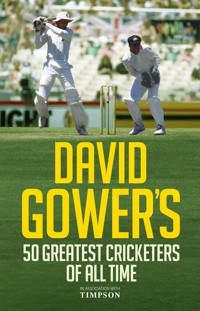
David Gower's 50 Greatest Cricketers of All Time David Gower's 50 Greatest Cricketers of All Time E-Book
David Gower
Erhalten Sie Zugang zu diesem und mehr als 300000 Büchern ab EUR 5,99 monatlich.
- Herausgeber: Icon Books
- Kategorie: Lebensstil
- Sprache: Englisch
Former England captain and impeccably stylish batsman David Gower, himself inducted into cricket's Hall of Fame, here takes a leap of faith and names his 50 greatest players of all time. Going back through the history of the game, he honours the finest run-getters, wicket-takers, glove men and captains he played with and against, as well as those he has been able to observe as a spectator or commentator, and legendary achievers from earlier eras. Full of first-hand recollections and anecdotes, this book is sure to delight – and occasionally infuriate – cricket enthusiasts everywhere. Who was the best of the great West Indian quicks? Have England heroes like Boycott, Pietersen and Flintoff made the cut? Who has been the greatest Australian batsman, post-Bradman? All is revealed in this lively and contentious celebration of cricket's true greats.
Sie lesen das E-Book in den Legimi-Apps auf:
Seitenzahl: 285
Veröffentlichungsjahr: 2015
Das E-Book (TTS) können Sie hören im Abo „Legimi Premium” in Legimi-Apps auf:
Ähnliche

















DAVID
GOWER’S
50 GREATEST CRICKETERSOF ALL TIME
IN ASSOCIATION WITH
TIMPSON
Also availableGeoff Hurst’s 50 Greatest Footballers of All Time
DAVID
GOWER’S
50 GREATEST CRICKETERS OF ALL TIME
DAVID GOWER
Published in the UK in 2015 by
Icon Books Ltd, Omnibus Business Centre,
39–41 North Road, London N7 9DP
email: [email protected]
www.iconbooks.com
Sold in the UK, Europe and Asia
by Faber & Faber Ltd, Bloomsbury House,
74–77 Great Russell Street,
London WC1B 3DA or their agents
Distributed in the UK, Europe and Asia
by TBS Ltd, TBS Distribution Centre, Colchester Road,
Frating Green, Colchester CO7 7DW
Distributed in Australia and New Zealand
by Allen & Unwin Pty Ltd,
PO Box 8500, 83 Alexander Street,
Crows Nest, NSW 2065
Distributed in South Africa by
Jonathan Ball, Office B4, The District,
41 Sir Lowry Road, Woodstock 7925
Distributed in India by Penguin Books India,
7th Floor, Infinity Tower – C, DLF Cyber City,
Gurgaon 122002, Haryana
Distributed in Canada by Publishers Group Canada,
76 Stafford Street, Unit 300
Toronto, Ontario M6J 2S1
ISBN: 9781906850883
Text copyright © 2015 David Gower
The author has asserted his moral rights.
No part of this book may be reproduced in any form, or by any means, without prior permission in writing from the publisher.
Images courtesy of the Press Association
Typeset and designed by Simmons Pugh
Printed and bound in the UK by Clays Ltd, St Ives plc
ABOUT THE AUTHOR
David Gower made his mark on the game through the 15 years of his international career from the late 1970s onwards as an elegant and at times prolific left-handed batsman. His finest year came in 1985 when he captained England to victory in the Ashes and in the process set a new record for the most runs in a home Ashes series for an England captain. Sadly not every series as captain reaped quite the same success and he is still waiting for the scars to heal after ‘leading’ England through two 5–0 defeats at the hands of the all-powerful West Indies teams of the mid-1980s.
David’s second career as a broadcaster with, in order, Channel Nine, the BBC and Sky Sports has seen him establish himself as a calm and measured judge of the game. It is with those qualities to the fore that he has turned his mind to picking his 50 all-time greats.
CONTENTS
INTRODUCTION
THE 50 GREATEST CRICKETERS
50. Alan Knott
49. Jeff Thomson
48. Kapil Dev
47. Kevin Pietersen
46. Virender Sehwag
45. Joel Garner
44. Harold Larwood
43. Ray Lindwall
42. Adam Gilchrist
41. Kumar Sangakkara
40. Dale Steyn
39. AB de Villiers
38. Fred Trueman
37. Greg Chappell
36. Herbert Sutcliffe
35. Frank Worrell
34. Ricky Ponting
33. Javed Miandad
32. Curtly Ambrose
31. George Headley
30. Muttiah Muralitharan
29. Glenn McGrath
28. Allan Border
27. Wasim Akram
26. Sunil Gavaskar
25. Graeme Pollock
24. Richard Hadlee
23. Andy Roberts
22. Bill O’Reilly
21. Keith Miller
20. Denis Compton
19. Richie Benaud
18. Wilfred Rhodes
17. Len Hutton
16. Dennis Lillee
15. Barry Richards
14. Jacques Kallis
13. Sydney Barnes
12. Ian Botham
11. Imran Khan
10. WG Grace
9. Malcolm Marshall
8. Wally Hammond
7. Jack Hobbs
6. Brian Lara
5. Viv Richards
4. Shane Warne
3. Sachin Tendulkar
2. Garry Sobers
1. Don Bradman
INTRODUCTION
No one said this was going to be easy. There again, nobody said it was going to be as hard as it turned out to be either. Picking just 50 to be my greatest ever has had me twisting and turning this way and that and not surprisingly the final order (if it really is the final order) was only achieved after numerous revisions, including the late promotion of Kumar Sangakkara after his 11th Test double hundred came just as I was poised to submit the first official draft of this book.
To be blunt, this is the sort of pub quiz-style discussion that I would normally avoid. One of my many failings is that I hate to admit that I am wrong and a list like this will inevitably have you screaming at me, ‘How on earth can you have put A, B or C above/below X, Y and Z?’. There will be names that are not even in my list that might be instant selections on yours. That is just how these things work and is all part of the fun, promoting fervent discussion, passionate arguments and agreements to disagree – but hopefully no violence!
I must have had some criteria in mind at the start of the process, although whim and whimsy also played a major part. This might be a game that loves statistics but it is also a game that must rise above those mere facts and figures, and in any case how does one reconcile mere averages across over a hundred years of a constantly evolving sport, one which now sees three clearly different codes in use with Test cricket, one-day internationals and T20? I have no idea how I would have coped with T20 cricket, let alone having to imagine how WG might have played it! Apart from the expansion of those so-called codes, the laws have changed; pitches, equipment, techniques, fitness levels – everything has evolved.
As such, I have tended to give greater weight to what all these extraordinary men have done in what I still like to refer to as ‘proper cricket’, Test cricket, while at the same time acknowledging the very real and important skills required over 50 overs and 20 overs – hence, for instance, the inclusion of some of the current stars across all three formats, AB de Villiers (another who was granted further promotion, on the back of his record-breaking ODI hundred at the Wanderers in January 2015) probably the most versatile of all.
There are a number of players from my own era of whom I have first-hand experience either as colleagues or opponents, knowledge which, I have to say, made it no easier to happily put them into any order. For instance, I am often asked who was the best, fastest or toughest bowler I ever faced and I quite enjoy giving different answers every time. Well, it keeps me amused anyway – but the underlying point is that one could revise this whole list on a daily basis and never really be right and never really be wrong.
There are those from the current era, some of whom have benefited from the amount of international cricket played today to put thousands of extra runs and hundreds of extra wickets into the record books. One admires both their skill and their determination to play on – none more so than Sachin Tendulkar, against whom I played what seems like several decades ago.
When it comes to those great players from the more distant past, I have obviously had to rely entirely on other sources. Two of the great journalists of my time, John Woodcock and Christopher Martin-Jenkins, have both compiled their own lists in relatively recent times and both know or knew infinitely more than I about some of these great icons of cricket. Their judgements, other historical sources and, to give credit where it is absolutely due, Simon Wilde, with whom I have collaborated on this project, were all invaluable in helping to assess the merits of men long since dead but whose reputations remain very much alive and whose inclusion in this list was incontrovertible.
I also wondered about knocking ‘The Don’ off his long-established perch at number 1. Could I, just maybe, put my boyhood hero, Garry Sobers, above Bradman? Garry is my all-rounder to beat all all-rounders – try saying that quickly and often! – who managed to combine a love of playing the game with a love of life in general and a reluctance to head for bed too early that would be challenged only by my long-time friend and colleague in England teams and now the Sky commentary box and studio, Ian Botham. But Bradman’s achievements and the story of how he practised his way to the top, beginning with a stump for a bat and a golf ball against the water tank deep in country Australia, could only confirm him as the greatest of all time.
As for the rest, what separates them is probably no more than a decimal point, or in athletics terms no more than the odd hundredth or even thousandth of a second. Please enjoy this book for what it is: a tribute to some absolutely brilliant players, with apologies to those that remain just on the outside – and there are more than a few with excellent claims who will just have to stay on the outside until the next man comes up with his own list of all-time favourites!
I hope there will be amiable discussion to follow, especially when Sir Ian finds out I have placed his arch-rival, Imran Khan, just ahead of him. On that one all I can say is that captaincy swung it for Pakistan’s greatest ever cricketer and that the ability to appreciate the finest vintages of Vega Sicilia did not come into it!
Whatever your thoughts, feel free to share them but let me say emphatically this: I am not on Twitter. As far as I know there is at least one relatively sympathetic impersonator out there, who I am sure will be delighted to receive all your comments, adverse or otherwise, and I can only leave him to respond accordingly! The Don, Garry and WG never had to worry about social media and one can only wonder what they might have made of it!
THE 50 GREATEST CRICKETERS
50. ALAN KNOTT
England 1967–81
Alan Knott was one of the purest wicketkeepers there can ever have been. I only played alongside him in a couple of Tests during the 1981 Ashes but saw enough of him over the years, as teammate, opponent or simply observing him on TV, to get the very real sense of a genius at work. His departure for World Series Cricket opened a door into the England team for Bob Taylor, with whom I played many times, and Taylor’s own class as a glove-man was itself a clue as to the quality of the man who had been preferred to him year after year. Knott’s superior batting played a part in this; as keepers they were both outstanding. It would feel wrong not to include someone in a list of this sort who was a specialist wicketkeeper as opposed to those such as Adam Gilchrist, Kumar Sangakkara and AB de Villiers who, fine keepers though they were or are, were chosen for their sides as much if not more for their batting skills.
Knott had the silkiest of hands. People often say that you only notice a wicketkeeper when he is doing things wrong and on that basis it was easy to overlook how well Knott was doing his job. Keeping wicket standing back to fast bowlers and standing up to the stumps for spinners are very different tasks, but his technique and movement were always excellent. The ball just seemed to nestle into his hands every time he took it. I can remember him taking a catch off quite a thick edge while standing up to a left-arm spinner, probably Derek Underwood, with whom he formed a great alliance; his hands just seemed to glide into the right position and you were left wondering how on earth he could have reacted so quickly. Very few keepers would have held that catch; most would have seen the ball clatter off their wrist. Keeping does not get any better than that. Taylor ran him pretty close, so I regard myself as very privileged to have played alongside both.
ALAN KNOTT
As wicketkeepers sometimes are, Knotty was a complete eccentric, but only bonkers in an endearing rather than an irritating way. Concentrating intently on every ball that is bowled for hour after hour probably encourages a certain quirkiness and fastidiousness; they feel everything must be just right if they are not to commit the inexplicable, costly error. One of Knotty’s obsessions was keeping himself ultra-fit, this at a time when fitness was not quite the prerequisite for England selection that it is now. Like Jack Russell – another member of the wicketkeeping fraternity with oddball tendencies – Knotty looked a bit of a shambles in his beloved floppy white hat, but you hardly cared about that when the ball went so precisely and regularly into the gloves.
He was born to his work. He established himself as Kent’s regular keeper at the age of 18 and having been chosen for his first Test at 21 cemented himself as England’s first-choice glove-man within months, excelling on his first winter tour of West Indies under his Kent colleague Colin Cowdrey in 1967–68. England had been through several keepers in the previous couple of years and were grateful for the stability Knott offered. He became a central figure in a highly successful England Test side in the late 1960s and early 1970s, and also helped Kent win multiple championship titles and one-day trophies.
He was also a very gutsy, pugnacious batsman who made a speciality of digging England out of trouble in resourceful, unorthodox fashion. His strengths as a keeper were his strengths as a batsman too. His agility and quick-footedness made him nimble around the crease and therefore difficult to bowl to. His ability to concentrate for long periods and watch the ball closely helped not only when he was standing behind the stumps but when he was in front of them too.
It was a great testament to his batting skills that he coped better than most of England’s specialist batsmen with the raw pace of Dennis Lillee and Jeff Thomson in Australia in 1974–75. Only Dennis Amiss scored more runs for England in that series; a defiant century at Adelaide was one of five three-figure scores Knott made in Tests. He may have used unusual methods at times but he would not have scored the runs he did in that series – with no helmet for protection in those days, of course – had he not possessed a fundamentally sound technique. He also took another century off Australia in a famous partnership with Geoff Boycott at Trent Bridge in 1977 when they rescued England from a desperate start that had seen Derek Randall fall victim to Boycott’s famously erratic running between the wickets.
In 95 Tests he scored 30 half-centuries in addition to his five hundreds, which suggests an impressive reliability. In later times, keepers were expected to offer more with the bat than they were then, but his Test record of 4,389 runs at an average of 32.75 definitely put him in the all-rounder class for his generation. He finished with what was then a Test record of 269 dismissals, which would have been many more had he not signed up with Kerry Packer and for a rebel tour of South Africa, decisions that meant he appeared in only six Tests after 1977. He was only 35 at the time of his last Test and could easily have kept going for a few years beyond that.
49. JEFF THOMSON
Australia 1972–85
Jeff Thomson was a freak of cricketing nature. In his pomp, he was an exceptional athlete with a suppleness and elasticity of frame enabling him to deliver the ball in a way which, if not unique, was certainly very rare, and mighty effective. Shuffling into a side-on position as he approached the crease, he started with his bowling arm low before it followed a mighty arc from behind his back and over his head. Some people found this made it hard to get a clear sight of the ball but I didn’t think that was the main problem. He was just quick, even when I first faced him a couple of years after he was at his peak. His peak, in fact, only lasted a few years before an injury diminished his powers but when he was at the top it was one of the greatest sights in cricket – unless, of course, you were the batsman, in which case you had absolutely no time to appreciate the aesthetics.
I regard myself as having been very lucky to face him when I did. When he was sending shock waves through the game in the mid-1970s, I was old enough to be interested in what was happening, but young enough not to be involved. I watched TV highlights of the 1974–75 Ashes series in Australia in which ‘Thommo’, with the help of Dennis Lillee at the other end, terrorised England’s batsmen and some of those images still burn bright, such as Keith Fletcher being clattered on the St George’s badge of his cap and the ball bouncing out to cover. (It also provided what would become one of the great after-dinner stories about David Lloyd’s pink Litesome protector being knocked inside out by a ball from Thommo, with excruciatingly painful consequences for ‘Bumble’.) It was awesome to watch and remains awesome to contemplate. Mitchell Johnson created similar mayhem in England’s ranks in 2013–14. Their mettle was tested and found wanting, and they had the advantage of wearing helmets. Imagine what it would have been like had they faced Johnson without such protection and you have an idea of what it must have been like facing Thomson circa 1975.
JEFF THOMSON
He also had an immense physical and psychological impact on West Indies when they toured Australia the following winter. He took 29 wickets in six Tests against them as opposed to 33 in five against England, which suggests they coped marginally better, but the main difference was that it galvanised them into improvement. It was an especially formative experience for the likes of Clive Lloyd, Viv Richards and Michael Holding. It hardened them to the realities of Test cricket and when West Indies assembled a fearsome pace attack of their own they did not think twice about using it to the full. Lillee and Thomson taught them that much.
No wonder batsmen around the world offered up silent prayers of thanks when Thomson was involved in a collision with a teammate, Alan Turner, in the field during a Test in Adelaide and dislocated his right shoulder. Understandably, he never quite had the same flexibility or power in that shoulder again. He lost pace, it was as simple as that. It was tragic for him, but great news for his opponents, and we in the England camp were duly grateful.
If he was awesome before his injury, he was still very good after it. He took 20 or more wickets in the next three series he played, starting with the tour of England in 1977 when he was left to spearhead the attack on his own, Lillee having joined Kerry Packer. Thommo initially and admirably decided to stay loyal to Establishment cricket and the efforts he put in on Australia’s behalf when the team were missing many frontline performers were most impressive. Clive Lloyd said that one of the things the West Indies found most striking about Thomson at his peak was his ability to come back late in the day with the old ball, and still summon up some explosive pace to shake you out of the complacent assumption that you were nicely settled.
That was Thommo to a tee. Even in his second career, he was always full-on, quick enough to keep you on your toes, and always trying his utmost. I first faced him on a 1979–80 tour of Australia in a warm-up match against Queensland, and I can vividly recall the ducking and weaving. He appeared in one Test against us that time but I remember him more on our next tour when he played a much bigger part in Australia’s win. Despite not being given the new ball, he took 22 wickets at 18.68 in four matches, which rightly suggests he had intelligence as well as raw pace. Used in short bursts, he remained very dangerous. On one occasion when I was facing Thommo shortly before lunch at Sydney, where he perhaps bowled best of all, I looked behind to see Rod Marsh, the wicketkeeper, with his hand held up by the peak of his cap, suggesting that Thommo bowl a bouncer. I then looked at Thommo, who was by now at the end of his mark, and back at Marsh. It was classic ‘I know that he knows that he knows that I know’ but now I hadn’t a bloody clue whether Thommo would go for the double – or treble – bluff or what! I could have tried ducking well before he got to the crease and released the ball but in the end it faded into a damp squib moment as I ended up leaving a length ball outside the off stump. I can only apologise that the end of the story was not more interesting.
By the time I faced him again during the 1985 Ashes, when he was recalled to the Test side after a long absence, he was a shadow of his former self and no longer as serious a threat, but the legend of Thommo had long since been established and it won’t die as long as the game is played. I will always remember him as someone who was competitive, uncomplicated and bloody good fun.
48. KAPIL DEV
India 1978–94
India have been blessed with many great batsmen and spin bowlers but they have often suffered from a shortage of great fast bowlers and all-rounders. But in Kapil Dev they had one of each. Kapil’s pace was in fact never of the express variety (despite his nickname of the ‘Haryana Express’): fast-medium rather than fast in his early years, and something less than that later on. But he had seemingly endless reserves of bustling energy, swung the ball, and knew how to take wickets.
Even though he lost some nip towards the end of a long career, his figures remained impressive given the unhelpful bowling conditions in which he was often operating. Only two other fast bowlers have taken 200 Test wickets for India, Zaheer Khan and Javagal Srinath, and both had averages on the top side of 30, whereas Kapil’s 434 wickets – which stood as the world record for a few years – cost 29.64 apiece. Of the seven India players to do the Test double of 1,000 runs and 100 wickets, Kapil is the only one who averaged more with bat than ball.
Above all, though, Kapil earned a place in history as the man who captained India to victory in the 1983 World Cup, a result that converted the subcontinent to one-day cricket and astonished pundits who had written off his team as no-hopers before the tournament. By doing his bit as a player – 12 wickets and 303 runs, 175 of which were plundered off Zimbabwe in an afternoon of mayhem at Tunbridge Wells – he instilled the belief in his players that they could go all the way, never more so than in the final when they were defending only 183 against West Indies. He bowled 12 miserly overs and took a running catch on the boundary to dismiss Viv Richards. India cricket being the fickle creature it is, he lost the captaincy within a few months but regained it in 1985 and kept it until India’s defence of the World Cup failed at the semi-final stage in 1987.
What also marked him out was his background. Born in Chandigarh and raised in the countryside at a time when most Indian Test cricketers came from middle-class families based in the big cities, he broke the mould.
Of the ‘Big Four’ Test all-rounders who dominated in the 1980s – Imran Khan, Ian Botham and Richard Hadlee were the others – Kapil was probably the least dangerous bowler. His figures would certainly suggest that. But he was very effective in his early years, making his Test debut at the age of 19 and being instantly at home on the big stage as effortlessly as Botham. Kapil clocked up the 1,000 run–100 wickets double within 15 months of his first game and the 2,000 run–200 wickets double in four and a half years. Kapil was just a prodigious natural talent in everything he did. In those days, he did a lot of twisting and turning in his action, but it got him sideways on and in a position to swing the ball. He needed watching very carefully.
As a batsman, Kapil came closest to matching Botham for destructive and entertaining hitting. Like Botham, he was far better than the ‘slogger’ label that some might have attached to someone who so obviously delighted in finding the boundary. He could strike the ball in classical fashion and was sound enough technically to score three hundreds against West Indies pace attacks of various vintages, on one occasion in 1983 seeing off Andy Roberts, Michael Holding, Malcolm Marshall and Joel Garner to make a game safe in Trinidad. In all, he scored eight Test hundreds, two more than Imran.
KAPIL DEV
Quite late in his career, at Port Elizabeth, he halted a rampaging Allan Donald-led South Africa pace attack in its tracks with a superbly measured counter-attacking century, scored almost entirely with the tail for company. When he went in, India were 27 for five, which soon became 31 for six. Of India’s eventual 215 all out, Kapil’s share was 129.
Kapil made something of a speciality of making light of a crisis. While others fretted, he coolly went about fixing things with some measured blows. The classic example of this, of course, was at Lord’s in 1990 in an epic Test, which saw Graham Gooch score a triple century in the first innings and a mere single one in the second, and one of the silkiest hundreds you could ever wish to see from Mohammad Azharuddin. Kapil again found himself batting with the tail as India battled to avoid the follow on. With 24 needed, and the last man in, Kapil came on strike against Eddie Hemmings and spotted an opportunity few others would have contemplated. He struck four straight sixes in four balls down towards the Nursery End, where men in hard hats constructing the Compton and Edrich Stands came under fire, and the job was done. It was fantastic to watch, and very brave. Imagine if he’d got out attempting one of those shots?
Botham gets on very well with him. He loves him because of their shared passion for golf – Kapil has developed into a phenomenal player and has various business ventures linked to the sport – and their shared approach to cricket. They played the game in the same uninhibited fashion and I think their desire to outdo each other spurred them on. Both were close to their best in 1982 when England and India faced each other for six Tests in India and three in England. In what was a largely turgid series on the subcontinent, both hit hundreds in Kanpur, Kapil batting in sparkling fashion for 116 off 98 balls. Then, in England, he hit 89 off just 55 balls at Lord’s – had he reached his hundred it could have been the fastest in Test history to that point – followed by 65 off 55 balls at Old Trafford and 97 off 93 balls at The Oval, where Botham himself scored a pretty rapid double century.
47. KEVIN PIETERSEN
England 2005–14
It would have been easy to omit Kevin Pietersen from this list on the grounds of unreasonable behaviour, but it would also have been most unjust. He has played some of the most extraordinary innings I have witnessed either as player, commentator or spectator, and it is those that I would rather remember than the unseemly way in which his England career was brought to an end.
Pietersen ranks as one of the game’s greatest entertainers. When he walked out to bat, you simply had to watch because he was capable of amazing things. He manufactured shots other people had not thought of and found original ways to attack some of the greatest bowlers of all time, those such as Shane Warne, Glenn McGrath, Muttiah Muralitharan and Dale Steyn, whom lesser mortals were simply content to keep out.
In the end, he took more risks than the England management was prepared to tolerate in a team that was struggling (this was one of his ‘crimes’, though not apparently the only one), but it was the risk-taking that made him such a spellbinding sight. It requires daring and bravery to play the way he did because there are commentators, colleagues and team management all ready to question you if it all goes horribly wrong. To his immense credit, everything he tried in the middle had been thought through and practised in the nets, exhaustively so. It takes guts to keep playing the way he did, and he was only as successful as he was through hard work and careful analysis. He clearly had an unfortunate talent for saying the wrong thing at the wrong time, but when he spoke about the science of batting you were aware of how thoroughly he thought about what he was attempting to do.
Let’s be clear, England would not have regained the Ashes in 2005 had it not been for him. Many members of the team contributed to the result, but Pietersen led the way by showing that Warne and McGrath were not invincible. At the time, the sight of someone in an England shirt hitting McGrath back over his head into the Lord’s pavilion for six, or repeatedly slog-sweeping Warne over midwicket for six, was a revelation. Batsmen simply did not treat them with that sort of disdain. It showed an extraordinary ability to watch the ball and make contact with it, something his height and reach helped to make possible. With the fate of the series and the Ashes in the balance on the final afternoon of the series at The Oval, his bravura innings of 158 sealed the day for his adopted country and cemented his status as superstar and saviour. To an extent, his later performances were attempts to repeat the heroism of that day. Certainly, he seemed determined to entertain first and think about the consequences later.
Nor would England have won the World Twenty20 in 2010 – their first global one-day trophy – without him. He was the player of the tournament and his destruction of Steyn and Morne Morkel in Bridgetown was a sight to behold. He also scored runs in the final against Australia. His assault on Steyn and Morkel in the Headingley Test two years later was even more astonishing, given that it was a Test match and he would have had to weigh the risks more carefully, not to mention that he was by then at odds with some of his team. Steyn has probably never been treated quite so unceremoniously in a Test.
It is also highly likely that England would not have recovered from 1–0 down in India later that year had he not destroyed India’s spinners on a pitch in Mumbai that was tailor-made for them. Several months earlier he had done something similar to Sri Lanka’s spinners in their backyard in Colombo. He was a man for a challenge and a man for a big occasion, and these were some of the biggest any batsman could encounter. Far from being afraid of a bowler’s reputation, he was stimulated by the challenges the best bowlers posed. His development of the switch-hit was a move designed to counter a spinner such as Murali. Others might have viewed it as a risk; he saw it as simply the logical answer to the problem.
His overall figures – 8,181 Test runs at an average of 47.28 – were not exceptional, merely very good, but then if consistency was what you were after he was not your man. He specialised in match-winning innings and provided plenty over the years. Even so, he perhaps ought to have done better. By the end of 2008, he had scored 4,039 runs and 15 hundreds in 45 Tests at an average of 50.48, so to only add another eight centuries after that and average 44.53 during the remainder of his career represented underachievement. He was 28 years old by then, and should have been entering his best years. The highs were still very high but they became less frequent and for that must be blamed the loss of the England captaincy and his frustration at not being able to spend more time at the Indian Premier League; for both, he appeared to hold the England management and the ECB responsible.
KEVIN PIETERSEN
There was no doubt blame on both sides but Pietersen’s history of falling out with various teams points to a common denominator. He appeared to have a serial inability to understand how a sporting team functions. Although there are conflicting stories that have emerged from the England dressing room at this crucial time in his career, for all those that saw him as an inspiration you have to wonder how two decent men in Andrew Strauss and Alastair Cook both judged ‘KP’ to be dispensable. I can sympathise in that a ‘My Way’ approach to life can set you apart from your colleagues, but, although they are in essence very different characters, one can see parallels with Geoffrey Boycott, who I observed at close quarters at the start of my career. Geoffrey was not a natural integrator and followed his own rules doggedly when it came to the art of making runs. Pietersen is a very different player, entertainment more his bag than Geoffrey’s clinical accumulation, but it is a crying shame that his apparent inability to fit in cost him and the rest of us so much.
46. VIRENDER SEHWAG
India 2001–13




