


9,99 €
Mehr erfahren.
- Herausgeber: Titan Books
- Kategorie: Fantasy und Science-Fiction
- Serie: Dread Nation
- Sprache: Englisch
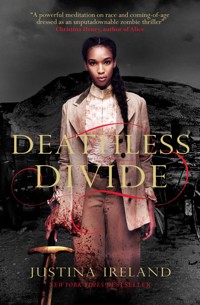
"Savvy, enlightening, and harrowing" Buzzfeed on Dread Nation After the fall of Summerland, Jane McKeene hoped her life would get simpler: Get out of town, stay alive, and head west to California to find her mother. But nothing is easy when you're a girl trained in putting down the restless dead, and a devastating loss on the road to a protected village called Nicodemus has Jane questioning everything she thought she knew about surviving in 1880s America. What's more, this safe haven is not what it appears—as Jane discovers when she sees familiar faces from Summerland amid this new society. Caught between mysteries and lies, the undead, and her own inner demons, Jane soon finds herself on a dark path of blood and violence that threatens to consume her. But she won't be in it alone. Katherine Deveraux never expected to be allied with Jane McKeene. But after the hell she has endured, she knows friends are hard to come by—and that Jane needs her too, whether Jane wants to admit it or not. Watching Jane's back, however, is more than she bargained for, and when they both reach a breaking point, it's up to Katherine to keep hope alive—even as she begins to fear that there is no happily-ever-after for girls like her.
Das E-Book können Sie in Legimi-Apps oder einer beliebigen App lesen, die das folgende Format unterstützen:
Seitenzahl: 673
Veröffentlichungsjahr: 2020
Ähnliche



















CONTENTS
Cover
Also available from Justina Ireland and Titan Books
Title Page
Copyright
Dedication
A Prologue: In Which I Arrive at Miss Preston’s
Part One: In The Garden of Good and Evil
1: In Which our Sequel Begins
2: Notes on a Broken Heart
3: In Which I have an Uncomfortable Chat
4: Notes on a Restless Night
5: In Which My Heart Breaks
6: Notes on a Horde
7: In Which our Luck Runs Out. Again.
8: Notes on a Struggle
9: In Which I Learn the Fate of Baltimore
10: Notes on a Plot to Save Jane Mckeene
11: In Which I Cool My Heels
12: Notes on the Ones Lost
13: In Which I get a Visit From the Dead
14: Notes on the Foolishness of Men
15: In Which I Spoil for a Fight
16: Notes on a Friendship
17: In Which Things Begin to Unravel
18: Notes on the Follies of Science
19: In Which I get the Lay of the Land
20: Notes on Foolhardy Endeavors
21: In Which I Err
22: Notes on a Heartbreak
23: In Which I am Saved
Part Two: The Road to Perdition
24: Notes on a Card Game
25: In Which A Dark Omen Appears
26: Notes on an Arrival
27: In Which I Consider Domestic Bliss
28: Notes on a Curious Wagon Train
29: In Which I am Once Again Fortune’s Fool
30: Notes on an Overland Journey
31: In Which I am Flummoxed
32: Notes on the Impossible
33: In Which I Find that Reunions Ain’t Always so Happy
34: Notes on a Bounty Hunter
35: In Which I Respond to an Inquiry
36: Notes on a Troubling Sign
37: In Which our Plans Change
38: Notes on an Expedition
39: In Which I have Regrets and Count My Blessings
40: Notes on a Disaster
41: In Which I Contemplate My Future
42: Notes on the California Trail
43: In Which I Realize Life is Ludicrous
44: Notes on a Terrible Idea
45: In Which I Fail
46: Notes on Scientific Discovery
47: In Which My Fight Ends
48: Notes on a Happily Ever After
49: In Which the End is Near
Author’s Note
About the Author
Also available from Justina Ireland and Titan Books
Dread Nation
JUSTINA IRELAND
TITAN BOOKS
Deathless DividePrint edition ISBN: 9781789090895E-book edition ISBN: 9781789090901
Published by Titan BooksA division of Titan Publishing Group Ltd.144 Southwark Street, London SE1 0UPwww.titanbooks.com
First Titan edition February 202010 9 8 7 6 5 4 3 2 1
Copyright © 2020 Justina Ireland. All rights reserved.
Cover photograph by Gustavo Marx/MergeLeft Reps Inc.
This is a work of fiction. All of the characters, organizations, and events portrayed in this novel are either products of the author’s imagination or are used fictitiously.
No part of this publication may be reproduced, stored in a retrieval system, or transmitted, in any form or by any means without the prior written permission of the publisher, nor be otherwise circulated in any form of binding or cover other than that in which it is published and without a similar condition being imposed on the subsequent purchaser.
A CIP catalogue record for this title is available from the British Library.
For every reader who found something worthwhile in Jane and Katherine’s story.★Thank you★
A PROLOGUE
IN WHICH I ARRIVE AT MISS PRESTON’S
The first thing you should know about me, the truest most important thing, is that I ain’t never really had friends. Not back at Rose Hill Plantation, where the kids regarded me as some kind of outsider, the daughter of the plantation mistress and uppity besides; and definitely not at Miss Preston’s School of Combat for Negro Girls. Sure, Big Sue had some affection for me, and the other girls tolerated me well enough, but there was never a point I had a person that I could confide the deepest yearnings of my soul to in the manner of close acquaintances.
It was my own fool fault.
After the Negro and Native Reeducation Act enforcement officers took me from Rose Hill, the only home I’d ever known, they loaded me on a train and sent me east. It wasn’t because there weren’t any combat schools in Kentucky—there were—it was because there was a greater demand for trained Negro girls in the Eastern cities than there was anywhere else. I didn’t know it at the time, but the whole Attendant business had become big money for folks, churning out girls they could sell to the highest bidder, those fees taken by the schools as reimbursement for the training they provided us. And if the rates they charged us colored girls for our government-mandated training was higher than what families paid for tuition at the fancy Eastern colleges, well, who were we to complain? Life as an Attendant had to be better than whatever hole we’d come from.
So the boys were sent to local schools, to one day be hired out for patrols and die defending a wall somewhere, guarding some town that had no right existing in the first place. But girls like me were put on a train and delivered to fine cities like Philadelphia, New York, and Baltimore.
The trip is a blur, mostly because I cried my way through it. Adventure is only swell so long as a body is enjoying the trip. After that, it becomes an ordeal. Mine took me through Ohio and Pennsylvania, and finally to Baltimore, which stank of human misery, fish, and death. It’s a stench you get used to, although it would never smell like home.
We were unloaded from the train, hungry and tired, while the fine ladies of the combat schools haggled over us like animals at market. There was pushing, and maybe some hitting, and the next thing I knew I was on a pony—a smaller, overland version of an armored train—bound for Miss Preston’s.
I didn’t cry once I was gathered with the other girls on our way to the school. There were four of us: doe-eyed Jessamin, who would run off our second year, never to be heard from again; Bessie, who died one spring when she accidentally stepped on a shambler buried in a bramble patch; Nelly, a girl who was fond of reminding everyone how she could read, not that it kept her from dying a week into her stint as an Attendant; and me. We sat in the pony, each trapped in our own private hells as we silently considered our futures.
The pony pulled into Miss Preston’s, and for the first time since I’d left home I felt a stirring of possibility. See, Miss Preston’s looked like home to me. Oversized oaks, white split rail fence, deadlier exterior fences, a wide lawn. The school had been built in the manner of a plantation house, and while such a design caused the other girls to suck their teeth and shake their heads, it made me feel something that few places have made me feel: safe.
I do realize that there is a fine bit of irony in the architecture of oppression granting me a measure of peace, but keep in mind I was not always the woman awoken to the dynamics of power I became during my tenure at Miss Preston’s.
As we tumbled out of the pony and into the front yard of Miss Preston’s, the headmistress and school’s namesake descended the front steps to greet us. She was a large woman, and an excess of ruffles accentuated her size. She gave me the impression of a very fancy cake, all layers and joy, and the memory now makes me cringe. Had she been calculating our value to her own plans for ascension, like a villain in a Shakespearean tragedy, even as she greeted us with warmth and affection? I’d like to think not, but I know people too well to believe any differently. Folks are, at their heart, selfish, and anything they tell you is more often than not designed to meet their own goals.
I know, because I ain’t any different.
“Welcome, girls, to Miss Preston’s School of Combat for Negro Girls,” she proclaimed. “Here you will leave behind your old lives and find yourselves transformed into women of the world. It will be you who attend to and protect the finest and most elite women in this country. You will lead lives of bravery and service, and your future is now full of limitless potential.”
Silence was our only response. Because every single one of us would have done anything in that moment just to get back home.
“The upper-class girls behind me will escort you to your rooms. You’ll each start with form-one lessons. As you get settled in, the girls will explain to you the household rules. Welcome once again to Miss Preston’s, and I hope you take advantage of the miraculous opportunities afforded to you here at the school.”
With that, we were whisked away to our rooms.
The thing that stuck with me from Miss Preston’s little speech was the idea that we were embarking on a new life. But the problem about starting a new life is you bring your old self with you. Even though I was told that this was a great opportunity and I had a responsibility to grasp it and work toward greatness, I was still the same Jane McKeene that couldn’t help but run off at every opportunity to get into trouble. Back at Rose Hill, rules had been breakable as eggshells, and just as easily disposed of. My impetuousness had, more often than not, been rewarded with indulgence, not punishment, and I suppose part of me had expected somewhat of the same at Miss Preston’s. But that wasn’t to be, and I learned right quick where I stood with the instructors at the school.
Two days after I arrived, I got my first lashing.
That initial night at Miss Preston’s, I had lain in the dark and listened to the crying and sleep sounds of twenty or so other girls. I would have been the oldest girl in my class, if it hadn’t been for a pretty blond-haired girl named Katherine Deveraux. I couldn’t say why I hated Katherine so much on first sight. Maybe it was her bossiness. Maybe it was the way all the other girls gravitated to her, as though her friendship and approval could change their lives. Or maybe it was because she smiled all the time, always smoothing things over when a mistake was made—but there to witness the mistake, every time, without fail.
And so when I committed the crime of taking an extra piece of corn bread at dinner without permission and Miss Anderson dragged me into the yard before the whole school for my first-ever whipping, Katherine was right up front, hands folded in her skirts, looking like an angel sent down to witness my punishment.
I’ll spare you the details of the ordeal. There were ten lashes, and it was more pain than I’d ever endured in my life. After it was done, Miss Anderson made some grand pronouncement, as despots are prone to do, and I knelt there in the dirt without a single regret, because that corn bread was delicious.
But when Miss Anderson left, it was Katherine who came over to me, who helped me to my feet.
“Jane,” she said, her voice high and clear, loud enough for all the girls to hear, “it will be okay. There is no need to cry. This is a trial of your own making, one many of us will surely endure, sooner or later. We are, so often, our own worst enemies.” She smiled that smile of hers. “But the rest of us, we are here for you.”
See, this is the kind of nonsense Katherine would spout, like she just couldn’t help herself. A barb wrapped in cotton, some sort of admonishment tucked into platitudes.
And I was not one to stand for it.
I looked at Katherine, my tears drying cold on my cheeks. “A trial of my own making.”
She blinked, as if surprised at how her own words sounded coming out of someone else’s mouth. “Well, yes. We all wanted an extra piece of corn bread, but only you were fool enough to go into the kitchens and snatch one.”
“There was plenty of corn bread. Why shouldn’t we all have an extra piece?” I crossed my arms even though it made my back scream in pain. A few of the other girls murmured in agreement, and I could feel the questions sprouting beneath them, taking root in that moment. Why did we have to be sent halfway across the country to care for some fancy white ladies that wouldn’t even let us have an extra piece of corn bread? Where was the justice in that?
But Katherine didn’t understand the change in landscape, and she muddled along on her high horse just as best as she could. “Because there are rules. You cannot just go around breaking them. And if you do, there must be consequences. Otherwise everyone would just do as they like.”
“That don’t sound half bad to me,” a girl said, and there were more murmurs of agreement.
Katherine huffed a little in frustration. “You all are missing the point. I was trying to tell Jane we understand how she feels, that we are here for her after her punishment.”
Maybe it was the way Katherine said punishment, like it was something I deserved. Or maybe it was the way she kept saying that she understood how I felt, even though I was sure that fair skin had never borne the brunt of the lash. Either way, something in me gave way, and my black temper rose up, blotting out all reason.
I drew my hand back and slapped Katherine with all the force I could muster in that broken moment.
It was a good slap. The sound carried throughout the yard, silencing conversations and eliciting a few gasps. Katherine’s eyes widened, impossibly large, and tears filled them, though none fell. A thin tendril of horror uncurled in my middle, and in the back of my mind Aunt Aggie chided me for being too quick to resort to violence to express my feelings, but mostly it felt good to take all the ugliness of the past week and direct it at one person, to give it to them, a gift of pain.
“Maybe,” I said, my voice low, and a few girls took a step back lest the slap become a real dustup, “maybe now you understand a little bit of how I feel.”
Katherine blinked, and her tears finally fell. I was ready for her to hit me back, and I’d have a chance to work out the rest of my homesickness and heartache in a bit of fisticuffs. But instead, she turned on her heel and fled, back toward the main building of Miss Preston’s.
And that is the story of how Katherine and I became sworn enemies.
Sometimes, when sharp-edged personalities like ours rub against each other, it generates nothing but sparks and heat. But after a while, well, they can wear each other down until the pieces fit together. If it hadn’t been for what happened at Summerland, Katherine and I facing the worst ordeal of our lives and each of us only surviving for the companionship of the other, I suspect we would still be adversaries. We’re too different to be anything else.
Which begs the question: What comes next?
PART ONE
IN THE GARDEN OF GOOD AND EVIL
In a wide sea of wax; no levelled malice
Infects one comma in the course I hold,
But darts, an eagle flight, bold, and forth on,
Leaving no tract behind.
—Shakespeare, Timon of Athens
— JANE —
1
IN WHICH OUR SEQUEL BEGINS
It’s a curious thing, to watch a town fall to the dead.
Usually, you only discover a place that’s been overrun after the fact: hollowed-out buildings full of shamblers, broken windows marked with the blood of fleeing occupants, scattered ephemera, cups and combs and bottles, the small things that people drop in the midst of headlong flight. It’s an eerie sight, the aftermath of a shambler attack, but it’s an echo of the horrors, not the actual carnage.
Seeing it in action? Well, that’s something I’d hoped never to bear witness to.
And yet I’m actually enjoying watching an ocean of undead overwhelm Summerland.
The dead are too far off for me to smell them, but the sound of their moans carries on the hot summer air to where I stand. The buildings of town are matchboxes; the dead are ants swarming all around. I ain’t never seen so many shamblers in one place, and I can’t help but wonder if this is what it looked like when the dead first rose in the midst of the Battle of Gettysburg, back in 1863.
“Jane.”
I turn. Katherine stands nearby, her arms crossed. Even in the midst of running for our lives, she is beautiful. Her golden skin is flushed, and a few tawny curls have escaped her updo to blow in the wind, her eyes as blue as the hot summer sky. The bonnet she wears should look homely, a fashion relic, but on her it’s lovely, if a bit blood-spattered. You might not know Katherine was a Negro from looking at her—she’s that light—but there is a dusky hue to her skin that belies the truth.
“Do you think Gideon made it out?” I ask. Gideon Carr, a boy about whom I have entirely too many opinions, was nowhere to be found as we escaped. And even though the boy ain’t my problem . . . with his muddy hazel eyes, pale skin, and tousled curls, I kind of want him to be. Which is hard to contend with, since nothing of consequence can come from any such feelings.
“Gideon is resourceful,” Katherine says, an answer that ain’t an answer, “like Ida, your acquaintance from the Summerland patrol. I am certain she was able to see to matters and cleared out before the dead could complicate escape. But we have dawdled long enough. The wagon with the others is going to be out of sight soon, and we should get moving. The restless dead are not going to stay within the town forever.”
Katherine is a bit of a nag, and usually all of her bossiness puts me into a provocative mood. But today I am feeling quite fine, since we have survived a near slaughter, rid the world of some particularly unsavory characters, and found our freedom all in the same fell swoop.
We stopped here because I wanted to take one last look at Summerland, the hellhole where I nearly lost myself. The town had been a Survivalist utopia founded by an unholy minister and lorded over by his sheriff son—a town where Negroes had been put in their place, which was in brutal service to the well-to-do white folks that had come to make it their home. It had been hell, but I’d survived. All that effort, however, had been driven by a single thought: that I had a place to go when all was said and done. Rose Hill Plantation, my childhood home.
Now, from the letter I grip in my hand, the last one my mother had tried to send to me, I know that to be false. I’ve got nothing now but a dream of a faraway place—California—and the hope of finding my beloved Momma and, more importantly, Aunt Aggie. I ain’t seen either of them since Rose Hill Plantation, and my letter-writing campaign was thwarted by Miss Anderson, one of the most vile people ever born and an instructor at Katherine’s and my alma mater, Miss Preston’s School of Combat for Negro Girls.
But that was all then, and this is now. Momma’s last note says California is where she was headed, but that don’t mean much in these end times. The question that matters more: Is she even alive? And what about Aunt Aggie, the woman that mostly raised me up? What do I do if she’s gone to the great beyond?
It’s too much to consider in one go. Before I can answer any of those questions, I have to keep surviving today.
“Yeah, okay, let’s go,” I say.
“Would you mind relacing my corset before we set out?” Katherine asks, pointing to her back. “Not too tight. Just enough to give me a little bit of security.”
I manage not to roll my eyes, but just barely. “I don’t know what it is about you and corsets,” I mutter, but oblige her request anyway. On the way out of town I’d cut the lacings to the contraption so that Katherine would have a bit more range of motion with her swords. We were fleeing from the restless dead, after all. But now that the danger has passed it’s apparently time to return to a modicum of respectability.
I lace and knot where necessary but leave the whole thing looser than I’d learned in my sartorial training back at Miss Preston’s.
“I suppose that will have to do,” she sniffs, and by that time the wagon with the rest of our party is far enough down the road that all we can see is the dust cloud it kicks up behind it.
It ain’t hard to follow. It makes such a creaking racket that if there are any shamblers around they’ll show themselves quickly enough. But unless it’s a horde, I ain’t worried. Jackson Keats, my sometime beau, walks beside the wagon that carries his sister, Lily, and the rest of our ragtag group. The Duchess, the former madam of Summerland’s house of ill fame and a white woman of fine moral character, sits in the back with tiny Thomas Spencer, while her girls Nessie and Sallie sit up front and drive the wagon. We are a merry band of survivors, and no one seems all that upset about leaving Summerland behind us. One day, our time there will be just another terrible memory.
“How long until we get to Nicodemus?” I ask, running up to the front, where Jackson leads the way as we walk the dusty track. We’re the only ones on the road, which makes me think anyone else who had fled Summerland must’ve taken a different route. There’d been a crossroads a little ways back, and Jackson had conferred with Sallie in a low voice before we’d continued on, taking a turn that hadn’t borne the same deep wheel marks that the other road did. At the time, I’d thought Jackson knew an alternate route, one that would leave us less open to attack, since Jackson was more familiar with the land in these parts than I am. But still, I’m a mite bit worried. Not because I don’t trust Jackson, but because I don’t like being beholden to a plan that ain’t my own.
And maybe the for-real truth is that I do have misgivings about placing my faith in Jackson. After all, once upon a time he was my beau before he decided to put me aside, and the only reason I ended up in Summerland was because we went looking for Lily and uncovered the mayor of Baltimore’s plan to build some kind of peculiar utopia out in the middle of Kansas. Now here we are, in between a whole lot of nothing and a ravenous shambler horde, with nothing but our wits and a handful of weapons. No plan, no rations, just hope.
It makes me nervous, how alone we are in the big, wide-open prairie. I don’t like feeling so exposed, like the entirety of my sins are being laid bare before that watery blue sky.
“Yeah, you and I need to talk about Nicodemus,” Jackson says, gaze steely, hand resting lightly on the revolver hanging by his side. “Not now, but once we stop for the night.” His jaw is set, and whatever warmth I might have seen in him back in Summerland has faded. Red Jack is back, ruthless and cutthroat, the boy who used to make my heart pound.
Today his attitude just annoys me.
I stop walking and pull him with me onto the side of the road, out of the path of the wagon. “What are you talking about? What’s going on in Nicodemus?”
Jackson crosses his arms. “I just said we’ll talk when we stop for the night. The town is a two-day ride, and we’re exposed out here. My words were about keeping us all safe, not an invitation to fight about it.”
“Fighting is how we get to safe, and it seems like maybe you got a plan that the rest of us should get clued in on.”
Behind Jackson, Katherine has left the wagon’s side, brows pulled together in a frown. “What’s going on?” she asks.
“Jackson says there’s something he needs to tell everyone about Nicodemus, but he wants to wait until we stop for the night. I think we need to have it out now before we get too far down the track.”
Katherine sighs. “What’s the problem with Nicodemus?”
“Nothing,” Jackson says. He takes a deep breath and then lets it out. “Your classmates from Miss Preston’s are in Nicodemus. There was just a conversation I wanted to have with Jane. Later. When there ain’t an audience.” He gestures with his head toward the wagon.
“Is something the matter?” the Duchess calls. The wagon has now passed us by and is slowly making its way down the road. I imagine the Duchess ain’t too fond of all the folks with weapons falling too far behind.
I tug Jackson by the arm and we start walking, keeping to the side of the road to avoid the worst of the dust. “Look, this ain’t the time for half stepping the truth of the matter, no matter how bleak. At some point that horde back behind us is going to be on our tail. If there’s something we should know about Nicodemus, out with it.”
Jackson sighs and rubs the back of his neck, lowering his voice. “All right, fine. The town, well . . . it’s a bit crowded. There was hardly enough room for the people who were there back when I left. And with the rest of the folks fleeing the horde heading there, I think it would be a better plan to not go there at all but to rather head to the eastern part of the state, make a run for Fort Riley and the Kaw River.” He presses his lips together.
I look at Katherine, and her expression of confusion mirrors my own feelings. There’s more to his decision than that, and we both know it. “What ain’t you telling us?” I ask, but Jackson just shakes his head.
“Drop it, Jane, and trust me for once, will you?” He takes off his hat and swipes away the sweat with the back of his hand before resettling it into place. His bowler is flecked with ominous-looking dark spots just like my wide-brimmed hat, and I wonder if he stole his from a dead man like I did. “There ain’t nothing worth seeing in Nicodemus. It’s just as cursed as Summerland, the same old evils prettied up with whitewash.” He takes a deep breath, lets it out, and starts walking. “It’s a Negro settlement, founded by Freedmen and runaways from the Five Civilized Tribes. But that doesn’t mean it doesn’t have issues. You can’t trust those Egalitarians any more than you trust the Survivalists.”
I have no doubt what Jackson is saying is true—the Egalitarians were against using colored folks to bulk up patrols and defend towns, but they were still hardheaded in their own way. The best-case scenario would be to avoid a town altogether and just strike out for California. But that’s a fool’s errand with no rations, and Jackson knows that just as well as I do.
“Runaways?” Katherine says, bringing me back to the matter at hand.
“Some of them Indians kept slaves the same as everyone else,” Jackson says, his words clipped. “Ain’t a single body in this entire cursed country that didn’t have a hand in trying to own the African.”
I shake my head, because neither the words nor the tone beneath them sound like the Jackson I know. But I got bigger problems than a bit of proselytizing. “I don’t think the Duchess or Sallie will care about going to a Negro town,” I say, deftly changing the subject. I’m pretty sure Sallie and Nessie are sweet on each other, and the Duchess was one of the few allies I had in Summerland. Gideon and Ida are both in the wind, and while I hope they made it out of Summerland safely I can’t worry about that just yet. I still haven’t saved my own miserable hide.
Jackson shrugs. “Maybe not, but we really should head east. If we skip Nicodemus altogether, we’ll have a better chance of getting to the Mississippi, and from there we can go anywhere, quickly and safely.”
“But there are Miss Preston’s girls in Nicodemus,” I say. “Sue might still be there. And Ida and the Summerland Negro patrols were planning to make their way there. If Nicodemus is crowded or compromised, we have to find them and let them know. They’ll want to come along with us. And there’s safety in numbers, especially when they know how to put down the dead.”
Katherine crosses her arms, and a look I recognize all too well comes over her face. Jackson is about to get an earful. “Jane is right. Our friends are in Nicodemus, Jackson. There is no way we could abandon them like that. It’s unconscionable.”
Jackson presses his lips together. “Since when do you have friends?” he asks me.
“What, you think there ain’t anyone I care about more than you in this world?” I shoot back. “Don’t forget why we’re in Kansas in the first place.”
“Fine,” he says, hightailing it toward the wagon. Katherine and I exchange a glance.
“What got into him?” she asks.
I shrug, and jog to catch up to where Jackson is stopping the wagon.
Love does not delight in evil but rejoices with the truth.It always protects, always trusts, always hopes, alwaysperseveres. Love never fails.
—1 Corinthians 13:4–8
— KATHERINE —
2
NOTES ON A BROKEN HEART
Once the wagon is stopped, Jackson, or Red Jack as Jane sometimes refers to him, addresses the group. It is easy to see he is uncomfortable. There is a reason he avoided the discussion of Nicodemus, and even though it is not immediately clear, I believe it has something to do with Jane. His gaze skips over her as he surveys our group, like whatever the boy is about to say is something that she will not want to hear. It is curious, and, like Jane, I want to know just what is going on.
But his nerves are catching, and I press in at my sides, trying to find some security in the relaced corset. The familiar panic is still there, just as it always is, right below the surface. I take a deep breath and recite Scripture in my mind to distract myself from the feeling.
Jackson shifts his weight a couple of times, and we all watch him warily, except for the little Spencer boy, who is fast asleep in the Madam’s lap. Red Jack takes off his hat, and I know for a fact I have never seen him look this unsure of himself. Granted, we have not been long acquainted, but even while we were on that miserable train ride west, a consequence of an overzealous investigation into affairs that did not concern us, he still looked like he was out on a lark. This is a different Jackson, and he chews on his words, as though weighing them carefully will somehow make them more palatable. “We ain’t headed to Nicodemus.”
Jane and I exchange a glance. She shrugs. I twist my hands in my skirt, as though the material can absorb the anxiousness I am feeling. My only comfort right now is the knowledge that Jane has no more of a clue as to what is happening than I do.
The Madam—I refuse to refer to her as the Duchess; it is a ridiculous nickname—pushes her red hair out o f her face and adjusts her grip on the little Spencer boy. “Then just where is it that we’re headed? Jane said Nicodemus was our best bet.” Her face still bears the bruising of Sheriff Snyder’s wrath, and a fiery rage swells within my breast, pushing back the panicky feeling. I would never tell Jane this because her penchant for violence does not need any encouragement, but I am glad she killed him. That man deserved to die.
I hold close to my anger, because it is a much more welcome feeling than the fear that some terrible thing waits just around the bend.
Jane crosses her arms, Sheriff Snyder’s hat, now her hat, pulled low over her eyes. “It is our best bet, but Jackson thinks we should head east to Fort Riley.”
One of the other soiled doves, a white girl named Sallie with long, dark brown hair and a defensive jut to her jaw, crosses her arms. “That makes sense to me. Fort Riley is on the way to the Mississippi, and we could go anywhere from there. We should find the Big Muddy and try to head up north before winter gets on. One of my weekly callers heard tell of an enclave up around Saint Paul. Hardly any dead up that way, and they say Fort Snelling is big and strong enough that those who can get there won’t have to worry about anything.”
Nessie, a colored girl a bit darker than Jane with mournful eyes, frowns. “What’s wrong with Nicodemus?”
“Nothing, if you’re a fan of those temperance biddies,” Sallie says, her expression going stormy. “They’re all about respectability in Nicodemus. They like to say they survive by being a better class of people. It’s not as if I think Negroes ain’t good people or nothing, but those folks in Nicodemus make a big deal about it. No drink, no whoring, no swearing. It’s like a town made of a church.”
I look to Jackson. “Is that true? Is that why you want to go east?” I cannot keep the edge out of my voice. I get the sense there is something he still is not telling us, and I despise secrets.
Nothing good ever comes of withholding the truth.
“Sallie is right, Nicodemus is a bit . . . restrictive.” It is not an answer, and it is a vexing response to say the least. “And it’s not nearly as safe as Fort Riley. I’m not putting Lily in danger again, if I can help it.”
“Hey! I can defend myself,” she says, cheeks going ruddy. “I’ve been taking care of me and Thomas for months. Don’t treat me like a baby.”
Like me, Lily is light enough to pass. It was looking for her that got Jane, Jackson, and me carted off to Summerland in the first place. She is a plucky girl, and seeing her gives me some idea of just how Jackson and Jane fit together. Jane says the two of them are no longer an item, but I see the way her expression softens when she glances in his direction. And I saw that kiss he gave her outside Summerland. Jane might deny it, but she has a soft heart, and one too easily given, in my opinion. Her love affairs were a constant source of conversation at Miss Preston’s School of Combat for Negro Girls, although to hear Jane tell it she was as discreet as they come.
“It seems to me making a beeline for Fort Riley only makes sense if you think there’s somewhere to lay on for supplies along the way,” Jane says, crossing her arms. “If it’s further than we can walk in a day or two we’re setting ourselves up for trouble, especially in this miserable heat. Just how far you think the lot of us is going to get without food or clean water?”
“There are some abandoned farmsteads we can scavenge along the way,” Jackson says, giving Jane a hard look.
“You got a map of these farmsteads? Because that doesn’t sound like any kind of plan to me,” she shoots back. “Hoping that we can find supplies.”
“I have to agree with Jane,” the Madam says. “Lily here might be able to fend for herself, but little Thomas most definitely can’t. And to be truthful, me and the girls aren’t exactly used to fighting the dead or hunting for our food.”
“And I’m not even sure I want to go to Minnesota,” Nessie says with an apologetic look to Sallie. “Forts mean soldiers, and I don’t have good memories about any of that business.”
Sallie’s expression is stricken, and Nessie takes her hand. But the rest of our party is looking more vexatious by the moment, and I clap my hands three times to get everyone’s attention.
“All of this arguing is not going to get us anywhere,” I finally say. Panic thrums in a low key through my veins, like a plucked guitar string. That horde might not be upon us just yet, but if we keep at this they will. “Perhaps there is some logic to Jackson’s idea, but as Jane points out, it is still not a plan. How far to Fort Riley?”
A muscle in Jackson’s cheek twitches. “Three days, maybe a little more, depending.”
“And Nicodemus is what, another day’s walk?” Jane asks, needling. At Jackson’s slow nod, she snorts. “We’ve got no provisions, no water, and a bunch of tired, hungry people. I don’t think there’s a real choice, here.”
“Jane is right,” I say. “We should head north to Nicodemus, and once we have gotten our bearings and procured some supplies, we can discuss how we might head east to Fort Riley. Besides, with that horde behind us, we should send word out to all the nearest towns and encampments so that they can prepare.”
“That makes sense,” the Madam says.
Jackson opens his mouth to reply. “But—”
“Perhaps we should vote on it?” I interrupt him.
The Madam and Nessie both look uncertain, and Jane’s eyebrow has a cock to it that I dislike. She is plotting, and whatever has gotten the gears of her mind turning cannot be good. But a vote is the best way to put to rest hurt feelings, and there is no sense in setting off with someone out of sorts. This is not a pleasure trip. We are literally running for our lives.
“I know how I’m voting,” Sallie says. “I ain’t fond of Nicodemus, especially seeing as how they ain’t exactly going to be rolling out the welcome wagon for working girls like me and Nessie. But I’m even less fond of shamblers, and it’s only a matter of time until that horde starts to follow the rest of the food. We need a chance to prepare, no matter where we decide to go.”
Jackson does not appear convinced, but the rest of the group murmurs concurrence, and it seems like the majority has spoken. But that is when I notice that Jane is barely paying the discussion any attention. Instead, she watches Jackson like a hawk.
“I’m not voting on anything until I know why Jackson is so damn eager to run to Fort Riley,” Jane says, as direct as ever, her eyes narrowed.
Here we go. I swear, Jane lives to fight. It is her daily bread.
Jackson looks at Jane, but his expression is not angry. It is sad, almost regretful. “Fine, Jane, you win. The truth is that I heard there were survivors from Baltimore in Fort Riley, come west on the same train that brought Miss Preston’s girls out this way, and I’m hoping my wife is there.”
My breath catches. Jackson’s words fall into the oppressive heat of the afternoon like birds from the sky, sudden and unexpected.
Jane takes half a step back, as though she has been struck. “Your wife?”
He shrugs. “I got hitched back in May. I was going to tell you eventually . . . but, yes, Jane. I’m married.” His tone is gentle, but even so, the soiled doves all bear similar expressions of sadness and anger. It is impossible to ignore that this is a blow to our poor Jane.
“You went and got married? Without even discussing it with me?” Lily yelps. The girl is too young to parse the subtext of Jackson’s declaration.
All of my attention is for Jane. I remember how she looked when she thought Jackson was dead, the anguish that had crossed her face before she twisted her expression back into her usual scowl. The naked despair on her face now puts that past sorrow to shame.
Jane tries to recover, and Jackson watches her expectantly. I am not quite sure why. Does he want her to cry? I know they were close, close enough that I am sure Jane has compromised the boy a few times. But there is something here I just do not understand.
“Well, congratulations!” I say, forcing all the brightness I can muster into my voice. “Lovely that you, sir, have been able to find a wife amid the tragedy and death of these end times. You are quite the enterprising fellow.”
Jane makes a choked sound that is somewhere between laughter and a sob, and I keep talking, hoping no one else has heard her. I have found that when all else fails, a sunny disposition can save the moment.
I continue. “While Fort Riley does sound like a potential goal for us eventually, how delightful to be able to reconnect with other Baltimoreans, it seems that the only reasonable plan of action is that we seek out the nearest settlement, no matter whose wife may or may not be in residence there.” Once again, the group murmurs its assent. I look to Jackson and Jane, and they both give curt nods.
I give everyone my best smile and clap my hands once like Miss Duncan, my old instructor at Miss Preston’s. No one could redirect a mishap like Miss Duncan, and her poise was unimpeachable.
“Excellent, then let us stop wasting daylight.” I gesture for Sallie to take up the reins again. “Jackson, can you man lead scout? Jane and I will take the rear.”
He stalks off toward the front of the wagon and sets out with long strides. Jane and I fall behind and slightly to the left of the wagon, doing our best to stay out of the considerable cloud of dust the wheels kick up. After a short while it becomes clear that it is a wasted effort, and, using my boot knife, I slice off a strip of my petticoat to tie around my nose and mouth. I slice a piece for Jane as well, and she takes it without a word.
“Are you okay?” I ask in a low voice. I daresay Jane and I are not exactly confidantes, even after our trials together in Summerland. Our friendship is newborn, and I am wary of placing a strain upon it that it will not bear. I remember too well our first meeting and how quick Jane is to take offense at the least little comment. But it is plain to see that she is hurt. She cares about that boy in a way I only understand in an academic context. I know love, of course, but not the push-pull of whatever Jane shares with Jackson. I have come to believe that it just is not in my being to feel such a powerful longing for a person, not physically nor romantically. I am sure that there are lots of reasons why, and folks most likely would try to blame my upbringing, which I would say is wholly incorrect. I am the way God has made me, and I shall not question the wisdom of my Creator. But whatever the reason, the true fact is that I have never had to deal with the complications of romantic entanglements, because they are just not something I desire nor will seek out.
But no matter how she may feel about me, I care about Jane deeply. And even if I do not understand the pain she feels right now, it does not mean I cannot support her through it.
That is what friends do.
Jane does not answer, and I bump my shoulder into hers, give my boot knife a few quick flips. “We could kill him if you would like.”
That gets Jane’s attention, and she looks at me with wide-eyed surprise. For a brief moment I think I am going to have to explain the joke, but then she bursts out in a hearty laugh.
“Kate, you are too much.”
“Perhaps you are right. But we should at least cover him in honey and leave him out for the ants. I am still rather sore at him for getting us shipped out west. Kansas, of all places! And now he has hurt your feelings? That definitely warrants some kind of retaliation.”
Jane sighs and shakes her head. “It’s fine. I’m fine, Kate. But thank you. I’m going to fall back a little more, this dirt is all up in my eyes.” She swipes at her face, and I know the tears are not because of the dust at all.
She drops back a little ways behind me, turning and watching our rear as we walk. I draw up alongside the wagon a bit more, and smile brightly at Lily and the Madam. Thomas is still sleeping, poor thing. Does he even realize his plight?
“How is Jane doing?” the Madam asks.
“Oh, she is just . . . tired. She was up all night killing the dead, and I daresay today has been even more eventful.” The briefest memory of the sheriff’s office in the aftermath of our shootout flashes in my vision: dead men, blood everywhere, Pastor Snyder yelling expletives at us as we armed ourselves and departed. My smile turns brittle, and I have to blink hard to keep back the anxious sensation that plagues me like a restless beast. “It will be better for all of us when we find a place to rest.”
The Madam nods, and if she notices my momentary lapse in composure she does not say. As an Attendant, it is my job to always remain in control of my emotions, no matter how strong they may be.
I turn my attention back to the tall grass on either side of the road, taking as deep a breath as the corset will allow, and try to will myself calm. The old panic gnaws away at the edges of my mind, a constant catalog of worries that now includes all the terrible things Jane must be feeling and a fair bit of guilt over the dead men back in Summerland. My pulse thrums, and if I were to stop walking I fear that everything would overwhelm me. I wish my corset were tighter. Even though Jane hates the thing, calling it certain suicide in a shambler fight, the control the garment provides helps me to keep the panic inside. Jane would surely laugh at the thought, a bit of satin and bone holding back all the awful that prowls through this world, preying on the wary and unwary in equal measure. But when I am dressed and looking my best, I feel like I actually have power over something.
And even the smallest feeling of security is a comfort in a brutal, unforgiving world.
I pray you, do not fall in love with me,
For I am falser than vows made in wine . . .
—Shakespeare, As You Like It
— JANE —
3
IN WHICH I HAVE AN UNCOMFORTABLE CHAT
I can feel Katherine’s eyes on me all through the afternoon. I scrub my face with my sleeves, smearing around dirt and snot and tears, and try to untangle my feelings while we walk. Katherine thinks I’m crying because Jackson broke my heart, but really my tears were brought on by rage. How dare that boy kiss me outside Summerland, a kiss that felt like a promise, when he was already hitched to another? How dare he get me all tangled up in the cutthroat politics of Survivalists and a quest for his missing sister when all along he was bedding down next to someone else?
How dare he?
But I say none of this, and I keep myself in control by uttering not a sound as we walk, the slice of petticoat Katherine gave me tied around my nose and mouth. If I let loose the tenuous hold I have on my feelings, there will be blood. And it won’t be mine.
We walk all through the day, not wanting to give the dead a chance to catch us resting. The sun beats down on my neck, and our lack of water soon takes its toll. My mouth tastes like the wrong side of a boot, and I cough and fight to work up enough saliva to spit. I’m only moderately successful, and the aftertaste of my effort is even worse than the dust coating my teeth.
At this rate, I ain’t even sure we’ll make it to Nicodemus. Still we press on, never stopping, though we take frequent breaks whenever we see anything that looks like it could be a creek. But this late in the summer everything is dry, and the cottony hotness that coats my mouth grows thicker by the minute.
Instead of thinking about my thirst I think about Jackson. His shirt clings to the strong muscles of his back—he’s stripped off his waistcoat to combat the heat, and I ain’t one to skip the view. I remember all the times I saw that fine red-brown skin of his. Jackson and I ran together for nigh on a year, and even after our falling-out he still came around, roping me into schemes that promised adventure and money but never panned out quite the way we thought they would. But in all that time together, not once did he ever mention the idea of marriage, even in the abstract. Not that I would have agreed to any proposal from him, mind you. I got goals of my own, and I ain’t never seen a woman get hitched and keep on with her business. Hell, I ain’t sure I ever want to set up housekeeping, let alone do it with a man. And having babies? Lord save us all.
No, Jackson never even mentioned it, the possibility of children and “till death do us part” and a life less chaotic. And yet, in all that time we were still up to our adventures he never saw fit to tell me he’d gone and jumped the broom. Where was this wife of his while Katherine and I were helping Jackson poke around the Spencers’ homestead? Where was she when we crashed the mayor’s fancy dinner? Why wasn’t she the one that got uprooted and sent west to a settlement that was little more than a reinstated version of the old South? Which makes me wonder what kind of girl he married. If she’s all the things I ain’t.
I ain’t sure why I’m fixating on Jackson and his marital status when there’s a horde less than a day’s march behind us, but I am. A bleak mood taps at my brain, and I let it in without a second thought. The killing from earlier in the day is still with me, and with this newest revelation I just want to lie down in the long grass alongside the road and let the dead find me. It has to be better than this miserable existence.
Just as the sun is beginning to head home for the night, we come upon a cabin, and Jackson calls for a halt.
“This is likely the best we can hope for as far as shelter goes,” he says. “I figure we’re about halfway to Nicodemus, and if we rest we can make good time tomorrow.”
No one objects, and once Katherine and I have cleared the cabin to make sure there ain’t any shamblers lurking about, everyone gets to making the best of a bad situation. At the very least, there’s a pump, and after a good bit of work water comes up, first silty, then cool and clear.
“Well, at least something is going right,” Lily says, saying what we’re all thinking.
We cup our hands and drink our fill, scrubbing our faces as we do so. The water makes me feel a little more human even though there’s an ache in my middle that no amount of water can relieve. A loud growl comes from Katherine’s belly, and she flushes.
“I beg your pardon, but it has been a long moment since I last ate,” she says, as though we ain’t all powerful hungry. Only Katherine would apologize for a breach of etiquette in the midst of fleeing for her life.
Jackson and Lily head out into the prairie to see if they can scare up a rabbit for dinner. The Duchess sets to stoking a fire in a long-disused hearth inside the cabin, tiny Thomas at her side, while Sallie and Nessie unhook the horse from the wagon and set him to grazing in a fenced area that looks to be built for just such a thing, complete with a wooden trough they fill using a bucket found in the cabin. That leaves Katherine and me to keep watch in the gloaming, and we perch on a couple of empty wooden crates we find on what would’ve served as the porch.
“Jane, I think the wounds on your back have opened again,” Katherine says after a few moments. Her voice is low and her words are careful, but I already know she’s right. There was never any doubt that I’d carry a reminder of Sheriff Snyder’s lashes, but at this rate I’ll be lucky not to get an infection. My dress tugs and pulls at the welts on my back, and even though I’ve been mostly ignoring the pain, the hotness lets me know I’ve let it go too far.
“Well, at least I’m alive,” I say with a sigh, trying to push aside my fear and worry.
“Let me see to them, Jane. We can at least clean them up.” Her tone is gentle, and it makes me want to laugh. If anyone had told me six months ago I’d be mixing it up like this with Katherine Deveraux I would’ve punched them in the mouth and called them a fool. Guess the only fool here is me. I nod, and Katherine disappears and returns with a bucket. She slices off another piece of her garments and gently dabs at my back.
“If you’re not careful, you ain’t going to have but four petticoats left,” I say.
“Jane McKeene, you know full well I am wearing only two petticoats. It is far too hot for more than that.” She winks at me, and I can’t help but smile.
We sit in companionable silence for a few moments before Katherine clears her throat. “Are you sure you do not want to talk about Jackson? Because I cannot help but—”
“Why the hell would I want to talk about him?” I ask, deciding anger is an easier emotion to cling to at the moment than despair.
Besides, Katherine ain’t going to be able to answer the only question I have at this moment: Why? Why ain’t I good enough? For him, or for anyone? Because everyone sets me aside, sooner or later. My momma, who tried to drown me when I was little even though I loved her more than the moon and stars. Aunt Aggie, who urged me to go with the school officers when they came calling for kids for the combat schools. And now Jackson. Everyone I’ve ever loved has pushed me away, in one way or another, and I ain’t keen on rehashing a lifetime of angst with the one person who might give a fig about me now.
Best she find out how unlovable I am in her own good time.
Katherine mercifully doesn’t press me; she throws the bloody rag back in the bucket and gestures at me to button my dress up. “The sheriff, then? You have had quite the emotional shock today, and killing a living person is no small thing. There is a toll it takes on the mind and the soul, and I worry that after all we have been through . . .” She trails off, her words as delicate as her touch.
But kindness ain’t what I need right now. I stand, my body smarting, my belly aching, and sigh. “I’m fine, Kate. Besides, we got bigger problems. What are we going to do once we get to Nicodemus? Jackson told us before that the rest of Miss Preston’s girls ended up there after escaping Baltimore, but you and I both know that no town is safe for long.”
Katherine shakes her head. “I do not think we should make any decisions until we can take the measure of the town for ourselves. It is clear that Jackson and Sallie have their reasons for not wanting to go there, but survival is the thing that matters now, and I think the only people we can trust are one another. You urged me to have patience back in Summerland, and I think that is the proper course of action here as well. After all, a cautious and cool head is the hallmark of a Miss Preston’s girl.”
A rustling comes from the edge of the grass, and both Katherine and I jump to our feet, she readying her Mollies—short swords with a blade the length of my forearm—and me pulling my revolver, leaving my sickles in their holders. It wouldn’t be the first time either of us have seen the dead crawling along looking for a meal, legs too broken or ruined to walk properly.
But it’s a rabbit that bursts out, zigzagging toward us. I don’t hesitate. My first shot misses, but the second hits, the small body flopping dramatically as it dies.
“Jane!” Katherine gives me a look of wide-eyed horror.
“What?” I ask. I gesture at the prone form with the barrel of the gun, which still smokes. “That’s dinner.”
She shakes her head again. “The way you go off pulling that thing out at a moment’s notice, I swear . . .” She trails off and walks over to grab the rabbit, holding it up by the ears. There’s another rustling sound, but this time it’s Jackson and Lily, their silhouettes clear with the bright of the setting sun lighting them from behind. They come walking out of the tall grass at the far edge of the property, Lily clutching her shotgun with a grin.
“We got two of them,” she announces.
“You mean I got two of them,” Jackson says, his voice warm with affection. “You need to work on your trigger pull.”
“Jane also got one, and if you had arrived a few seconds earlier she probably would have plugged you full of holes as well.” Katherine sniffs.
“Pffft. I know the difference between a girl and a rabbit,” I say.
Katherine looks meaningfully at me and then Jackson, and gives the group of us her best smile, before she gestures to Lily. “Come along, let us get these dressed so the Madam can cook them.”
“She likes to be called the Duchess,” I say.
Katherine huffs. “That is not a name,” she tosses over her shoulder as she and Lily round the corner of the house, heading to the pump. It ain’t until they’re gone that I realize I’m all alone with Jackson.
Dammit.
He must be feeling the same thing I am, because he takes off his hat and draws a breath. “Don’t start.”




