


17,99 €
Mehr erfahren.
- Herausgeber: John Wiley & Sons
- Kategorie: Fachliteratur
- Sprache: Englisch
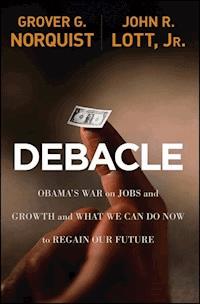
A provocative critique of the Obama administration's economic policies and an examination of America's difficult economic future During the 2008 presidential campaign, Barack Obama promised "a net spending cut" to make government smaller in order to reduce the deficit. But this huge increase in government spending and debt, and the resulting prospect of higher taxes, will make America a poorer country. Are Americans happier because the government has determined where this money should be spent? According to John Lott and Americans for Tax Reform President Grover Norquist, the answer is no, and in Debacle: Obama's War on Jobs and Growth and What We Can Do Now to Regain Our Future they explain why. Obama's economic policies have raised unemployment, slowed economic growth, dramatically raised the national debt, squandered taxpayer money through poor investments, and damaged the housing market. The book explains why Obama's policies on spending, taxes, and regulation have all worked to harm the recovery, increase unemployment, and depress housing prices. * The Congressional Budget Office estimates that the deficits that President Obama proposes for the years from 2011 through 2020 come to a staggering $126,000 per family of four, and John Lott and Grover Norquist make clear why the costs outweigh the benefits * Explains why Keynesian economics is more a way of transferring wealth to political constituencies than a legitimate economic theory for understanding how the economy operates * Posits that Obama's economic policies were more an opportunity "to do big things" than to solve the country's economic problems Arguing that the policies of the Obama administration have created widespread economic chaos, Debacle is a bleak look at American finance from Grover Norquist.
Sie lesen das E-Book in den Legimi-Apps auf:
Seitenzahl: 327
Veröffentlichungsjahr: 2012
Ähnliche


















Contents
Acknowledgments
Introduction
Chapter 1: The Financial Crisis
Chapter 2: The Worst Recovery on Record
Chapter 3: The Stimulus Made Things Worse
What was Promised
Did Fearmongering Damage the Economy?
“Created or Saved” Jobs
States Hit Hardest by Recession Got the Least Stimulus Money
Corrupting Stimulus Money
Space Aliens Invading as Stimulus
Chapter 4: Would the Economy Have Been in Worse Shape without the Stimulus?
Obama’s Own Words
Comparing Our Experience to Other Countries
Did States Getting the Most Stimulus Money Create the Most Jobs?
Did the Financial Crisis Cause Long-Term Unemployment?
Didn’t the Stimulus Slow Job Losses?
So What Went Wrong? The Excuses
Our Government was Already Very Big
The Hangover
Chapter 5: Regulatory Thuggery
Businessmen as Bad Guys
Ever More Regulations and Their Burden
Socialist Takeovers
A Case Study: Obama and the Push for Health Care Regulation
Chapter 6: We Have Seen What Happened under Obama. So Now What Do We Do?
Understand the Two Competing Political Coalitions in America
The Takings Coalition
Step One: Never Raise Taxes
Step Two: Keep the Focus on Spending, Not the Deficit
Step Three: Reform the Federal Tax Code to Tax Consumed Income One Time at One Rate
Kill the Death Tax
Taxing Only Consumed Income
Taxing Income at One Rate
Step Four: Reforming the Corporate Income Tax
Territoriality
Expensing
Step Five: No Value Added Tax
Step Six: Add the Warren Buffett Line
Step Seven: Never Repeat the Debacle of 1982 or 1990
Step Eight: Reform Government to Reduce Spending
Reform Social Security for Younger Americans
Block-Grant All Means-Tested Welfare Programs
Keep the Ban on Earmarks
Transparency
Attrition
Reform the Number and Pay and Benefits of Government Workers
Competitively Bid All Government Jobs
Term-Limit Appropriators . . . Revive the Anti-Appropriations Committee
Sell Assets: Feds and States Should Sell Land, Mining Rights, and the Airwaves
Step Nine: Reduce the Regulatory Burden
Step Ten: Remember the States and Towns and Cities and Counties
Party Control of States
Step Eleven: BBA Robust versus Weak
Step Twelve: Remember Archimedes and His Lever: Wear Bifocals
Conclusion
Appendix
About the Authors
Index
Additional Praise for
Debacle
“A sobering examination of the challenges facing all Americans struggling in today’s precarious economy. Whether employed, looking for work, or retired, readers will find Debacle a fascinating and insightful examination of government’s often misguided efforts at economic reform.”
—Robert Ringer, Publisher, www.robertringer.com
“Like him or not, Grover Norquist is a lightning rod that attracts electricity from all sources. This book doubles the wattage. The tax solutions in this book should be required reading for every member of Congress The surprise may be that members on both sides of the aisle will agree with many of these proposals.”
—Peter J. Tanous, President, Lepercq Lynx Investment Advisory, LLC; co-author of Debt, Deficits, and the Demise of the American Economy
Copyright © 2012 by Grover G. Norquist and John R. Lott Jr. All rights reserved.
Published by John Wiley & Sons, Inc., Hoboken, New Jersey.
Published simultaneously in Canada.
No part of this publication may be reproduced, stored in a retrieval system, or transmitted in any form or by any means, electronic, mechanical, photocopying, recording, scanning, or otherwise, except as permitted under Section 107 or 108 of the 1976 United States Copyright Act, without either the prior written permission of the Publisher, or authorization through payment of the appropriate per-copy fee to the Copyright Clearance Center, Inc., 222 Rosewood Drive, Danvers, MA 01923, (978) 750-8400, fax (978) 646-8600, or on the Web at www.copyright.com. Requests to the Publisher for permission should be addressed to the Permissions Department, John Wiley & Sons, Inc., 111 River Street, Hoboken, NJ 07030, (201) 748-6011, fax (201) 748-6008, or online at www.wiley.com/go/permissions.
Limit of Liability/Disclaimer of Warranty: While the publisher and author have used their best efforts in preparing this book, they make no representations or warranties with respect to the accuracy or completeness of the contents of this book and specifically disclaim any implied warranties of merchantability or fitness for a particular purpose. No warranty may be created or extended by sales representatives or written sales materials. The advice and strategies contained herein may not be suitable for your situation. You should consult with a professional where appropriate. Neither the publisher nor author shall be liable for any loss of profit or any other commercial damages, including but not limited to special, incidental, consequential, or other damages.
For general information on our other products and services or for technical support, please contact our Customer Care Department within the United States at (800) 762-2974, outside the United States at (317) 572-3993 or fax (317) 572-4002.
Wiley also publishes its books in a variety of electronic formats. Some content that appears in print may not be available in electronic books. For more information about Wiley products, visit our website at www.wiley.com.
Library of Congress Cataloging-in-Publication Data:
Norquist, Grover Glenn.
Debacle: Obama’s war on jobs and growth and what we can do now to regain our future / Grover G. Norquist and John R. Lott, Jr.
p. cm.
Includes index.
ISBN 978-1-118-18617-6 (cloth); 978-1-118-24047-2 (ebk);
978-1-118-22753-4 (ebk); 978-1-118-26520-8 (ebk)
1. United States—Economic policy—2009- 2. United States—Economic conditions—2009- 3. United States—Politics and government—2009- 4. Global Financial Crisis, 2008–2009. I. Lott, John R. II. Title.
HC106.84.N675 2012
330.973—dc23
2011053434
To Harold Demsetz and Ben Klein, who helped teach me how to apply economics to everyday life.
—John Lott
Acknowledgments
Many individuals provided helpful comments and assistance in putting this book together. Among them are Gertrud Fremling, Robert Hansen, Anna Henderson, Maxim Lott, Sherwin Lott, Ryan Ellis, Mattie Duppler, Adam Radman, Christopher Prandoni, Kelly William Cobb, Patrick Gleason, Joshua Culling, and William Upton. Alexander Hoyt, our agent, as well as Debra Englander and her colleagues at John Wiley & Sons, have also been very helpful.
Introduction
The Players
President Obama campaigned in 2008 on bringing the country together, promising to “turn the page on the ugly partisanship in Washington.”1 On many issues, he campaigned as a sensible moderate and even repeatedly advocated conservative positions such as cutting the size of government spending and deficits.
But once in office, he took a hard left turn: overseeing a massive 21 percent increase in federal government spending from 2008 to 2011. Creating the largest deficits that the United States had ever seen, with virtually every possible project on Democratic wish lists getting funding. Generating multibillion dollar wealth transfers to unions. Unleashing a flood of new regulations—a 40 percent increase over George Bush’s last term in so-called major regulations costing $100 million or more.
But these actions by Obama were no surprise to those who knew him. One of the authors of this book, John Lott, had the dubious distinction of getting to know Barack Obama while they both worked at the University of Chicago Law School.
At Chicago, Obama was neither the type who wanted to bring people together, nor was he moderate. As Lott tells of a meeting in 1996:
When I was first introduced to Obama, he said: “Oh, you’re the gun guy.”
I responded: “Yes, I guess so.”
“I don’t believe that people should be able to own guns,” Obama replied.
I then suggested that it might be fun to have lunch and talk about that statement sometime.
He simply grimaced and turned away, ending the conversation. That was the way numerous interactions with Obama went.
At the one faculty seminar that I saw Obama attend, he asked a question, but it didn’t appear that the speaker understood the point. After the seminar, I went up to him telling him that I thought that he had an interesting point but that it might have been clearer if he phrased it differently. Obama’s response was simply to turn his back.
It was very clear that Obama disagreed on the gun issue and acted as if he believed that people who he disagreed with were not just wrong, but evil. Unlike other liberal academics who usually enjoyed discussing opposing ideas, Obama simply showed disdain.
With that background, it’s not too surprising that Obama was caught during what he thought was an off-the-record conversation in April 2008 with supporters in San Francisco about how Americans in “small towns . . . cling to guns or religion.”2 Or that he was later caught privately telling Sarah Brady, with a group that supported gun bans in Washington, DC, and Chicago, about his under-the-radar efforts at gun control.3
But Obama can be good at the political game. He has taken various antigun positions: bans on importing semiautomatic rifles, support for the UN Arms Trade Treaty, putting more regulations on the sale of rifles and defining any rifle more than a .22 as “high-powered,” and the appointment of judges to the Supreme Court and lower courts who do not believe that there is an individual right to self-defense. Nevertheless, he has convinced the media of his moderate views on the issue. An Associated Press article in November 2011 supportively quotes the Obama administration as saying their goal is to “protect the Second Amendment rights of law-abiding citizens” and claims that the administration has done nothing to push more controls.4
He assembled a group of very bright academics with no experience outside of academia or government, elitists who think they know what is best for others, that from their ivory towers they think that they can micromanage people’s lives. It isn’t just a question over whether people can be trusted to own guns, but it goes to issues such as health care and how people spend their own money.
Take Larry Summers, a very bright Harvard professor, a former president of Harvard, and a former Clinton administration official. Summers became Obama’s chief economic adviser during the beginning of his administration. Explaining why universal health care wasn’t going to increase the deficit, Summers told NBC’s Meet the Press in April 2009 that the government needed to step in and reduce the number of surgeries people are getting. Summers claimed: “Whether it’s tonsillectomies or hysterectomies . . . procedures are done three times as frequently [in some parts of the country than others] and there’s no benefit in terms of the health of the population. And by doing the right kind of cost-effectiveness, by making the right kinds of investments and protection, some experts that we—estimate that we could take as much as $700 billion a year out of our health care system.”5
But surgeries aren’t just done to increase life expectancy. Tonsillectomies have primarily been done because of acute or chronic throat pain.6 Where different people are willing to draw the line between pain and surgery is a choice that we have traditionally left up to patients, but unless you know something about the patient’s preferences, it is hard to claim that a surgery was a “mistake.”
This sure seems like rationing. Total health care expenditures in the United States in 2008 came to $2.4 trillion, implying that Summers believes that the proper government regulations can cut health care expenditures by almost 30 percent. That would cut back health care a lot. Summers softened the blow by saying that right now the government wouldn’t have to cut expenditures by more than a third of that $700 billion.
Obama and his advisers have consistently demonstrated an extreme willingness to shade the truth when it helps the cause. Take one particularly bright individual, Austan Goolsbee. In college, he had excelled as one of the nation’s top debaters, ranking third at the 1991 World Championships.7 Goolsbee was also a professor at the University of Chicago during the time that Obama was there, and he served as an economics adviser ever since Obama ran for the U.S. Senate in 2004. Goolsbee later ran Obama’s Council of Economic Advisers.
In one instance, during the 2008 presidential campaign, Obama adviser Austan Goolsbee caught the national spotlight when he reportedly told Canadian diplomats in private that they could ignore Obama’s anti-NAFTA rhetoric, saying that it was just blather told to win the support of Democratic primary voters. But he explicitly denied this when confronted, telling the New York Observer: “It is a totally inaccurate story.”8
Yet, after Goolsbee had sworn multiple times that the incident never happened, the Associated Press discovered a memo proving that the meeting had taken place.9 The memo was written by Joseph DeMora, a Canadian consulate staffer, as a record of Goolsbee’s February 8 meeting with a man named Georges Rioux, the Canadian Consul General in Chicago.
Additionally, confirming what Goolsbee had told the Canadians, Obama later disowned the promises he had made the voters regarding NAFTA. Obama explained away the change by telling CNN: “Sometimes during campaigns the rhetoric gets overheated and amplified.”10
It is also hard to forget Goolsbee’s weird definition of taxes during the health care debate.11 During the 2008 campaign, Obama had promised: “I can make a firm pledge. Under my plan, no family making less than $250,000 a year will see any form of tax increase. Not your income tax, not your payroll tax, not your capital gains taxes, not any of your taxes.”12 So how do you raise money to pay for the very expensive health care bill? Goolsbee solved the problem by claiming that penalties that the administration planned to impose on those refusing to buy health insurance didn’t really constitute a tax. According to Goolsbee’s logic, defending the administration, the penalty wasn’t really a tax because if those without health insurance get hurt and require health care, costs are imposed on everyone else.
Of course, by Goolsbee’s logic, gasoline taxes wouldn’t really be taxes because people are using the roads. And our income taxes wouldn’t really be taxes because we all are getting benefits from national defense or other government spending.
But the administration disowned Goolsbee’s argument when a new political problem arose: States were challenging the health insurance mandate as unconstitutional. The solution seemed simple. Declare that the health insurance mandate isn’t a mandate, but a tax. The government may not have the authority simply to penalize people who don’t buy health insurance, but the government has broad authority to levy taxes. Even the administration has conceded that mandates are constitutionally questionable. The Supreme Court is expected to decide in its 2011–2012 term whether Obama can relabel the penalties as taxes whenever it is politically convenient.
These bright guys often seem to act as if the normal rules don’t apply to themselves and that they can slyly obscure issues. Misleading Americans is viewed as all right as long as it is for a good cause.
But so how have Obama’s policies of these best and brightest worked out?
Why was unemployment still at least 9 percent 30 months into Obama’s economic recovery? Why has median household income fallen and poverty risen by record amounts despite a recovery? Why has our economy gotten so much worse than others, such as Canada’s, right after Obama passed the Stimulus?
Obama may have a lot of bright academics advising him, but they, and he, have little real-world experience and are willing to go to any extreme to accomplish what they deem to be the morally right policies. As we shall see in this book, the result has been disastrous.
Notes
1. Congressional Quarterly Transcripts, “Sens. Obama and Biden Deliver Remarks in Springfield, Ill.,” Washington Post, August 23, 2008, www.washingtonpost.com/wp-dyn/content/article/2008/08/28/AR2008082803216.html.
2. Saira Anees, “Obama Explains Why Some Small Town Pennsylvanians Are ‘Bitter,’” ABC News, April 11, 2008, http://abcnews.go.com/blogs/politics/2008/04/obama-explains-2/.
3. Jason Horowitz, “Over a Barrel? Meet White House Gun Policy Adviser Steve Croley,” Washington Post, April 4, 2011, www.washingtonpost.com/lifestyle/style/over-a-barrel-meet-white-house-gun-policy-adviser-steve-croley/2011/04/04/AFt9EKND_story.html.
4. Associated Press, “Gun Issue Represents Tough Politics for Obama,” Fox News, November 24, 2011, www.foxnews.com/politics/2011/11/24/gun-issue-represents-tough-politics-for-obama/.
5. David Gregory, Meet the Press transcript for April 19, 2009, NBC News, www.msnbc.msn.com/id/30291720/page/2/.
6. Reasons for tonsillectomy, www.scribd.com/doc/4705075/Reasons-for-Tonsillectomy.
7. Alec Brandon, “Austan Goolsbee: The College Years,” Chicago Maroon, October 11, 2007, http://chicagomaroon.com/2007/10/11/austan-goolsbee-the-college-years/.
8. Byron York, “Is Obama Lying about NAFTAGate?” National Review Online, March 4, 2008, www.nationalreview.com/articles/223826/obama-lying-about-naftagate/byron-york.
9. Jennifer Parker, Teddy Davis, and Kate Snow, “Obama Campaign Denies Duplicity on Trade,” ABC News, March 3, 2008, http://abcnews.go.com/Politics/DemocraticDebate/story?id=4380122&page=1#.TtWZS2AeI0M. “Subject: Report on U.S. Elections—CHCGO Meeting with Obama Advisor Austan Goolsbee,” ABC News, http://abcnews.go.com/images/Politics/Canwest%20News_1.pdf.
10. Nina Easton, “Obama: NAFTA Not So Bad after All,” CNN Money, June 18, 2008, http://money.cnn.com/2008/06/18/magazines/fortune/easton_obama.fortune/index.htm?postversion=2008061810.
11. Editorial, “Obama’s Taxing Logic,” Washington Times, September 27, 2009.
12. PolitiFact.com, “No Family Making Less than $250,000 Will See ‘Any Form of Tax Increase,’” St. Petersburg Times, updated April 8, 2010, www.politifact.com/truth-o-meter/promises/obameter/promise/515/no-family-making-less-250000-will-see-any-form-tax/.
Chapter 1
The Financial Crisis
“You’ve picked the wrong people. I don’t understand how you could do this. You’ve picked the wrong people!”1 Senator Byron Dorgan (D-North Dakota) shouted at President-elect Obama in a private meeting shortly after Obama announced his economic team back in December 2008.
Dorgan—along with many other Democrats—was upset about Obama’s choice of Larry Summers as director of the National Economic Council, and Tim Geithner as Treasury Secretary.2 Dorgan blamed these two men for having helped cause the crisis by persuading President Clinton to deregulate banks.
Summers and Geithner did play a big role in creating the crisis, but not because they once supported deregulation.3
Summers and Geithner bore responsibility for the crisis in another, much more direct and obvious way. They had a hand in encouraging risky home-mortgage lending and ensuring that the federal government would cover any losses Fannie Mae and Freddie Mac would bear. And with a loss of $141 billion as of October 2011, these two organizations were at the center of the mortgage collapse.4
Lesen Sie weiter in der vollständigen Ausgabe!
Lesen Sie weiter in der vollständigen Ausgabe!
Lesen Sie weiter in der vollständigen Ausgabe!
Lesen Sie weiter in der vollständigen Ausgabe!
Lesen Sie weiter in der vollständigen Ausgabe!
Lesen Sie weiter in der vollständigen Ausgabe!
Lesen Sie weiter in der vollständigen Ausgabe!
Lesen Sie weiter in der vollständigen Ausgabe!
Lesen Sie weiter in der vollständigen Ausgabe!




