


16,99 €
Mehr erfahren.
- Herausgeber: John Wiley & Sons
- Kategorie: Fachliteratur
- Sprache: Englisch
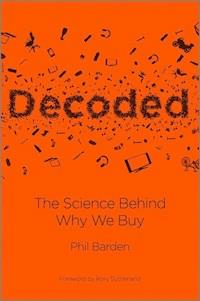
In this groundbreaking book Phil Barden reveals what decision science explains about people’s purchase behaviour, and specifically demonstrates its value to marketing.
He shares the latest research on the motivations behind consumers’ choices and what happens in the human brain as buyers make their decisions. He deciphers the ‘secret codes’ of products, services and brands to explain why people buy them. And finally he shows how to apply this knowledge in day to day marketing to great effect by dramatically improving key factors such as relevance, differentiation and credibility.
- Shows how the latest insights from the fields of Behavioural Economics, psychology and neuro-economics explain why we buy what we buy
- Offers a pragmatic framework and guidelines for day-to-day marketing practice on how to employ this knowledge for more effective brand management - from strategy to implementation and NPD.
- The first book to apply Daniel Kahneman’s Nobel Prize-winning work to marketing and advertising
- Packed with case studies, this is a must-read for marketers, advertising professionals, web designers, R&D managers, industrial designers, graphic designers in fact anyone whose role or interest focuses on the ‘why’ behind consumer behaviour.
- Foreword by Rory Sutherland, Executive Creative Director and Vice-Chairman, OgilvyOne London and Vice-Chairman,Ogilvy Group UK
- Full colour throughout
Sie lesen das E-Book in den Legimi-Apps auf:
Seitenzahl: 369
Veröffentlichungsjahr: 2013
Ähnliche


















Table of Contents
Title page
Copyright page
Dedication
Foreword
Preface
1 Decision Science: Understanding the Why of Consumer Behaviour
Let there be light!
Decision science and economics merge
A science-based framework for marketing
The (almost) unlimited capacity of the autopilot
What fires together wires together
Framing – the autopilot frames our experience
Why we underestimate the influence of the implicit level
Decoding the autopilot
2 The Moment of Truth: Decoding Purchase Decisions
The neuro-logic of a purchase decision
How to increase value
Price can increase perceived value
Language can increase perceived value
Suggestion
Reducing perceived cost
Money is not the only cost
Value–cost relation is relative
Occasion-based marketing
3 Decoding the Interface: How the Autopilot Perceives Touchpoints
The power of perception
The eye is not a camera
Recognition – what is it?
Recognition is also based on contextual cues
Concepts – what does it stand for?
New and consistent – squaring the circle?
Value-based attention: What we want is what we see
The ‘pop-out’ effect – attention is also triggered by contrast
Perceptual fluency adds value
Faces are of high value
Price sensor – the sixth sense
4 Optimizing the Path to Purchase: The Decision Interface Makes the Difference
Decision interfaces influence purchase decisions: a visit to the canteen
Interfaces change behaviour without changing minds
Incremental innovations with huge impact
Principles of persuasive decision interfaces
Tangibility – no signal no action
Immediacy – I want it NOW!
Certainty – the bird in the hand
How it all works together
Heuristics work internationally
5 Goals: The Driving Forces of Purchase Decisions
Goal value – the driver of motivated behaviour
Goals drive attention
Implicit goal pursuit: goals can be activated and monitored on autopilot
Relevance – purchase as a means to an end
Brands serve consumer goals
We buy expected goal achievement
The two levels of goal value
Decoding implicit goals
Maximizing relevance and differentiation: goal-based brand propositions
6 From Positioning to Touchpoints: Bringing Value to Life
Closing the implementation gap
Why ‘emotion’ does not help
Goals guide implementation because they are linked to signals
People buy categories first
Guidance beyond formalism
360 degree – how to avoid goal dilution
Borrowed memory – the source of objectivity
Borrowed memories are culture specific
Baked in – signals determine credibility
The bottom-up approach to credible propositions
Embodied cognition – our body thinks as well
Closing Remarks
Acknowledgements
Recommended Reading
Index
This edition first published 2013
© 2013 John Wiley & Sons
Registered office
John Wiley & Sons Ltd, The Atrium, Southern Gate, Chichester, West Sussex, PO19 8SQ, United Kingdom
For details of our global editorial offices, for customer services and for information about how to apply for permission to reuse the copyright material in this book please see our website at www.wiley.com.
All rights reserved. No part of this publication may be reproduced, stored in a retrieval system, or transmitted, in any form or by any means, electronic, mechanical, photocopying, recording or otherwise, except as permitted by the UK Copyright, Designs and Patents Act 1988, without the prior permission of the publisher.
Wiley publishes in a variety of print and electronic formats and by print-on-demand. Some material included with standard print versions of this book may not be included in e-books or in print-on-demand. If this book refers to media such as a CD or DVD that is not included in the version you purchased, you may download this material at http://booksupport.wiley.com. For more information about Wiley products, visit www.wiley.com.
Designations used by companies to distinguish their products are often claimed as trademarks. All brand names and product names used in this book are trade names, service marks, trademarks or registered trademarks of their respective owners. The publisher is not associated with any product or vendor mentioned in this book.
Limit of Liability/Disclaimer of Warranty: While the publisher and author have used their best efforts in preparing this book, they make no representations or warranties with the respect to the accuracy or completeness of the contents of this book and specifically disclaim any implied warranties of merchantability or fitness for a particular purpose. It is sold on the understanding that the publisher is not engaged in rendering professional services and neither the publisher nor the author shall be liable for damages arising herefrom. If professional advice or other expert assistance is required, the services of a competent professional should be sought.
Library of Congress Cataloging-in-Publication Data
[9781118345603]
A catalogue record for this book is available from the British Library.
ISBN 9781118345603 (hardback) ISBN 9781118345573 (emobi)
ISBN 9781118345580 (epdf) ISBN 9781118345597 (epub)
Cover design: Jason Anscomb
For Luke and Jack
Foreword
If it seems strange to open the foreword to a book about marketing by making reference to a 16th-century Danish astronomer, please do bear with me for a moment.
Tycho Brahe (1546–1601) is now credited by many historians of science as being the man who made the work of Kepler and Newton possible.
The formulation of the laws of physics which have proved so useful in the physical sciences was possible only because of Brahe’s work in cataloguing the movements of celestial bodies. Without the hoard of empirical data amassed by Brahe, the theories propounded by his student Kepler or by Newton may never have come about. Or – equally likely – other theories may have appeared and persisted which were plausible and expedient, but simply wrong.
Quite a few people, among them the economist Paul Ormerod, have used this point to make a fairly damning attack on conventional economic theory. And with good reason. The theory of human action advanced by neo-classical economics is not founded on any empirical observation of how people make decisions, or on any research into neuroscience: instead, unlike the advances in astronomy and physics, where observation led to theory, the process was made to work the other way round: a plausible theory was developed of how human beings should make economic decisions, and a whole body of work was then constructed by extrapolation from these initial assumptions.
But these assumptions, though convenient, may turn out to be almost entirely wrong. People do not make decisions based on perfect information; they do not compare value between different categories; and they are not unaffected by the behaviour of other people (or by their own past behaviour) when making their decisions. Nor are their preferences or ideas of value unaffected by context. Once you acknowledge these truths, the whole mathematical edifice of economic thought starts to crack at the foundations.
But a similar accusation could be levelled at the (considerably feebler) school of thought that drives most marketing decision making. Marketing seldom attempts to be much of a science in any case, but, when it does, it certainly does not attempt to be an empirical science. Again, like economics, it takes an assumption on how people should be influenced in any course of action and then constructs a whole set of ‘rules’ derived from that initial assumption. It also decides its actions on the basis of a spectacularly dangerous delusion: that people know and can accurately describe the mental mechanisms underlying their decisions and actions.
What Phil has done with this book is to fire a powerful and timely salvo in the battle against this backwards approach.
So, while this is ostensibly a book about marketing, it has implications for fields far beyond it. The book collates a large body of scientific evidence which shows that people do not make decisions in the way marketers (or economists) commonly and simplistically assume. So, just as economics has often been blind to a wide range of human emotions and tendencies (such as regret, loss aversion, contagion or the endowment effect), it seems that marketers have been similarly blind to a whole range of unconscious influences on human decision making (such as context, goal dilution, path dependency or framing).
For this reason, the book – and its wealth of case studies and citations – is invaluable to marketers and to anyone working in an ad agency, in a digital agency, in market research or in media. But it is also of importance to anyone who seeks to understand people, their perceptions and their motivations: politicians, policy makers, retailers, product designers, financial regulators, legislators and businesses of every kind.
And I very much hope these other people discover the book. For I rather suspect it may gain more traction there than within the marketing and advertising community. Why? Because, to be frank, the record of the marketing services community to what seems to be a Copernican revolution in the behavioural sciences has so far been mostly notable by its absence. The past reaction to earlier work by Ehrenberg, Jones, Stephen King and so on – which challenges assumptions with real empirical evidence – suggests that marketers may do what they usually do: show great interest and appreciation of this new information, before carrying on doing what they have always done. ‘Yes, all very good, Phil, but I’m behind target for the month on my Facebook “Likes”.’
Or, as Upton Sinclair observed long before the concept of ‘loss aversion’ had been scientifically observed: ‘It is difficult to get a man to understand something when his salary depends upon his not understanding it.’
But let’s not despair quite yet. First of all this book is unusual in that it is not only a very useful collection of observations, it also explains what we should do in response. It is more than just a new way of looking at the marketing universe, valuable though that is: it is also an eminently practical handbook which tells you what to do differently in response.
And it is also very timely. Earlier marketers, among them David Ogilvy, Bill Bernbach and Howard Gossage, have striven for a more intelligent approach to understanding human behaviour (Gossage even founded a company called Generalists, Inc, which was an attempt in the 1960s to connect marketing to the behavioural sciences). And all good direct marketers – including my first boss, the wonderful Drayton Bird – have been first-rate behavioural psychologists. Deep down, everyone good in marketing has known instinctively for years that marketing has a vast and disabling blind spot in understanding both individual and collective behaviour.
The problem everyone faced back then was that, without the vocabulary and the overarching body of theory, talking about this stuff made you seem trivial and small-minded. No one got promoted for changing the choices on a coupon, even though that might have had a bigger effect on sales and profits than long, self-aggrandizing hours spent discussing the typography of the TV commercial’s endframe. #OgilvyChange even has a mantra to underscore the importance of these small things: ‘Dare to be Trivial.’
But now, finally, we have a vocabulary to match the importance of these findings. I am no longer ‘just designing the coupon’, I am a ‘choice architect’. Finally those areas of marketing activity which were typically delegated to the office boy may start to find their place in the marketing director’s office, or even the boardroom.
This new vocabulary is, of course, a wonderful example of ‘reframing’ at work.
How elegant is that?
Rory Sutherland
Executive Creative Director and Vice-Chairman, OgilvyOne London and Vice-Chairman, Ogilvy Group UK
Preface
I spent 25 years of my life in Unilever, Diageo and T-Mobile trying to influence consumer behaviour in favour of my brands and products. In order to achieve this, we as marketers accumulate a huge amount of information and sophisticated analyses about our customers. Indeed, companies such as those for which I worked have developed models and processes that capture years of collective experience. These models guide our multi-million investments in product development and innovation, communication and research. However, the true reasons why we, as human beings, do what we do remain a mystery. Otherwise the failure rate of new products would be nowhere near the reported 80–90 per cent and advertising budgets would be totally efficient and effective.
But marketing life’s not like that. Sometimes my activities were successful, sometimes they were not, and based on my personal experience, and in common with many marketers, I built my own mental model of how consumers decide. I knew that this belief system was far from perfect, but no one had a better one to offer – each had his own belief system, which of course led to massive internal discussions (or arguments!), ending in decisions based on personal preferences, often dictated by hierarchy.
This is symptomatic of a more general point, and one that should concern all marketers – a recent study by the Fournaise Marketing Group among 1,200 CEOs across North America, Europe and Asia Pacific reported that 80 per cent of chief executives believe marketers are ‘disconnected’ from business results and focus on the wrong areas. More specifically, 78 per cent of respondents said that marketers ‘too often lose sight of what their real job is’ – namely, to increase demand for goods and services in a quantifiable way. The research concluded that marketers will have to transform themselves into true return on investment (ROI)-driven business people if they are to earn the trust of CEOs and if they want to have a bigger impact in the boardroom. Otherwisethey will forever remain in what 65 per cent of CEOs call ‘marketing la-la land’.
A sobering challenge indeed, yet marketers hold the key to company revenue – understanding consumers, and translating that into compelling product and service propositions. As brand custodians we’ve always known that brands have some sort of intangible quality over and above the pure functionality of whatever product or service they grace. This is what we’ve called brand ‘equity’, but it’s always been difficult to pin down, explain and make tangible. No wonder CEOs think marketing’s ‘fluffy’ and trust their CFOs more than their CMOs. To step out of la-la land and earn that trust we must make brand equity tangible and understandable and explain better why it’s by no means trivial. It’s what enables brands to command a price premium compared with more commodity-like alternatives. Consumers are willing to pay £2 or £3 for a coffee in Starbucks, yet they know, objectively, that for the price of two cups they could buy a whole jar of coffee in a supermarket. So they must be buying something else. Some sort of value applies over and above the physical product, but what is it? How does the brain perceive such value? In short, how do consumers decide?
Whenever science enters a domain it adds significant value, but, ironically, the mental model we apply in marketing today is still based on 1970s’ thinking – almost half a century ago! In this time, the understanding in the areas of decision science has advanced dramatically. It behoves us to update the way we think about how consumers decide. From my perspective, the knee-jerk reaction of the marketing community in the last few years has been to delegate this scientific evolution to their market researchers, utilizing new ways of measurement like brain scanning. But do we really think that we need even more data? And what if such new methodologies generate similar results – a likely outcome since most of them are validated using existing models and metrics? Or what if they show differences? What then is right and what is wrong, and how should we make this judgement? As long as we continue to ask the same questions and don’t update our mental model for consumer decision making, we will not be able to exploit the powerful insights that decision science offers. This requires a paradigm shift in marketing, not just a change of tools.
So why have I written this book? Because my belief system was significantly shaken four years ago. I was then Vice-President Brand Development for T-Mobile, taking the brand through changes in brand architecture and positioning. I was confronted by a totally new mental model for marketing and consumer decision making based on decision science: the conclusions from the latest collective learnings from neuroscience, behavioural economics, cognitive and social psychology. I found it fascinating because it offered me explanations of consumer behaviour which previously had mystified me, but at the same time it was irritating because it disproved some of my very basic assumptions about how consumers decide. It was the first time I had experienced the power of an approach that was based not on beliefs and assumptions but on the latest scientific findings. Using this knowledge not only yielded new vocabulary that was more valuable in understanding why consumers do what they do but at the same time provided a profound framework for marketing – from brand strategy and positioning, through to innovation, advertising and interactive media.
This approach was not only fascinating and different, it proved to be a huge financial success for the brand, inspiring the ‘Dance’ advertising campaign in the UK. In a fiercely competitive market, the results were stunning:
146 per cent ROIsales increased by 49 per centmarket share grew by 6 per centcustomer acquisition costs halvedbrand consideration tripledretail store footfall doubled and conversion grew by 20 per centexisting customers increased their usage of the services, spending 11 per cent more than the market36 million YouTube views, 68 Facebook groups.(Source: T-Mobile and IPA)
Consequentially, this approach has been applied across all other T-mobile brand ‘touch points’, such as proposition development, retail store design and customer services. According to Lysa Hardy, until recently the T-Mobile VP in the UK, the combined effect of these changes, and subsequent advertising based on the same communications platform, is that T-Mobile has halved its customer churn (the percentage of customers who leave the network). From being the worst churn in the UK mobile network market three years ago, it is now the best and is at an all-time low. The approach has subsequently been rolled out by the brand across Europe, resulting in further industry recognition for its achievements, including an award for the best brand relaunch.
Inspired by this, I started to dive deep into the literature of decision science. As I suspected, the mental model I had applied for all those years was far from complete – and, in many cases, simply wrong. I became more and more fascinated by what I learned and its value in building brands and driving revenue. This experience was so profound and exciting that it inspired me to switch careers. I left my job at T-Mobile and joined Decode, the consultancy responsible for the step change I had experienced at T-Mobile, and they have kept me on a steep learning curve for the past three years.
Decode was founded, and is staffed, by former scientists from the fields of decision science. To stay at the leading edge of developments, Decode collaborates with leading universities for neuro-economics, such as the California Institute of Technology (USA). In addition, its consultants still practise, at professorial and doctoral level, in academe. They have been complemented by practitioners from advertising and brand management to form an interdisciplinary team of experts with a unique blend of capabilities, translating the latest scientific learnings into pragmatic and concrete marketing application. This bridge from science to day-to-day marketing practice is what this book is about.
The goal of this book is to share what I learned on my journey about bringing decision science to life for marketing, and the fascinating insights I have come across about why consumers buy what they buy. We now have a framework, a language and a growing body of knowledge to enable marketers to address the real drivers of brand choice. Most importantly, with this book I want to empower the reader to harness this valuable knowledge and apply it to everyday marketing work. The benefits of doing so resonate with my personal experience and are echoed consistently by feedback we receive from clients and their agencies: better explanatory and predictive power from a new and deeper level of insight, sharper propositions, more precise briefings, greater efficiency and effectiveness in the client–agency relationship, more confidence and an enhanced ability to scale knowledge and training. Additionally, multinational clients have enjoyed a release from the tension and frustration involved in typical ‘centre’ versus ‘local’ debates about brand positioning and creative development. Last, and by no means least, decision science offers a way for marketers to step into the boardroom and leave la-la land behind.
I hope you enjoy this journey as much as I have.
Author’s note: There are many studies and experiments cited in this book. These are referenced in a section at the end. More details about these, and other topics related to the book, can be found at www.decoded-book.com.
1
Decision Science
Understanding the Why of Consumer Behaviour
Lesen Sie weiter in der vollständigen Ausgabe!
Lesen Sie weiter in der vollständigen Ausgabe!
Lesen Sie weiter in der vollständigen Ausgabe!
Lesen Sie weiter in der vollständigen Ausgabe!
Lesen Sie weiter in der vollständigen Ausgabe!
Lesen Sie weiter in der vollständigen Ausgabe!
Lesen Sie weiter in der vollständigen Ausgabe!
Lesen Sie weiter in der vollständigen Ausgabe!
Lesen Sie weiter in der vollständigen Ausgabe!




