


Erhalten Sie Zugang zu diesem und mehr als 300000 Büchern ab EUR 5,99 monatlich.
- Herausgeber: THP Ireland
- Kategorie: Geisteswissenschaft
- Sprache: Englisch
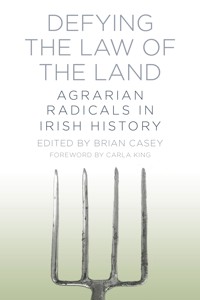
This history of Ireland is inextricably linked with our relationship with the land. In this book, based on extensive research and investigation, the authors examine some of the key figures in Irish agrarian agitation and change. Looking at the Land League, the Knights of the Plough, the perception and reality of the Irish Landlords, this is an important book which makes a significant contribution to our understanding of the nature of the 'land question' in Irish history.
Sie lesen das E-Book in den Legimi-Apps auf:
Seitenzahl: 615
Veröffentlichungsjahr: 2013
Das E-Book (TTS) können Sie hören im Abo „Legimi Premium” in Legimi-Apps auf:
Ähnliche



















For Patricia Johnston, Michael Lally and Joe Molloy
Contents
Title Page
Dedication
Abbreviations
List of Contributors
Preface and Acknowledgements
Foreword by Carla King
1. Demonising the Irish Landlords Since the Famine
L. Perry Curtis, Jr
2. Narrating the Irish Famine: Chartism, the Land and Fiction
Timothy Keane
3. Rural Radicals or Mercenary Men? Resistance to Evictions on the Glinsk/Creggs Estate of Allan Pollok
Pauline Scott
4. Agrarian Radical or Tenant Reformer: James Daly, a Reappraisal
Gerard Moran
5. Matt Harris and the Ballinasloe Tenant Defence Association, 1876–9
Brian Casey
6. Thomas Stanislaus Cleary (1851–98): Land League Leader and Campaigning Newspaper Editor
Oisín Moran
7. ‘A Few Good Canons?’: Canon Ulick Bourke and Clerical Reaction to the Outbreak of the Land War
Shane Faherty
8. Redressing Historical Imbalance: The Role of Grassroots Leaders Richard Hodnett and Henry O’Mahony in the Land League Revolution in the West Cork, 1879–82
Frank Rynne
9. Canon Keller of Youghal
Felix M. Larkin
10. A ‘First Voice’: Henry Villiers Stuart (1827–95) and the Cause of the Irish Agricultural Labourers
Ian d’Alton
11. Benjamin Pelin, the Knights of the Plough and Social Radicalism, 1852–1934
Fintan Lane
12. John Fitzgibbon of Castlerea: ‘A Most Mischievous and Dangerous Agitator’
John Bligh
13. Daniel Desmond (D.D.) Sheehan (1873–1948) and the Rural Labour Question in Cork, 1894–1910
John O’Donovan
14. Pádraic Ó Máille: Irish Agrarian Radical? The Case Considered
Mícheál Ó Fathartaigh
Notes
Plate Section
Copyright
Abbreviations
AFIL
All-for-Ireland League
BMH WS
Bureau of Military History Witness Statement
BTDA
Ballinasloe Tenant Defence Association
CAC
Cork Advisory Committee
CE
Cork Examiner
CF
Clare Freeman
CI
Clare Independent
CJ
Clare Journal
CT
Connaught Telegraph
CSO, RP
Registered Papers of the Chief Secretary’s Office
CTDA
Central Tenant Defence Association
CWN
Cork Weekly News
DI
District Inspector
FJ
Freeman’s Journal
GH
Glasgow Herald
IDLF
Irish Democratic Labour Federation
IDTLF
Irish Democratic Trade and Labour Federation
IHS
Irish Historical Studies
II
Irish Independent
ILLA
Irish Land and Labour Association
ILP
Independent Labour Party
IMA
Independent Munster Advertiser
IO
Iris Oifigúil
IPP
Irish Parliamentary Party
IRA
Irish Republican Army
IT
Irish Times
ITUC
Irish Trades Union Congress
JP
Justice of the Peace
KO
Kildare Observer
LL
Leinster Leader
LLA
Land and Labour Association
MP
Member of Parliament
MSF
A Practical Work on the Management of Small Farms
NAI
National Archives of Ireland
NLI
National Library of Ireland
NUI
National Univeristy of Ireland
PPP
Protection of Persons and Property Act
RH
Roscommon Herald
RILC
Royal Irish Land Commission
RM
Resident Magistrate
SÉD
Seanad Éireann Debates
SS
Southern Star
TDA
Tenant Defence Association
TCD
Trinity College Dublin
TD
Teachta Dála
UCC
University College Cork
UCD
University College Dublin
UFPA
United Farmers’ Protection Association
UI
United Ireland
UIL
United Irish League
WCE
West Cork Eagle
List of Contributors
Carla King is a lecturer in Modern History at St Patrick’s College, Drumcondra. She has published various works on Michael Davitt and the land question and is writing a biography of his later life.
Professor Emeritus L. Perry Curtis retired from Brown University in 2001 after a long stint of teaching modern Irish and British history. Author of Coercion and Conciliation in Ireland (1963), Anglo-Saxons and Celts (1968), Apes and Angels (1971, 1997), and The Depiction of Eviction in Ireland (2011). He is now working on the sale of estates under the Wyndham Act of 1903.
Timothy Keane has recently completed a PhD in English, studying the uses of Ireland in the discourse of, and about, English radicalism in the nineteenth century. His thesis was titled “‘Ireland’s Wrongs and England’s Grievance”: Representations of Ireland in English Radical Discourse, 1824–1850.’ He is currently teaching in the Department of English at NUI, Galway, and preparing a monograph.
Pauline Scott is a PhD student at NUI Galway. She is currently completing a thesis on the Pollok Evictions which took place in north-east Galway in the mid-1850s. She has worked with a number of local newspapers in counties Longford and Roscommon.
Gerard Moran is a lecturer in history at NUI Maynooth and has published extensively on various aspects of social, political and migration history in nineteenth- and twentieth-century Ireland.
Brian Casey completed a PhD in history at NUI Maynooth in 2011, entitled ‘Land, politics and religion on the Clancarty estate, east Galway, 1851–1914’. He has previously worked in the NLI and as an undergraduate tutor at St Patrick’s College, Drumcondra. He is currently employed as the Clonfert Diocesan Archivist in Loughrea, County Galway.
Oisín Moran is a native of County Clare and studied for an MA in History at the NUI Galway. His thesis, ‘Thomas Stanislaus Cleary: Land League Leader and Campaigning Newspaper Editor, 1879–1882’, looked at the organisation and spread of the Land League in County Clare and was completed in 2012.
Shane Faherty is a PhD student in History in UCC. The title of his dissertation is ‘Canon Ulick Bourke, the Knock Apparition and the Construction of Memory in Modern Ireland’. He holds an MA in Culture and Colonialism from NUI Galway and a BA in English and Human Development from St Patrick’s College, Drumcondra.
Frank Rynne has recently gained a PhD in History at TCD, entitled ‘Grassroots Fenians and the Land War in West Cork, 1879–82’ under the supervision of Dr W.E. Vaughan. He has published articles relating to his research in History Ireland and the collection of essays entitled The Black Hand of Republicanism, edited by James McConnel and Fearghal McGarry.
Felix M. Larkin is the author of Terror and Discord: The Shemus Cartoons in the Freeman’s Journal, 1920–1924 (A&A Farmar, Dublin, 2009). He studied history at UCD, and is chairman of the Newspaper and Periodical History Forum of Ireland. He is also a member of the statutory Readers Advisory Committee of the NLI.
Fintan Lane has a PhD in history from UCC. His publications include The Origins of Modern Irish Socialism (1997), In Search of Thomas Sheahan: Radical Politics in Cork, 1824–36 (2001), and, as editor, Politics and the Irish Working Class, 1830–1945 (2005), Essays in Irish Labour History (2008), Michael Davitt: New Perspectives (2009) and Politics, Society and the Middle Class in Modern Ireland (2010).
Ian d’Alton MA (NUI), PhD (Cantab), a former senior Irish public servant, has spoken and published widely on southern Irish Protestantism from the eighteenth to the twentieth centuries. The author of Protestant Society and Politics in Cork, 1812–1844 (1980), he was awarded the Royal Historical Society’s Alexander Prize in 1972, and was an honorary Senior Research Fellow, Institute of Irish Studies, University of Liverpool, 2011–12.
John Bligh is a financial auditor, with a research interest in economic and political history. He graduated from TCD in 1981 and is a great-grandson of John Fitzgibbon.
John O’Donovan recently completed an MPhil thesis at the School of History, UCC, entitled ‘William O’Brien and the UIL in Cork 1900–1910’. He has previously published articles in Saothar, JCHAS and History Studies. His current research interests include the AIL and the work of Canon P.A. Sheehan as part of a wider project entitled ‘Turbulent Cork, 1890–1916’.
Mícheál Ó Fathartaigh’s main research interest is Irish economic and social history in the twentieth century. In this area he has looked at the on-going land issue and the failure of the fishing industry in the west, rural development and State intervention nationally, the semi-state sector and the early history of the IDA. He lectures in modern history at Dublin Business School.
Preface and Acknowledgements
This collection of essays explores the lives of agrarian radicals from the Chartist period until the early days of the Irish Free State. The contributors show the rich possibilities that are still present in the study of land and agrarian issues in Irish historiography. They all explore common and disparate themes, while exposing some of the anomalies that can be present in national surveys. They all ask new, if sometimes provocative, questions of the readers.
The majority of these essays were delivered as papers at a conference entitled ‘Irish Agrarian Radicals, 1850–1930’, held at the NLI on 22 and 23 March 2012. L. Perry Curtis’s essay was the R.I. Best memorial lecture at the same institution in October 2011. My thanks to the staff of the NLI, especially Ciara Kerrigan, Katherine McSharry and Colette O’Flaherty, for their support of the conference. Thanks are due to the other speakers at the conference for their contributions: Dr W.A. Smyth, Dr Donnacha Seán Lucey and Dr Patrick Cosgrove. Dr Ciara Breathnach, Dr Danny Cusack, Dr Conor McCabe, Dr Ciarán Reilly, Dr Paul Rouse and Dr Niall Whelehan were superb chairs of the various sessions, and the assistance of Cathal Smith and Pauline Scott is also appreciated.
Permission to quote and publish from various sources is duly acknowledged and authors have made further acknowledgements at the end of their essays for assistance given to them in the preparation of their essays. Particular thanks to the director of the NAI, the NLI, the director of the National Folklore Collection at UCD, the Department of Manuscripts at TCD for permission to cite and quote from material in their possession.
Ronan Colgan and The History Press Ireland were very supportive of this publication and the NLI Society offered generous support also. I am deeply indebted to the contributors for embracing this project with enthusiasm and forbearance. This collection is dedicated to three former teachers of mine, Patricia Johnston, Michael Lally and Joe Molloy. Despite leaving Garbally over a decade ago, their superb teaching, enthusiasm and decency continues to inspire me.
Brian Casey
Ballinasloe,
County Galway,
February 2013
Foreword
Since the 1970s, when Barbara Solow, James S. Donnelly, Paul Bew, Samuel Clark and others challenged the traditional, simplified narrative of landlord-tenant conflict of late nineteenth-century Ireland, historians have been engaged in uncovering a far more complex, multi-layered – and in many respects, more interesting – picture.1 Recent research has penetrated further into issues such as class, mobilisation, regional variation and the politicisation of rural society. The conference on ‘Irish Agrarian Radicals, 1850–1930’, held in the NLI on 22 and 23 March 2012, represented an intention to move away from the better-known leaders of the movement and focus attention on the often now forgotten, more local figures, without whom rural mobilisation would have been impossible. What emerged and is presented in these essays will serve to enhance our understanding of the dynamics of Irish rural society at this formative time.
Apart from addressing the contributions of local agrarian radicals, including James Daly, Matt Harris, Thomas Stanislaus Cleary, Richard Hodnett, Henry O’Mahony, Benjamin Pelin, John Fitzgibbon and D.D. Sheehan, the collection explores issues relating to social groups such as landlords, labourers and clergy. It also valuably traces the interaction between British Radicals and the Irish land question in the ideas of the Irish Chartist leader, Feargus O’Connor.
The ‘baddies’ of popular perception, frequently reflected in literature of the period were the landlords and their agents, but historians must distinguish between the system and individuals. Perry Curtis, whose pioneering analysis of depictions of the Irish in images, such as cartoons in Apes and Angels: The Irishman in Victorian Caricature,2 here turns his attention to the demonisation of Irish landlords in popular culture, nationalist imagery and folklore, despite the fact that landlords, like any other social group, were quite diverse in their behaviour and there were always some reforming landlords. Nevertheless, it was advantageous for the unity and momentum of the late nineteenth-century campaigns to portray them as universally greedy and oppressive. Curtis traces their cartoon images in nationalist papers such as the Weekly Freeman of the 1880s, following the endurance of hostility to them into post-Independence Ireland. Animosity toward landlords became conflated with anti-Protestant sentiment, although many Irish Protestants had no connection with landlordism and a sectarian divide served to marginalise both landlord and non-landlord Protestants in the new state. One means of perpetuating the demonisation of landlords was through folklore that continued well into the twentieth century, highlighting their cruelty and eventual punishment for their misdeeds.
An aspect of the problematic relationship was that what constituted ‘reforming’ from the landlord side was not necessarily what the tenants wanted. Thus one of the ‘demon landlords’ mentioned by Curtis is Allan Pollok, whom Pauline Scott discusses in her examination of his conflict with tenants on his Glinsk/Creggs estate. Pollok, stereotypical of the new post-Famine Scottish landlord who purchased under the Encumbered Estates Court, was, according to his own lights, an agricultural reformer, whose efforts to introduce a ‘tsunami of modernisation’, which would entail extensive evictions, met with the united resistance of 600 tenants on a hitherto neglected and overpopulated estate. Opposition was strong, despite the fact that Pollok offered generous financial inducements to his tenants to leave and sought in other cases to convert his tenants into labourers on the estate, rather than evicting them outright. Scott analyses the tenants’ campaign against their landlord, ably coordinated by parish priests and (interestingly) the agent on the estate, Michael Kelly. The confrontation cost Pollok both financially and in terms of his reputation and sparked a widespread debate but he ultimately succeeded in his aims. Scott suggests the ultimate defeat of the Glinsk/Creggs tenants explains why when tenant agitation re-emerged two decade later, it was in another part of Pollok’s estate at Ballinasloe where resistance had been muted in 1853.
The Ballinasloe Tenant Defence Association (BTDA), established in May 1876, attempted to organise farmers to challenge both landlords and graziers, the latter having emerged with the expansion of a livestock economy in the 1850s and 1860s. Its leader was Matt Harris, a Ballinasloe-based building contractor and Fenian. Brian Casey explores Harris’s radicalism through his role in the Ballinasloe association, demonstrating the part it played in mobilising local small farmers, fostering a sense of class-consciousness and preparing the ground for the emergence of the Land League later in the decade. Indeed, many of Harris’s ideas anticipated the radical end of the Land League and he was to be disappointed by the more conservative path ultimately taken by the organisation.
James Daly, whose career is here discussed by Gerard Moran, was once dubbed by J.J. Lee ‘the most forgotten man in Irish history’. He was a comrade-in-arms of Harris in the BTDA and, like him, had supported the Fenian John O’Connor Power’s election for Mayo in 1874. Nevertheless, in many respects they were quite different: Harris was a radical and a Fenian, whereas Daly, a grazier and editor of the Connaught Telegraph, was a moderate. And while Harris became a nationalist MP for Galway East, Daly’s focus remained local, although he played an active role as a Poor Law Guardian and, through his newspaper, provided invaluable publicity for the Land League and eventually adding some apposite criticisms of its failings. Two striking features of the regional figures examined here are firstly, the fact that in terms of social composition they tended to mirror the national leadership, and secondly, the overlap between activism and newspaper editorship, or at least journalism. It has been observed before how few of the executive of the Land League and its successor organisations were in fact tenant farmers, and this pattern seems to follow through, though to a less marked degree, to regional level.3 The other aspect reflects the crucial role played by newspapers in the spread of agrarian organisations. Thomas Stanislaus Cleary, whose career is examined by Oisín Moran, was a Land League organiser and newspaper editor in County Clare. His career indicates how the League was diffused through the localities and just how much could be achieved by a vigorous and committed local leader. Moran observes that Cleary’s announcements in the Clare Independent and Tipperary Catholic Times, appearing on Saturday, could rally supporters to attend public meetings the next day.
Another study which elucidates mobilisation in the land agitation is Frank Rynne’s essay on Richard Hodnett and Henry O’Mahony in their organisation of the West Cork Land League in 1879–82. Hodnett was a Skibbereen solicitor and Poor Law Guardian and, Rynne suggests, he was ‘the architect of the New Departure in West Cork’. O’Mahony was a builder and shopkeeper, probably an IRB member, recently returned to Ballydehob from the United States. Under the Protection of Person and Property Act, Hodnett was arrested in April and O’Mahony in June 1881 but their organisation served to rally local opinion to their support.
John Fitzgibbon of Castlerea, County Roscommon, had a sustained role as an agrarian activist from the Land League years, through the Plan of Campaign to his central role in the United Irish League (UIL) struggle on the de Freyne estate in 1901–2. A Parnellite during the party split, his influence in throwing his support behind William O’Brien’s efforts in the UIL proved important in healing divisions at local and regional levels. He later gave evidence to the Royal Commission on Congestion and served as a member of the Congested Districts Board. Significantly, he would refer later in his life to Pollok’s clearances on the Creggs estate, referred to above, as having prompted his activism, although he would have been a small child at the time. A shopkeeper in Castlerea, owning a draper’s store in the town, he served as a local leader, temperance activist, occasional journalist, and MP.
A figure of a different stamp was Pádraic Ó Máille, a large tenant farmer from Leenane in north Connemara, a prominent Irish-language campaigner who participated in the Irish revolution and became a senior figure in the Free State, first as a prominent member of Cumann na nGaedheal and later as a Fianna Fáil Gaeltacht commissioner and member of the Seanad. Mícheál Ó Fathartaigh argues that rather than viewing Ó Máille as a bourgeois political conservative, closer examination of his background and career suggests a more complex picture in which he emerges as an agrarian radical.
The most disadvantaged group in Irish society throughout the period under review were the agricultural labourers. Despite attempts to enlist them in successive land agitations, class conflict between them and tenant farmers tended to limit radical measures to ameliorate their position. Ian d’Alton examines the contribution of Henry Villiers Stuart, a Waterford landlord whose voice was the first raised in the 1880s on behalf of the agricultural labourers. D’Alton links Villiers Stuart’s sympathy for the labourers to resentment against the establishment arising from his own complicated relationship with it. However, his involvement in the question seems to have radicalised his political ideas, leading him to argue that only the extension of the franchise to the labourers would enable them to obtain redress for their situation. As an MP, Villiers Stuart attempted to provide houses and allotment for labourers and he tried, unsuccessfully, to foster a Southern Labour League and his efforts drew the hostility of the Irish Parliamentary Party (IPP).
Fintan Lane addresses the life of a very different campaigner, Benjamin Pelin, founder, chief organiser and president of the Knights of the Plough, a radical organisation of agricultural labourers centred in County Kildare. Pelin, whose politics were influenced both by socialism and the ideas of Henry George, came, like Villiers Stuart, from outside the labouring population; in his case, from a family of shopkeepers and tenant farmers. The Knights of the Plough, founded in June 1892, sought to provide access to land for labourers and State pensions for all workers over sixty-five, which was to be paid for through a £1 per acre tax on uncultivated land. The organisation was a forerunner of the Irish Land and Labour Organisation, but Pelin emigrated to Australia in 1895, where he lived until his death in 1934.
Another labour activist was Daniel Desmond (better known as D.D.) Sheehan, a journalist, solicitor and MP representing the labour interest in the IPP. In 1894 he co-founded the Irish Land and Labour Association (ILLA) with J.J. O’Shee. His experience in politics was reflective of the tensions between farmers and labourers as played out both at a local level and in party politics. The IPP was always uncomfortable with its labour wing and there were at times disputes between its mainstream and its small number of labour representatives.
By the late nineteenth century the Irish Catholic clergy were a powerful force in Ireland, drawing strength from a traditional role as leaders of their parishioners. While they tended to take a socially conservative stand, in politics they were frequently divided. In its early stages the Land League had been opposed by the majority of the clergy, owing particularly to the role of the Fenians within the movement. However, in other cases they acted as a mobilising force and defenders of their parishioners. An example of the latter position was Canon Keller of Youghal, whose role in relation to the tenants on the Ponsonby estate during the Plan of Campaign is traced by Felix Larkin. While not an instigator of the Plan, Keller did not attempt to restrain the tenants and probably acted as a trustee of the estate fund. Eventually, in recognition of his leadership role, he was jailed for contempt of court in March 1887 and served two months in prison.
Another priest whose response was more ambiguous was Canon Ulick Bourke, a cultural nationalist and Gaelic language enthusiast, here discussed by Shane Faherty. Bourke, while one of the first clergy to take an active role in the nascent Land League, made efforts to control it, in particular, coming into conflict with James Daly in July 1879 and opposing its links with English radicals.
Timothy Keane addresses Feargus O’Connor’s Chartist Land Plan and more generally the relationship between English radicalism and Irish nationalism in the mid-nineteenth century. Feargus O’Connor, a nephew of the famous United Irishman, Arthur O’Connor, is best known as the most prominent Irish member of the Chartist movement. While Chartism has mainly been associated with the industrial and urban centres of the North of England, O’Connor linked its radical policies to agrarianism, seeking in his Land Plan to settle workers on the land in agricultural co-operatives. The plan, which became a supplement to the People’s Charter, tapped into a deep longing within the working class, for a renewed engagement with the land. While O’Connor’s Land Company succeeded in settling only some 250 families on the land, his criticisms of Daniel O’Connell’s failure to address the Irish land question provided an important legacy and influenced members of Young Ireland, in particular James Fintan Lalor, in their own critique of O’Connell. Moreover, O’Connor, in establishing a link between English radicalism and Irish nationalism initiated a relationship which, while overlooked by much of traditional nationalism, was powerfully effective in the late nineteenth and early twentieth century.4
Any one of the figures treated here might, if considered in isolation, be seen as typical of a movement too often taken for granted. The collective impact of these essays acknowledges individuality, variety, and occasional disagreement. Brian Casey, in initiating both this volume and the conference from which it emerged, is to be commended in fostering original and fruitful areas of historical investigation.
Carla King, 2013
1
Demonising the Irish Landlords Since the Famine1
L. PERRY CURTIS, JR
Shortly after midnight on a moonless August night in 1971 an American historian of Ireland descended into the semi-darkness of Derry’s Bogside where a car bomb had recently exploded. Along with a friend who taught at Magee College, he picked his way through shards of glass from the blown-out windows of a large warehouse where workers were busy nailing plywood boards into the empty window frames. A grizzled old man standing in the doorway of a small house announced himself as the last resident of William Street. Surveying the grim, almost surrealist scene, he shook his head and muttered: ‘It’s all the fault of the landlords’.2
This epiphany was all the more ironic because the historian visitor had spent the previous week in the Public Record Office of Northern Ireland exploring the estate papers of Ulster landlords in the Victorian era. Why, he wondered, did the old man not blame this renewal of the Troubles on the Protestant business elite of Belfast and Derry that had dominated Northern Ireland for so many decades? Was this venerable Bogsider thinking, perchance, of Sir Basil Brooke, later Lord Brookeborough? The epitome and legatee of the old political and social elite, Brooke, had founded the B-Specials and governed a Protestant state on behalf of a Protestant populace for more than twenty years. Despite the steady erosion of wealth and political clout among Ulster’s hereditary landocracy, this poor Bogsider, who had endured so much urban and sectarian conflict, still clung to an image of an omnipotent and predatory elite that belonged to the bygone era of the land wars instead of the guerrilla warfare of the 1970s.
Rather than addressing the question of how and why the former Ascendancy class lost its hegemony in the north to the rich and aggressive members of Belfast’s Chamber of Commerce, this essay seeks to explore the cultural and political roots of the old Bogsider’s blanket indictment of that hereditary elite. Well before the partition of Ireland the haut bourgeois leaders of Ulster Unionism had orchestrated a formidable campaign against Home Rule. Making good use of money, organisation, mass meetings, marches, and an endless stream of Orange or sectarian propaganda, they prevented any alliance between the Protestant and Catholic working classes. Determined to scuttle the third Home Rule Bill at any cost to democratic and constitutional principles, the Ulster Unionist Council arranged the massive ceremonial signing of the Ulster Covenant in September 1912 and then backed up this oath with the threat of force by means of the Ulster Volunteer Force, composed of Solemn League Covenanters who would never accept a Catholic-dominated government in Dublin. After the horrors of the First World War had ended and the predictable partition of Ireland had become a reality, the northern Unionist oligarchs formally established their ascendancy and played the Orange card to the fullest extent relegating the Catholic minority in the six counties to second-class citizenship.3
Demonising the traditional Anglo-Irish landed elite had a long history, owing in large part to the huge disparity in wealth, status, and power – not to mention religion – between the owners and tillers of the soil. To appreciate the persistence and the virulence of anti-landlord prejudice after the Great Famine we need first to examine the popular images of this class that flourished during the heyday of the Irish National Land League. What is remarkable is the enduring nature of these negative images both north and south of the border long after the old gentry had ceased to lord it over their largely Catholic tenantry.
Despite creeping insolvency, the decimation of the officer class on the Western Front, the voluntary or compulsory sale of estates, arson attacks on over 250 Big Houses and emigration, the former landlords remained an object of abuse or derision in the popular imagination. In this scenario of denigration, myth played a major role. As the late and great historian Professor T.W. Moody once observed about myths and memory:
The past is dead. Nothing, for good or ill, can change it; nothing can revive it. Yet there is a sense in which the past lives on: in works of human hands and minds, in beliefs, institutions, and values; and in us all who are its living extension. It lives on in us, both for good and ill, shaping our lives and helping to determine our action.4
For reasons that had little or nothing to do with post-Independence Ireland’s pressing political and economic problems and despite the existence of many ex-landlords with ‘good’ reputations, the stereotype of the callous or rack-renting and evicting landlord lived on.
Accounts of the allegedly ruthless and avaricious behaviour of the landlords during the Great Famine could easily fill a book. Despite numerous exceptions to the rule, owners of large and small estates never fully recovered from the stigma arising out of the clearances and destruction of cabins or dwellings during and after 1846–7. Of course there was nothing new about either partial failures of the potato crop or multiple evictions. But after the lethal blight arrived in the summer and autumn of 1845 the plebeian small holders and labourers lost their staple food supply and had no money to pay the rent. In order to avoid paying higher rates for poor relief and to free themselves from the onus of beggars at their backdoors, countless landlords and their agents purged the estate of the poorest or least profitable occupiers, who had now become too heavy a burden for them to bear. They then consolidated or ‘squared’ the now vacant holdings and converted them into larger rent-producing farms.5
No doubt the grim black-and-white prints of roofless hovels, deserted villages, and ragged and emaciated peasants that appeared in the Illustrated London News made an indelible impression on readers in England, where liberal-minded MPs were appalled by all the reports of mass evictions, house-razings, disease, and starvation. It took only a handful of serial evictors, like Lords Lucan and Sligo in County Mayo, the Gerrards and Lord Dunsandle in County Galway, Col. Vandeleur and the land agent Marcus Keane in County Clare, to condemn the entire class as ‘exterminators’, notwithstanding the strenuous efforts of a few benevolent landlords to alleviate the overwhelming distress.6
Wherever landlords imported new tenants, known as ‘land-grabbers’, to cultivate the enlarged holdings, the latter were regarded, as James Donnelly has observed, ‘with a poisonous, ineradicable hatred’. Local people were ‘much more likely to remember, and remember much longer, the landlords whose large-scale evictions branded them as “exterminators” in popular estimation’.7 In short, the death toll from Famine-related diseases and starvation, the clearances and forced emigration, and the failures of Famine relief all combined to create an enduring legacy of resentment aimed at both the British government and the Irish landlords, who were also reviled in England for dumping untold thousands of unwashed, dirty, ragged, and destitute Irish evictees on their shores. A rant by a Catholic bishop in America illustrates just how deep this demonisation went: ‘Everything, in a word, tended to make the Irish landlords the worst aristocracy with which a nation was ever cursed; and by the most cruel of fates this worst of all aristocracies was made the sole arbiter of the destinies of the Irish people’.8
The radical Young Irelander and devout Anglophobe John Mitchel famously accused the English government of mass murder by refusing to provide adequate relief. He also found the landlords guilty of ‘exterminating’ or ‘slaughtering’ their tenants. While modern historians have disavowed this indictment, some have justified Mitchel’s wrath by emphasising the devotion of Whig legislators at Westminster to both political economy and evangelical Providentialism, the combination of which spurred many landlords to modernise their estate management by means of eviction, enlarging the small holdings and re-letting them to solvent tenants. Cecil Woodham-Smith’s own gentry affiliations did not stop her from declaring that ‘few classes of men have had so much abuse heaped on them as Irish landlords, and with justification’.9
A few fragments of this abuse came from the unlikely quarter of Anglo-Irish aristocracy. Thus the hero of Waterloo, the Duke of Wellington, roundly condemned every absentee landlord in the country of his birth. After touring the country at the height of the Famine, the young Lord Dufferin castigated the gentry for having ‘left their people to grow up and multiply like brute beasts’ and for stifling ‘by their tyranny all hope and independence and desire of advancement’. Even worse, they had turned the peasantry into ‘cowards and liars’ and were now abandoning them ‘to die off from the face of the earth’. For such reasons this Oxford undergraduate declared that they deserved to be swept away and replaced by improving landlords like himself.10
Landlords who did not have to liquidate their properties in the Encumbered Estates Court after 1849 remained heavily burdened with family charges, annuities, and other liabilities. What saved them from bankruptcy was a combination of fertile land, the hiring of professional land agents, the economic recovery of 1865–77, the yield from investments, and low-interest mortgage loans obtained from British assurance companies as well as the Church of Ireland’s endowment.11
This brief spell of prosperity ground to an abrupt halt in 1878–9, owing to the concurrence of foul weather and an agricultural depression that reduced the earnings of tenant farmers. The sharp increase in arrears of rent after 1879 was also caused by Land League-inspired resistance to paying the rents that were now denounced as exorbitant. Needless to say, the resort of agents to threats of ejectment for non-payment, even if these were not carried out, did not exactly improve landlord-tenant relations.
Despite sundry disagreements about causation, most historians of the first Land War concur that the leaders of the Land League and the Home Rule agitation proved highly effective in their verbal attacks on the landlords as rack renters and evictors. They demanded both independence from Westminster and the abolition of England’s ‘garrison’ in Ireland – from the landlords to the bureaucrats of Dublin Castle, the Royal Irish Constabulary, and the magistracy – all in the name of ‘the land for the people’. Launching their offensive against landlordism, they relied on a network of branches, mass meetings, brass bands, processions, and the press to send the message that the landlords were predators and deserved to be sent packing.12 Against a background of bad weather, local crop failures, and declining prices, the nationalist triumvirate of Michael Davitt, Charles Stewart Parnell and John Devoy joined forces in 1877–9 under the umbrella of the New Departure and embarked on a campaign to undo the Act of Union and restore the land to its rightful owners – ‘the Irish people’ – by non-violent or constitutional methods. Mobilising so many thousands of tenants and their urban allies into concerted action under the auspices of the Land League was no easy task. Nevertheless the dynamic and resourceful leaders of the League, aided and abetted by militant priests, proved equal to this challenge and created a formidable coalition designed to achieve both Home Rule and peasant proprietorship. The propaganda war waged by Parnellite MPs and the League’s national and local leaders proved successful, and many landlords were forced to reduce their rents by at least 15 per cent, rather than face boycotting or intimidation.
All over the south and west, League branches organised resistance to eviction and sponsored ‘indignation’ meetings where anti-landlord rhetoric reached new heights of passion. While insisting on non-violent tactics, the League’s leaders turned a blind eye to agrarian outrages that often followed eviction. Notices to quit by landlords unwilling to grant abatements fuelled the Land War and increased League membership. The new tactic of boycotting those who disobeyed the League’s orders took a heavy toll on landlords, agents, process-servers, bailiffs, and land-grabbers alike. The police and magistrates had a hard time prosecuting the offenders, despite the summary powers authorised by Coercion Acts. In the meantime, moonlighters or nocturnal marauders issued death threats, fired into dwellings, mutilated livestock, set fire to hay stacks and waited in ambush to shoot ‘obnoxious oppressors’.
This agrarian agitation grew rapidly into a full-scale revolt against the entire land system driven by Catholic tenants and their town allies, determined to achieve ‘fair’ rents, security of tenure and in the long run the abolition of the rent nexus altogether. Not even Gladstone’s famous Land Act of 1881 that conceded the ‘three F’s’ curbed agrarian outrages during the ensuing year.13 However, the Land War did put an end to the traditional deference of tenants to their lords and masters – what the ex-Fenian Davitt denounced as a ‘slavish social attitude’ marked by cringing and unmanly posturing before the landlord and his agent. Instead of bowing or doffing their hats in the presence of the gentry, after 1879 the politicised tenantry reserved that mark of respect for their parish priest who proudly wore that signifier of secular gentlemanliness, the polished silk top hat.14
As a mere child Davitt had been traumatised by eviction in 1852 when his impoverished family was driven out of their hovel in Straide, County Mayo. Undying resentment moved him to accuse the alien Sassenachs of having treated the people like ‘intruders and outlaws’ in their own country. Although he conceded that a few landlords had shown compassion during the Famine, most of them had acted in an ‘inhumanly selfish and base’ manner owing to their ‘vulture propensities’. At the huge Land League rally at Westport in June 1879 he called the gentry ‘the bastard offspring of force and wrong’, who had confiscated the land from its rightful owners; and he exhorted his audience to rise up and ‘win back the soil of Ireland from the land-robbers who [had] seized it’. He also blamed the Great Famine – what he called that ‘holocaust of humanity’ – on the landlords and their backers, the English government, for having promoted ‘a pagan homage to an inhuman system’.15
Besides indulging in virulent anti-landlord rhetoric at protest rallies, League activists also disrupted the gentry’s favourite sport of foxhunting after the government had arrested the League’s top leaders including Parnell on 13 October 1881. Spuriously claiming to be a confidant of Parnell, one nationalist priest notified League branches in Queen’s County that the leader objected to hunting because it represented the values of ‘a dominant, worthless, insulting class’.16
The revolt of so many Catholics in town and country against landlord hegemony proved a major watershed in Irish history. Defending the Land League and its long-term goal of peasant proprietorship, Parnell, scion of a long-established landed family in County Wicklow, called absentee landlords ‘colossal bloodsuckers’, who always exacted ‘the last pound of flesh’ from their tenants. One of his chief lieutenants, John Dillon, nursed a lifelong hatred for the landlords. In his youth he had urged Irishmen to arm themselves with rifles for the coming struggle against their oppressors.17 His equally militant comrade, William O’Brien, told a cheering audience in Dublin in September 1887 that the landlords were an alien ‘race’ descended from ‘the throat-cutting and psalm-singing’ soldiers of Oliver Cromwell. No longer the lords and masters of yesteryear, they had had ‘three hundred years of unbroken power to make history, and the only history they made was one of famines and rack-rents and penal laws and misery’. A ‘few thousand foreigners’ had ‘plundered and degraded millions in their own land’, and these ‘bigots and rack-renters’ were entirely to blame for their present ‘humiliation and helplessness’. After all they had produced one Parnell out of the ‘ten thousand aliens or enemies and oppressors of the people’.18
In September 1878 the outspoken Irish-American nationalist John Devoy told a boisterous audience in New York that landlordism was ‘a disgrace to humanity and … civilisation’ because it had caused ‘the expatriation of millions of Irishmen’ and ruined the lives of all who stayed behind. The land question, he concluded, could never be resolved until the ‘foreign tyrants’ who had made the lives of the people so miserable were ‘driven back to England, or to perdition’, and the land had been restored to its rightful owners.19 Another caustic critic of the landed elite was himself a minor landowner in County Cork. A convert to Catholicism and a moderate Home Ruler, William J. O’Neill Daunt, wrote to his good friend the eminent historian, W.E.H. Lecky, blaming Ireland’s parlous condition on:
the atrocious landlords who have mercilessly scourged the unfortunate people by intolerable rents and capricious evictions. They confiscated the improvements effected by peasant industry and they held aloof from, or actively opposed, the just and moderate demand for Fixity of Tenure and Fair Rents … By their greed, their cruelty, and their degrading West Britonism, they left the field open for such men as the present fraternity of anti-landlord agitators.
While deploring the Land League extremists, Daunt could not forgive the (Protestant) landlords for having ‘deserted the post they should have occupied as Irishmen’. And he held the ‘insatiable West British landlords’ responsible for ‘the evil features of the land agitation’.20
With great flair and wit Ireland’s leading cartoonists – John Fergus O’Hea, John D. Reigh, and Thomas Fitzpatrick – caricatured the landlords as avaricious evictors in the colour supplements they produced for the nationalist papers, the Weekly Freeman and United Ireland. Three striking stereotypes of the old elite emerged from their drawing boards. First came the fat or obese rack-renter of O’Hea’s vivid imagination in ‘COMPENSATE’ (Weekly Freeman, 26 November 1881, see Fig. 1). Here the bloated landlord on the left cries out for State compensation because his affluent tenant on the right is flaunting the lower judicial rent just received under Gladstone’s new Land Act.
Another ‘fat cat’ proprietor dominates O’Hea’s ‘THE LAND (LORDS) COURT: JUDGMENT’ and ‘THE REVERSE’ (Weekly Freeman, 24 May 1884, see Fig. 3) wherein the disgruntled landlord on the left complains about the 20 per cent rent reduction awarded to the handsome tenant by the Land Court. The tenant on the right scratches his head in dismay while his landlord gloats over the Land Commissioners’ decision to reverse the ruling on appeal and restore the old ‘Rack Rent’.
Lean and mean proprietors comprised the second stereotype. Their cadaverous bodies, tattered clothes, and gaunt features bespoke their severe financial straits as well as avarice. Thus, O’Hea’s ‘ON THE ASSES BACK, ONCE MORE’ (Weekly Freeman, 4 December 1886, see Fig. 4) features a sadistic landlord whose torn ‘pink’ fox-hunting coat underscores his insolvency. Backed by police constables or rent-enforcers, he sits astride the donkey of? ‘Tory Government’.
A similarly ‘seedy’ and debt-ridden landlord appears in O’Hea’s ‘A DISHONOURED BILL’ (Weekly Freeman, 6 August 1887, see Fig. 2). Wearing a tattered coat and torn breeches, he contemplates the new land bill while ‘Farmer Pat’ urges him to realize that because the Unionist regime cares little for either of them the former should ‘become an Irishman in reality’ and befriend his tenants. In the background the bearded Prime Minister, Lord Salisbury, peeps over the wall of Westminster after ‘chucking [the] dilapidated’ bill at the feet of these two traditional adversaries in the name of divide and conquer.
By the same token the shabbily dressed landlord in ‘PROTECTING THE WOUNDED’ (Weekly Freeman and National Press, 16 December 1893, see Fig. 5) defiantly shakes a sheaf of ejectment writs in the face of statuesque Erin, who symbolises the Irish National Federation and carries the sword of the Irish Home Rule Party and the shield of the Evicted Tenants Fund. A battering ram looms behind the landlord while a thuggish bailiff or emergency man carries a bunch of writs. On the right, a wounded but resolute tenant farmer has just been evicted along with his wife and children.
Another fine example of the villainous landlord appeared in Thomas Fitzpatrick’s cartoon of an eviction on Aranmore. In ‘ARRAN ISLES, 1894’ (Weekly Freeman and National Press, 21 April 1894, see Fig. 7) a Shylock-like miser sits opposite the dead tenant whom he has just driven out while the Grim Reaper surveys his latest victim. With a gleeful or sadistic grin, the evictor counts the few coins of rent he has just collected from the distraught and now homeless family in the background.
Third, there was the muscular and tyrannical landlord portrayed by O’Hea in ‘BOYCOTTING AND INTIMIDATION’ (Weekly Freeman, 24 June 1882, see Fig. 6). Pointing the pistol of the ‘Crimes Bill’ at the cowering tenant, Tim Murphy, this landlord offers a measly ten shillings for the pig. After Murphy refuses this offer, the domineering resident magistrate armed with the shotgun of ‘Summary Jurisdiction’ sentences this obstreperous tenant to six months in jail for ‘boycotting and intimidation’ while he also confiscates poor Murphy’s pig.
Another mesomorphic landlord looms large in O’Hea’s ‘THE “CROMWELL” COMPANY, LIMITED’ (Weekly Freeman, 1 July 1882, see Fig. 8). Dressed in Cavalier attire and carrying the sword of ‘Destruction’ in one hand and the flag of ‘Eviction, Extermination, and New Plantation’ in the other, this villain stands inside a cave surrounded by a cannon, a barrel filled with notices to quit, and a sack containing £700,000. As the sub-title indicates, ‘Irish Landlordism Dons Its True Garments, And Prepares To “Make War in The Enemy’s Country”’.
Last but not least, there was the perennially favourite object of vilification by these comic artists, namely the 2nd Marquis of Clanricarde. This notorious millionaire and miser lived in regal splendour in London while refusing to lower the rents on his 57,000-acres in County Galway. O’Hea’s ‘dark, satanic’ image of ‘Lord Clan-rack-rent’ in ‘THE MOST NOBLE’ (Weekly Freeman, 17 December 1887, see Fig. 9) bears more than a passing resemblance to Bram Stoker’s immortal vampire, the blood (or rent) sucking ‘Prince of Darkness’, Count Dracula.
All three stereotypes epitomised the popular image of landlords bent on tyrannising their tenants in order to feed their appetite for luxuries and privileges. These melodramatic colour prints – some of which were pasted on their cabin walls by ardent Land Leaguers – must have left an indelible impression on Home Rulers and tenant-right advocates alike.
The widespread rage to demonise landlords did not abate until the end of the 1890s, when moderate Home Rulers and conciliation-minded southern Unionists held out an olive branch and collaborated in an effort to enable occupying tenants to buy their farms through low-interest loans from the British Treasury. However sporadic and controversial, these efforts culminated in the Land Conference of 1902, followed by the famous Wyndham Land Purchase Act of 1903 that facilitated the voluntary sale of whole estates to tenant occupiers. Where purchase agreements were signed and sealed both parties were relieved to escape the rent nexus. In order to induce owners to sell their tenanted lands, Chief Secretary George Wyndham held out the almost irresistible bonus of 12 per cent of the purchase price. Unfortunately for Wyndham, his permanent undersecretary, Sir Antony MacDonnell, and the liberal Unionist 4th Earl of Dunraven, along with his fellow members of the Irish Reform Association, however, this bold measure failed to achieve the long awaited ‘union of hearts’ between the two major adversaries of the land wars.21
The precipitous decline and fall of the Anglo-Irish ‘Descendancy’ after 1914 did nothing to improve their image in the minds of many country people. Regardless of the land acts passed by reform-minded Liberals and Unionists since 1870, the hunger for land among the remaining tenants and the landless continued to cause resentment. Extremism prevailed on both sides of the great political and religious divide as members of the United Irish League (UIL) demanded a complete transfer of ownership of the still unsold estates, as well as the breakup of cattle ranches. Although more than two-thirds of the tenantry had bought their holdings through State subsidies, by 1920 some 3 million acres remained unsold, especially in western counties where small farmers yearned to increase the size of their farms and invest in cattle. They preferred to see the ‘Ould Quality’ confined inside their Big Houses and demesnes or relocated abroad. While tenants evicted during the land wars cried out for reinstatement, smallholders in Munster and Connacht resented the affluent graziers who leased their profitable ranches from landowners like the 3rd Baron Ashtown and looked down on their plebeian neighbours.22
Backed by radical Sinn Féin leaders after 1909, agrarian activists called on the Congested Districts Board to buy up and redistribute the western grazing lands among the ‘deserving’ poor. As Terence Dooley and Fergus Campbell have shown, the frustrations arising out of the refusal of some proprietors to sell their land, along with all the bureaucratic delays involved in transferring title to the occupiers, inspired outbreaks of agrarian outrage. To the acute dismay of Protestant and Catholic graziers alike, the tenants of ‘uneconomic’ holdings resorted once again to cattle driving and the police could do little to stop this tactic or arrest the offenders. In the early 1920s supporters of the Free State along with Republican opponents of the Anglo-Irish Treaty deplored the existence of so much pastureland still in the hands of landlords unwilling to sell.23
The age-old land question thus evolved into a basic land quest by the descendants of tenants evicted during the land wars and other landless men. While the remnants of the Anglo-Irish gentry retreated further into the increasingly austere comforts of their mansions, the Free State government ignored their clamour for compensation for all the rental and acreage they had lost through the compulsory purchase clauses of the Land Act of 1923. Armed with the formidable weapon of expropriation, the Irish Land Commission became one of the most powerful branches of government as it acquired unsold acres of good land that were bestowed on small holders from the west.
During the violent conflicts of 1919–23 hundreds of gentry families experienced arms-raids and the ‘lifting’ of their cars by Irish Volunteers or IRA combatants. More than 250 Big Houses and castles were set on fire in the course of both the Anglo-Irish and Civil wars. These arson attacks were fuelled by a potent mixture of political, religious, and social motives and in some cases the arsonists were convinced – rightly or wrongly – that the owners were informers. Former landlords who had never pressed for rent in hard times were punished in this manner, even though they had not collaborated with either the Crown forces or the Free State government.24
Confined to their demesnes, the surviving elite may well have owned a few town houses or ground rents in Dublin or the nearest town. They continued to cherish their sporting or riparian rights, even if they could not prevent poaching. They bred or trained horses, managed the home farm, and escaped the tedium of country life by indulging occasionally in sumptuous dinners in the county club or Dublin’s elegant Kildare Street Club. However reduced their circumstances, they nevertheless enjoyed numerous luxuries by the standards of the local citizenry. Surrounded by a few devoted servants, senile aunts, feeble-minded cousins, and the inevitable Jack Russell, they solved some of their cash-flow problems by selling valuable paintings and books for a pittance while holding onto the family silver, jewellery, and a few thoroughbred horses. Free at last from the onus of estate management, they paid little heed to Sir Horace Plunkett’s exhortation to join in the regeneration of the war-torn country. As he lamented in Noblesse Oblige (1908), ‘we have failed … so to identify ourselves with the national life as to establish our influence upon the only sure foundation – popular goodwill’.25
Neither the beneficial effects of peasant proprietorship nor the end of British rule in the twenty-six counties came close to obliterating all the bad memories of landlordism. For countless country folk the most reviled figure next to the informer, the bailiff, and the land-grabber remained the former landlord, especially where evictions had occurred, no matter how long ago. Some veterans of the War of Independence retained searing memories of evictions witnessed in their youth. Thus the ejectment of a neighbour near Grange in County Tipperary in the 1890s had made an ‘indelible impression’ on the young Dan Breen, the renowned guerrilla fighter, not least because the victim, Michael Dwyer Bán, was a kinsman who had died on the roadside.26 Such memories spurred members of the IRB and the IRA to risk their lives in the struggle to undo the ‘English conquest’ and restore the land to ‘the people’.
During the early 1920s some gentry and middle-class Protestants had good reason to worry about their safety because guerrilla warfare and unofficial reprisals spilled over into their districts. Thus the highly publicised murders of a dozen Protestant farmers, solicitors, and shopkeepers around Dunmanway in West Cork at the end of April 1922 sent a chilling message to local Protestants, even though none of the victims belonged to the old landed elite. A far cry from ‘ethnic cleansing’, these homicides were inspired by a mixture of land hunger, suspicion of informers, and retaliation for the deaths of IRA soldiers. Sporadic attacks on Protestant farmers elsewhere and collective anger arising out of sectarian violence in the north prompted many Protestants to emigrate. In addition, the burning of Big Houses as well as lack of both economic and marital opportunities contributed to a 20 per cent decline in the number of Protestants around West Cork. In sum, the confluence of social, political, and economic incentives during the 1920s resulted in the exodus from County Cork of some 39,000 Protestant families by 1930. And during the next decade more Big Houses and castles were abandoned in the south and west.27
A compelling reason for the endurance of animosity towards the landlords lay in the almost palpable division between the two main Christian communities in the south. Apart from the obvious social and economic disparity between the inhabitants of the Big House and the cottage, there was the ancient distinction between church and chapel. The overwhelming preponderance of Catholics in the Free State and later Republic made most Church of Ireland members and Nonconformists feel almost beleaguered and they tended to retreat further into their little enclaves and exclusive clubs.28 The playwright Lennox Robinson captured some of this isolation in his elegiac play, The Big House (1926). Kate, the rebellious and unmarried daughter of the almost impoverished Cork landowner, St Leger Alcock, has tried hard to bridge the great divide between Them and Us. As she explained in a bitter outburst:
Oh yes, I threw a bridge across the gulf and ran across it and called Pat, Mick and Larry by their Christian names, and hobnobbed with priests and creamery managers and Gaelic teachers – but it was only a bridge, the gulf remained and when the moment came they instinctively forced me to stand on the farther side.29
Robinson’s play reflected the social and political predicament of many ex-landlords who no longer had a significant role to play in their districts. Elizabeth Bowen’s equally elegiac novel The Last September, published in 1929, concludes with the burning – or rather ‘execution’ – of three Big Houses on the same night in the same county. Bowen, the deft recorder of the last years of the Anglo-Irish Raj, grew up in the closed ‘minority world’ of south Dublin where Roman Catholics were ‘simply, “the others”’ whose ‘world lay alongside ours but never touched’. She looked upon this difference as no less profound than that of sex and class. Feeling ‘an almost sexual shyness about Catholics’, she ‘hurried’ past ‘the porticos of churches that were “not ours”’. In her ‘kaleidoscopic’ memoir, Elizabeth, Countess of Fingall, recalled the acute social and political estrangement during the Troubles, when Big Houses were being attacked by arsonists with inside knowledge of the premises. ‘People whose families had lived in the country for three or four hundred years’, she lamented, ‘realised suddenly that they were still strangers and that the mystery of it was not to be revealed to them … the barrier they had tried to break down standing as strong and immovable as those hills, brooding over an age-long wrong’.30
Aware of their unpopularity in the ‘new Ireland’, the residue of the old Ascendancy withdrew further into a privileged cocoon defined by the Church of Ireland, Trinity College, the Kildare Street and United Services Clubs, the county hunt, the Dublin Horse Show and Punchestown. In the west only a few bold gentry dared to cross over the great divide. The handful of upper-class rebels like Constance Gore-Booth, later Countess Markievicz, who joined the Gaelic League, struggled with the complexities of the Irish language, and embraced Home Rule, Sinn Féin, or James Connolly’s radical brand of socialism, had no serious impact on the balance of political power within the new regime. Such notable exceptions to the rule could hardly undo the legacy of landlords like Lords Leitrim and Clanricarde. In general, as Ian d’Alton has observed, southern Protestants were advised to ‘keep a low profile’ and live like ‘white mice’ during the long reign of Eamon de Valera. In Cork city, ‘it was still possible to live a Protestant life and die a Protestant death without entering into that Catholic world’.31
The relative isolation of the Protestant minority – whether or not gentry – within the Free State and later Republic became even more pronounced after 1921, when the Catholic hierarchy and priesthood embarked upon their aggressive spiritual and moral crusade aimed at promoting the faith and enforcing obedience to ecclesiastical authority. The Church’s rigid opposition to divorce, contraception, and abortion was bound to cause acute distress and resentment among Protestants, not to mention liberal or agnostic Catholics. Maurice Curtis has shown how the Catholic Action movement, backed by the Catholic Truth Society of Ireland and reactionary prelates like Archbishops Edward Byrne and John Charles McQuaid, imposed their conservative dogma on every nook and cranny of the country. The Catholic reformationists were determined to deliver the ‘new Ireland’ from the evils of atheism or paganism, socialism, communism, liberalism, and Free Masonry. For them, being a devout Christian was not good enough. One had to be pious and pure in thought as well as deed. In short, the Catholic Actionists strove to ‘copper-fasten the Catholic-Irish identity’ while Catholic intellectuals deplored the rise of a religious and moral conservatism that banned literature and films deemed profane or obscene.32 At the same time, as Joseph Lee contends, the Church was not just ‘potentially a church of condemnation if its commandments were disobeyed’ but also one of ‘consolation … offering a sanctuary of solace for the weak and the lonely’.33
Another sign of the sectarian gap was the publication and hawking of ‘strident anti-Protestant pamphlets’ from Dublin street-barrows during the 1940s. According to the elegant Trinity College classicist W.B. Stanford, ‘to be truly Irish one must be a Roman Catholic as well as of Gaelic ancestry and Irish-speaking’. And for ‘a hymn-singing English-speaking Protestant with a Sassenach name’, like himself, there was ‘no hope’.34 Granted that many businessmen, doctors, lawyers, and other professionals regularly bridged the great divide because their livelihoods depended on such mobility, not even these relationships prevented Protestants from being ‘haunted by the spectre of mixed marriages and Catholic grandchildren’. Moreover, the election of two distinguished, albeit ‘token’, Protestants to the presidency of Ireland – Douglas Hyde in 1938 and Erskine Childers Jr in 1973 – did little to narrow the gulf.
For the title of his provocative essay about the great divide between Catholics and Protestants in modern Ireland, Donald Akenson chose the ironic and quasi-Freudian phrase, Small Differences (1988). No doubt those differences seemed minor to outsiders. But to insiders bred and born within a world of Them and Us the division was unmistakable up to at least the 1960s.35 Such was the cultural and political context for the continuing demonisation of landlords after independence. One way of tapping into these subterranean currents is to explore the images found in folklore collected around the country during and after the mid-1930s by agents of the newly established folklore commission – now called the National Folklore Collection – headquartered at University College Dublin, Belfield. These English and Irish language materials contain insights into the vivid memories and fantasies of country people during the ascendancy of Eamon de Valera as Taoiseach and then president of the republic. Carefully transcribed by the commission’s field workers, the tales relating to the old landlords combine strands of local history, myth, and magic. Of course these brief narratives must be handled with care owing to all the unknowns surrounding their source, the amount of bias, and the theoretical complexities of folklore.
The central role of memory in the construction of these tales means that they cannot bear much weight when it comes to revealing popular attitudes. There is no need to indulge in fancy French or Anglo-American theorising in order to establish the problematic nature of both personal and social memory. Because folktales based on memories are far removed from lived realities they are bound to raise questions about their usefulness as historical evidence. In this respect one should always bear in mind the shrewd comment of the novelist Wright Morris that ‘anything processed by memory is fiction’.36




