


9,59 €
Mehr erfahren.
- Herausgeber: Luath Press
- Kategorie: Fachliteratur
- Sprache: Englisch
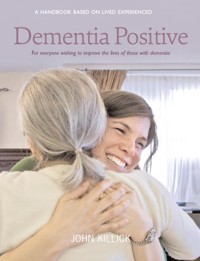
This book is not about the past, which has gone. Or the future, which is uncertain. But it is for those who want to improve the lives of people with dementia and themselves in the Here and Now. The book is not written by an expert but by a man seeking to find new approaches concerning dementia who wishes to share his discoveries. Killick steers clear of any sort of medical terminology and instead nurtures the often neglected aspects of dementia, thereby reinforcing to the reader that these are of no lesser importance. In recognition that we are all in this together, Killick gives equal prominence to quotations from, and conversations with, people with dementia and their carers.
Das E-Book können Sie in Legimi-Apps oder einer beliebigen App lesen, die das folgende Format unterstützen:
Seitenzahl: 159
Veröffentlichungsjahr: 2013
Ähnliche

















JOHN KILLICK was a teacher for 30 years, and has been a writer all his life. He has published books of his own poetry and books on creative writing. He began working with people with dementia in 1992, and has held a number of posts with nursing homes, hospitals, libraries and arts centres. With Kate Allan, John created and moderates the websitewww.dementiapositive.co.uk. He has edited six books of poems by people with dementia, and co-authored books on communication and on creativity. He has written many articles and book chapters, and given many workshops in the UK and abroad. He has also made a number of appearances on radio and TV.
By the same author:
Playfulness and Dementia: A Practical Guide(Jessica Kingsley, 2012)
Creativity and Communication in Persons with Dementia: A Practical Guide(with Claire Craig, Jessica Kingsley, 2011)
Communication and the Care of People with Dementia(with Kate Allan, Open University Press, 2001)
DEMENTIA POSITIVE
A HANDBOOK BASED ON LIVED EXPERIENCES
For everyone wishing to improve the lives of those with dementia
JOHN KILLICK
LuathPress Limited
EDINBURGH
www.luath.co.uk
First published 2013
eBook 2013
ISBN (print): 978-1-908373-57-1
ISBN (eBook): 978-1-909912-41-0
The author’s right to be identified as author of this work under the Copyright, Designs and Patents Act 1988 has been asserted.
© John Killick
You did then what you knew how to do and when you knew better you did better.
MAYA ANGELOU
We receive and we lose, and we must try to achieve gratitude; and with that gratitude to embrace with whole hearts whatever of life that remains after the losses.
ANDRE DUBUS
I dwell in Possibility
EMILY DICKINSON
CONTENTS
ACKNOWLEDGEMENTS
INTRODUCTION
CHAPTER ONE Talking the Talk
CHAPTER TWO What Kind of Thing is Dementia?
CHAPTER THREE Removing the Walls of Fear
CHAPTER FOUR Being Aware
CHAPTER FIVE Maintaining Relationships
CHAPTER SIX How Are You Managing?
CHAPTER SEVEN Hanging Onto Memory
CHAPTER EIGHT Listening to the Language
CHAPTER NINE Learning the Language Without Words
CHAPTER TEN Telling Tales
CHAPTER ELEVEN Seeking the Spiritual
CHAPTER TWELVE Coming to Our Senses
CHAPTER THIRTEEN Keeping In Touch
CHAPTER FOURTEEN Being Creative
CHAPTER FIFTEEN Cultivating Playfulness
CHAPTER SIXTEEN Living in the Moment
CHAPTER SEVENTEEN A Home From Home
CHAPTER EIGHTEEN A Good Sunset
CHAPTER NINETEEN Making Preparations
POSTSCRIPT
WHERE THE QUOTES COME FROM
EXPLORING FURTHER
ACKNOWLEDGEMENTS
I would especially like to express my gratitude to Caroline Brown, Kate Grillet and Helen Finch for their contributions, and for their comments on the manuscript generally. The extracts by all three of these individuals have been specially offered to me for this book. Kate Allan has once again been my sternest, and therefore most valuable, critic. I owe the format of the book to her as well, which I have borrowed from her groundbreaking training resourceFinding Your Way, alas no longer available.I am also grateful to Cathy Greenblat for the use of one of her wonderful photographs on the cover: this surely sets the tone for what this book is about.
INTRODUCTION
You will already have read three quotations which I have chosen because, despite the fact that dementia was probably not in the writers’ minds when they wrote them, I believe they carry the message of this book.
I would like to apply these not just to dementia but specifically to those of us in a supporting role. They are a call to arms, but of the compassionate rather than the military sort. They offer us what I would like to call ‘a manageable challenge’.
It’s a challenge I took on over twenty years ago, and it’s a never-ending one. I have gradually come to see more and more people engaging with a vision of how life with the condition could be, and can be. In this book I want to reflect that vision and their experience.
For myself, I was a teacher for thirty years, and a writer in my spare time. Then I left the classroom behind to live a life in a writer’s study. Only that’s not how it worked out. I had to earn a living, so I began to take writers’ residencies, placements in the community where one can be of use in a different way from writing poems and stories of one’s own. I worked first in a women’s prison, then a hospice, and latterly in care homes. I began with the life stories of older residents, then I met my first person with dementia.
I knew then that I had found the area I wanted to concentrate on. There was a crying need (sometimes literally) for people’s voices to be heard, and written down, and shared back with them. It was a way of confirming for them that they were still there. It was a way of reassuring them that their words were still of importance.
I thought a lot about the process I was engaged in, and I began to listen to what others were saying about the condition, particularly those who had experience of it through family and friends. I realised that there was something about the subject that makes communication and relationships especially important, and wanted to share my viewpoint with others. I believe it has all been leading up to this book.
I can’t tell you much about plaques, tangles or drugs – I’m not qualified to do so. I don’t deal with diet or exercise – though these are positive strategies which complement those I concentrate on.
My conviction is that one person’s experience, however extensive, is by no means the whole story. So eighteen of the nineteen chapters include a section solely dedicated to the words of people with dementia themselves, and those who come into contact with them – family and friends mainly, but some professionals as well, where I thought their insights might be helpful. You can find out where these quotes come from at the back of the book.
In Chapter One I consider the language we use to talk about dementia. It is very important to get the words right. I have decided to use the term ‘dementia’ sparingly because it becomes monotonous, so when I refer to someone with dementia I often use the word ‘person’, and sometimes the phrase ‘person with the condition’. I also want to avoid the word ‘carer’ as much as possible, because it always puts the person with dementia into a dependent role. I have decided to use the term ‘supporters’ for those closest to the person (often referred to in other books as ‘primary carers’) as well as the rest of family and friends. I am excluding professional carers here: their relationship is necessarily on a different basis. That is not to say that some of what I and others have to say in these pages may not resonate with them, but they are not the main audience I am addressing.
I say I have a vision of how things could be – that’s true, but I don’t want to stray too far from things as they are. However, there is still so much negativity swirling around this subject, I have no intention of adding to that. I have looked for the upbeat wherever I can find it and it seems justified.
But I don’t want you to come away from this introduction with the feeling that I am going to give you lots of dogmatic pieces of advice. I have learnt enough to know that that would be deceiving. We are dealing with, on the one hand, possibly the most complex condition humans can face, and on the other, individuals in all their diversity. So this is a book of hints and potentials, not certainties. If you find me overstepping the mark, please give me a mental wrap on the knuckles!
We have a long way to go in creating the ideal dementia world. Maybe that is a world in which it never occurs to us to use the word. But starting from where we are now I believe we can all make a difference, however small, in the spirit of the quotations at the head of the book. The first thing we need to do is to stop ‘fighting’ the condition, as some experts and organizations would have us do, and adopt a mindset of cooperating with it. (I do not mean by this that we should refrain from fighting for the services we believe we deserve!) I am referring to an attitude of acceptance rather than conflict in how dementia is viewed by both person and supporter. That should take us a lot further. I hope to show you some ways in which this can be achieved.
CHAPTER ONE Talking The Talk
Part One
Some time ago I saw a video about group homes for people in Japan. The strongest message about the kind of support developed there was that those with dementia and those who look after them form a partnership. It was said that they are like a family, exploring relationships and sharing achievements.
The film was made for the Japanese market but I saw the English language version. In this the residents were referred to as ‘occupants’ and ‘cohabitants’ and the carers as ‘staff members’ and ‘professionals’. Despite the positive messages contained in the film I felt that the use of these terms undermined its spirit. It made me think anew about the significance of the words we use.
The language in which we talk about any subject is crucial. It reflects our attitudes and beliefs as well as our knowledge and understanding. But that’s not all: it can impose narrow limits on our potential for taking on new ideas and ways of acting in the future. In this way language can hold us back from essential learning and growing. It can reinforce our prejudices and confine us within our limitations.
I believe our current ways of talking about dementia often let us down in these ways. If we don’t get the words right in talking and thinking about the subject we will never achieve a helpful and realistic understanding of a really complex condition. And this can act like a computer virus spreading throughout the system and infecting all our attempts to get things right in our relationships with people.
Firstly, in the world of professional care it is my view that ‘manage’ is a weasel word. People are there to be ‘managed’, and this leads staff into the unthinking adoption of practices which actually work against the person and lead to their disempowerment. As supporters we shouldn’t fall into this trap.
Then there is the word ‘sufferer’. Whilst it is clear that in certain respects people with dementia do suffer, referring to them as ‘sufferers’ is objectionable because it puts the condition first, as if the individual’s very identity has been subsumed by it. And this means getting rid of the word ‘victim’ too. It carries similar and even more negative suggestions. The idea that someone may have been targeted in some way is far too simplistic. As for the term ‘patient’, this carries associations of doctors and hospitals and leaves society’s role completely out of the frame. We don’t use this term for someone diagnosed with diabetes living in their own home, so why someone with dementia in a similar situation?
I suggest we use the idea of dementia as a disability, with all that that implies of coming to terms and social attitudes, rather than considering it solely as a medical condition, with the emphasis on treatment. This will get around the idea that all the problems a person faces are caused by the state of their brain. I am suspicious of the use of the terms ‘illness’ and ‘disease’ in talking about dementia and prefer the word ‘condition’ which is less specific and more commensurate with the present state of our knowledge.
Looming above all of us is, of course, the term ‘Alzheimer’s’. Let’s trace how this word came to be used and acquire its current associations. What follows is a very brief summary of the views of the English psychologists Mike Bender and Rik Cheston, supplemented by those of the American neurologist Peter Whitehouse.
Over 100 years ago, Dr Alois Alzheimer met Frau Auguste D and attempted to find an explanation for the unusual ways in which she appeared to him. He came under the influence of a celebrated psychiatrist who decided on the basis of this one instance to call it ‘Alzheimer’s’ and include it in a new edition of the textbook he was compiling.
There it lay, innocently undisturbed, until the 1970s, when various organizations were created, national and international. To give them a catchy title in order to attract research funding, the word was promoted. Thus a disease was born.
Since then the drugs companies have proclaimed it and profited hugely. It has been convenient to them to present a worst-case scenario because it attracts cash from scared individuals like you and me. I’m not saying that it’s all a con-trick – there is undoubtedly something there to be addressed, but we are dealing here with hype on a large scale, and this seriously interferes with our ability (individually and as a society) to get the thing into some sort of perspective.
As I hope to explain in the next chapter, dementia is a condition which is uniquely responsive to how we regard it and the person labelled with it, so it is unhelpful to all concerned to maintain a negative attitude.
If we ceased using the term ‘Alzheimer’s’ and substituted ‘dementia’ we wouldn’t be much better off. This is because, despite the fact that the latter includes the former and therefore they are not synonymous, they have come to be used as such, and so all the alarming associations have rubbed off on the latter term. In any case a word which means ‘without mind’ is hardly reassuring, and certainly no more accurate. Really we need to get rid of both terms.
Have we any alternatives? I have scoured the experts for suggestions but without much success. In America the term ‘major neurocognitive disorder’ is under consideration. In the UK Julian Hughes, a psychiatrist, favours ‘acquired diffuse neurocognitive dysfunction’, which is probably more accurate but hardly trips off the tongue! We badly need a word (no more than three syllables?) that does the job without carrying the stigma. Any ideas?
Part Two Other Voices
Here is someone speaking on an Alzheimer’s Society video:
Names have power, like the word ‘Alzheimer’s’; it terrorises us; it has power over us. When we are prepared to discuss it aloud we might have power over it. There should be no shame in having it, yet people still feel ashamed and people don’t talk about it.
And here is Richard Taylor, an American psychologist who has been diagnosed with Alzheimer’s Disease, in an extract from a book he has written:
Some words are so powerful because the territory we believe it describes is so scary, is so scandalous, is so sinful, is so gross that we believe if we do not use the word, then we won’t think about the territory. In these cases, we have already located the symbol (the word) and the territory (its meaning). We think we can control our fear of the territory by controlling the saying of the word…
Please, sit down with each other and talk first about the territory. Nothing is to be gained, and much will be lost, if saying the words aloud so traumatizes those involved that they do not hear what follows the wordsAlzheimer’s disease.
Christine Bryden is a woman with the condition in Australia, and has this warning to offer:
Please don’t call us ‘dementing’ – we are still people separate from our disease, we just have a disease of the brain. If I had cancer you would not refer to me as ‘cancerous’ would you?
Bob Fay, who has Pick’s Disease says:
What a very unfriendly word ‘dementia’ is. Technically I must have been ‘dementing’ for about ten years. To me the term suggests insanity – and the dictionaries agree. To be demented implies being frantic, overactive, out of one’s mind. I haven’t settled on a better term, but I usually say I have Pick’s disease or that I have a degenerative brain disease. Sometimes I call myself ‘an old Dementonian’ but then people think I’m claiming to have had an elitist education!
I shall end this section with the words of Joanne Koenig Coste, a supporter who has realised the power of words to distort and obstruct:
Let’s try some new vocabulary here, some reframing:
End Note
I hope I have convinced you that the words we use to describe or refer to something are important. They are a give-away as to our attitude. So in order to think sensibly about this subject we need to watch our language and the language of other people very carefully, not least that very word ‘dementia’ which is on the cover of this book. In conjunction with the word ‘positive’ it really reads like a contradiction in terms. I will never forget the words of Ian McQueen:
Every time someone uses the word I think they are saying ‘Give him another kick!’
CHAPTER TWO What Kind of Thing is Dementia?
Part One
I begin this chapter with a kind of a riddle from the neurologist Oliver Sacks. I invite you to try to solve it and keep returning to it over the course of the book to see if it means any more to you:
A Who has a What –
Will the What overcome the Who?
Will the Who emerge through the What?
Or will the two combine in a way that embraces and transcends the Condition?
The reason for this chapter is that I believe dementia is different from other conditions, and an understanding of this is essential to the messages carried by the rest of the book. Many illnesses with a strong medical component do have interpersonal aspects, and you can never discount the effect of mind on body and vice versa, but dementia is different in the degree to which this is significant, and I will try to spell out some of the implications later. There are, of course, different types of dementia, medically speaking, including Alzheimer’s, Vascular and Korsakoff’s, but from the point of view of communication and relationship they have more in common than they are different.
For a long time what was called ‘the medical model’ held sway. Everything was put down to shrinkage of the brain, plaques and tangles, so that the condition was invariably spoken of in terms of problems – with reasoning, memory, carrying out practical tasks, orientation and various physical effects.
A definition I came across recently in an early textbook used all of the following words: ‘degenerative’, ‘incapable’, ‘disintegration’, ‘adrift’, ‘disturbed’, ‘dislocation’, ‘regresses’, ‘ailing’ and ‘helpless’.




