


Erhalten Sie Zugang zu diesem und mehr als 300000 Büchern ab EUR 5,99 monatlich.
- Herausgeber: The Crowood Press
- Kategorie: Lebensstil
- Sprache: Englisch
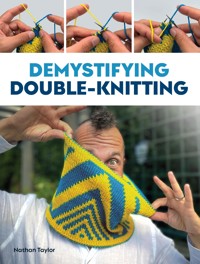
Master the art of double knitting to produce reversible, double-layered, multi-coloured knits. In its simplest form, double knitting is a form of colour work that creates a dual-layered, two-sided fabric, without there being an unattractive or float-ridden 'wrong side'. It is therefore different to any other knitting technique and can mystify novices and experienced knitters alike. Demystifying Double Knitting takes the mystery out of the process with step-by-step explanations of the key techniques, illustrated with detailed photographs. Once the fundamentals are mastered, you can then learn to move beyond basic stocking stitch and introduce texture, shaping and even non-mirrored designs to your work. Whether you're new to the technique or simply want to understand it better, this book offers an accessible introduction to double knitting and a celebration of the creative opportunities it offers.
Sie lesen das E-Book in den Legimi-Apps auf:
Seitenzahl: 190
Veröffentlichungsjahr: 2023
Das E-Book (TTS) können Sie hören im Abo „Legimi Premium” in Legimi-Apps auf:
Ähnliche















CONTENTS
1 Before We Begin
2 Double-Knitting: The Basic Concepts
3 Your First Double-Knitted Project: Learning the Basics
4 Different Textures in Double-Knitting
5 Increases in Double-Knitting
6 Decreases in Double-Knitting
7 Non-Mirrored Double-Knitting
8 Wrapping Things Up
9 The Patterns
Index
CHAPTER 1
BEFORE WE BEGIN
WHO IS THIS BOOK FOR?
‘Isn’t it the kind of yarn that’s about twice as thick as sock-weight yarn?’ Um… yes… well, kinda… but not only…
That’s the answer I get a lot, whenever I ask the question, ‘What is double-knitting?’ Most people are still only aware of the term relating to 8-ply yarn, and have never come across it in any other arena, much less that of an actual knitting technique. This book, then, is for everyone who has never heard of double-knitting.
Then there are those people who have heard of double-knitting, who almost unanimously tell me, ‘Oh, that’s far too complicated for me. I could never knit anything that difficult. I’ve only been knitting for forty-five years…’ This book, then, is for everyone who thinks that double-knitting is too scary for them.
Then there is another group of people. People who see a piece of double-knitting, and immediately, their eyes start to glisten with excitement. Their pulses start to race at the sight of something that looks both beautiful and complex, but they choose to see only the beauty, and the possibilities that lie ahead of them. They think to themselves, ‘I have no idea how that was made, but I want to do that!’ This book, then, is for everyone who has never been frightened of learning something new.
In fact, regardless of what category suits you best, this book is for you.
I’ve been teaching double-knitting for nearly ten years. I’ve taught the technique at local yarn shops, in private workshops, and at the most prestigious yarn expos and festivals all over the world. I have taught it to brand-new knitters, who have only recently learnt how to make a knit stitch and a purl stitch, and I have had the privilege of teaching experienced, veteran knitters, some of whom have been knitting for nearly twice as long as I’ve been alive.
I have taught it to colourwork novices, lefties, righties, throwers, pickers, flickers and Portuguese knitters alike. Whatever their level, whatever their methods, they have all entered my class with some degree of trepidation – the kind that often accompanies the experience of being faced with something unknown – and all of them have left the class with a foundational knowledge of a technique that will bring them untold numbers of hours of great joy and satisfaction. And before you leap to the conclusion that I must be a very arrogant man indeed to make the assertion of being such a brilliant teacher, let me tell you this: I did not successfully manage to teach all these different kinds of knitters how double-knitting works because I am some kind of educational legend. No, I was able to do it because of one very important fact: double-knitting simply isn’t that hard.
WHAT IS DOUBLE-KNITTING?
In its simplest form, double-knitting is a form of colourwork (that is, knitting using more than one colour) that creates a reversible, two-layered, two-sided fabric, that is usually (but not always) worked with two colours, and that usually (but not always) presents itself as stocking stitch on both sides. Most other forms of knitting create a fabric that has only one layer, and that layer usually has an attractive ‘right’ side, and a pretty gnarly-looking ‘wrong’ side. Double-knitting, by contrast, has no unsightly wrong side. Both sides of a piece of double-knitted fabric are equally attractive.
Both sides of a piece of double-knitting are equally attractive.
Double-knitting tends to feature graphical or pictorial designs: the nature of the smooth, stocking-stitch fabric, and the possibilities granted by having at least two different colours in play, make it ideal for patterns and designs that would be difficult to achieve with other forms of knitting.
Usually, the two sides of a piece of double-knitting feature mirror images of the same pattern, where one side is the negative image of the other. In other words, if one side shows a black cat sitting on a white background, with its head looking over its left shoulder, the other side will show a white cat sitting on a black background, with its head looking over its right shoulder.
Double-knitting is the greatest knitting technique in the world. That’s a pretty bold statement, isn’t it? It’s one that I wholeheartedly stand by, however, and one that I can easily back up with plenty of facts. Don’t get me wrong: there are many other wonderful techniques in the canon of ‘Knitting’ that are absolutely brilliant, which can be used to make unlimited numbers of beautiful items, and they all have their place. They all have their strengths, too: things that they do really well, gifts that they bring to the table that some other knitting techniques can’t achieve.
Lace knitting, for example, uses decoratively placed increases and decreases to create textures and patterns, sending columns of stitches skewing off in different directions, with gorgeous results. What about cables? Working certain stitches out of their usual order results in a structural three-dimensionality that lace alone could never dream of. Undulating sections of knitting cross over and under each other, in a writhing mass of beautiful designs, unique to the world of cabling. Fair Isle, and other forms of stranded knitting, bring colour to the party. Where lace and cables are really only ever monochrome techniques, relying on texture and form to create their magic, suddenly, through the practice of stranded knitting, you can open up a whole new vista of creativity, using colour as your paint, and your knitting as your canvas.
All of that is wonderful, of course, and I will never say anything to take those positive aspects away from these techniques. It must be said, though, that while they have their undeniable strengths, all of these kinds of knitting have their drawbacks too. Or, perhaps, to put it more diplomatically, these other techniques have definite limitations. As knitters or designers, we are used to those limitations: they are simply ‘features of the technique,’ and we don’t pay them much mind, but they are there, nonetheless. Cables and lace are single-colour techniques, and both very definitely have a good side and a bad side. The whole ‘right-side/wrong-side’ issue is a big factor in all forms of stranded colourwork, too. Stranded knitting has limitations on the kinds of patterns that can be achieved with it: because of the floats on the wrong side of the fabric, you can’t have too many stitches of the same colour in one stretch. Not, at least, without trapping or catching the float in some way, and even then, as much as knitters like to tell themselves that you can’t see the catching of a float on the right side, we all know you can!
When double-knitting enters the room, however, it looks at the limitations of all the other knitting techniques, and says, ‘Ha-hah! I see your problems, and I trample all over them! Your restrictions present no obstacles to me – I can do it all!’ That’s a rather ostentatious way of saying that whatever is possible in single-face knitting is also very doable in double-knitting and, what’s more, it can be achieved without the restrictions of the corresponding, single-faced techniques. Yes, you can cable in DK, and you can do it without needing a purl-stitch bed on either side of the cables in order for them to pop visibly. You can, of course, have a purl bed in DK as well, but you can also make the cables stand out by making them a different colour from the background stitches at either side. Yes, you can work lace patterns in double-knitting, and you’ll never have to worry about an ugly wrong side. With double-knitting, both sides of your lace shawl are as lovely as each other, and you can bring them to life with colour in a way that was never possible before. As for getting around the limitations inherent in stranded knitting, this is what DK does best of all. In DK, there are absolutely no rules governing the placement of the colours whatsoever, meaning that you can work large areas of the same colour without causing any problems with floats, precisely because there aren’t any floats in double-knitting. You can go wild, creating whatever design you like, without fear that it won’t work, because it will. I think you are getting the idea.
Double-knitting, for me, has lots of plus points of its own, as well. The fabric is twice as thick as a single-layered piece of knitting made with the same yarn would usually be, and that means double the warmth and double the squish. It’s also pretty much windproof, in a way that knitting usually isn’t. This is because there is a half-stitch offset in how the two layers of the fabric line up with each other, so wherever there is a space between the strands of yarn on one side of the fabric, that space is being plugged by a strand of yarn from the other side of the fabric, so even lighter yarn weights can be used to create very cosy items indeed.
Because, as I mentioned, there are no floats, DK fabric doesn’t have that stiff rigidity from which stranded colourwork often suffers. It has the same amount of lateral stretch as ordinary stocking-stitch knitting, making it great for shawls and other garments that benefit from a lot of drape.
Then there is what is possibly my favourite aspect of DK. Because it is double the thickness of ordinary knitting, you can work with much finer yarn than you otherwise might. And because DK is a graphic medium at heart, this means that the stitches – the pixels of your pattern – can be much smaller than they would normally be. This in turn means that your image/pattern/design will be rendered in much higher resolution, with more detail and clarity. Curves and circles no longer need to look so jagged and stepped, without having to sacrifice anything in terms of the thickness and comfort of the fabric.
Are you beginning to see why I say that double-knitting is the best knitting technique in the world? Oh, and if you still aren’t convinced – double-knitting comes off the needles completely flat and doesn’t need blocking. That’s right: even when it has stocking stitch on both sides. A single layer of stocking stitch will always curl back on itself, but with DK, you have two layers of stocking-stitch fabric with their backs facing each other. These two opposing forces, each trying to curl up one layer of the fabric, completely cancel each other out and the result is a perfectly flat piece of knitting, without even having to try. Heaven!
OK, WE GET IT – YOU LOVE IT: BUT WHAT ARE THE DRAWBACKS?
People often ask me about the drawbacks of double-knitting. I don’t believe there are any. Oh come on, they insist, there absolutely must be some things about double-knitting that could be easier, or that could turn out more neatly, or that could frustrate you less while you are doing them? Nope, I adamantly respond. But hang on, they counter, doesn’t having two layers of knitting, rather than one, mean twice as many stitches? Yes, it does. And doesn’t having twice as many stitches mean that it will take twice as long to knit? Yes, probably. But then I turn around and ask them why they knit. The answer is invariably because they enjoy it. It’s fun. Double-knitting, then, by its very definition, is double the fun!
Double the warmth, double the squish, double the comfort, double the beauty: all of these, yes, and for me, most definitely, double the fun.
WHAT CAN BE DONE WITH DOUBLE-KNITTING?
As I mentioned earlier, it is my genuine belief that there is absolutely nothing that can be done with ordinary, single-faced knitting that cannot be given the DK treatment and, in so doing, projects and patterns that were perfectly lovely before, are now sublimated by twin superheroes – colour and reversibility – and transformed into something better than they could ever have dreamed of being. But that’s all subjective conjecture, I admit. I am, after all, somewhat biased on this subject, so allow me to go into a bit more detail.
The vast majority of double-knitting already out there consists of the kind of fabric I was talking about before: stocking stitch on both sides (all of the purl bumps are hidden away in between the two layers of fabric, before you ask), displaying a two-colour, graphic or pictorial design. As you can imagine, without any limitations on colour placement, the possibilities for variation are endless, almost infinite, curtailed only by the limits of the imagination of the designer.
Here is the question I often get asked when someone looks at a piece of my double-knitting: ‘So, is that two separate scarves sewn together?’ No. It very much is not. The two separate layers of the fabric are worked at the same time. The stitches on your needles are arranged so that you work one stitch for the side of the fabric that is currently facing you (the front), followed by one stitch that will belong to the side of the fabric that is currently facing away from you (the back). The stitches for both layers are all on the needles at the same time, alternating one for the front, one for the back, one for the front, one for the back, and so on. The smooth, flat texture of stocking stitch lends itself very well to this kind of knitting, as the perfect canvas upon which to show the design that you are working into your project.
Sometimes, however, stocking stitch just isn’t enough, and a designer might want to spice things up a bit by adding some texture to their design. You can just as easily work reverse stocking stitch in double-knitting, and once you have both knit stitches and purl stitches playing happily together on the same side of the fabric, you open up new dimensions of possibilities.
What about increases and decreases? Sure: why not? Now you’re talking! Increases and decreases don’t just mean shaping (although they can very easily be used to create different-shaped items in your double-knitting), they are also the fundamental components of lace knitting, and that’s when things start to get really interesting. Short rows, texture, intarsia, entrelac, cables, bobbles, lace, brioche: basically, anything you can think of. Any stitch pattern or texture that you care to choose. Literally anything. Have I made that point emphatically enough? Literally anything.
There are also things that can be done with double-knitting that can’t be achieved any other way. The main one that springs to mind is the ability to have two completely different designs on the two sides of your fabric. You might want a dog on one side, and a cat on the other. With a bit of careful planning, that’s perfectly possible. There are various names for this kind of double-knitting floating around out there, but the one that I favour is ‘non-mirrored double-knitting’, or NMDK. I call it that because that’s exactly what it is. It can be used to make text readable on both sides of your fabric, which is a neat trick: if you think about it, text on one side of a piece of double-knitting would (and, seemingly, should) show up on the other side looking like it has been written backwards. NMDK can take care of that for you, completely. It’s good stuff, this double-knitting, isn’t it?
WILL THIS BOOK COVER ALL OF THAT?
Oh, how I wish it could! As much as I’d love to take the time to write the most complete compendium of double-knitting techniques and know-how that has ever existed, this book is only intended to be your introduction to this exciting new world: a stepping stone, if you like, to whet your appetite, and send you on your way. It will cover all the basics: and by that, I mean ‘all the stuff I think you need to know’. You’ll get a firm foundational understanding of how this stuff works, rather than just an ability to follow the instructions on the page and do what they say. I always say there is a big difference between knowing something and owning it. I want you to own this knowledge, so that it is yours to play with and to do with as you please. There’s such glorious freedom in that, and I want you to be able to enjoy it fully.
Once the basics are thoroughly owned by one and all, we’ll look at some further techniques, and hopefully give you a peek through the doorway into the world of what else is out there for you to go and explore. By then, you’ll have all the building blocks you need, and you can run around this fantastic playground, seeing what toys you like the look of most, knowing that you can choose any of them, and make them yours forever.
If all of that sounds a little bit fanciful, and you just want to know how to make that lovely scarf you’ve seen on my website, then don’t worry: that’s all in the pages of this book for you as well. That’s one of the things I love most about knitting in general: it’s all out there for you, at whatever level you want. You can always just take the bits you think you are going to enjoy the most.
CHAPTER 2
DOUBLE-KNITTING: THE BASIC CONCEPTS
THINKING ABOUT YOUR STITCHES IN A SLIGHTLY DIFFERENT WAY
The very first thing to get your head around, when learning double-knitting, is the concept of thinking about your knitting in terms of pairs of stitches, rather than individual stitches. Look at it this way: double-knitting, by its very name, is knitting, doubled, right? Ordinary knitting has one layer of fabric, double-knitting doubles that up, and has two. Essentially, everything in double-knitting is doubled up from its single-faced counterpart.
It’s a good idea to start thinking about your stitches in pairs, right from the very start.
THE BASIC UNITS OF KNITTING
It might be said that the basic unit of ordinary knitting is a single stitch. The atomic particle, if you like, of knitting, is a single, individual stitch. That atom might be a knit stitch, or it might be a purl, or it might be a yarnover, or it might be decrease, but it’s the fundamental part of what knitting is. Just as with atoms in the real world, a single stitch isn’t much use to anyone on its own: you need a lot of them all joined together to make anything worthwhile. (Yes, I know that atoms are made up of smaller particles, like electrons, and protons, and that they in turn are made up of even smaller things like quarks and all the quantum stuff I won’t pretend I understand, but the same can be said of a stitch: the electrons and protons might be the front leg and the back leg of the stitch, and the even-smaller-level stuff might be the fibres of the yarn, and, well, you know what I mean! Let’s not examine the metaphor too closely…)
If, then, it is true that the basic unit of knitting is a single stitch, and it is also true that everything in double-knitting is knitting, doubled, then it must be true that the basic unit of double-knitting is one pair of stitches. Yes, there are still two of them, and yes, we will be working them individually – one for the front, and one for the back – but they are nevertheless a pair, and the sooner you can start thinking about them as a pair, a single unit, rather than as separate entities, the easier this will all be.
THE GOLDEN RULE OF DOUBLE-KNITTING
A long time ago, when I was formulating my methods for teaching this stuff, I devised what I have called the Golden Rule of standard double-knitting. The Golden Rule of standard double-knitting is as follows:
‘Whatever you do to the firststitch ofthe pair, you do the exact opposite tothe second stitch ofthe pair.’
I want you to stop and think about that for a moment. Examine what it might mean. It’s so fundamental to the technique that it’s worth saying it a second time. Whatever you do to the first stitch of the pair, you do the exact opposite to the second stitch of the pair. It gives us a lot of information. It confirms the existence of a relationship between two stitches. It establishes one as ‘the first stitch of the pair’ and the other as ‘the second stitch of the pair’, which is important for identifying the component parts of the pair, but it also goes a lot deeper than that.
You might say that the opposite of a knit stitch is a purl stitch, and the opposite of a purl stitch is a knit stitch. Getting really nerdy for a moment, that rather depends on how you knit: most ‘Western-style’ knitters form all of their stitches by wrapping their working yarn around the tip of the working needle in an anticlockwise direction, when looking down at the needle tip. Some knitters, on the other hand, are ‘combination knitters’, which means that although they form their knit stitches by wrapping the working yarn in an anticlockwise direction, they form their purl stitches by wrapping the working yarn clockwise around the needle tip. This style of knitting creates a purl stitch that truly is the opposite of a knit stitch, but I’m splitting hairs here… For argument’s sake, let’s go with saying that knit stitches and purl stitches are two sides of the same coin.
Going back to the Golden Rule, then, if you knit the first stitch of the pair, it follows that you must then purl the second stitch of the pair, right? We can go further than that: if you knit the first stitch of the pair with Yarn A, the Golden Rule tells you that you must then purl the second stitch of the pair withYarn B. Do you see how unpacking the information in that one simple sentence actually gives a lot of detail about what you need to be doing at any point. The clues are all there. Embrace the Golden Rule and you are less likely to get lost along the way.
WHY I’M SO PEDANTIC




