


38,99 €
Mehr erfahren.
- Herausgeber: John Wiley & Sons
- Kategorie: Fachliteratur
- Sprache: Englisch
Praise for Demystifying Technical Training "Demystifying Technical Training is a must-read for CLOs,managers of training, instructors, and instructional designers. Allwho read it will gain critical insights into how to lower the costand improve the efficiency and effectiveness of learning." --Wm. Douglas Harward, CEO and founder of TrainingIndustry, Inc. "Individuals interested in and accountable for derivingsignificant value from technical training investments will gaingreat benefit from reading this book and applying itswisdom." --Karen Kocher, CLO at Cigna Healthcare "Demystifying Technical Training is an essential,complete guide for any learning organization. The overviews andconcepts are clearly stated, while the case studies and sidebarsprovide practical examples you can apply in your situation." --Jean Barbazette, president of The Training Clinic andauthor of Managing the Training Function for Bottom-LineResults "Considering the cost of acquiring and developing talent, whywouldn't all CEO/COOs insist on investing in people to improveresults and reduce risk? This book demystifies the process ofdeveloping technical experts to increase the return on investmentin human capital. Bravo!" --Martin J. Menard, former group CIO at IntelCorporation "Technical training is a key to sustaining competitiveness inthe new economy. Learn how to leverage and optimize its value inyour organization through this wonderfully insightful and practicalresource." --Dr. Arthur L. Jue, director of global organizationand talent development at Oracle and co-author of Social Mediaat Work: How Networking Tools Propel OrganizationalPerformance "Don't be misled by the title--this book--whilefocusing on the often segmented world of domain specific jobskills--provides guidance valid for the full spectrum ofworkforce learning from soft-skills to 'technical' skills." --Ruth Clark, principal and president of Clark Training& Consulting and author of e-Learning and the Science ofInstruction
Sie lesen das E-Book in den Legimi-Apps auf:
Seitenzahl: 488
Veröffentlichungsjahr: 2010
Ähnliche


















Table of Contents
Cover
About This Book
About Pfeiffer
Title
Copyright
LIST OF FIGURES, TABLES, SIDEBARS, AND CASE STUDIES
FOREWORD
PREFACE
ACKNOWLEDGMENTS
INTRODUCTION
1: What Is Technical Training?
The Complete Training Suite for Technical Experts
Technical Training and Related Activities
Summary: The Power of a Common Language
2: Challenges and Opportunities for Technical Training
Environmental Factors
Organizational Considerations
Capability Aspects
Summary: The Value Proposition for Technical Training
3: Differentiators of Technical Training
What Are Differentiators?
Analysis
Design
Development
Implementation
Evaluation
Overarching Differentiators
Summary: The Potential of Differentiators
4: Stakeholders of Technical Training
Technical Training Stakeholder Needs
Collaboration and Governance Structures
Stakeholder Support and Buy-In
Summary: The Requirements for Collaboration
5: Technical Training Strategy
Primer on Strategy
Components of Strategy
Capabilities to Execute the Strategy
Summary: Setting the Stage for Execution
6: Getting the Technical Training Agenda Funded
Considerations in Advance of Funding
Setting Up the Budget
Managing the Budget
Summary: The Art and Discipline of Budgeting
7: Staffing the Technical Training Organization
Structure of the Training Function
Technical Training Skills
Technical Training Recruiting
Managing the Technical Training Team
Summary: Hiring and Development in a Nutshell and Development
8: Technical Training Analysis, Design, and Development
Identifying Technical Training Needs
Prioritizing Technical Training
Designing the Technical Training Portfolio
Summary: Stakeholders Participate Throughout the Training Life Cycle
9: Marketing of Technical Training
Why Market Technical Training?
Hurdles to Marketing Technical Training
Marketing Principles Applied to Technical Training
Common Sense and Marketing Technical Training
Summary: The Prospect of Marketing Technical Training
10: Technical Training Delivery and Evaluation
Preparation for Training Delivery
Modes of Technical Training Delivery
Evaluating Technical Training
Summary: Learning from Technical Experts
GLOSSARY
REFERENCES
ABOUT THE AUTHORS
INDEX
End User License Agreement
List of Tables
1: What Is Technical Training?
Table 1.1. Training Categories by Content Types
2: Challenges and Opportunities for Technical Training
Table 2.1. The Current and Future State of Training and Talent Management
3: Differentiators of Technical Training
Table 3.1. ADDIE Phases and Differentiators
Table 3.2. Differentiators and Primary Training Actions
4: Stakeholders of Technical Training
Table 4.1. Forms of Stakeholder Involvement
5: Technical Training Strategy
Table 5.1. Vision and Mission Development
Table 5.2. Content Development Enabled by Technology
6: Getting the Technical Training Agenda Funded
Table 6.1. Training Vendor Cost Comparison
Table 6.2. The Average Cost of Training
Table 6.3. Creative Cost Savings at a Multinational Corporation
7: Staffing the Technical Training Organization
Table 7.1. Training Industry Staffing Ratios
Table 7.2. Remote Management Roles
8: Technical Training Analysis, Design, and Development
Table 8.1. Technical Training Need Categories
Table 8.2. Needs Assessment Considerations
Table 8.3. Training Prioritization Factors
Table 8.4. Coordination Across ADDIE Phases
Table 8.5. Course Development Considerations
10: Technical Training Delivery and Evaluation
Table 10.1. Research on Training Transfer
List of Figures
1: What Is Technical Training?
Figure 1.1. Training Categories
2: Challenges and Opportunities for Technical Training
Figure 2.1. Two Required Core Competencies
Figure 2.2. Managerial Versus Technical Career Path Pyramids
4: Stakeholders of Technical Training
Figure 4.1. The Influence-Interest Grid
Figure 4.2. Stakeholder Mapping Technique
5: Technical Training Strategy
Figure 5.1. Training Business Model
Figure 5.2. Training Operating Model
Figure 5.3. Technical Training Roadmap
7: Staffing the Technical Training Organization
Figure 7.1. Three-Legged Stool of Training Expertise
Guide
Cover
Table of Contents
Begin Reading
Pages
Cover
Contents
i
ii
iii
v
vi
xv
xvi
xvii
xix
xx
xxi
xxiii
xxiv
xxv
xxvii
xxviii
1
2
3
4
5
7
8
9
10
11
12
13
14
15
16
17
18
19
20
21
22
23
24
25
26
27
28
29
30
31
32
33
34
35
36
37
38
39
40
41
42
43
44
45
46
47
48
49
50
51
52
53
54
55
56
57
58
59
60
61
62
63
64
65
66
67
68
69
70
71
72
73
74
75
76
77
78
79
80
81
82
83
84
85
86
87
88
89
90
91
92
93
94
95
96
97
98
99
100
101
102
103
104
105
106
107
108
109
110
111
112
113
114
115
116
117
118
119
120
121
123
124
125
126
127
128
129
130
131
132
133
134
135
136
137
138
139
140
141
142
143
144
145
146
147
148
149
151
152
153
154
155
156
157
158
159
160
161
162
163
164
165
166
167
168
169
170
171
172
173
174
175
176
177
178
179
180
181
182
183
184
185
186
187
188
189
190
191
192
193
194
195
196
197
198
199
200
201
202
203
204
205
206
207
208
209
210
211
212
213
214
215
216
217
218
219
220
221
222
223
224
225
226
227
228
229
230
231
232
233
234
235
236
237
238
239
240
241
242
243
244
245
246
247
248
249
250
251
252
253
254
255
256
257
258
259
260
261
262
263
265
266
267
268
269
270
271
272
273
274
275
276
277
278
279
280
281
282
283
284
285
286
287
288
289
290
291
292
293
294
295
296
297
299
300
301
302
303
304
305
306
307
308
309
310
311
312
313
315
316
317
318
319
320
321
322
323
324
About This Book
Why is this topic important?
This book represents one of very few resources for examining technical training from both a strategic and a tactical perspective. There are a few books available on how to develop technical training courses, but none on how to lead and manage the technical training function and develop and deploy complete technical training solutions. Technical training is very different from soft-skills training and management development. For example, partnerships with technical experts are required due to two core competencies involved in technical training: technical and training competencies. Technical experts provide the technical skills, and training professionals provide the training knowledge. Because of this and many other key differentiators between technical and non-technical training, technical training must be managed differently to be successful and contribute to the bottom line. These differentiators, along with suggestions on how to address them and many other key concepts relevant to technical training are documented for the first time in this book, which will enable the reader to respond proactively to the complexities and intricacies of technical training.
What can you achieve with this book?
By applying the concepts and suggestions in this book, the reader can build and manage a technical training organization either within HR or the business that has
Strong relationships and partnerships with the business it serves
Vision, mission, strategic objectives, guiding principles, business and operating models, roadmap, and portfolio
A technical training strategy that directly aligns to business priorities
The people, process, and technology capabilities to execute the training strategy
Training professionals with training, business, technical and technical functional, project management, and relationship skills
Collaboration and governance structures, including a steering committee and extensive technical expert and stakeholder involvement in training activities
A budget for technical training that is supported and funded by stakeholders
Training needs assessment, prioritization, design, development, and evaluation processes
A proactive marketing plan for technical training
High credibility and increased quality and relevancy of technical training solutions
How is this book organized?
This book is organized into ten chapters, sequentially organized by topic in the manner that would be used when building a technical training organization. The first three chapters focus on setting the stage and defining technical training, explaining the key differentiators associated with technical training, and clarifying the challenges and opportunities of technical training. The next three chapters cover key planning steps and provide the basis for effective stakeholder engagement, strategy development for technical training, and funding the technical training agenda. Successive chapters focus on execution and cover staffing; analysis, design, and development; marketing; and delivery and evaluation of technical training—all within the context of how these practices are different for technical training than other types of training and making an elusive concept approachable and manageable.
About Pfeiffer
Pfeiffer serves the professional development and hands-on resource needs of training and human resource practitioners and gives them products to do their jobs better. We deliver proven ideas and solutions from experts in HR development and HR management, and we offer effective and customizable tools to improve workplace performance. From novice to seasoned professional, Pfeiffer is the source you can trust to make yourself and your organization more successful.
Essential Knowledge Pfeiffer produces insightful, practical, and comprehensive materials on topics that matter the most to training and HR professionals. Our Essential Knowledge resources translate the expertise of seasoned professionals into practical, how-to guidance on critical workplace issues and problems. These resources are supported by case studies, worksheets, and job aids and are frequently supplemented with CD-ROMs, websites, and other means of making the content easier to read, understand, and use.
Essential Tools
Pfeiffer’s Essential Tools resources save time and expense by offering proven, ready-to-use materials—including exercises, activities, games, instruments, and assessments—for use during a training or team-learning event. These resources are frequently offered in looseleaf or CD-ROM format to facilitate copying and customization of the material.
Pfeiffer also recognizes the remarkable power of new technologies in expanding the reach and effectiveness of training. While e-hype has often created whizbang solutions in search of a problem, we are dedicated to bringing convenience and enhancements to proven training solutions. All our e-tools comply with rigorous functionality standards. The most appropriate technology wrapped around essential content yields the perfect solution for today’s on-the-go trainers and human resource professionals.
Essential resources for training and HR professionals
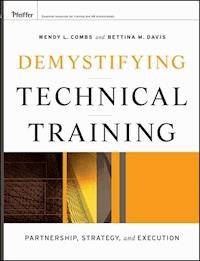
Demystifying Technical Training
Partnership, Strategy, and Execution
WENDY L. COMBS
BETTINA M. DAVIS
Copyright © 2010 by John Wiley and Sons, Inc. All Rights Reserved. Published by Pfeiffer
An Imprint of Wiley 989 Market Street, San Francisco, CA 94103-1741 www.pfeiffer.com
No part of this publication may be reproduced, stored in a retrieval system, or transmitted in any form or by any means, electronic, mechanical, photocopying, recording, scanning, or otherwise, except as permitted under Section 107 or 108 of the 1976 United States Copyright Act, without either the prior written permission of the Publisher, or authorization through payment of the appropriate per-copy fee to the Copyright Clearance Center, Inc., 222 Rosewood Drive, Danvers, MA 01923, 978-750-8400, fax 978-646-8600, or on the web at www.copyright.com. Requests to the Publisher for permission should be addressed to the Permissions Department, John Wiley & Sons, Inc., 111 River Street, Hoboken, NJ 07030, 201-748-6011, fax 201-748-6008, or online at http://www.wiley.com/go/permissions.
Limit of Liability/Disclaimer of Warranty: While the publisher and author have used their best efforts in preparing this book, they make no representations or warranties with respect to the accuracy or completeness of the contents of this book and specifically disclaim any implied warranties of merchantability or fitness for a particular purpose. No warranty may be created or extended by sales representatives or written sales materials. The advice and strategies contained herein may not be suitable for your situation. You should consult with a professional where appropriate. Neither the publisher nor author shall be liable for any loss of profit or any other commercial damages, including but not limited to special, incidental, consequential, or other damages.
Readers should be aware that Internet websites offered as citations and/or sources for further information may have changed or disappeared between the time this was written and when it is read.
For additional copies/bulk purchases of this book in the U.S. please contact 800-274-4434.
Pfeiffer books and products are available through most bookstores. To contact Pfeiffer directly call our Customer Care Department within the U.S. at 800-274-4434, outside the U.S. at 317-572-3985, fax 317-572-4002, or visit www.pfeiffer.com.
Pfeiffer also publishes its books in a variety of electronic formats. Some content that appears in print may not be available in electronic books.
Library of Congress Cataloging-in-Publication Data
Combs, Wendy L.Demystifying technical training: partnership, strategy, and execution/Wendy L. Combs and Bettina M. Davis. p. cm. Includes bibliographical references and index. ISBN 978-0-470-42083-6 (hardback) 1. Employees—Training of. 2. Technical education. 3. Occupational training. I. Davis, Bettina M., 1967— II. Title. HF5549.5.T7C58976 2010658.3’124—dc222010018699
Acquiring Editor: Matthew Davis
Production Editor: Dawn Kilgore
Editorial Assistant: Lindsay Morton
Director of Development: Kathleen Dolan Davies
Editor: Rebecca Taff
Manufacturing Supervisor: Becky Morgan
LIST OF FIGURES, TABLES, SIDEBARS, AND CASE STUDIES
Figures
Figure 1.1. Training Categories
Figure 2.1. Two Required Core Competencies
Figure 2.2. Managerial Versus Technical Career Path Pyramids
Figure 4.1. The Influence-Interest Grid
Figure 4.2. Stakeholder Mapping Technique
Figure 5.1. Training Business Model
Figure 5.2. Training Operating Model
Figure 5.3. Technical Training Roadmap
Figure 7.1. Three-Legged Stool of Training Expertise
Tables
Table 1.1. Training Categories by Content Types
Table 2.1. The Current and Future State of Training and Talent Management
Table 3.1. ADDIE Phases and Differentiators
Table 3.2. Differentiators and Primary Training Actions
Table 4.1. Forms of Stakeholder Involvement
Table 5.1. Vision and Mission Development
Table 5.2. Content Development Enabled by Technology
Table 6.1. Training Vendor Cost Comparison
Table 6.2. The Average Cost of Training
Table 6.3. Creative Cost Savings at a Multinational Corporation
Table 7.1. Training Industry Staffing Ratios
Table 7.2. Remote Management Roles
Table 8.1. Technical Training Need Categories
Table 8.2. Needs Assessment Considerations
Table 8.3. Training Prioritization Factors
Table 8.4. Coordination Across ADDIE Phases
Table 8.5. Course Development Considerations
Table 10.1. Research on Training Transfer
Sidebars
Definitions of Technical Training
Characterizing Technical Training at an International Pharmaceutical Company
Challenges from Training Professionals’ Perspectives
Dispelling Myths of Technical Training
Systematic Life Cycle Methodologies
Sample Team Charter for Curriculum Maintenance
Technical Training Business Model Example
Technical Training Portfolio
Important Business Process Components
Training Programs and Employee Retention
Vendor Price Reduction Incentives
Seven Lessons Learned for Marketing Technical Training
Branding Technical Training in the Medical Field
Common Marketing Mechanisms for Technical Training
Blended Technical Training in the Transit Industry
Evolving Definitions of Training Transfer
TransferLogix™ Technology for Managing Transfer
Case Studies
Motivating Engineers to Take Non-Technical Courses with ASME
Making Technical Training a Priority at TriQuint Semiconductor
Driving Technical Excellence at Electronic Arts
Getting Stakeholders to Embrace Technical Training in the Rail Industry
Technical Training at Toyota Motor Sales
A Global Leader—Lufthansa Technical Training
Technical Training Team Forms a Three-Legged Stool at Vangent
Training Requirements Gathering at Hitachi Data Systems
New Platform, Training, and Marketing for Microsoft Unified Communications
Learning Technology at Drexel University
FOREWORD
THE TRAINING INDUSTRY is especially good at segmentation. In thirty years of ‘practicing’ in the field, working for companies like Cisco Systems, Oracle Corporation, NetApp, Sun Microsystems, and NeXT Corporation in executive and leadership positions, I knew training professionals in manufacturing, sales, sales engineering, professional services, call centers, customer service, products, IT, engineering, leadership, management, communications.… Well, you get the idea.
We have institutionalized specialization and segmentation by job title, by industry, by function, and by any other delimiter that we have been able to identify because in each instance “It’s different here.”
Perhaps the largest gap, the most universal and undisputed segmentation, has been between human resources (HR) training, often known as “soft skills,” and technical training, the latter of which has so many nuances and characteristics that it does not have an “often-known-as” alternative. It’s a single umbrella name, covering a vast—almost indefinable—list of training efforts. These two camps are seldom related to each other within the enterprise. And even if they are, and happen to reside in the same organization, there is a multitude of challenges associated with that. They all too often operate completely independently, and to the detriment of the company they both are trying to serve.
Why is that? There are probably more answers to that question than anyone should want, and in the end, it does not really matter why. What does matter is that the segmentation results in communication breakdowns, duplication of systems, clumsy use of resources, and gaps in employee effectiveness. These are symptoms of the real impact of segmentation and specialization: impaired execution. The enterprise cannot easily overcome strategic or tactical execution problems that stem from institutional indifference or outright conflict in the training function(s). In this instance, it is not even easily diagnosed, so it is even more difficult to fix. It is assumed that HR and technical training are “vastly different” and not compatible; ask the experts and they will confirm it.
This book, Demystifying Technical Training, takes a bold and timely step toward debunking the myth that these two worlds must exist separately. In fact, success of the enterprise may hinge on the strategic partnership and collective execution of training in a more holistic way than our traditional approaches have been able to accomplish in the past.
A more unified approach to training employees and partners, a more holistic approach to the endless learning that individuals pursue to be successful in their jobs and careers, is not separate from the success of the company. It may seem so because of language differences or some other artificial barrier erected by one or both sides over the decades, but it just isn’t so. It is, in fact, the opposite: individual successes are integral to organizational success.
People are at the core of the charter of both sides, and the success of the enterprise is the goal of both sides. So why is there such a chasm between the non-technical and technical training worlds?
I think it is part “tradition” and part ignorance.
I was very excited by the premise and the promise of this book: breaking down the barriers between non-technical and technical training. Traditional, institutional behavior can only be changed by informed and motivated people.
The authors have done extensive interviews, gathered case studies, and put definitions to many of the terms that make up the gelatinous mass of “training language.” They force us to see the similarities and the overlaps between non-technical and technical training. They make obvious the real differences that exist so that a productive dialogue can take place between two factions that should be organizational allies, but have all too often been antagonists or passive-aggressive isolationists.
This book goes a long way toward informing us in the training field. It is up to us to generate that motivation and change the status quo, to bridge that chasm. We owe it to the companies we work for, the people who are our audiences, and to ourselves.
Tom KellyTraining and Learning Industry Consultant
PREFACE
“IT IS GREAT YOU ARE FULFILLING YOUR DREAM of writing a book” was the response many gave when we mentioned our book-writing endeavor. Writing a book wasn’t a dream for either of us—but we both were excited about seizing the opportunity to put all of our learnings and practices into a permanent resource for others to use. Now, many months and long hours of writing later, we are both grateful that we persevered in putting our words—and the thoughts, ideas, and suggestions of many others in the technical training world—down on paper. We are passionate about the importance of skills development and hope readers will find the “demystification of technical training” to be insightful.
Lesen Sie weiter in der vollständigen Ausgabe!
Lesen Sie weiter in der vollständigen Ausgabe!
Lesen Sie weiter in der vollständigen Ausgabe!
Lesen Sie weiter in der vollständigen Ausgabe!
Lesen Sie weiter in der vollständigen Ausgabe!
Lesen Sie weiter in der vollständigen Ausgabe!
Lesen Sie weiter in der vollständigen Ausgabe!
Lesen Sie weiter in der vollständigen Ausgabe!
Lesen Sie weiter in der vollständigen Ausgabe!
Lesen Sie weiter in der vollständigen Ausgabe!
Lesen Sie weiter in der vollständigen Ausgabe!
Lesen Sie weiter in der vollständigen Ausgabe!
Lesen Sie weiter in der vollständigen Ausgabe!
Lesen Sie weiter in der vollständigen Ausgabe!
Lesen Sie weiter in der vollständigen Ausgabe!
Lesen Sie weiter in der vollständigen Ausgabe!
Lesen Sie weiter in der vollständigen Ausgabe!




