


Erhalten Sie Zugang zu diesem und mehr als 300000 Büchern ab EUR 5,99 monatlich.
- Herausgeber: Next Factory Ottensen
- Kategorie: Fachliteratur
- Serie: Edition NFO
- Sprache: Englisch
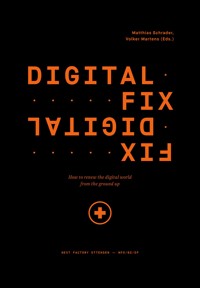
Are the promises of salvation made by digital technologies threatening to turn into the opposite? How can the various issues our societies face these days as a result of the negative effects of the digital revolution be resolved? Strategists, designers, engineers, researchers, journalists, philosophers, practitioners, entrepreneurs and artists present various solutions in this book. They all share a constructive view of the digital world in which we live today. Edited by Matthias Schrader and Volker Martens, the organizers of the NEXT Conference in Hamburg. With contributions by Virginia Dignum, Pamela Pavliscak, François Chollet, Stephan Dörner, Martin Recke, Adam Tinworth, Nika Wiedinger, Fifer Garbesi, Tobias Revell, and David Mattin.
Sie lesen das E-Book in den Legimi-Apps auf:
Seitenzahl: 186
Veröffentlichungsjahr: 2021
Das E-Book (TTS) können Sie hören im Abo „Legimi Premium” in Legimi-Apps auf:
Ähnliche



















Table of Contents
ADAM TINWORTH
From innocent idealism to pragmatic fixes
Two decades of internet culture
PAMELA PAVLISCAK
Can we design technology for well-being?
DAVID MATTIN
Welcome to augmented modernity
FIFER GARBESI
Five pillars of ethical immersion
Framework for a societally beneficial metaverse
FRANÇOIS CHOLLET
What worries me about AI
VIRGINIA DIGNUM
With great power comes great responsibility
Responsible artificial intelligence is needed to fix the digital world
STEPHAN DÖRNER
Luxury problems
How to overcome the paradox of the digital economy
NIKA WIEDINGER
No way back?
MARTIN RECKE
Digital Fix – Fix Digital
TOBIAS REVELL
The imagination trap
MATTHIAS SCHRADER
Preface
In its first decades, the digital economy was inspired by a belief in progress that seems naive to us today. Digitalisation was already considered good in itself and was therefore synonymous with progress. It took groundbreaking events such as the Brexit referendum and the election of Donald Trump as President of the United States to shake this belief. Now the promises of salvation through digitalisation are suddenly threatening to turn into the opposite.
We see digital products that do not improve life and have no real benefit, but isolate us in filter bubbles and divide society. We recognise the excessive dominance of the GAFA companies (Google, Apple, Facebook, Amazon), which are penetrating ever new areas of our lives. We are worried about digital technology that does not serve people but controls them: DIGITAL FIX.
With the NEXT Conference 2018 and this book, we want to contribute to a differentiated view of digitalisation. It’s about looking at opportunities and risks in a sober way and outlining ways in which we as digital pioneers can become better: FIX DIGITAL.
The indisputable added value created by digital technologies is initially offset by value destruction, which is often described as disruption. Initially, disruption was mainly about outdated business models and yesterday’s technologies, but it has since spread to areas such as politics, society and the physical world. From this point of view, the techlash we are currently experiencing is all too understandable. It is a systemic defence reaction against irritations that appear as an existential threat.
We cannot yet be sure of all the problems. Digitalisation deeply interferes with our self-image as human beings and our way of living and working. This brings with it numerous conflicts that must be resolved. But the fundamental promises of digitalisation remain intact: many things will become more convenient, annoying routine activities will disappear, personal reach will grow, the horizon will be expanded. There will be a digital world after the GAFAs and it will be better than today.
In this book we ask how we can renew the digital world from the ground up. So what’s the key? Our recommendation can be summed up with one keyword: digital humanism. The success of digitalisation is closely linked to terms such as user-centric, customer-centric or human-centric. The consistent focus on the user, the user experience and the user value made the digital triumphal march possible in the first place. Now is the time to make the well-being of human beings and all of humanity the benchmark.
Digital humanism puts people (the people who used to be known as users) first and restores technology to its true role as a means to an end. The authors of the various essays in this volume provide insights into what this means in detail and how it can be implemented. Strategists, designers, engineers, researchers, journalists, philosophers, practitioners, entrepreneurs and artists present approaches to various solutions.
They all share a constructive view of the digital world in which we live today. We are convinced that, in the end, the digital economy will be successful with a consistent focus on people and their well-being. We can let ourselves be overwhelmed by the dynamics of digitalisation or we can control them. It’s in our hands. We remain optimistic.
Matthias Schrader is founder and CEO of SinnerSchrader and the NEXT Conference as well as managing director of Accenture Interactive.
Volker Martens
Preface
A country full of worries was the title of an article on the state of the republic in the summer of 2018. [1] The text quotes a survey of high school students in Baden-Württemberg, Germany. According to this survey, the students considered artificial intelligence to be potentially more dangerous than the atomic bomb. “Most of us react to technological shifts with unease at best, panic at worst,” writes AI expert François Chollet in his contribution to this book. He notes that “most of what we worry about ends up never happening.” Chollet in no way denies that technological change can also have a terrible effect, including world wars and nuclear armament. But he warns that we are once again worried about the wrong thing and overlook the real dangers. Thus, students of today are not only afraid of a nebulous superintelligence, they also let their opinions and behaviour be manipulated by social media and the algorithms behind them.
The authors of this book are also concerned, but they do not panic. Strategists, designers, engineers, researchers, journalists, philosophers, practitioners, entrepreneurs and artists look at technological development from very different perspectives. Their criticism of the current state of the digital world is correspondingly diverse. But they all share the desire to fix what goes wrong – and the hope that this can succeed.
In fact, we seem to be at a turning point. Perhaps trend researcher David Mattin is right when he says that modernity as we know it ends here and now. Perhaps we now need to break away from the central belief of bourgeois morality that the performance of the individual should determine his or her place in society, as tech journalist Stephan Dörner demands. The philosopher Nika Wiedinger warns that there may even be a fin de siècle in which “technological development finally defines and prescribes our wishes” and thus deprives democracy of its foundation.
And yet this book is by no means characterised by an end-time mood, but rather by an irrepressible creative drive. The authors propose concrete solutions to how people can regain control of the digital toolbox (François Chollet), define ethical principles for the development of virtual reality (Fifer Garbesi) and artificial intelligence (Virginia Dignum), and call for a radically new approach to technology design based solely on human well-being (Pamela Pavliscak). They do not shy away from great visions and instead allow themselves the dream of a world full of possibilities for new ways of being, where the previously impossible can be explored and realised (Tobias Revell).
Reading this book, it becomes clear that digitalisation is least of all a technological question, it affects all areas of life and fundamentally changes the way we live, work, communicate and perceive the world. That is why the artist Tobias Revell is quite right to emphasise the political dimension of digitalisation. And that’s why it’s also right for many authors to take a closer look at the concept of responsibility. Today, every digital decision-maker must ask themself where exactly the line between what is technically feasible and what is socially desirable should be drawn. Every communicator must face a dual responsibility: for the content he or she disseminates and for the possible mechanisms of manipulation. Especially in the digital age, responsibility always means resisting temptations.
The Swedish physician and scientist Hans Rosling has impressively proven time and again throughout his life that people basically see the world in a darker light than it actually is. Rosling opposed pessimism and defeatism with his concept of factfulness, an open, curious and relaxed attitude in which we only make judgments based on solid facts. For me, factfulness is the prerequisite for defining one’s own attitude in the digital world. Reflected communication, the will to establish connections and the attempt to assess consequences are also the goal and purpose of the NEXT Conference – and of this book. The definition of a humane, superordinate canon of values and the derivation of individual frameworks for action would be possible avenues to explore.
But who takes up these proposals? Where can good ideas mature into concrete proposals and initiatives? Where will initiatives become a set of rules and who could possibly still be the addressee of global approaches in a world that is currently localising itself? If institutions are lacking, the creative power of the individual and of groups of like-minded individuals as well as their ability to network in a global community remain. As initiators of the NEXT Conference, we want to make a contribution to this.
At this stage of development, it is imperative that we find new answers to pressing questions: What is the human being? What is the purpose of our existence? How do we want to live? This book also makes this clear. And while reading, there is the quiet hope that this enormous technological revolution can lead to a new reflection on the true value of the human being. Digitalisation would thus become an opportunity to fill meaningless modernity (David Mattin) with new meaning, and the future would not be a country full of worries, but a place of confidence.
Volker Martens is one of the founders and board members of the Hamburg-based communications agency FAKTOR 3. Together with his partners Sabine Richter and Stefan Schraps, he has been following the central communication aspects and trends of a digitalised world for years. Alongside SinnerSchrader, FAKTOR 3 is the organiser of the NEXT Conference (www.nextconf.eu).
Source
Knop, Carsten (2018). Zu viele alte Strukturen und zu wenig Mut. Frankfurter Allgemeine Zeitung, 28.07.2018.
ADAM TINWORTH
From innocent idealism to pragmatic fixes
Two decades of internet culture
Like many people of the Internet Generation – those of us who became seriously involved online in the mid to late ’90s – I was caught up in the wave of idealistic euphoria that surrounded the first communities to come together on the web. It’s easy to see why we saw the cyber world through rose-tinted mirror shades. We were a self-selecting group of tech-savvy nerds who were able to enjoy connecting with people just like us, sometimes for the very first time.
We were able to build communities around the things we cared about and make discussion of them part of our daily routine for the very first time.
The internet was clearly making our lives better. Connections and relationships were bringing us together in a way that made geography irrelevant. If we brought this to the whole world, surely everything would get better.
Oh, dear.
We were, perhaps, the first victims of digital bubbles. We were trapped in our own little sphere of self-selecting early adopters. We hadn’t yet realised how homogenous that group was, or how different things would become when all the rest of humanity followed us into cyberspace.
To be young and a part of a passionate, idealistic crowd is a great feeling. Everyone should experience it – for a while at least. But we also need to grow up at some point and realise that the world might be more complicated than our evangelism allowed. We’re far from the first generation to be disillusioned, either; two decades before the internet, people dreamed that music would bring the world together.
Mark Hamill, the actor who played Luke Skywalker in the Star Wars movies, has given us another taste of that. He recently described how he realised that Luke’s journey in the most recent movie, The Last Jedi, reflects his own journey from idealism to disillusionment:
“It is tragic. I’m not a method actor, but one of the techniques a method actor will use is to try and use real-life experiences to relate to whatever fictional scenario he’s involved in. The only thing I could think of, given the screenplay that I read, was that I was of the Beatles generation – ‘All You Need Is Love’, ‘peace and love’.
I thought at that time, when I was a teenager: ‘By the time we get in power, there will be no more war, there will be no racial discrimination, and pot will be legal.’ So I’m one for three. When you think about it, [my generation is] a failure. The world is unquestionably worse now than it was then.” [1]
Those of us who followed a couple of decades later found their idealism not in protest songs and hippie idealism, but in the utopian worlds we were creating for ourselves in the nascent internet. And there is a link between the two sets of dreamers. Many of those who built the early internet were products of the hippie generation.
Idealism is a wonderful thing. But it needs to be tinged with caution. Throughout our exploration of the dichotomy of DIGITAL SUCKS and DIGITAL FIX over the last couple of years, the phrase I keep coming back to is “hope for the best, plan for the worst”. My generation of internet folks were so busy doing the first that we forgot about the latter. And so a new generation of internet people moved in, more driven by money and cynicism, but dreadful to ape the language of the early dreamers. They’re “connecting the world” and “making the world’s information accessible”, but they fail to mention the whole “building data profiles on you so you can be manipulated for political and commercial gain” part of the equation.
It’s worth remembering that not all of the songs The Beatles wrote were idealistic. As Martin Recke, the editor of this volume, is fond of pointing out, Happiness is a Warm Gun is a Beatles song. And for all its apparent drugs allusions, it’s actually about the horror of gun advertising. That’s according to John Lennon, whose enthusiasm for drugs was well-known and not something he tried to hide, so we can probably believe him.
The ability to see the worst in everything
The rather homogenous nature of many digital entrepreneurs – wealthy, white, male and straight – may well have contributed to the problems we now face. As Mike Monteiro’s scathing piece on the structural problems with Twitter put it:
“Their goal was giving everyone a voice. They were so obsessed with giving everyone a voice that they never stopped to wonder what would happen when everyone got one. And they never asked themselves what everyone meant. That’s Twitter’s original sin. Like Oppenheimer, Twitter was so obsessed with splitting the atom they never stopped to think what we’d do with it.” [2]
Giving people a voice is a noble aim, but you need to account for people who would use that to make other people’s life worse. The fact that so many founders had never been on the receiving end of abuse – be it racial, sexual or otherwise – meant that they were ill-equipped to think through the problems:
”Twitter, which was conceived and built by a room of privileged white boys (some of them my friends!), never considered the possibility that they were building a bomb.”
Well, those bombs have gone off in a series of explosions around the world. We’ve seen greater polarisation in our politics and the rise of self-righteous lynch mobs on social media, so caught up in their conviction they’re doing good that they can’t see the harm they’re doing. We’ve seen our lives reduced to data, used to target our psychological weaknesses.
It all seems a very far cry from the days when we could pop online and discuss Doctor Who or role-playing games without some moron popping up to call us a “SJW” or “libtard cuck”, being deliberately demeaning to engage us in conversation. Back then, if we were in chat rooms, we used the phrase “AFK” to indicate when we were away from the keyboard. That’s become an anachronism already, because the idea that we can be away from a keyboard – we carry a digital one on our phones at all times – is unimaginable. That’s only added to the pressure.
We’re trying to keep up with technology, but we can’t. The internet can effectively transfer information instantly, but human beings can’t process it with that same speed. Keeping up with the machines is a mug’s game, yet it’s one we’ve been playing for over a decade now. Just as the fast food revolution eventually birthed a slow food movement, the real-time internet is begging for a slow web movement, and, indeed, there already is one. And fixing the mistakes of the past requires longer, slower, more deliberate choices and thoughts.
On a more pragmatic note, the consolidation of power on the internet into a handful of platforms isn’t the situation most businesses would enjoy. There’s what the journalism world calls the “duopoly” – Google and Facebook – who maintain a stranglehold on the vast majority of advertising revenue between them. Amazon has become most of the world’s de facto shopfront. It’s the first place, and often the only place, we shop. We’ve been trained not to comparison-shop and are now unknowingly paying higher prices for goods.
But hang on, you say, this is DIGITAL SUCKS, Adam, not DIGITAL FIX. And you’d be quite right. But here’s the thing: DIGITAL SUCKS was a prerequisite for the DIGITAL FIX. To deal with this problem, you have to do what so much of the digital industry has been denying: acknowledge that there are problems. Moving fast and breaking things sometimes just leads to broken things. Not all disruption is good, and for every winner there is often a loser.
Things need fixing and new directions need to be found because technology cannot be uninvented. We have to move forwards with what we’ve got. Digital detoxes or withdrawal are no solution. To return to Star Wars and The Last Jedi, Luke Skywalker’s withdrawal from the galaxy into exile manifestly made the galaxy worse, and while we should be grateful for that, as it was the plot trigger for the conflict in the new wave of films, I’d rather not see the gains of the last few years overturned in the real world.
Regulation
Many of the idealists of the early internet saw the internet itself as almost a supranational community – and us as citizens of the internet.
As the late John Perry Barlow wrote in the Declaration of Independence of Cyberspace:
“We have no elected government, nor are we likely to have one, so I address you with no greater authority than that with which liberty itself always speaks. I declare the global social space we are building to be naturally independent of the tyrannies you seek to impose on us. You have no moral right to rule us nor do you possess any methods of enforcement we have true reason to fear.” [3]
Oh, for the halcyon days when it was government interference we feared most, rather than corporate irresponsibility.
And to be fair, some of the blame for this fall is ours. We failed to live up to our civic duty by failing to police ourselves and the companies who would “serve” us. We’ve let these abusive, monopolistic companies arise, and we’ve failed to be appropriately sceptical in what we read online.
But any such regulation needs to be careful, realistic and light-touch. For all the complaints about GDPR, I actually think the EU has done a pretty good job with it; it has protected the consumer and moved the onus on to businesses to behave better and more honestly. I’ve had more than one conversation in recent weeks with people who are suddenly enjoying their email again, simply because there’s so much less junky marketing material in there. The GDPR-driven winnowing process has improved their information landscape.
On the other hand, amongst the many ridiculous projects that the current UK government is engaged in (and you know what I’m talking about here), the move to build software backdoors into end-to-end encrypted messaging services shows a profound misunderstanding of encryption, mathematics, computing and security. That won’t make life better for anyone but government and criminals, which is a really uneasy combination, whatever your position of the political spectrum.
There’s lots to be said for the power of constraints to induce creativity. A more user-centric set of sensible, practical legislative constraints might actually trigger greater innovation, as some of the easier paths close down to new tech businesses, forcing them to think harder about their new products.
Business innovation
So-called business innovation has pretty much descended into “build an app, find users, sell to a bigger company or make money through advertising”. For a business that claims to be all about innovation, well, this isn’t really innovation, is it? It’s repeating the same basic process again and again in different flavours.
Sometimes the fact that you keep claiming something means that you are not actually that thing. It’s true of innovation, just as it’s true of airports (Nobody talks about Heathrow International Airport, do they? It’s just Heathrow. Hamburg doesn’t feel the need to append “international”, because it’s self-evident …)
If you’re building a digital business, or even a digital product, you’re going to have to accept that it will be much harder than it was even five years ago. You have greater government oversight and regulation to contend with, alongside significant bottlenecks in terms of the internet giants who act as gatekeepers on how people access your product: the Google, Amazon and Facebook monoliths.
Believe it or not, that’s actually a good thing. The increased difficulty will winnow out more weaker players in a burst of digital Darwinism, leaving more territory for those who survive. And those constraints will force you to be more creative in your thinking, and to build something new. We’ve already seen this at work in both marketing and journalism, as Facebook turning the screws on organic reach has led to greater efforts to reach consumers or readers directly (something the internet does facilitate, however hard some sites have worked to help us forget that). And the rewards in terms of customer loyalty and engagement have been remarkable.
Better media
Let’s be honest, the reporting around technology has been absolutely awful until recently. It was either entirely gadget-obsessed to the point of pandering to the big manufacturers, or completely sold out to the start-up and venture capital ecosystem.
A decade ago, NEXT18 speaker Andrew Keen, author of such books as The Cult of the Amateur, was one of a very few voices sounding the alarm about the direction we were heading in. [4




