


16,31 €
Mehr erfahren.
- Herausgeber: Fernhurst Books Limited
- Kategorie: Lebensstil
- Sprache: Englisch
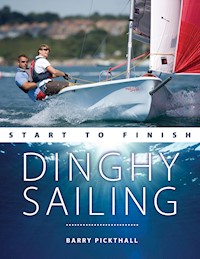
Dinghy Sailing Start to Finish is the perfect book for you if you are new to sailing, or if you are an experienced dinghy sailor wanting to broaden your skills and develop your techniques. You will enjoy your dinghy sailing more with greater knowledge. This easy-to-follow, step-by-step guide takes you through the basic principles, preparing to sail, your first sail, advanced sailing and the basics of racing. It includes advice on choosing a dinghy, essential gear, sailing manoeuvres, tides, wind and weather, all taken from the courses delivered by the UK's biggest sailing school, the UKSA. This book is accessible to all levels, giving those new to sailing straightforward advice, and showing experienced sailors how to take their sailing to the next level with tips on how to sail faster and safer. It covers single-handed and double-handed dinghies and catamarans. This book is packed with hundreds of illustrations and photographs, and is a great way to learn, develop and refresh your sailing skills.
Das E-Book können Sie in Legimi-Apps oder einer beliebigen App lesen, die das folgende Format unterstützen:
Veröffentlichungsjahr: 2021
Ähnliche

















Contents
Getting started
1 Basic principles
Parts of the boat
The rig
The science of sailing
Points of sail
Choosing a dinghy
Transporting dinghies
Knots & ropes
Essential gear
2 Preparing to sail
What to wear
Rigging the boat
Launching
Rules of the road
Wind and tides
Telltale signs of the weather
3 First sail
Balance, sail, trim
Tacking
Trim
Sailing downwind
Gybing
Capsize and recovery
Returning to shore
4 Advanced sailing
Trapezing
Tacking
Symmetric spinnakers
Asymmetric spinnakers
Catamarans
Tuning
Heavy weather sailing
5 Basics of racing
The start
Around the course
6 Glossary of terms
Acknowledgements
Getting started
I remember my introduction to sailing. My three young brothers and I and were on a family day out at Windsor, with a picnic by the river, watching people messing about in boats. Driving back home, we stopped at a garage to fill up and my Dad, who was not normally prone to whims, spied this small sailing dinghy for sale on the forecourt – and bought it!
What we knew collectively about sailing could have been written on a postage stamp. The nearest Dad had come to getting afloat before had been when he had got his feet wet during the D-Day landings. None of us had even been on a car ferry, let alone a boat. Yet this insignificant little dinghy was to have a life-defining effect on us all. I went on to spend my whole career reporting on watersports; Russell, my youngest brother, went on to become a sailmaker and winning crewmember of a Whitbread Round-the-World Race yacht; another became a professional boatbuilder, and the fourth joined the Royal Navy.
Sailing is like that. You either love it or loathe it. There are no half measures, and once bitten, you will never want to be far from the water’s edge again.
Buying a boat on a whim is not the best start. What little knowledge we culled from buying a magazine soon told us that we had bought a dud, but we had great fun with her that first season exploring rivers and creeks. We also learned from experience what effect the pull of a weir can have on a boat, and the need to keep wine corks ready for when the boat’s bungs got left at home!
There are far better and more rational ways to start sailing. Enrol on an introductory dinghy course at the UKSA or similar sailing school.
If you are a junior, many sailing schools and clubs run fun introductory sailing courses during school holidays.
Visit local sailing clubs in your area, look at the various types of boat they sail and ask if anyone needs a crew – invariably, someone will be short-handed. Then make a judgement on which club best meets your needs, join and learn the ropes there. Then, you can get experience and buy a class of boat that is sailed at the club at a later stage.
Sailing is a sport that is accessible to everyone from 5 to 95 and older. Disability is no handicap either. With audible compasses to guide the blind, sliding seats for paraplegics and wheelchair access or hoists now available on some yachts, everyone has the opportunity to get afloat. Go on, get your feet wet and give it a try.
Barry Pickthall
Parts of the boat
No need to get too bogged down with nautical terms at this stage, but it helps to know the various parts of a dinghy and what they do.
The rig
Modern dinghies are equipped either with a Bermuda rig, with jib and mainsail designed to interact like the slats of an aeroplane wing, or una rigged like the Laser single-hander.
The science of sailing
The sight of a jumbo jet coming slowly into land with wings and wheels extended always leaves me in awe. How can something weighing as much as 380 tonnes fly so slowly without falling out of the sky? The answer is the same as that to the common question about sailing: How can a sailboat sail as close as 40° to the wind?
It is all about aerodynamics and the pressure differentials on one side of a wing, compared to the other. An aeroplane wing has more curvature on its upper surface. As it moves forward, the airflow streaming across has to travel faster over a longer distance to meet up with the air flowing along the flatter lower surface. This difference in speed leads to a drop in pressure on the upper surface, which results in lift. The faster the plane’s speed the greater this becomes, to the point where the differential in pressure between the upper and lower sections of the wing is sufficient to raise the weight of the plane off the ground.
The same happens over the surface of a sail. The airflow across the back or leeward side travels faster than the air flowing across the windward side. The resulting pressure differentials create the lift that drives the boat forward.
Aeroplane wing with adjustable slat used to increase lift at low speeds
This force within the sail would drive the boat sideways were it not for the lateral resistance of the boat’s daggerboard or centreboard. The best demonstration of this is to hold a knife blade in water and move it about, first up and down, and then sideways, when you will feel the lateral resistance. It is the balance in design between the sails and shape of the hull that determines the efficiency with which a boat sails to windward.
Load carrying sailing ships from the past were shaped like bricks and only gained a spring in their step when wind was abeam or behind. As a result, sailors would rest up and wait for a fair wind rather than waste time attempting to buck into it.
By contrast, a modern dinghy sails very efficiently to windward, providing the crew position their weight to balance out the heeling force of the wind. This efficiency is enhanced by the jib or forward sail, which induces a slot effect in the same way that extending slats on a plane wing improves lift coefficient at slow speeds when taking off and landing. Airflow narrows and accelerates through the ‘slot’ between jib and mainsail, improving the lift coefficient.
The jib channels the air through the slot between the fore and aft sails, speeding the flow around the back of the mainsail to further improve the pressure differential between the windward and leeward sides.
Forces on a sailing boat
Centre of effort
A sailing dinghy is so well balanced that it is quite possible to alter course by adjusting the sails alone. Indeed, given the right conditions, instructors at the UKSA will often take students out in a dinghy without a rudder, to show them how they can vary the centre of effort within the sail plan and the direct effect this has on the course that the boat sails. They learn that by letting the jib out (which has the effect of moving the centre of effort aft) the boat will point closer to the wind. Conversely, releasing the mainsail and sheeting in the jib moves the centre of effort forward and makes the boat bear away from the wind.
The centre of effort is a point within the sail plan where, if it was a card cut-out, it could be balanced on the tip of a pin. This centre point within the rig must be in balance with the centre of resistance of the hull, a point on the centreboard. The closer these two points are on a vertical plane the better the balance will be.
Apparent wind
Apparent wind is the actual flow of air acting on the sail as the boat moves forward, and differs in speed and direction from the true or prevailing wind experienced by a stationary observer.
The apparent wind is an important factor when determining the sheeting angle for the sails. The faster the boat travels, the further the apparent wind angle moves forward and the greater its velocity. Wind indicators on the boat measure apparent wind. Stationary indicators such as flags show the true wind.
Driving force of the wind
Close-hauled sailing to windward
The strong lateral force of the wind on the sails is countered by the lateral resistance of the centreboard, which leads to forward drive up to 40° off the wind.
Reaching beam on to the wind
The most efficient angle of sail. With the sails let out, or sheets eased, as sailors like to call it, the lateral force of the wind is reduced and the energy produced by the sails provides additional driving force.
Running before the wind
With no airflow across the sails and no apparent wind benefit, all the wind energy goes to pushing the boat forward. As a result, the boat will never sail faster than the speed of the wind.
Points of sail
When sailing, the strength and direction of the wind are all-important. Look around you and see which way flags are flying. You can also feel the wind and sense its direction by turning your face. Your ears are highly tuned to sensing wind, as well as sound. When you change from one point of sail to another, the sails, centreboard and crew positions must also be adjusted to match the dinghy’s balance and heading towards or away from the wind.
Choosing a dinghy
Resist the impulse to buy the first dinghy that takes your fancy, and get some experience at either a sailing school or club before jumping in with both feet.
Our first family dinghy, bought on impulse from a garage forecourt, was our pride and joy for the first month. We soon learned how unsuitable it was!
Once you know the basics, you will have so much more idea of the type of boat best suited to your skill level and the area you want to sail. If you are joining a club, then selecting one of their classes will introduce you to a group of like-minded enthusiasts who will be only too pleased to offer help and advice – until you start beating them around the race course! If you prefer a boat to mess about in and tow to various venues behind the car, then you need one that is lighter than the towing vehicle, easy to launch and recover, and simple to rig.
Trapeze-rigged dinghies offer high performance, but only for those with the experience and agility to manage them.
Sailing a single-hander is the fastest way to learn, giving the steepest learning curve.
We show here just a selection of dinghies that you could learn in and move on to.
Laser Bahia
General purpose family dinghy: The Laser Bahia is a modern, stable dinghy that can be sailed, rowed or motored. This low-maintenance design even has a removable cool box for family outings. It is an ideal first boat to learn to sail in, having plenty of room for two crew and an instructor. You can add a gennaker and trapeze to upgrade the performance for racing.
Length:
15ft 3in
4.6m
Beam:
5ft 11in
1.8m
Mainsail:
102sq.ft
9.5sq.m
Jib:
40sq.ft
3.7sq.m
Gennaker:
118sq.ft
11sq.m
Hull weight:
342lb
155kg
Crew:
2-5 people
Other similar dinghies to consider are the RS Vision, Topper Argo, Hartley 15 and the more traditional Wayfarer.
Hartley 12
General purpose single-handed dinghy: The Hartley 12 is another modern dinghy which is ideal to learn to sail in for both adults and youth. It is low-maintenance and has a centreboard (most comparable boats have a daggerboard) making it easier to launch and recover safely. It can be upgraded with shrouds, a jib and an asymmetric spinnaker for more performance.
Length:
12ft 2in
3.7m
Beam:
5ft 3in
1.6m
Mainsail:
76sq.ft
7.1sq.m
Jib:
22sq.ft
2.0sq.m
Gennaker:
75sq.ft
7.0sq.m
Hull weight:
137lb
62kg
Crew:
1-3 people
Other similar dinghies to consider are the Laser Pico, RS Zest & Fusion.
Topper
Junior single-handed trainer / racer:
The Topper is a long-established boat for children to learn to sail in as well as providing competitive racing for those who aspire to that. It was designed in 1977 but has stood the test of time and remains popular today. The standard sail is 5.3sq.m, but there is a smaller 4.2sq.m option also available for younger / smaller children.
Length:
11ft 1in
3.4m
Beam:
3ft 11in
1.2m
Mainsail:
45 / 57sq.ft
4.2 / 5.3sq.m
Hull weight:
94lb
43kg
Crew:
1 child
Other similar dinghies to consider are the RS Tera & Optimist.
RS Feva
Junior double-handed trainer / racer: The RS Feva is a double-handed dinghy for youngsters. With an asymmetric spinnaker, it has an exciting performance. Available in the basic S specification with a smaller dacron mainsail or XL with a larger mylar mainsail. An ideal introduction to the asymmetric spinnaker.
Length:
11ft 6in
3.6m
Beam:
4ft 8in
1.4m
Mainsail:
59 / 70sq.ft
5.5 / 6.5sq.m
Jib:
23sq.ft
2.1sq.m
Gennaker:
75sq.ft
7.0sq.m
Hull weight:
161lb
73kg
Crew:
2 children (occasionally 1 child & 1 adult)
Other similar dinghies to consider are the Cadet & Mirror.
Laser
Single-handed racing dinghy: The Laser is a strict one-design single-hander that was designed in 1969 but is still the most popular adult sailboat worldwide with three rig sizes that cater for juniors up to adult Olympic competitors. It provides close competitive racing with success determined by individual skills and fitness.
Length:
13ft 9in
4.2m
Beam:
4ft 7in
1.4m
Mainsail:
51sq.ft
62sq.ft
76sq.ft
4.7sq.m
5.8sq.m
7.1sq.m
Hull weight:
130lb
59kg
Crew:
1 person
Other similar dinghies to consider are the RS Aero, Byte, Europe and the traditional Solo or Sunfish.




