


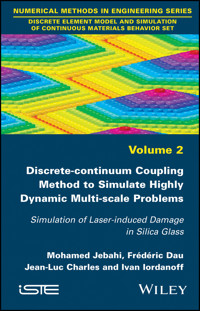
Discrete-continuum Coupling Method to Simulate Highly Dynamic Multi-scale Problems E-Book
Mohamed Jebahi
139,99 €
Mehr erfahren.
- Herausgeber: John Wiley & Sons
- Kategorie: Fachliteratur
- Sprache: Englisch
Complex behavior models (plasticity, crack, visco-elascticity) are facing several theoretical difficulties in determining the behavior law at the continuous (macroscopic) scale. When homogenization fails to give the right behavior law, a solution is to simulate the material at a mesoscale using the discrete element model (DEM) in order to directly simulate a set of discrete properties that are responsible for the macroscopic behavior. Originally, the discrete element model was developed for granular material.
This book, the second in the Discrete Element Model and Simulation of Continuous Materials Behavior set of books, shows how to choose the adequate coupling parameters to avoid spurious wave reflection and to allow the passage of all the dynamic information both from the fine to the coarse model and vice versa. The authors demonstrate the coupling method to simulate a highly nonlinear dynamical problem: the laser shock processing of silica glass.
Sie lesen das E-Book in den Legimi-Apps auf:
Seitenzahl: 293
Veröffentlichungsjahr: 2015
Ähnliche

















Table of Contents
Cover
Title
Copyright
List of Figures
List of Tables
Preface
Introduction
I.1. Bridging the scales in science and engineering
I.2. Scope and objective
I.3. Organization
PART 1: Discrete-Continuum Coupling Method to Model Highly Dynamic Multi-Scale Problems
1: State of the Art: Concurrent Discrete-continuum Coupling
1.1. Introduction
1.2. Coupling challenges
1.3. Coupling techniques
1.4. Conclusion
2: Choice of the Continuum Method to be Coupled with the Discrete Element Method
2.1. Introduction
2.2. Classification of the continuum methods
2.3. Choice of continuum method
2.4. The constrained natural element method
2.5. Conclusion
3: Development of Discrete-Continuum Coupling Method Between DEM and CNEM
3.1. Introduction
3.2. Discrete-continuum coupling method: DEM-CNEM
3.3. Parametric study of the coupling parameters
3.4. Choice of the coupling parameters in practice
3.5. Validation
3.6. Conclusion
PART 2: Application: Simulation of Laser Shock Processing of Silica Glass
4: Some Fundamental Concepts in Laser Shock Processing
4.1. Introduction
4.2. Theory of laser–matter interaction: high pressure generation
4.3. Mechanical response of silica glass under high pressure
4.4. Conclusion
5: Modeling of the Silica Glass Mechanical Behavior
5.1. Introduction
5.2. Mechanical behavior modeling
5.3. Brittle fracture modeling
5.4. Conclusion
6: Simulation of Laser Shock Processing of Silica Glass
6.1. Introduction
6.2. LSP test
6.3. LSP model
6.4. Results
6.5. Conclusion
Conclusion
Bibliography
Index
End User License Agreement
Lesen Sie weiter in der vollständigen Ausgabe!
Lesen Sie weiter in der vollständigen Ausgabe!
Lesen Sie weiter in der vollständigen Ausgabe!
Lesen Sie weiter in der vollständigen Ausgabe!
Lesen Sie weiter in der vollständigen Ausgabe!
Lesen Sie weiter in der vollständigen Ausgabe!
Lesen Sie weiter in der vollständigen Ausgabe!
Lesen Sie weiter in der vollständigen Ausgabe!
Lesen Sie weiter in der vollständigen Ausgabe!
Lesen Sie weiter in der vollständigen Ausgabe!
Lesen Sie weiter in der vollständigen Ausgabe!
Lesen Sie weiter in der vollständigen Ausgabe!
Lesen Sie weiter in der vollständigen Ausgabe!
Lesen Sie weiter in der vollständigen Ausgabe!
Lesen Sie weiter in der vollständigen Ausgabe!
Lesen Sie weiter in der vollständigen Ausgabe!
Lesen Sie weiter in der vollständigen Ausgabe!
Lesen Sie weiter in der vollständigen Ausgabe!
Lesen Sie weiter in der vollständigen Ausgabe!




