


11,99 €
Mehr erfahren.
- Herausgeber: Westend Verlag
- Kategorie: Geisteswissenschaft
- Sprache: Englisch
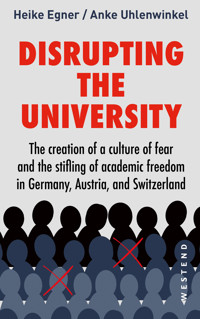
At universities, professors are increasingly being dismissed or demoted from high positions for allegedly disruptive behaviors. But when is a professor disruptive? In the media, you read about unpopular statements, false attitudes, bullying or abuse of power. But that is only part of the story. This book looks at the structures behind the cases and shows that the dismissals repeatedly affect certain groups of people. Instead of performance orientation, a 'right to certification' is gaining ground. Instead of academic freedom, there is increasing pressure to conduct research only in line with certain political ideologies. Based on their empirical surveys, Heike Egner and Anke Uhlenwinkel present worrying findings and remind us of the once seemingly unshakeable principles of free research and free teaching at our universities. Among other things, the authors have examined the questions of which groups of people were primarily affected by the dismissals, what accusations were made against them, what the respective course of proceedings was, and what role the media played. The findings unearthed in the process are disturbing, for the facts suggest that not only has there been a sharp increase in the number of professors who have been prematurely removed from university service against their will, but that qualitatively questionable developments have also been observed. Those affected seem to belong particularly often to certain sociological groups whose members are presumed to have been able to pursue a career in academia only through extraordinary personal effort and talent, to feel committed to the ethos of achievement, and to be particularly attached to the traditional, Humboldtian understanding of academia.
Das E-Book können Sie in Legimi-Apps oder einer beliebigen App lesen, die das folgende Format unterstützen:
Seitenzahl: 123
Veröffentlichungsjahr: 2025
Ähnliche



















Ebook Edition
Disrupting the University
The stifling of academic freedom in Germany, Austria and Switzerland
Heike Egner Anke Uhlenwinkel
Impressum
Mehr über unsere Autoren und Bücher:
www.westendverlag.de
Die Deutsche Nationalbibliothek verzeichnet diese Publikation in der Deutschen Nationalbibliografie; detaillierte bibliografische Daten sind im Internet über http://dnb.d-nb.de abrufbar.
Das Werk einschließlich aller seiner Teile ist urheberrechtlich geschützt. Jede Verwertung ist ohne Zustimmung des Verlags unzulässig. Das gilt insbesondere für Vervielfältigungen, Übersetzungen, Mikroverfilmungen und die Einspeicherung und Verarbeitung in elektronischen Systemen.
ISBN: 978-3-98791-097-5
1. Auflage 2025
© Westend Verlag GmbH, Waldstr. 12 a, 63263 Neu-Isenburg
Umschlaggestaltung: Buchgut, Berlin
Satz: Publikations Atelier, Weiterstadt
Inhalt
Cover
Foreword
1 The Dismissal of Professors: A new Phenomenon?
»The Professor«
Scientific Principles: Max Weber versus „Science Managers”
Impact on Academic Life …
Dismissals – Isolated Cases or a New Phenomenon?
Background and Objectives of the Study
2 Special Protection for Science
3 Who Is Being Fired?
The Long-term Effects of Old Stereotypes
Class Differences More Decisive Than Identity Politics
Risk Factor: First-generation Academic
Risk Factor: Old White Mann | Old White Woman
4 Phase I: Accusation – Misconduct in Leadership
Achievement Expectations as a Disruptive Factor at Universities
A Generational Question?
Abusing the Accusation of Abuse of Power
5 Phase II: Accusation – Ideological Insubordination
Blatant Interference with Academic Freedom
Betrayed Certainties
The Role of the Media
Feelings instead of Arguments
An Attempt at Systematization: Educational Guidelines in Earlier Times
Educational Guidelines Today
Competencies Replace Factual Subjects
Again: A Question of Generations?
6 On the Rule of Law in Proceedings
When is a Trial Constitutionally Correct?
The More Objective Principles of the Rule of Law
Returning to the Double Standards: Differences between Men and Women
More Subjectively Perceived Principles of the Rule of Law
Legitimation through Proceedings?
7 Media Framing: From Josef K. to Professor Nonsense
The Josef-K. Narrative
The Robin Hood Narrative
The Josepha-K. Narrative
The Professor Nonsense Narrative
Narratives as a Mirror of Social Development
8 Now What?
References
Annotations
1 The Dismissal of Professors: A new Phenomenon?
2 Special Protection for Science
3 Who is being fired?
4 Phase I: Accusation – Misconduct in Leadership
5 Phase II: Accusation – Ideological Insubordination
6 On the rule of law in proceedings
7 Media Framing: From Josef K. to Professor Nonsense
8 Now What?
Orientierungspunkte
Cover
Table of Contents
Foreword
Since the Middle Ages, the university has been one of the most important institutions shaping culture in the Western world. It also played a central role in the transition to modern times. With his call “Sapere audete—have the courage to know!”, Philipp Melanchthon demanded a reform of the university by reducing the influence of the guilds and the Catholic Church. The institution reached the zenith of its achievements and influence during the Enlightenment in the model of a state-organized body based on the autonomous self-government of scholars, which was developed in Prussia but had an impact far beyond Germany and even Europe. According to the idea developed by Wilhelm von Humboldt and first implemented in Berlin, the university should enable its members to engage in “research in solitude and freedom” that is inseparably linked to teaching. This was not meant to imply that scholars should turn their backs on the practical issues of life and retreat to the infamous ivory tower. Rather, the idea was to provide them with the opportunity, within the framework of certain organizational safeguards and with sufficient financial resources, to tackle the scientific questions they wanted to deal with in their own time and at a distance from social demands. The instrumentalization of their research activities for superficial purposes or for certain belief systems—in Prussia at that time mainly due to utilitarian, flattened educational concepts of the Enlightenment and the emerging Pietism—should thus be permanently excluded. In fact, Humboldt’s reform led German universities and the research and teaching conducted there to flourish as never before.
Today, however, we are apparently facing the same challenges as Melanchthon and Humboldt once did. The buzzwords may sound different, but essentially the same thing is meant: academic freedom is currently threatened, on the one hand, by a tendency known as managerialism, which increasingly places universities at the service of industry, organizes them like companies and relies more and more on the acquisition of so-called third-party funding to finance their research. On the other hand, scientists are increasingly coming under pressure from an ideologization that is taking hold of all areas, seeking to restrict the conceivable research topics, methods, and results in the name of “political correctness” and now culminating in a veritable cancel culture, a “culture” of censorship and erasure. The lively spirit of science is being stifled by these developments.
Among the organizational safeguards for the defense of genuine academic freedom, the tenure of university teachers at German universities could perhaps be considered the last bastion. This provision is not intended to make scientists part of the sovereign state administration. Rather, the purpose is to give the individual researcher the inner freedom that is indispensable for the university as an institution that is solely committed to science in the Humboldtian sense, by guaranteeing lifelong employment and a fixed salary. However, prompted by their own experiences, the authors Heike Egner and Anke Uhlenwinkel had to conclude, based on an empirical survey, that in Germany, Austria and Switzerland, the number of professors who have been prematurely removed from university service has increased significantly in recent years. This development has certainly been facilitated by the fact that, in the spirit of managerialism, university teaching positions are increasingly only being offered as temporary or at least terminable positions in an employment relationship, while the actual increase in the number of dismissals observed in many cases is likely to have ideological reasons.
The authors of the present study have set themselves the task of shedding light on this area, hitherto largely ignored by scholars, by means of empirical research. Among other things, they have examined the questions of which groups of people were primarily affected by the dismissals, what accusations were made against them, what the respective course of proceedings was, and what role the media played. The findings unearthed in the process are disturbing, for the facts suggest that not only has there been a sharp increase in the number of professors who have been prematurely removed from university service against their will, but that qualitatively questionable developments have also been observed. Those affected frequently seem to belong to certain social groups whose members are presumed to have been able to pursue a career in academia only through extraordinary personal effort and talent, to feel committed to the ethos of achievement, and to be particularly attached to the traditional, Humboldtian understanding of academia. In the early stages of the observed development, “misconduct in leadership” often seemed to be used as a reason for dismissal, while nowadays the accusation of ideological insubordination is usually expressed more or less openly. Generally speaking, the universities do not appear to be particularly good at following due process when terminating professorships. It also does not appear to help matters, either in terms of fairness to the targeted professors or in terms of fostering collegiality, when the media take up the case.
In view of the facts they have established, the authors Egner and Uhlenwinkel are to be commended for reminding us of the standards that may continue to be applied to the university and to science. They contrast their findings with the constitutional requirements of academic freedom, with the ideal of the researcher as outlined by Max Weber, and with the didactic guidelines for proper teaching that were once summarized in the Beutelsbach Consensus. The catalog of criteria they have compiled for fair proceedings in the clarification of accusations in academia is of great practical value, being based on proven principles of the rule of law. It is to be hoped that the present study will be widely disseminated and contribute to the consistent combating of existing abuses.
Siegen, 26.09.2024
Professor Dr. jur. Gerd Morgenthaler
Jurist
1The Dismissal of Professors: A new Phenomenon?
“The chances of a professor being dismissed are virtually zero if they don’t commit a capital offense.”
(Portal Gute Frage1)
For a long time, we were not even aware that a professor could be dismissed. We only thought it conceivable under the circumstances mentioned in the above quote: if someone were to pinch the proverbial “silver spoons” – in other words, commit a crime – then dismissal could indeed occur in exceptional cases, as in other professions too. At no point in our careers, which began with a university degree, a dissertation, a post-doctoral qualification, teaching assignments, substitute and guest professorships, and ultimately led to a full professorship, had we heard of the dismissal of a professor. In 2002, for example, there was still a belief that it was impossible to successfully take action even against blatant neglect of official duties, particularly in teaching (in the German context, many had been referred to as “Professor Holiday” or “Professor On-the-road”2 and still held their positions until retirement). Nevertheless, there have been cases of dismissal here and there even in earlier years, as we now know from our empirical study.
This book reports on the surprising and significant increase in the dismissal of professors in German-speaking countries, i. e., Germany, Austria and Switzerland. It takes a look at an area of society that few people know from the inside, but about which most people have a clear opinion. On the one hand, because they have (more or less painfully) gone through a course of study and have had their own experiences with representatives of this species as students. On the other hand, because “the professor” (in former times “the scholar”) is a thoroughly popular figure in art and literature: “Faust” and “Galileo Galilei” are considered to be among the greatest works of world literature, and the “wise fool” is one of its most popular motifs.3 Presumably, almost everyone in the Western cultural sphere has spontaneous associations in their minds as soon as the word “professor” is mentioned.
»The Professor«
Starting in the 1960s, a whole generation of German-speaking youngsters got to know the nature researcher Habakuk Tibatong, who in the children’s book “Urmel from the Ice Age” (Urmel aus dem Eis) taught animals to talk and shared his life with them on a desert island. The German Film and Media Assessment Board recognizes a “perfectly embodied professor”4 in Sönke Wortmann’s film Contra (2021). In it, the initially reluctant student Naima Hamid describes her professor Richard Pohl in a final speech as a cynic, a troublemaker, a “confident pessimist” and a “creep with a heart”. The Münster Tatort (a longstanding German crime-scene television series) also features a professor with stereotypical attributes: Karl-Friedrich Boerne is clever and therefore flawless, arrogant, from a good family and culturally educated. These stereotypes fit perfectly into the literary sketches of the fearless, daring explorer of unknown worlds, and in particular the ingeniously spiritualized thinker, removed from the world, with eccentric habits. The core that connects these quite contrary images is independence. Autonomy in thought and action. A sharpness of argument with which he challenges anyone who engages in a discussion in order to become even more accurate. A rebelliousness against the impositions of everyday life and the world – which also includes colleagues, those in power and contemporary fashions. As is usually the case with stereotypes, is also valid here: at no time did it apply to all members of the professoriate. Nevertheless, until relatively recently, nonconformist thinking, the urge for the highest degree of accuracy, the inner independence of the professor, and even recalcitrance, often associated with a certain social inability, were considered the core of what also characterizes a “good professor.”
If you are now picturing a male professor, that is no coincidence. The female professor is a phenomenon that has emerged only recently, so no stereotype has been developed for her yet. It was only about a hundred years ago that women were first employed as professors at universities in German-speaking countries.5 Despite all the elaborate programs that have aimed at increasing the proportion of women in academia for about three decades, the proportion of female professors across all disciplines in Germany in 2022 was only about 28 percent6 (in Switzerland 24 percent (2019)7 and in Austria 26 percent (2020)8). This too-brief history, as well as the enduring status as a minority group in the university, has not led to the development of a distinct character of its own that would differ from that of the stereotypical male figure of “the professor”. But maybe, this is not even necessary or desirable. Nevertheless, the results of our study show striking differences between female and male professors (chapter 3), which suggest that significant double standards continue to affect the perception and evaluation of their work. The stereotype of “the professor” can be quite helpful in bringing these differences into focus.
Scientific Principles: Max Weber versus „Science Managers”
The principles of modern science fit seamlessly into this largely culturally mediated image. The first person to explicitly mention these principles was the German sociologist and economist Max Weber (1864–1920) in a lecture entitled “Science as a Vocation” 9. For about a century, the maxims he formulated shaped not only the self-image of science, but also the general knowledge about how scientists work, what mission they pursue and what they are not responsible for; in short: what they should do and what they should not do. Accordingly, it is the task of science to provide individuals and society with knowledge that would otherwise be unavailable10; non-scientific actors (politicians or even individual people) can then reflect on and justify their actions on the basis of this knowledge and against the background of their own moral justifications. In order to arrive at this otherwise unavailable knowledge, scientists are obliged to search for the truth. The search for truth is considered the highest internal value of science; it legitimizes all research, including that which does not meet any of the expectations of usefulness or relevance that are brought to the attention of the researchers by, for example, politics or the economy. In this sense, it is virtually the central task of scientists to produce “unpleasant truths”11




