


Erhalten Sie Zugang zu diesem und mehr als 300000 Büchern ab EUR 5,99 monatlich.
- Herausgeber: The History Press
- Kategorie: Lebensstil
- Sprache: Englisch
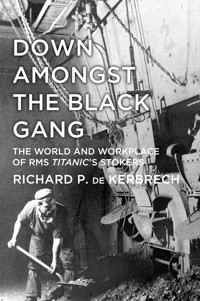
Down in the fiery belly of the luxury liners of the Titanic era, a world away from the first-class dining rooms and sedate tours of the deck, toiled the 'black gang'. Their work was gruelling and hot, and here deKerbrech introduces the reader to the dimly lit world and workplace of Titanic's stokers. Beginning with a journey around some of the major elements of machinery that one might encounter in the giant ships' engine and boiler rooms, the sheer skill and strength that a man in this employ must have had is brought to the fore. The human side of working for Titanic and her contemporaries is also explored through an investigation of stokers' duties, their environment and conditions: what it was like to be one of them. An oft-ignored part of Titanic's story, the importance of the black gang and the job they performed is brought to life, making poignant their fate on the maiden crossing of Titanic. This certainly is a book that no Titanic-era shipping historian or researcher should be without.
Sie lesen das E-Book in den Legimi-Apps auf:
Seitenzahl: 234
Veröffentlichungsjahr: 2014
Das E-Book (TTS) können Sie hören im Abo „Legimi Premium” in Legimi-Apps auf:
Ähnliche



















For Hilary
CONTENTS
Title
Dedication
Acknowledgements
Introduction
1 Introduction to the Power Plant
2 Engine Room Personnel, their Duties and Origins
3 Coal, Bunkers and Bunkering
4 About Scotch Boilers
5 Stokers, Pokers and Smokers
6 Main Propulsion Machinery
7 Reputations, Stereotypes and Urban Myths
8 The Low-pressure (LP) or Exhaust Turbine and Condensers
9 The Black Gang’s Struggle to Save Titanic
10 Other Labour-intensive Auxiliaries to Attend
11 Aftermath and Repercussions
12 The Coming of Oil-firing but Coal Burners Steam on and on
Appendix: List of Titanic’s Engineering Department Including Electricians, Greasers, Firemen and Trimmers
Bibliography
Copyright
ACKNOWLEDGEMENTS
I should like to extend my gratitude and acknowledgement to the following persons, firms and institutions for their kindness in contributing information and illustrations and other help, and without whose assistance this book would certainly not have been written.
Of necessity, a project of this nature draws heavily on a vast wealth of previously published sources. Chief among these, being The Marine Steam Engine by R. Sennett and H.J. Oram, and Engine Room Practice by John G. Liversidge, both of which were published in Edwardian times. More recently, the Haynes RMS Titanic Owners’Workshop Manual has proved to be a valuable source of reference. Of the illustrations, the images of the Olympic, Titanic and Britannic’s boilers, main engines, turbines and auxiliaries and parts under construction have been gleaned from a number of sources and credited as such. However, they were all originally created by the professional photographer Robert John Welch (1859–1936) and on some images his initials may be seen. From 1894 up until the First World War he worked as Harland & Wolff’s official photographer.
My thanks go initially to Nigel Overton, City and Maritime Heritage Curator at Plymouth City Museum and Art Gallery, for germinating the idea for this work.
To the following for their support and sharing their technical knowledge: to my old friend David Hutchings, an authority on the Titanic, for his technical advice and uses of images from his collection, Samuel Halpern, Simon Mills, John Siggins, Alan McCartney of the Ulster Folk & Transport Museum and Michelle Ambrose of the National Museums Northern Ireland, Maurizio Eliseo, Encyclopedia-Titanica, the Imperial War Museum, the Public Record Office of Northern Ireland, the United States Naval Historical Centre, Brian Ticehurst, Claes-Göran Wetterholm and Richard Woodman. Finally, to David Williams my good friend, former professional photographer and co-author on previous books, who with his usual enthusiasm gave his time and advice on picture selection and image quality.
Members of the Black Gang of Lloyd Sabaudo’s 1907-built Tomaso di Savoia who worked in the boiler rooms and bunker spaces, blackened by the coal dust and grime. These men were rarely encountered by passengers. In this group, during 1927, all are wearing head gear, and the two engineers are rigged in boiler suits and peaked caps. (Maurizio Eliseo collection)
INTRODUCTION
Much has been written and documented about the Titanic disaster, but this work seeks to concentrate on the actual world and workplace of the Titanic’s Black Gang. In doing so there will be an opportunity to take a journey and have a detailed look at some of the major elements of machinery that one might also have encountered in the engine and boiler rooms of the RMS Titanic and her sister ships, the Olympic and Britannic. This work does not deal with the engine room personnel as individual cases but rather from the human and social factor, with generic descriptions of their jobs and life in the stokehold. This to some may seem somewhat stereotypical. It also deals in some small part with the heroic efforts of the engine room personnel who tried in vain to save the ship following its collision with the iceberg.
As strange as it may seem, no known photographs of the engine and boiler rooms, with machinery in place, of the Olympic, Titanic and Britannic (Yard Nos 400, 401 and 433) exist. None even of firemen/stokers at work in their boiler rooms and stokeholds. This seems somewhat ironical when one considers that the Olympic was not converted to oil-burning until 1919–20!
In an attempt to help compensate for this, any images are from coal-burning vessels contemporaneous with the ‘Olympic’-class ships, such as French Line’s France of 1912 and Cunard’s Aquitania of 1914. The United States Naval Historical Centre have preserved boiler room images of the US Navy’s troopships George Washington, Leviathan, Mount Vernon and Troy. All were built during the Edwardian era and just before the First World War. Three were commandeered German liners: the George Washington completed in 1908 was formerly owned by North German Lloyd; the Mount Vernon had been the same company’s Kronprinzessen Cecilie completed in 1906; and the Leviathan had been Hamburg America Line’s Vaterland, completed in 1914. They were more than likely manned by US Navy conscripts (US: ‘draftees’). Other scenes are from merchant vessels of the coal-burning era, and with one exception show the stokeholds with fire tube, cylindrical or ‘Scotch’ boilers. Most of these engine room photographs may have been posed for the time exposure of film used in its day. Hopefully they may help show the harsh conditions of extreme heat, dimly lit, dirty, and back-breaking environment in which the Black Gang toiled. Indeed some are even somewhat ‘Gothic’ in appearance. Originally the Black Gang, also known as the ‘Black Feet Brigade’, were the firemen/stokers and trimmers who worked in the stokeholds and boiler rooms of coal-burning steamships like the Titanic. Their name derived from their black appearance due to the coating of coal dust on their faces, exposed skin and clothing, and the hot, coal-dust laden atmosphere in which they laboured. Along with coal miners, foundry workers and chimney sweeps, it was a dirty, filthy, grimy job, but unlike these two trades, firemen and trimmers also had to endure the searing heat from open furnaces. In time this would apply to anyone who worked down below among the Black Gang, like greasers, and also the engineers could be labelled by the same familiar (or perhaps derogatory) sobriquet.
The title of fireman or stoker is interchangeable, as in time the actual distinction has become blurred. It is believed that the title stoker was a Royal Navy rating, while fireman applied to the same post in the Merchant Navy and essentially their work was the same. It has been written in Commander (E) A. Funge Smith’s book Introduction to Marine Engineering that ‘there are no stokers in the Merchant Navy, the nearest approach to them being the firemen who attend to the fires of the boiler furnaces …’
The Titanic had twenty-four double-ended boilers and five single-ended boilers. When all the double-enders were fully fired up and operational, they could consume approximately 850 tons of coal per day, or on average 35 tons per hour, and the Titanic had a total bunker capacity of 6,611 tons. It was the Black Gang’s job to keep these boilers fed, which meant shovelling a ton of coal into the boiler furnaces every two minutes. Every boiler room was manned by ten firemen and four trimmers. Rarely seen or encountered by the passengers, the Black Gang provided the manpower behind the horsepower.
The stokehold and boiler rooms as terms were also interchangeable, but on the Titanic the boiler rooms were separated by watertight bulkheads, and the stokeholds were the transverse ‘alleys’ from the amidships line of the hull where the boiler fronts were worked.
Where possible descriptions of the Titanic’s boilers and main engines are from the ship’s actual technical specifications. When these have not been available, technical details from Marine Engineering and Naval Architecture literature contemporaneous with the era of the Titanic are used. As the Titanic was the second of a class of three ships, her earlier sister, the Olympic, has been referred to, as has the last of the trio, the Britannic. Also illustrations and descriptions from those of her sister ships have been used.
In a work of this nature which has a large amount of technical content it has be necessary to use a degree of technical terms and expressions. Regrettably this has been unavoidable and apologies are due to the general readership who may be from a non-technical background. In order to make the content a little more digestible, where possible the chapters have been arranged in an alternate technical description and social history/human element fashion. All units are in imperial quantities as befitting those used in shipyards of the day, the exception being electrical power which is quoted in watts (W) or kilowatts (kW).
Where displacement tonnages have been referred to, and masses and weights of machinery and bunker coal, imperial tons have been used (made up of 2,240lb) which are referred to in the United States as ‘long tons’.
During the Edwardian era and indeed up until 1922, the Merchant Navy was known as the Mercantile Marine, Merchant Service or Merchant Marine. The British Board of Trade (BoT) was the government department chiefly concerned with safety at sea, the survey of ships in its hands and the examination of Mercantile Marine officers for their Certificates of Competency (‘tickets’).
Harland & Wolff’s ‘Olympic’-class Passenger Vessels
The White Star Line, which began trading as a transatlantic steamship company in 1869, declared a policy of placing supreme comfort and size before speed, with the introduction of the innovative Oceanic of 1899. This move gained the company a considerable following with the travelling public, and a reputation for excellence. In 1902 the company was taken over by John Pierpont Morgan’s large United States shipping combine, the International Mercantile Marine Company (IMMCo) but still traded as the White Star Line.
By 1908 an emigrant could travel to the United States for just £2 ($10) and J.P. Morgan foresaw fixed prices in the hope of eliminating competition. However, for J. Bruce Ismay, then the chairman of White Star, one of the answers to the stiff competition from Cunard and other shipping companies from the continent, was to build larger and finer ships with greater carrying capacity. It was decided to build a class of three large vessels of immense size, which would later become the Olympic, Titanic and Britannic (originally proposed as the Gigantic).
The Harland & Wolff team responsible for the design of the ‘Olympic’- class comprised Lord Pirrie, Thomas Andrews, the managing director of the design department, Lord Pirrie’s nephew; Edward Wilding, deputy to Andrews and responsible for the design calculations, stability and trim; and finally Alexander M. Carlisle, Harland & Wolff’s Chief Naval Architect.
Although the Olympic was the first of the class to be laid down and built, the Titanic’s life began with the laying of her keel on 31 March 1909 as Yard No 401. At the time of the construction of the Olympic and Titanic, Harland & Wolff had a workforce of around 14,000 men, and at any time between 3,000 and 4,000 of these would be allocated to the building of the two sisters.
Her construction was of the traditional keel, 300 frames, rib and beam type rising upwards from the keel like a skeleton of some huge steel dinosaur. Shop managers, foremen, craftsmen, labourers and apprentices referred to detailed drawings, and from these manufactured from steel, wood, copper, brass and glass the frames, plates, engines, boilers and thousands of other items that would together create the largest ship ever built to that date.
The Titanic like the Olympic was constructed of mild steel with cellular double bottoms 5ft 3in deep. The bottom plating was hydraulically riveted; the strakes were arranged in clincher fashion and the underside of the framing was joggled to avoid the use of tapered packing pieces. In order to reduce the number of butts and overlaps to a minimum, plates of a large size for their day were adopted, some 2,000 in all. The shell plates were from 30ft to 36ft long and 6ft wide; the largest plates weighed some 41/2 tons. Steel plates used in the construction of her keel and the adjacent strakes were 1in thick, as were plates used at the waterline and the turn of bilge; however, plates used at the sheer strake were doubled for extra strength in this region. In all some 2 million rivets were used in her overall construction.
The hull was subdivided by fifteen transverse watertight bulkheads which created sixteen compartments. The watertight doors to these were electrically controlled from the bridge and should any two of the largest compartments become flooded, the vessel could remain afloat indefinitely. These safeguards led White Star to believe that the ship was practically unsinkable. As stated, in the event of an emergency, the Titanic had been designed to remain afloat with any two of her watertight compartments fully flooded. However, on the night of her collision with an iceberg the starboard hull along the first five compartments was breached and laid open to the sea. Her watertight integrity was compromised and the ship’s fate sealed.
There were eight steel decks amidships: A, the boat or promenade deck; B, the bridge deck; C, the shelter deck; D, the saloon deck; E, the upper deck; F, the middle deck; and G, the lower deck. At the ends an orlop deck was fitted, which made nine decks in all.
Accommodation was provided for 739 first-class, 674 second-class and 1,026 third-class passengers. In addition the Titanic had a crew of about 899 and was capable of carrying some 3,300 persons in total.
The Titanic’s huge structure rose in the gantry against the Belfast skyline, and following the construction of her hull, the shafting and its supporting bearings were installed but her three propellers were fitted following her launching. The centre propeller was four-bladed, cast manganese bronze of 16ft 6in diameter that would be driven by her Parsons low-pressure exhaust turbine. The two outward turning, three-bladed wing propellers built up from cast steel hubs and bolted on bronze blades were 23ft 6in in diameter and would be driven by the Titanic’s steam reciprocating engines. The Titanic’s massive bulk would be steered by solid cast steel ‘plate’ rudder made up of six sections bolted together, with an overall length of 78ft 8in and 15ft 3in wide. Its total weight was just over 101 tons.
At the day of the launch on 31 May 1911, those attending the list of VIPs such as Lord Pirrie, J. Pierpont Morgan and Bruce Ismay, were present, but it was not such a grand affair as one might suppose. Instead the Titanic followed White Star policy of not being formally named or sent on its way with champagne, merely the trigger was released at the appointed time of 12.15 p.m. and her slipway mass of 24,000 tons with a pressure on the launching ways of 3 tons/in2 took just sixty-two seconds to glide down the slipway and into the waters of the River Lagan to the accompaniment of some 100,000 onlookers cheering. It had taken the application of over 22 tons of tallow, engine oil and soft soap spread over the launching ways to enable the ship’s huge hull to slide down the gradual slope to the river. As she became afloat for the first time, 160 tons of drag chains were pulled along and took up the strain to arrest the Titanic’s sternward momentum and bring her to a gradual halt. Tugs then took her alongside her fitting out berth and it was here that her two sets of four-cylinder, inverted double-acting, triple-expansion steam reciprocating engines were installed on to the bedplates. In addition to these there was also a massive Parsons turbine, twenty-four double-ended and five single-ended Scotch boilers, piping, plumbing wiring and auxiliaries. The boilers were arranged in six entirely independent and isolated boiler rooms, and the uptakes from these six boiler rooms ran into three funnels, the aftermost fourth being a dummy. Other fittings included fans, generators, steering gear, ovens, condensers, evaporators and the refrigeration plant. There was also the interior like panelling, chairs, paintings, palms, lifts and furnishings. For first-class passengers the Titanic boasted a squash racquet court, a Turkish bath, a fully equipped gymnasium, a swimming pool (the first afloat), Parisian-style cafés and libraries staffed by librarians. Indeed some suites offered on the Titanic had private promenade space at a cost of £870 during the high season. First-class passengers also enjoyed free meals that were served in the Jacobean-style dining room; however, to dine in the à la carte Louis XIV restaurant, panelled in French walnut, was extra. The propellers (q.v.) were fitted in the Thompson Graving Dock and the entire fitting out period lasted some ten months in all.
The Titanic was completed, and following trials in which she achieved some 21 knots, was handed over to the White Star Line on 2 April 1912, under the command of Captain Edward J. Smith. With a gross tonnage of 46,328, an overall length of 882ft 9in and a beam of 92ft 6in, she was the largest moving object that had ever been constructed by man.
She left Southampton on her maiden voyage to New York on 10 April 1912, and following calls at Cherbourg and Queenstown had a total capacity of 329 first-, 285 second- and 710 third-class passengers aboard. On the night of 14 April she collided with an iceberg and sank with the loss of some 1,522 lives – a disaster that sent shock waves around the world and has stimulated discussion and research ever since. The Titanic was three years in the making and at the cutting edge of Naval Architecture and Marine Engineering technology of the day, and the epitome of Edwardian grandeur afloat. That said, it took only two hours and twenty minutes for her complete destruction and its attendant loss of life!
Richard de Kerbrech
Gurnard, Isle of Wight
1
INTRODUCTION TO THE POWER PLANT
In a ship so large for its day, the Titanic (and also the Olympic), was driven by a combination of steam reciprocating engines and a turbine. These were overseen by a staff of twenty-two engineers and six electricians.
The main engines were very large, but not the largest as has previously been believed, and were twin four-cylinder, double-acting, triple- expansion steam reciprocating engines. The term ‘reciprocating’ denoted the nature of the motion of the engine parts upon which the steam acted, such as an up and down or a backward and forward motion. A simple steam double-acting reciprocating engine consisted of a steam cylinder inside which a piston moved up and down, according to the arrangement, a piston rod and a link or connecting rod worked a crank on a shaft which delivered the power for the work to be done. The reciprocating motion of the piston and piston rod was converted into rotary at the shaft by the crosshead and guide mechanism. Developments in single then compound (double) steam engines made more efficient use of the expansion of steam.
In 1911 with high steam pressures, the triple-expansion engine made further use of the properties of steam. The Olympic and Titanic had four cylinders arranged in line on the top of the engine structure, supported on columns. Each cylinder had two columns, ‘forked’ at the lower end, which rested on the base or sole plate carrying the shaft with four cranks, one for each cylinder. On Titanic and her sisters, the combined effect of lower weights and four cranks instead of three on each engine, helped reduce overall vibration. The piston rods passed out of the cylinder bottoms, the outer ends being guided between the columns to the crossheads, and the connecting rods joined up with the crankshaft. On the side of each cylinder there was a chamber for receiving or collecting the steam, ready for admitting it to the cylinder, and in these chambers there were special valves, worked by eccentric mechanisms from the crankshaft which admitted the steam and allowed it to escape at the correct instant.
These enormous engines worked on external combustion in which coal was burned in the boilers to generate steam from water which was then in effect, recycled. The pressure when all twenty-four boilers were in operation was 215psi, and this ‘live’ steam was supplied by the boilers via common steam main pipes which then travelled through the boiler rooms to the two main steam stop valves on the engine room side of the bulkhead. The main steam lines from the boilers also incorporated a bypass branch line known as the ‘silent blow off’ line. This could be used when warming through the main engines prior to start up, or as an emergency dump line for excess steam to a large exhaust to the condensers. Therefore if the engines were stopped, steam passed to the silent dump to prevent high-pressure exhaust steam venting off through the boilers’ safety valves and up to the waste steam pipes to the funnels.
From the main steam stop valves the steam entered the high-pressure cylinders via the regulator valve (or throttle) on each engine and expanded driving the piston down. Then it exhausted into the intermediate-pressure cylinder to do further work. As the steam expanded, each cylinder in turn was of a larger diameter or bore to accommodate the larger volume of the expanded steam. As the ‘live’ steam at high pressure was in turn used to expand through the three stage cylinders of her engines and converted the heat energy to mechanical energy, this in turn drove the ships two 38-ton, three-bladed outer propellers.
Cutaway detail of a single-cylinder steam reciprocating engine. (Author’s collection)
The deserted stokehold of the Aquitania (1914) under coal. Note in the central front of the picture the firing rake or hoe, and to the right, a shovel hanging from a furnace door. The large lumps of coal had to be broken down into much smaller lumps before being fed into the furnace. (Author’s collection)
The same view of the stokehold with the boiler grates being cleaned under the eye of a boiler-suited engineer, while the trimmer wheels his coal-laden barrow. (Author’s collection)
The stokehold of the French liner France, completed in 1912. Note the coal piled by baffles to keep the passageway clear. The long handles hanging vertical are probably the damper levers to open the damper flaps located in the boiler uptakes. (French Line)
The expanded energy at this stage could not be used in a reciprocating engine properly because of cylinder size limitations. The combination of reciprocating engines together with a Parsons low-pressure (LP) turbine was first introduced by Harland & Wolff on White Star’s Laurentic of 1909. It was found that the superior economy of the system was due to the fact that increased power was obtained with the same steam consumption by further expanding the exhaust steam at a much greater volume from the reciprocating machinery in the low-pressure turbine beyond the limits possible with the reciprocating engine.
The trials and operating experience of the Laurentic led to Harland & Wolff adopting the combination machinery for the ‘Olympic’-class trio. The other option if manoeuvring or steaming at less than 15 knots, was the turbine could be bypassed by changeover valves which diverted the steam directly to the condensers.
Abaft of the main engines and on both sides of the LP turbine, were the condensers in which steam was condensed back into water and a vacuum formed.
In the ‘open feed system’, as it was known, after passing through the Parsons turbine, the now ‘dead’ or ‘spent’ steam then entered the two condensers, which had a combined cooling surface of 50,500ft2 and worked under a sub-atmospheric pressure of 28in. To condense the steam back to water, seawater at 60ºF was circulated through nests of tubes by four compound steam driven centrifugal pumps with a suction and discharge pipe diameter of 29in. The steam was effectively condensed back into water to be used in the cycle over again. Dual air pumps on each condenser outlet sucked out the water and air, and it was pumped into two 2,790-gallon feed tanks. From these the condensate gravitated down to two 300-gallon capacity hotwell tanks. It was here that the condensate came into contact with the air, and any boiler water lost through steam leakage was made up with fresh water from the fore peak or from distilled water supplied by one of the Titanic’s three 60-ton capacity evaporators.
The water from the hotwells was drawn off by four hotwell extraction pumps, and to ensure that the feed water was free from oil and other impurities, was discharged through four main feed filters to the surface feed heater which was capable of dealing with 700,000lb/h (312.5 ton/h) of water when supplied with 50,000lb/h (22.3 ton/h) of exhaust steam from the generators at a pressure of 5psi.Thus the feed water temperature was raised from 70ºF to 140ºF. The water then passed to a direct-contact heater which could also handle a capacity of 700,000lb/h of feed water using exhaust steam from the auxiliaries such as the steering engines, the two refrigeration compressors, numerous pumps and windlass, the steam temperature was further raised to 212–230ºF. After this the feed water then gravitated to four main feed pumps that returned the heated feed water back to the boilers above boiler pressure, to replenish and recycle the water back to steam once more. For continuous operation of the engines the rate of steam production in the boilers had to equal the rate of consumption.
Schematic diagram of the Titanic’s propulsion plant. (Samuel Halpern)
2
ENGINE ROOM PERSONNEL, THEIR DUTIES AND ORIGINS
The following table gives the muster of engine and boiler room personnel - the Black Gang - which formed the major part of the engineering department aboard the Titanic.
Position
Number Signed On
Saved
Chief Engineer
1
0
Engineers
24
0
Electricians
6
0
Boilermaker
1
0
Junior Boilermaker
1
0
Plumber
1
0
Storekeepers
4
0
Leading Firemen
13
3
Greasers
33
4
Firemen/Stokers
161
44
Trimmers
72
19
Engineers
The engineers in 1912 were not considered as officers (for they wore no ‘executive curl’ on their sleeve insignia), and were responsible for the management and organisation of men in the engine and boiler rooms, together with the smooth, efficient and safe running of the boilers and main steam engines. In the engineer’s structure, the chief engineer did not stand a watch but worked day-work and was in overall charge of the engineering department and its personnel. He was responsible for the safe and economical running of the engines, its fuel consumption and overseeing any breakdowns. In ships of the day his day probably started at 6 a.m. and before breakfast at 8 a.m. he had been round the bunkers to ascertain the amount of fuel remaining. This was a very important matter as it was uneconomical either to run short of coal or to have more than was reasonably necessary to complete the voyage. The former involved deviation to the nearest port to bunker; while the latter meant carrying coal bought, perhaps, in a port where it was more expensive than another port where it could be purchased cheaper.
In a ship as large as the Titanic the chief engineer would allocate about two hours’ work to be done in the forenoon for writing up details of the ship’s performance and keeping the top copy of the engine room log up to date. He would either take or delegate the third engineers of the watch to take ‘indicator cards’ to ascertain the indicated horsepower of the engines. He would also complete any records of any overhaul or adjustments that were made on the machinery.
About 11 a.m. he may well have had a meeting with the commander, the chief officer and doctor prior to any daily inspection of the ship. In this case the chief engineer’s particular interest was in the auxiliary machinery throughout the ship, electric light fittings, etc., as the latter in a vessel of the Titanic’s size were apt to be damaged if they were not closely watched.
For this massive responsibility the Titanic




