Table of Contents
Praise
Title Page
Copyright Page
Dedication
Foreword
Introduction
Drucker’s Evolving Attitudes Toward Leadership
Drucker’s Model for Effective Leadership
PART ONE - The Leader’s Role in Shaping the Organization’s Future
CHAPTER 1 - The Fundamental Decision Determining the Business of the Organization
Defining Your Business Is No Small Thing
How to Obtain Commitment to the Mission Throughout the Organization
Why Everyone Should Be Heard
How to Answer the Question, What Is Our Business?
When Should You Define Your Business?
Drucker’s Advice on Defining the Business of the Organization
CHAPTER 2 - The Process Creating a Strategic Plan
Drucker’s Vision of Strategic Planning
The Function of a Strategic Plan
Drucker’s Three Questions to Determine an Organization’s Future
Moving Forward on the Strategic Plan
The Impossibility of Accurate Forecasting
Drucker’s Secret (Which Violated His Own Rule)
Drucker’s General Directions Lead to New Ideas
Fine Tuning and Judging the Future You Have Selected
Drucker on the Process of Creating an Organization’s Future
CHAPTER 3 - Look, Listen, and Analyze The Information the Leader Needs
Looking Out the Window: A Carefully Chosen Metaphor
The First Thing You See When You Look Out the Window: The Broad Environment
Keeping Your Focus While Looking Out the Window
The Second Thing You See When You Look Out the Window: Specific Targets
Market Research: Acquiring the Information You Need
Drucker on the Information the Leader Needs and What to Do with It
CHAPTER 4 - Methodology Developing Drucker Based Strategies
Strategy Not by Formula
Drucker’s View of Strategy
Questions Any Company’s Strategy Must Answer
A Hypothetical Drucker Methodology
Principles, Resources, and Fixed Certainties
Developing Strategy Based on Drucker’s Concepts
CHAPTER 5 - Taking Action What It Takes to Implement Your Plan
Implementing and Controlling Your Plan
Drucker’s Metrics for Control
The Ultimate Control
Drucker’s Concepts on Taking Action
PART TWO - Ethics and Personal Integrity
CHAPTER 6 - Drucker’s Views on Business Ethics
The Concepts of Integrity, Ethics, Morality, Honor, and the Law
Drucker’s Early Struggles with Unethical Leadership
Drucker’s Analysis of Business Ethics for the Leader
Drucker on Ethics for Leaders
CHAPTER 7 - Effective Leadership and Personal Integrity
Integrity in Action
My Own Experience of Integrity in Action
Drucker on the Need for Personal Integrity
CHAPTER 8 - The Seven Deadly Sins of Leadership
Why the Seven Deadly Sins?
The Leadership Sin of Pride
The Leadership Sin of Lust
The Leadership Sin of Greed
The Leadership Sin of Sloth
The Leadership Sin of Wrath
The Leadership Sin of Envy
The Leadership Sin of Gluttony
Drucker on What a Leader Should Avoid
CHAPTER 9 - Effective Leadership and Corporate Social Responsibility
The Drucker Difference
Drucker on Leadership and Social Responsibility
CHAPTER 10 - The Responsibility of a Corporation First, Do No Harm
The Hippocratic Oath and Primum Non Nocere
Ensuring No Harm Is Done
Look Before Leaping
Never Change for the Good Without First Considering the Future
The Great Housing Depression
Drucker on Doing No Harm
PART THREE - The Military: Drucker’s Model Organization
CHAPTER 11 - Leadership Lessons from Xenophon
Who Was Xenophon?
The Consequences of Inaction
Leading the Troops: Pointers for Subordinates
How to Motivate
Reputation Must Be Earned
The Value of Worker Health in Leadership
Drucker’s Thoughts on Xenophon
Drucker on What Xenophon’s Lessons Meant
CHAPTER 12 - Training and Developing Leaders
Training Leaders in the Military and Civilian Worlds
Leadership Training: Starting on Day One
The Need for Continual Evaluation and Feedback
Applied and Practical Training
The Importance of Follow-Through
How to Handle Mistakes
Advantages of the Military Model
Drucker on Training and Developing Leaders
CHAPTER 13 - Promotion and Staffing
A Rational Promotion System
Staffing Decisions
Drucker on Promotion and Staffing
CHAPTER 14 - The Heart of Leadership
Command-and-Control Leadership
Leadership in Battle
Why Emulate Military Leadership?
Drucker and the Eight Principles
Drucker on the Heart of Leadership
CHAPTER 15 - Leadership for Upper Management
An Old Problem That Has Only Gotten Worse
The Leap from Tactical to Strategic
The Challenge of Specialization
The Responsibility of the Organization for Selection
How to Prepare for High Level Leadership
Drucker on Preparing for Top Management
PART FOUR - Motivation and Leadership
CHAPTER 16 - Leadership Style as a Motivator
Theory X and Theory Y
Drucker’s Views on Theory X
Five Dimensions of Work
How to Make Theory Y Work
Drucker on Style and Motivation
CHAPTER 17 - Motivating to Peak Performance
Employee Satisfaction Will Not Motivate Performance
Drucker’s Four Paths to Creating the Responsible Worker
Drucker on Motivation
CHAPTER 18 - Charisma as a Motivator
Was Drucker Right?
Charisma Defined
Are Charismatic Leaders “Misleaders”?
Researching and Developing Charisma
Drucker on Charisma as a Motivator
CHAPTER 19 - The Volunteer Paradigm
Why People Volunteer
Drucker on Treating Employees as Volunteers
PART FIVE - The Marketing Model of Leadership
CHAPTER 20 - Applying Marketing to Leadership
The Difference Between Marketing and Selling
The Rise of Marketing
The Value of Marketing as a Leadership Model
How to Adopt Marketing as a Leadership Concept
CHAPTER 21 - Applying Segmentation to Leadership
Disadvantages of Mass Marketing
The Solution for Marketers and Leaders: Segmentation
What Segmentation Means for the Leader
The Basics of One-on-One Segmentation
Interacting with Staff in the Workplace
Interacting with Staff Outside the Workplace
Off-Duty and Unofficial Meetings
The Function of Segmentation in Leadership
CHAPTER 22 - Applying Positioning to the Organization and the Leader
The Role of Positioning in Communication
Case Study: How to Apply Positioning to Leadership
Analysis of the Problem and Its Solution
The Benefits of Being First
CHAPTER 23 - The Role of Influence and Persuasion on Strategy and Tactics
The Mass Mind
Strategies of Influence and Persuasion
EPILOGUE
NOTES
ABOUT THE AUTHOR
INDEX
Praise forDrucker on Leadership
“What Cohen learned as Peter Drucker’s student, and their personal relationship afterwards, changed Bill’s life. Reading Drucker on Leadership will change the way you look at and apply leadership forever.”
—Bruce Rosenstein, author of Living in More Than One World: How Peter Drucker’s Wisdom Can Inspire and Transform Your Life
“Peter F. Drucker helped me found the Peter F. Drucker Academy in China. It is a pleasure to see his concepts and what he instructed me brought together in one place and explained so that they could be applied by any executive. Drucker on Leadership is a valuable and useful book.”
—Minglo Shao, chairman and CEO of the Bright China Group and founder of the Peter F. Drucker Academy
Copyright © 2010 by William A. Cohen. All rights reserved.
Published by Jossey-Bass A Wiley Imprint 989 Market Street, San Francisco, CA 94103-1741—www.josseybass.com
No part of this publication may be reproduced, stored in a retrieval system, or transmitted in any form or by any means, electronic, mechanical, photocopying, recording, scanning, or otherwise, except as permitted under Section 107 or 108 of the 1976 United States Copyright Act, without either the prior written permission of the publisher, or authorization through payment of the appropriate per-copy fee to the Copyright Clearance Center, Inc., 222 Rosewood Drive, Danvers, MA 01923, 978-750-8400, fax 978-646-8600, or on the Web at www.copyright.com. Requests to the publisher for permission should be addressed to the Permissions Department, John Wiley & Sons, Inc., 111 River Street, Hoboken, NJ 07030, 201-748-6011, fax 201-748-6008, or online at www.wiley.com/go/permissions.
Readers should be aware that Internet Web sites offered as citations and/or sources for further information may have changed or disappeared between the time this was written and when it is read.
Limit of Liability/Disclaimer of Warranty: While the publisher and author have used their best efforts in preparing this book, they make no representations or warranties with respect to the accuracy or completeness of the contents of this book and specifically disclaim any implied warranties of merchantability or fitness for a particular purpose. No warranty may be created or extended by sales representatives or written sales materials. The advice and strategies contained herein may not be suitable for your situation. You should consult with a professional where appropriate. Neither the publisher nor author shall be liable for any loss of profit or any other commercial damages, including but not limited to special, incidental, consequential, or other damages.
Jossey-Bass books and products are available through most bookstores. To contact Jossey-Bass directly call our Customer Care Department within the U.S. at 800-956-7739, outside the U.S. at 317-572-3986, or fax 317-572-4002.
Jossey-Bass also publishes its books in a variety of electronic formats. Some content that appears in print may not be available in electronic books.
Library of Congress Cataloging-in-Publication Data
Cohen, William A.
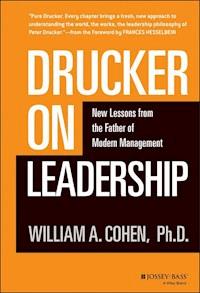
Drucker on leadership : new lessons from the father of modern management/William A. Cohen, PhD. p. cm.
Includes index.
eISBN : 978-0-470-54224-8
1. Leadership. 2. Organization. 3. Management. I. Title. HD57.7.C6426 2009 658.4’092—dc22
2009029118
HB Printing
For Doris DruckerThe First Lady of the Peter F. Drucker andMasatoshi Ito Graduate School of Managementbut more than that—the author of a best-selling book,the founder and CEO of a medical device company,and a woman who not only stood by her manfor almost seventy yearsbut continues to travel the worldpromoting his principles.
FOREWORD
by Frances Hesselbein
For those who sit at the feet of Peter Drucker, and always will, and for those just discovering our greatest leadership philosopher, Drucker on Leadership is a rare and timely gift, as we approach the great celebration of Peter Drucker’s hundredth birthday. And who better to bring us this exciting new book, these new observations, than Drucker’s first Executive Ph.D. graduate. No one else can claim this unique status—a thirty-year relationship with Peter, a unique understanding of almost a third of Peter Drucker’s journey that he shared.
The Peter F. Drucker Foundation for Nonprofit Management was established in 1990. Six weeks after I had left the CEO position at the Girl Scouts of the USA, I found myself the CEO of the new Drucker Foundation. We had ten inspiring years with Peter Drucker as our honorary chairman. He attended our board meetings, three times a year for ten years, spoke at every conference we held, and wrote forewords and chapters for many of our twenty six books. All of us—board members, staff members, and all—had numerous opportunities to listen to, dialogue with, work on the written and spoken word with Peter Drucker. With gratitude we absorbed and appreciated his messages, his voice, his timeless philosophy.
When Peter became frail, unable to be with us in person, we decided that the most loving and respectful thing we could do was to return his name to the family; we became the Leader to Leader Institute, taking the name of our journal, Leader to Leader. But it is the same organization, still committed to moving Peter Drucker’s works, his philosophy, his message across all three sectors and around the world. We are as committed today as we were in March 1990 when the Drucker Foundation was born.
I share this preamble to the Introduction with you because my reflections on Bill Cohen’s Drucker on Leadership have a deep and close appreciation and experience with the hero of the book, and I can say with documented certainty that Cohen’s Drucker on Leadership is pure Drucker. Every chapter brings a fresh, new approach to understanding the world, the works, the leadership philosophy of Peter Drucker. I read the manuscript with a critical eye, for I felt I owed Bill Cohen an alert if a Drucker concept did not come through clearly or was not consistent with the Peter Drucker that the Girl Scouts of the USA and the Drucker Foundation (Leader to Leader Institute) welcomed, understood, practiced, made their own.
Drucker on Leadership passes this most rigorous test—these lessons are the lessons all those who sat at the feet of Peter Drucker learned, practiced, and lived: the Drucker philosophy. To this day I quote Peter to audiences in all three sectors: for example, “The U.S. Army does the best job of developing leaders, because it develops leaders from within.” Bill Cohen’s analysis in Part Three captures Peter’s respect for the military model of leadership development.
Strategic planning is strengthened by “The best way to predict the future is to create it.” We see T shirts with this wisdom. Peter was the model for the principled, ethical leader. Almost one hundred years of his “gift of example” in leadership and ethics sustains us in our times when far too many have lost their way.
And when it comes to marketing, with “A business has just two functions—marketing and innovation,” Peter lights a fire.
In Part One, Bill Cohen is faithful to Peter’s focus on “mission,” defined as “why we do what we do, our reason for being,” which is all about the desired future. Determining what business we are in is a primary responsibility of the leader and the power of inclusion comes through clearly, along with determining who is our customer, an equally powerful message.
Creating an organization’s future may seem a formidable task in our uncertain times, when few dare to describe the future—even ten years from now—yet in this book are guidelines for that journey into an uncertain future. Drucker’s concepts of the process of creating an organization’s future give reassurance to today’s planners of the future. When I finished Bill Cohen’s book, I felt as though I had been listening to the voice of Peter Drucker himself.
Bill Cohen has been a faithful student, a faithful friend, a faithful disciple, and now with Drucker on Leadership he has, and I use a term I learned from Peter, truly “kept the faith.”
INTRODUCTION
Peter Drucker and Leadership
There is little doubt that Peter Drucker, the “Father of Modern Management,” considered leadership the essential management skill. As early as 1947, he declared in Harper’s Magazine, “Management is leadership.”1 Seven years later, in his first book devoted entirely to management, he wrote: “Leadership is of utmost importance. Indeed there is no substitute for it.”2 However, despite these clear early statements, Drucker did at times seem to equivocate about leadership. Only a few short sentences after the statement about the importance of leadership, for example, he added, “Leadership cannot be taught or learned.”
Clearly, Drucker was ambivalent about leadership—or at least the idea that it could be taught—and he remained so for much of his career. In Management: Tasks, Responsibilities, Practices, published in 1973, he reiterated, “There is no substitute for leadership. But management cannot create leaders,” and, although the book ran 839 pages, leadership did not appear as a topic in its own right.
Lesen Sie weiter in der vollständigen Ausgabe!
Lesen Sie weiter in der vollständigen Ausgabe!
Lesen Sie weiter in der vollständigen Ausgabe!
Lesen Sie weiter in der vollständigen Ausgabe!
Lesen Sie weiter in der vollständigen Ausgabe!
Lesen Sie weiter in der vollständigen Ausgabe!
Lesen Sie weiter in der vollständigen Ausgabe!
Lesen Sie weiter in der vollständigen Ausgabe!
Lesen Sie weiter in der vollständigen Ausgabe!
Lesen Sie weiter in der vollständigen Ausgabe!
Lesen Sie weiter in der vollständigen Ausgabe!
Lesen Sie weiter in der vollständigen Ausgabe!
Lesen Sie weiter in der vollständigen Ausgabe!
Lesen Sie weiter in der vollständigen Ausgabe!
Lesen Sie weiter in der vollständigen Ausgabe!
Lesen Sie weiter in der vollständigen Ausgabe!
Lesen Sie weiter in der vollständigen Ausgabe!
Lesen Sie weiter in der vollständigen Ausgabe!
Lesen Sie weiter in der vollständigen Ausgabe!
Lesen Sie weiter in der vollständigen Ausgabe!
Lesen Sie weiter in der vollständigen Ausgabe!
Lesen Sie weiter in der vollständigen Ausgabe!
Lesen Sie weiter in der vollständigen Ausgabe!
Lesen Sie weiter in der vollständigen Ausgabe!
Lesen Sie weiter in der vollständigen Ausgabe!
Lesen Sie weiter in der vollständigen Ausgabe!
Lesen Sie weiter in der vollständigen Ausgabe!
Lesen Sie weiter in der vollständigen Ausgabe!
Lesen Sie weiter in der vollständigen Ausgabe!
Lesen Sie weiter in der vollständigen Ausgabe!
Lesen Sie weiter in der vollständigen Ausgabe!
Lesen Sie weiter in der vollständigen Ausgabe!