


19,99 €
Mehr erfahren.
- Herausgeber: John Wiley & Sons
- Kategorie: Geisteswissenschaft
- Sprache: Englisch
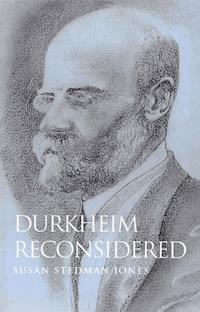
Durkheim is one of the founding fathers of modern sociology and a key figure in the development of social theory. And yet today his work is often misunderstood, since it is commonly viewed through the lens of later authors who used his writings to illustrate certain tendencies in social thought.
Durkheim Reconsidered challenges the common views of Durkheim and offers a fresh and much-needed reappraisal of his ideas. Stedman Jones dismantles the interpretations of Durkheim that remain widespread in Anglo-American sociology and then examines afresh his major works, placing them in their historical and political context. She emphasizes Durkheim's debt to the socialist and republican thought of his contemporaries - and especially to Renouvier who, she argues, had a profound influence on Durkheim's approach.
This book will be recognised as a major reinterpretation of the work of one of the most important figures in the history of sociology and social thought. It will be of great interest to scholars and students in sociology, anthropology and related disciplines.
Sie lesen das E-Book in den Legimi-Apps auf:
Seitenzahl: 607
Veröffentlichungsjahr: 2013
Ähnliche




















To the memory of my parents,Bill and Doreen Stedman Jones
Durkheim Reconsidered
Susan Stedman Jones
Polity
Copyright © Susan Stedman Jones 2001
The right of Susan Stedman Jones to be identified as author of this work has been asserted in accordance with the Copyright, Designs and Patents Act 1988.
First published in 2001 by Polity Press in association with Blackwell Publishers Ltd
Editorial office:
Polity Press
65 Bridge Street
Cambridge CB2 1UR, UK
Marketing and production:
Blackwell Publishers Ltd
108 Cowley Road
Oxford OX4 1JF, UK
Published in the USA by
Blackwell Publishers Inc.
350 Main Street
Malden, MA 02148, USA
All rights reserved. Except for the quotation of short passages for the purposes of criticism and review, no part of this publication may be reproduced, stored in a retrieval system, or transmitted, in any form or by any means, electronic, mechanical, photocopying, recording or otherwise, without the prior permission of the publisher.
Except in the United States of America, this book is sold subject to the condition that it shall not, by way of trade or otherwise, be lent, re-sold, hired out, or otherwise circulated without the publisher’s prior consent in any form of binding or cover other than that in which it is published and without a similar condition including this condition being imposed on the subsequent purchaser.
ISBN 0-7456-1615-1 ISBN 0-7456-1616-X (pbk)
A catalogue record for this book is available from the British Library.
Library of Congress Cataloging-in-Publication Data
Jones, Susan Stedman.
Durkheim reconsidered / Susan Stedman Jones.
p. cm.
Includes bibliographical references and index.
ISBN 0-7456-1615-1–ISBN 0-7456-1616-X (pbk.)
1. Durkheimian school of sociology. 2. Durkheim, Emile 1858–1917. I. Title.
HM465 h.J65 2001
301–dc21
00-060615
Typeset in 10 on 12 pt Times
by SetSystems Ltd, Saffron Walden, Essex
Printed in Great Britain by MPG Books Ltd, Bodmin, Cornwall
This book is printed on acid-free paper.
Contents
Preface
1 Questions of Interpretation: Sociology contra Durkheim
2 Durkheim as Theorist of Order and Science
3 Understanding Durkheim in his Time: Historical and Political Considerations
4 Philosophy and the Republic: The Influence of Renouvier
5 Differentiation and the Problems of Modernity
6 Individualism and Socialism?
7 The Science of Facts and Things: Methodological Considerations
8 Society as the ‘Coefficient of Preservation’: The Question of Suicide
9 The Thinking State: Power and Democracy
10 Practical Reason and Moral Order: Morality and Society
11 Belief and the Logic of the Sacred
12 Final Reflections: Durkheim contra Sociology
Appendix: Durkheim and Renouvier
Glossary
Biographical Sketches
Preface
Why does Durkheim need a reconsideration? There is certainly always a gap between a thinker and what is made of him or her subsequently; but when this gap becomes unbridgeable, then something must be done. The gap between Durkheim’s thought and what has been made of him subsequently in the social sciences is the reason for this reconsideration. This book is a response to the puzzles I have encountered in the way he has been interpreted and the research that inspired me to attempt to unravel them. Unlike many sociologists or anthropologists, I read Durkheim before I read those thinkers or movements by whom he has been interpreted – this at least allows the possibility of a fresh view of an important thinker. I discovered that the interpretation of Durkheim has a feature which characterizes prejudice everywhere: if something is repeated long and often enough, it acquires the patina of truth. These difficulties which I encountered in the interpretation he has received in the social sciences have led to questions which are germane to the understanding of his thought and which serve to underpin the reflections in this book.
I first encountered Durkheim through anthropology, when between my degrees in philosophy, I buried myself for a while in the study of ‘other cultures’, and it was here that my suspicions were initially aroused. Here through his identification with Radcliffe-Brown’s structural functionalism, he was a characterized as a thinker interested above all in rigid structures and functions as sustaining them: he was associated with ‘closed’ and ‘unchanging’ societies whose only dynamic, it would appear, is to stay still. This early colouring has remained as an accepted feature of his view of society. But I could not square this with the picture I got when I read his actual texts: did he not insist on the changing dynamic quality of social relations? But how did he account for these?
Durkheim’s vision is so much larger than that of Radcliffe-Brown: he employed a language in his description of the social that is so much more complex and nuanced than that encapsulated simply by ‘structure’ and ‘function’. Indeed, the more I read and reflected, the more it became clear that there was another language which seemed more theoretically profound than the first, and even to be the basis for it. I recognized certain terms of this consistent language, which, while put to a different use, were distinctly philosophical – in fact were Kantian in origin – where else could all that talk about representations and categories come from? Here, then, is a another question: how do representations relate to structure and function?
Then I encountered another Durkheim in anthropology; here he had became source and justification for a kind of determinist collectivism outré in questions of knowledge; again, this has clung to his name. So he was held to authenticate reference to the group and its structural and symbolic activity as sufficient to answer all questions about knowledge in society. Certainly Durkheim put society and the collective centre stage in terms of epistemology, but what is, and what is not, entailed by this position? How is it that he uses the concept of ‘reason’ as part of his account of the human being (1925a: 95/113)? How does this relate to the collectivity? And having just read Le Suicide, I was inspired to ask how he could then hold ‘free thought’ to be a constant aspect of ‘the history of the human mind’ (1897a: 430/375) These might not be very interesting questions for anthropological accounts of specific societies, but they are crucial when it comes to the interpretation of a thinker, especially in evaluating his notorious ‘sociologism’. So how do these fit in here? The answer I received was that they don’t, and that this is not authentic Durkheim! So – and this has remained a feature of the interpretations imposed on him – those features that do not fit each passing ‘dominant ideology’ are swept under the carpet in the interest of sustaining each cherished interpretation, or one that is easier on the mind theoretically.
It was whilst teaching the philosophy of social science that I noticed that students arrived at university with their minds made up about Durkheim, and that their views were confirmed not only by what they were taught subsequently, but also by student texts which continue to exercise a baleful influence. Durkheim appears peculiarly easy to parody and reject, particularly when certain philosophical and historical issues are left out of account. It was also whilst teaching that I encountered yet another Durkheim – this was the sociologists’ Durkheim. Unlike the sociologists, I became acquainted with Parsons only through my interest in Durkheim; whereas they, it would appear, were acquainted with Durkheim through Parsons. Thereafter, Durkheimianism and Parsonianism were identified. But again I could see that Durkheim’s theoretical interest or language was not adequately expressed by Parsonianism. The result of this identification was a Durkheim concerned above all with order and normative integration. But what does Durkheim mean by order and the normative?
I was now becoming aware of the peculiar fate Durkheim had suffered: he was treated as a kind of badge of foreign authority for theories which only encapsulate a small aspect of his thinking, but with which he was identified and through which he was interpreted. This fate is the contrary of the old adage that a rolling stone gathers no moss. The Durkheim stone had rolled between different theories, and was thick with moss – consisting of the set of interpretations and criticisms attached to his name. The Durkheim stone has travelled widely: it was rolled all the way from France to the United States and from there to Britain and elsewhere.
Although previously he was positively attached to theories which claimed to represent him, now a new phenomenon occurred. With the swing away from structural functionalism, he became the bogeyman of sociology – this is particularly clear in Gouldner’s The Coming Crisis of Western Sociology, where Durkheim is blamed for structural functionalism’s ahistorical, uncritical thinking. Of course, he was also by now the archetypal conservative as interpreted by Nisbet, Coser and Parsons. But this raises further questions: in what sense is Durkheim a structural functionalist, and what is entailed by the functionalism he does espouse? In what sense is he a conservative? By now the moss on the Durkheim stone was thick with all the attachments, positive and negative, that clung to the concept ‘Durkheimian’.
There was a further movement in sociology which added significantly to this and which I was uniquely placed to observe. This was the swing away from science and the move towards questions of interpretation and meaning as dominant in theory. Durkheim now became the straw man of the phenomenological movement for his scientism and positivism. Odd that he was originally held to be mystical for his strange concept of the conscience collective! Now there is another question: what does Durkheim mean by ‘science’? Why did Durkheim think there was a science which adequately accounted for social reality? What was its nature, and what is and is not entailed by it? This concept of ‘science’ had become a political football amongst the competing schools of sociology. I stubbornly refused to believe both the critics of his science and his supporters who wanted to turn him into the hard man of science who ignored all ‘soft’ philosophical issues. I was convinced that he was using a scientific language, but with a unique philosophical nature. How else can his science be connected with ‘rationalism’ (1895a: ix/33)?
A distinct feature of many of the critiques of Durkheim is their philosophical inspiration. Since he had acquired the reputation for both scientism and conservatism, he was now the butt for both Marxist and phenomenological critiques. But did he never consider the type of questions raised here? Did he not know about meaning and the question of how things appear to consciousness (the problem of phenomenalism)? But here is another question: what is the relation of meaning to structural conditions? Are social worlds built up out of the rational pursuit of meaning? Further, for Marxists – through the static, moralizing aura that clung to his name – he failed to acknowledge conflict or historical development. But had he not heard about Hegel and dialectical views of history, or questioned the problem of materialism? Now another question emerges for the radicalism that has so consistently opposed Durkheim: why is it, given the degree of conflict (industrial and gender) in society, that it hasn’t quite fallen apart? What is it about social worlds that has such a tenacity? Uniquely, Durkheim underlines this, but how?
Whatever the critiques of his actual sociology, Durkheim has been treated as though extraordinarily philosophically naïve. But there is an unusual feature of this: those educated as sociologists were using concepts derived from philosophy to attack Durkheim, but here was a thinker educated as a philosopher, who taught it before turning to found his sociology. The peculiarity of Durkheim is that he does not overtly reflect on the philosophical aspect of methodologies, but advances a distinct theoretical language as a means of accessing the social world. Was it possible that this was like the tip of an iceberg, whose concealed mass might, if brought to the surface, begin to answer some of these philosophically inspired critiques?
It has been stated correctly that Durkheim is well known, but not known well. With significant exceptions, he has been taken out of context theoretically and politically – particularly through the critiques addressed to him. The world he lived in was swept away by the horrors of the 1914–18 war – and it is to significant features of this that we must return to understand the full complexity of his thought. Given the current state of the social sciences, a reconsideration of Durkheim is timely, and even necessary. What follows can only contribute to this, by revealing certain misunderstood or neglected aspects of the original vision, and by clearing away the thicket of interpretations that obscure the view. It is with these that we must begin.
1
Questions of Interpretation: Sociology contra Durkheim
Durkheim, who died in Paris in 1917, was a republican philosopher, a self-proclaimed rationalist and socialist; yet he is taken as the apostle of conservative thought as well as the most unphilosophical scientism, empiricism and positivism in the social sciences. Of the triumvirate of thinkers who are regarded as the founding fathers of sociology, neither Marx nor Weber has received more opprobrium than Durkheim. He has, it would appear, committed every sociological sin: he is concerned with consensus, and has no theory of conflict or of power; he has a static view of society, with no theory of social change; he has no theory of agency and no conception of the problems of meaning and interpretation; he has little or no conception of the individual and individual consciousness; and, as the architect of sociological positivism, he is the principal author of what has been characterized as a crisis of irrationalism in the human sciences. The name ‘Durkheim’ now evokes all that must be avoided in sociology, and has become like a billboard which is so pelted with missiles that the original message is obscured. The attempt to uncover this is my task in this book.
Sociology has its own oral tradition, and it is in this that Durkheim’s name has been particularly blackened. The process is fed by pre-university courses and by introductory texts. An example of this is Bilton et al. (1981), where Durkheim is presented as an ‘organicist positivist’ whose view of science, which is ‘crudely positivistic’, comes from Comte (Bilton et al. 1981: 691, 702). Organicism, based on an analogy with a living organism, is held to be tied to functionalist explanation, where the elements are explained by the role they play in the functioning of the whole (ibid. 704). Functionalist explanations alway require equilibrium mechanisms; in this way Durkheim, like other functionalists, avoids historical explanations and stresses order and integration (ibid. 713–15). So organicism leads directly to social order, for conflict cannot be allowed between component parts, and a high degree of integration and coordination is regarded as ‘normal’. The primacy of value consensus ‘cannot be overemphasized’ for, like other organicists, Durkheim considers society as primarily a ‘moral order’, that is constituted by institutionalized norms and values (ibid. 701).
In another textbook, the external and constraining nature of social facts for Durkheim is held to confirm his organicism and holism; his concept of constraint is said to be central to his functionalism, and is opposed to conflict theory. His view of structure is viewed as opposed to action, meaning and, for Giddens, agency (1989: 720–3). This continues a longstanding criticism that Durkheim’s objectivism – seen in the externality of social facts – rejects the subjectivity of the individual (Tosti 1898).
It is not only textbooks which express such views; we find them also in recent commentaries. Lehmann’s Deconstructing Durkheim sees him as a conservative patriarch whose conservatism is tied to his positivism and whose ‘uncompromising’ organicism (1993: 8) is central to his social ontology and entails his determinism (ibid. 45). His view of constraint is evidence of holistic determinism (ibid. 55), as are his concepts of externality, force and thing. In maintaining that for Durkheim the individual is ‘impotent’ in face of society as a ‘natural entity’, Lehmann continues the critiques that have stemmed from Gehlke (1915) and continued through ethnomethodology that he ignored the role of the individual as an active cause of social phenomena. His most distinguished commentator claims that Durkheim has ‘an absolutist conception of knowledge’ which misses the ‘essentially meaningful character of social interaction’ (Lukes and Scull 1984: 23). Further, in books focusing on other topics, asides are thrown at Durkheim which are equally condemnatory: ‘Durkheim modelled his sociology on the natural sciences, thus violating hermeneutics’ (Meadwell 1995: 189).
These criticisms circulate widely, and form the basis of a thinking about Durkheim that can be called ‘vulgar Durkheimianism’, which is the distillation or worst-case analysis of what has been said about him in the history of sociology. It combines the concepts of system, order, morality, holism, functionalism and science. With this conglomeration of unreconstructed concepts, the main accusations against Durkheim have been made: he is a thinker who adapted the methods of the natural sciences to the study of society; he is a conservative in his concern for social order and moral integration in society; and his functionalism confirms his scientism and conservatism, just as his view of society is taken to deny the individual.
Is there anything wrong with these views? Are they not a fair distillation of his failures, and an accurate final judgement on the founder of the subject? Whilst I will show in the next two chapters how various views that have been ascribed to Durkheim are contradicted by his own statements, and in the subsequent chapters offer new light on Durkheim’s theoretical positions, here I will just indicate some of the problems with these views. Accusations centring on his organicism ignore his rejection of biological explanations in sociology: to call society an ‘organism’ is ‘an aphorism’ which alone does not establish a science (Durkheim 1885a: 1.373). And why should an unreconstructed organicist argue that, with society, the organism ‘spiritualises’ itself (1893b: 338/284)? If society is really a ‘natural entity’ which renders us impotent, why is it ‘irreducible’ and how can Durkheim argue that through social forces ‘we rise above things’ to deprive them of their ‘fortuitous, absurd and amoral character’ (ibid. 381/321)? If his holism is really incompatible with freedom, agency and the individual, why does he reject those views which overemphasize cohesion to the exclusion of liberty (1892a: 14), argue that the individual is the only active element of society (1898b: 43n./29), and hold that ‘freedom of thought is the first of freedoms’ (1898c: 269/49)?
Lesen Sie weiter in der vollständigen Ausgabe!
Lesen Sie weiter in der vollständigen Ausgabe!
Lesen Sie weiter in der vollständigen Ausgabe!
Lesen Sie weiter in der vollständigen Ausgabe!
Lesen Sie weiter in der vollständigen Ausgabe!
Lesen Sie weiter in der vollständigen Ausgabe!
Lesen Sie weiter in der vollständigen Ausgabe!
Lesen Sie weiter in der vollständigen Ausgabe!
Lesen Sie weiter in der vollständigen Ausgabe!
Lesen Sie weiter in der vollständigen Ausgabe!
Lesen Sie weiter in der vollständigen Ausgabe!
Lesen Sie weiter in der vollständigen Ausgabe!
Lesen Sie weiter in der vollständigen Ausgabe!
Lesen Sie weiter in der vollständigen Ausgabe!
Lesen Sie weiter in der vollständigen Ausgabe!
Lesen Sie weiter in der vollständigen Ausgabe!
Lesen Sie weiter in der vollständigen Ausgabe!
Lesen Sie weiter in der vollständigen Ausgabe!




