


13,99 €
Mehr erfahren.
- Herausgeber: Parkstone International
- Kategorie: Geisteswissenschaft
- Sprache: Englisch
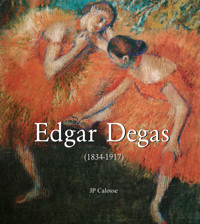
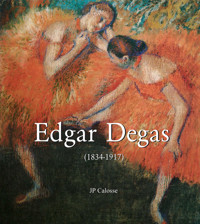
Degas was a French artist famous for his work in painting, sculpture, printmaking, and drawing. His career was long and his style, unlike that of most famous artists who worked into their old age, never ceased developing. He is regarded as one of the founders of Impressionism and is especially identified with the subject of dance (over half of his works depict dancers such as The Dance Class or the sculpture Little Ballet Dancer). These display his mastery in the depiction of movement, as do his less common themes of horse racing and female nudes (After the Bath). His portraits are considered to be among the finest in the history of art. His work was strongly influenced by Ingres and Delacroix combining the expressive qualities of Ingres with the colour of Delacroix.
Das E-Book können Sie in Legimi-Apps oder einer beliebigen App lesen, die das folgende Format unterstützen:
Seitenzahl: 46
Veröffentlichungsjahr: 2019
Ähnliche
















JP Calosse
© Parkstone Press International, New York, USA
© Confidential Concepts, worldwide, USA
© Image-Barwww.image-bar.com
ISBN : 978-1-64461-823-3
No part of this publication may be reproduced or adapted without the permission of the copyright holder, throughout the world. Unless otherwise specified, copyrights on the works reproduced lies with the respective photographers. Despite intensive research, it has not always been possible to establish copyright ownership. Where this is the case we would appreciate notification
Contents
A
The Absinthe Drinker orGlass of Absinthe
Achille De Gas
Achille De Gas
Achille De Gas in Uniform of Cadet
After the Bath
The Amateur
The Artist in his studio
At the Races, Gentlemen Jockeys
At the Theatre
B
The Ballet Class
Ballet Dancers
The Ballet from “Robert le Diable”
Ballet from an Opera Box
The Bellelli Family
Breakfast After the Bath
C
Café-Concert at Les Ambassadeurs
Chanteuse de Café
The Chiropodist
The Convalescent
Conversation
Count Lepic and his Daughters
Count Lepic and his Daughters - place de la Concorde
D
Dance Class
The Dance Class
The Dance Class
The Dance Examination
The Dance Rehearsal
Dancer (studio)
Dancer in her Dressing Room
Dancer Posing for a Photograph
Dancer Standing, her Hands Crossed Behind her Back
Dancer with a Bouquet
Dancer with a Bouquet, Curtseying
Dancers Backstage
Dancers in the Wings
Dancers Resting
The Dancing Class
The Daughter of Jephtha
Degas and Valernes
Diego Martelli
E / F
Elena Montejasi-Cicerale
The Fallen Jockey
Four Studies of a Jockey
G / H / I
Gentlemen Race
Giulia Bellelli
Horse Rider in a Red Dress
Hortense Valpinçon
In the Tuileries. Woman with Umbrella
It was the Marquis Cavalcanti who turned around most of the time
J / K
James Tissot
Jockeys
Jockeys before the Race
Jockeys in front of the grandstand
Kneeling Woman
L
Little Dancer Aged Fourteen
The Little Milliners
Lorenzo Pagans and Auguste de Gas
Lorenzo Pagans and Auguste de Gas
Lyda: Woman with Opera-Glasses
M
Madame de Rutté
Madame Gobillard
Madame Jeantaud in front of a mirror (detail)
Madame Morbilli
Manet and his Wife (detail)
Mary Cassatt
Mary Cassatt at the Louvre
Melancholia
The Millinery Shop
Miss La La at the Cirque Fernando
Mlle Fiocre in the Ballet “La Source” (detail)
Monsieur and Madame Edmondo Morbilli
N / O
Naked woman wiping her foot
The Name Day of the Madame
Nude Woman Combing her Hair
Nude Woman Scratching Herself
The Orchestra at the Opera
Orchestra Musicians
P
Portrait after a Costume Ball. Madame Dietz-Monnin
Portrait of a Young Woman
Portrait of Friends in the Wings
Portrait of Mademoiselle Eugénie Fiocre in the Ballet “The Source”
Portraits at the Bourse
Portraits in the office in New Orleans
The Procuress
R
Racehorses at Longchamp
Reading a Letter
The Rehearsal of the Ballet Onstage
René Hilaire de Gas
Repose on the Bed
A Roman Beggar Woman
S
La Savoisienne
Self-Portrait
Self-portrait with hat
The Singer in Green
The Song of the Dog
The Song Rehearsal
The Star
Study for the Little 14-Year-Old Dancer
Sulking
Swaying Dancer (Dancer in Green)
T
Thérèse Mallot
Three Girls Sitting Opposite
La Toilette
Two Dancers
Two Dancers Entering the Stage
Two Dancers on a Stage
Two Laundresses
Two Studies of Mary Cassatt at the Louvre
W / Y
Woman at the Window
Woman Combing her Hair Before a Mirror
Woman Getting Out of the Bath
Woman Ironing
Woman Ironing
A Woman Ironing
Woman with a Vase of Flowers
Woman with Chrysanthemums
Woman with Opera Glasses (detail)
Women Combing their Hair
Women on a Café Terrace
Young Spartans Exercising
Young Woman in a Café
“And even this heart of mine has something artificial. The dancers have sewn it into a bag of pink satin, pink satin slightly faded, like their dancing shoes.”
— Edgar Degas
Self-portrait with hat
1857-1858. Oil on canvas on cardboard, 26 x 19 cm. The Sterling and Francine Clark Institute, Williamstown.
Biography
1834: Birth of Hilaire Germain Edgar de Gas, named Degas, in Paris on July 19th. He came from a family that belonged to a large bourgeois bank.
1855: After his classical studies at the Louis-le-Grand High School, he goes to the School of Fine Arts and studies in Lamothe's workshop where he continues the studies of Ingres and Flandrin.
1853-1859: His first works: self-portraits and portraits of his family, as well as a number of copies of paintings found in the Louvre.
1856-1860: In order to prepare for the Prize of Rome, Degas stays in Italy where he discovers and fervently copies the works of the Florentine masters. He reproduces a number of figures from these frescos in pencil and oil. He takes night classes at the Villa Medicis and learns about several painters, one of which is Gustave Moreau. Moreau and Degas become friends.
1858-1859: Degas begins work on a large painting in the manner of Holbein or Van Dyck representing his uncle, aunt and their two little girls. This painting, The Bellelli Family, is one of the masterpieces of Degas' early years.
1860: Degas begins painting portraits that resemble the linearism of Ingres and his historical subjects. (Semiramis Constructing Babylon, 1861).
1860-1862: Degas paints his first horses and quickly becomes interested in dance and the opera. His social environment and his musician friends had led him to discover the artificial and colourful world of the racecourses and the theatre wings. From then on, Degas becomes attached to observing these particular aspects of his environment.




