


10,99 €
Mehr erfahren.
- Herausgeber: Lomasi Ahusaka
- Kategorie: Lebensstil
- Sprache: Englisch
Are you tired of eating only industrial foods but don't trust collecting plants in nature?
Learn how to
recognize them easily to live in harmony with the environment
without risking intoxication!
If you would like to embark on this healthy and ethical lifestyle choice, I advise you to learn only from those who can provide you with scientific and exact information.
Until a few years ago, I lived between home, work, and the supermarket shelves filling my house with packaged foods that were slowly ruining my health.
My life changed dramatically when a trusted and experienced friend asked me to accompany him to
pick some wild herbs he was looking for (which I thought I could only find in the supermarket, to be honest).
During our research, he showed a passion that pushed me to learn about
this new world by delving deeper with teachings from expert foragers to the point where I could find everything I needed
directly from the producer: nature!
With this guide, I want to pass on all the
passion and experience I have accumulated over the years so that you, too, will become an
expert researcher of edible plants safely and quickly.
Here is a taste of what you will find in this guide:
• Becoming a Forager – Discover the most ethical way to wildcraft your food! You'll learn to use the right tools to search and harvest wild plants in the right season and place. All while respecting nature.
• Edible Plants Encyclopedia – You'll recognize all edible wild plants thanks to their identikits with pictures, descriptions, and tips on using and preserving them (both as food and other preparations).
• Poisonous Plants? No thanks - Don't jeopardize your or your family's health! Thanks to the protocol for recognizing toxic plants and the universal test for edibility, you won't take any chances.
• Plant Use and Preservation - Some wild plants can be consumed as raw food, but why stop there? You'll discover a plethora of preparations you can make: from teas to tinctures and salves (with tips on how to preserve them).
And so much more!
If you want to break free from prepackaged foods by embracing a lifestyle in harmony with nature, then it's time to find all the information you need in the most comprehensive guide to edible plants.
Click "Buy Now" and learn all the secrets of these plants!
Das E-Book können Sie in Legimi-Apps oder einer beliebigen App lesen, die das folgende Format unterstützen:
Veröffentlichungsjahr: 2022
Ähnliche



















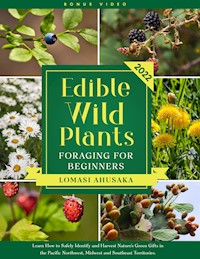
EDIBLE WILD PLANTS FORAGING FOR BEGINNERS
Learn How to Identify Safely and Harvest Nature's Green Gifts in the Pacific Northwest, Midwest, and Southeast Territories
Copyright © 2022
Lomasi Ahusaka
COPYRIGHT & DISCLAIMER: all rights are reserved by law. No part of this book may be reproduced by any means without the authors' written permission. It is expressly forbidden to transmit this book to others, neither in paper or electronic format, neither for money nor free of charge. What is reported in this book is the result of years of studies and accumulated experience. The achievement of the same results is not guaranteed. The reader assumes full responsibility for their choices, the book is exclusively for an educational purpose.
TABLE OF CONTENTS
INTRODUCTION
CHAPTER 1: AT THE ROOT OF IT ALL
1.1 The History of Edible Plants
1.2 What Makes a Wild Plant Edible?
1.3 The Edible Wild Plant Option
1.4 The Biology of Edible Wild Plants
1.5 Conclusion
CHAPTER 2: THE FOUNDATIONS OF FORAGING
2.1 The Proper Identification of Edible Plants
2.2 Where to Find Your Edibles
2.3 Seasons of Harvest
2.4 A “Fruit”ful Harvest
2.5 The Foragers’ Kit
2.6 Our Responsibility to Nature
2.7 Conclusion
CHAPTER 3: TAMING THE WILD PLANTS
3.1 Nutritional Value of Wild Plants
3.2 The Transport and Storage of Foraged Plants
3.3 Preparations for Edible Wild Plants
3.4 Food Preservation of Edible Wild Plants
3.5 The Universal Edibility Test
3.6 The Identification of Poisonous Plants and how to Avoid Them
3.7 Conclusion
CHAPTER 4: A COMPENDIUM OF EDIBLE WILD PLANTS
4.1 Amaranth (Amaranthus spp.)
4.2 Arrowroot (Sagittaria latifolia)
4.3 Bay Laurel (Laurus nobilis)
4.4 Cat’s Ear (Hypochaeris radicata)
4.5 Cattail (Typha latifolia)
4.6 Chamomile (Matricaria chamomile; Chamaemelum nobile)
4.7 Chickweed (Stellaria media)
4.8 Chicory (Cichorium intybus)
4.9 Common Mallow (Malva neglecta)
4.10 Curly Dock (Rulex crispus)
4.11 Dandelion (Taraxacum)
4.12 Elder (Sambucus nigra)
4.13 Fiddlehead Fern (Matteuccia struthiopteris)
4.14 Garlic Mustard (Alliaria petiolata)
4.15 Jerusalem artichoke (Sunchokes) (Helianthus tuberosus)
4.16 Juniper (Juniperus communis)
4.17 Lamb’s Quarters (Chenopodium album)
4.18 Milkweed (Asclepias syriaca)
4.19 Nettle (Urtica dioica)
4.20 Nipplewort (Lapsana communis)
4.21 Nipplewort Prickly Pear Cactus (Opuntia humifusa)
4.22 Nipplewort Purslane (Portulaca oleracea)
4.23 Nipplewort Ramps (Allium tricoccum)
4.24 Nipplewort Sheep Sorrel (Rumex acetosella)
4.25 Nipplewort Shepherd’s Purse (Capsella bursa-pastoris)
4.26 Nipplewort Sow Thistle (Sonchus oleraceus)
4.27 Nipplewort Watercress (Nasturtium officinale)
4.28 Nipplewort Wild Rose (Rosa arkansana)
4.29 Nipplewort Wild Violet (Viola odorata)
4.30 Nipplewort Wood Sorrel (Oxalis acetosella)
4.31 Yarrow (Achillea millefolium)
4.32 Yellow Rocket (Barbarea vulgaris)
CONCLUSION
INTRODUCTION
T
here is a certain level of primeval satisfaction when you are able to successfully forage for berries, herbs and other edible plants in the woods. You may have purchased this book with the intent to learn more about how to properly forage in the woods and fields around you for the sustainable produce that nature has provided. While there is certainly a vast amount of greenery from which you could make your choices, not all plants are edible and if you are unguided as to how to properly tell apart edible from inedible plants, you may find yourself in a pickle. Some plants are truly edible, while others have parts that are edible while the other parts may be toxic to consume. This book serves to be a guide by which you will be able to safely forage for sustainable and ecologically friendly produce and live off the land successfully. You would be able to save on grocery bills since you would be able to source your produce from nature itself.
CHAPTER 1: AT THE ROOT OF IT ALL
1.1 The History of Edible Plants
P
rior to the evolution of humanity into an agrarian society, the earliest human civilizations survived as hunter-gatherers. These were the people who were able to live off the land, and once the resources in the land petered out, they moved on to more fruitful areas. Despite the presence of predators that could easily overpower the humans back then as their main competition, and the weather conditions that prevented fruitful harvests, humanity was able to survive and flourish through the act of foraging. The ability to forage for edible plants back then was crucial, in that the earliest humans needed to know when was the best time to harvest certain types of plants, and this was carried on even with the development of the agrarian society that allowed for the cultivation of these wild plants into a regular supply of food that would enable them to survive winter.
Given that hunter-gatherers do have the connotation that they are primarily carnivores, this idea would be erroneous. Take for example Native American societies, which are hunter-gatherers in classification, but an observation of their dietary practices indicate that they utilized a plant-based diet. One characteristic that the Native American population shares with other indigenous peoples throughout the world is that they do have the necessary knowledge to differentiate edible wild plants from those plants that are unfit for human consumption. The Native American tribes were able to supplement the protein sources that they had with the edible wild plants that were abundant in their respective tribal lands. What may be just a random thicket of greenery to our untrained eyes may be the food source for a group of people, so it would be best to be careful with how we treat plants.
The responsibility to gather and differentiate edible plants was accorded to the women and children. A usual image that comes to mind is that the men are out in the fields, stalking their prey; while the women and children remained near their tents, and foraged in the nearby fields for the plants, herbs, seeds and nuts that they use to augment their meals. It is expected that the consumption of food varied in accordance with the seasons. Food stores on the first day of spring were rapidly consumed to compensate for the lack of food throughout the winter. This practice was cyclical in nature, in that once their hunger was sated, these hunter-gatherers began to forage to replenish their depleted food stores in preparation for the coming winter. While most of the produce were consumed in their fresh state, or were immediately prepared into food; extra produce was preserved through traditional means to form part of their winter food supplies. Hunter-gatherers often dried food and combined with other types of food to form food items that would be suitable for prolonged storage such as pemmican.
The Native American tribes populated throughout the North American continent had their own customary diets that were composed of plants and other wildlife native to their areas. They were able to live off the land for centuries with the use of basic foraging tools. These tools included sharpened sticks and crude knives that could be used to dig up root crops; and hand-woven baskets and pouches to carry the foraged plants back to their camps for preparation by the women of the tribe. If one would recall the life of the Pilgrims when they first landed in North America with their favored crops, they were able to survive the North American winters with the supplementation of other edible wild plants back then such as corn, squash and beans. Of course, these latter three are by no means considered wild in this contemporary age, but given that the North American climate was too cold for traditional European crops to grow, these edible wild plants enabled these Pilgrims and other colonists to survive and make a life in North America.
1.2 What Makes a Wild Plant Edible?
In the previous paragraph, plants that were considered wild such as corn, beans and squash became instrumental to the survival of the early colonists, and thus were cultivated to such a degree that they were no longer considered as wild. This begs the question: What makes an Edible Wild Plant?
To define this, it would be necessary to break the phrase up into its components. At this point, we already know what a plant is thanks to our science classes. We each have different ideas on what makes a plant edible and what makes a plant wild. Collectively, Edible Wild Plants are plants that have not undergone any type of modification such as Genetic Modification, nor have they been specially crossbred with other species to ensure that the plant produced carries the most desirable characteristics of both species. These plants are also composed of a one or more parts that are fit for human consumption once these parts have been gathered at a certain stage of their development and if they have been properly prepared and cooked.
What does the latter part mean? Just because you are able to eat the product of one plant does not necessarily mean that the rest of the plant is edible. You may be able to enjoy the tomato for instance, but under no circumstances are you permitted to eat the flowers of the tomato, nor its relatives such as the eggplant and the potato whose flowers are equally as toxic as the tomato. Plants have parts that are certainly edible, be it the roots, stems, leaves, berries, or flowers. There are also plants whose structures are too woody to eat, plants whose other parts are used as medicine rather than food, and parts that are simply too unpalatable for the human taste. It becomes necessary to identify not only the wild plants that are edible, but the specific parts of the wild plant that are edible for us to eat. A good rule of thumb is, if in doubt, throw it out. It would be better to spend a few dollars on a grocery bill rather than spend thousands on a hospital bill, more so in this economy.
Earlier, it was mentioned that not only do you have to gather the right parts of the plant for food, but also gather them at the right stage of development. As with the other parts of the plant, some parts of the plant, once they have matured, become toxic or unpalatable, hence it is necessary to equip yourself with the knowledge of not only knowing what to gather, but when to gather it. One of the plants in this list is the common Milkweed, which can produce pods with immature seeds that are edible while still at that stage and are suitable for culinary usage. Once these same pods reach maturity however, they become poisonous and this poison cannot be removed from the plant no matter which culinary preparation it is used in. Throughout this book then, it would be necessary to note the part of the plant that is edible, and at which stage is this plant safe to eat.




