


13,99 €
Mehr erfahren.
- Herausgeber: Parkstone International
- Kategorie: Geisteswissenschaft
- Sprache: Englisch
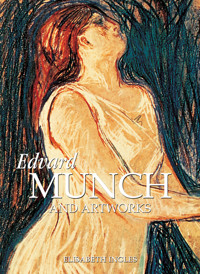
Edvard Munch, born in 1863, was Norway's most popular artist. His brooding and anguished paintings, based on personal grief and obsessions, were instrumental in the development of Expressionism. During his childhood, the death of his parents, his brother and sister, and the mental illness of another sister, were of great influence on his convulsed and tortuous art. In his works, Munch turned again and again to the memory of illness, death and grief. During his career, Munch changed his idiom many times. At first, influenced by Impressionism and Post-impressionism, he turned to a highly personal style and content, increasingly concerned with images of illness and death. In the 1892s, his style developed a ‘Synthetist' idiom as seen in The Scream (1893) which is regarded as an icon and the portrayal of modern humanity's spiritual and existential anguish. He painted different versions of it. During the 1890s Munch favoured a shallow pictorial space, and used it in his frequently frontal pictures. His work often included the symbolic portrayal of such themes as misery, sickness, and death. and the poses of his figures in many of his portraits were chosen in order to capture their state of mind and psychological condition. It also lends a monumental, static quality to the paintings. In 1892, the Union of Berlin Artists invited Munch to exhibit at its November exhibition. His paintings invoked bitter controversy at the show, and after one week the exhibition closed. In the 1930s and 1940s, the Nazis labeled his work “degenerate art”, and removed his works from German museums. This deeply hurt the anti-fascist Munch, who had come to feel Germany was his second homeland. In 1908 Munch's anxiety became acute and he was hospitalized. He returned to Norway in 1909 and died in Oslo in 1944.
Das E-Book können Sie in Legimi-Apps oder einer beliebigen App lesen, die das folgende Format unterstützen:
Seitenzahl: 57
Veröffentlichungsjahr: 2023
Ähnliche














Elizabeth Ingles
© 2023, Confidential Concepts, Worldwide, USA
© 2023, Parkstone Press USA, New York
© Image-Barwww.image-bar.com
© 2023, The Munch Museum/ The Munch-Ellingsen Group/ Artists Society (ARS), NY
All rights reserved. No part of this may be reproduced or adapted without the permission of the copyright holder, throughout the world.
Unless otherwise specified, copyright on the works reproduced lies with the respective photographers. Despite intensive research, it has not always been possible to establish copyright ownership. Where this is the case, we would appreciate notification.
ISBN: 978-1-78160-568-4
Contents
BIOGRAPHY
NOTES
LIST OF ILLUSTRATIONS
A
Alma Mater, 1911-1916
Androgynous Self-Portrait, 1927
Anxiety, 1894
Ashes, 1894
Attraction II, 1896
B
Bathing Boys, 1904-1905
Bathing Men, 1907
By the Death Bed (Fever), c. 1915
By the Deathbed, 1895
C
Christen Sandberg, 1909
Christian Gierloff, 1910
D
Dagny Juel Przybyszewska, 1893
Death and Spring, 1893
Death in the Sickroom, c. 1895
Despair, 1892
Dr Daniel Jacobson, 1909
E
Edvard Munch. Photograph, c. 1902.
Encounter in Space, 1899
Evening on Karl Johan Street, 1892
Eye in Eye, 1894
F
Fertility II, 1902
Four Ages in Life, 1902
G
Girl Lighting a Stove, 1883
Girls on the Pier, c. 1901
Golgotha, 1900
H
History, 1911-1916
I
Ibsen in the Grand Café, 1898
Inheritance I, 1897-1899
J
Jealousy, 1895
K
Karen Bjølstad in the Rocking Chair, 1883
Kneeling Female Nude (Anna), 1920
L
Loving Woman (Madonna), 1895-1902
M
Madonna, 1894
Man’s Head in Woman’s Hair, 1896
Melancholy (Laura), 1899
Melancholy, 1891
Melancholy, 1892
Metabolism, 1899
Model by the Wicker Chair, 1919-1921
Moonlight on the Coast, 1892
Moonlight, 1893
Morning (A Servant Girl), 1884
My Brother Studying Anatomy, 1883
N
Nietzsche I, 1906
Night in St Cloud, 1890
O
Old Aker Church (Gamle Aker kirke), 1881
On the Operating Table, 1902-1903
P
Portrait of Inger, the Artist’s Sister, 1892
Portrait of the Author Hans Jaeger, 1889
Portrait of the Painter Karl Jensen-Hjell, 1885
Puberty, 1894-1895
R
Reclining Nude, 1912-1913
Red Virginia Creeper, 1898-1900
Rose and Amélie, 1893
Roulette Table, 1903
Rue de Rivoli, 1891
S
Self-Portrait after the Spanish Flu, 1919
Self-Portrait as Reclining Nude, 1933-1934
Self-Portrait between Bed and Clock, 1940-1943
Self-Portrait by the Window, c. 1940
Self-Portrait During the Eye Disease I, 1930
Self-Portrait in Bergen, 1916
Self-Portrait in Dr Jacobson’s Clinic, 1909
Self-Portrait in Hell, 1903
Self-Portrait with Bottle of Wine, 1906
Self-Portrait with Brushes, 1904
Self-Portrait with Cigarette, 1895
Self-Portrait with Lyre, 1896-1897
Self-Portrait, 1881-1882
Self-Portrait, 1886
Self-Portrait. The Night-Wanderer, 1923-1924
Separation II from “The Mirror”, 1896
Separation, 1896
Sketch of the Model Posing, 1893
Spring Day on Karl Johan Street, 1890
Springtime Landscape with Red House, 1935
Stanislaw Przybyszewski (with Skeleton Arm), 1895
Starry Night, 1893
Summer Night / Inger at the Beach, 1889
Summer Night’s Dream (The Voice), 1893
T
Tête-à-tête, 1885
The Artist and His Model I, 1919-1921
The Author August Strindberg, 1892
The Beast, 1902
The Brooch: Eva Mudocci, 1903
The Dance of Life, 1899-1900
The Day After, 1894-1895
The Dead Mother, 1897-1899
The Death of Marat I, 1907
The Drowned Boy. Warnemünde, 1908
The Four Sons of Dr Max Linde, 1903
The Galloping Horse, 1910-1912
The Hands, 1895
The Island, 1900-1901
The Kiss, 1892
The Kiss, 1897
The Murderer, 1906
The Murderer, 1910
The Mystery of a Summer Night, 1892
The Scream, 1893
The Scream, 1895
The Seine at St Cloud, 1890
The Sick Child, 1896
The Sin (Nude with Red Hair and Green Eyes), 1902
The Spring, 1889
The Storm, 1893
The Sun, 1911-1916
The Voice / Summer Night, 1896
The Woman in Three Stages (Sphinx), c. 1894
The Yellow Log, 1912
Towards the Forest I, 1897
Two Human Beings. The Lonely Ones, 1899
V
Vampire, 1895
W
Walter Rathenau, 1907
Weeping Nude, 1913
Winter in Kragero, 1912
Woman in Blue against Blue Water, 1891
Worker and Child, 1908
Workers in the Snow, c. 1913
Workers Returning Home, 1915
Y
Young Girl with Three Male Heads, 1895-1898
“To me, life is like a window in a cell – I shall never reach the promised land.”
— Edvard Munch
Edvard Munch. Photograph, c. 1902.
Biography
1863:
12 December: born in Løten, Norway, the second child of Laura (born Bjølstad) and Christian Munch, a doctor. There are to be three more children: Andreas, Laura, and Inger.
1864:
The family moves to Christiania (Oslo).
1868:
Mother dies of tuberculosis at the age of thirty.
1877:
Elder sister Sophie dies of tuberculosis at the age of sixteen.
1879:
Attends the Technical College in Christiania to study engineering. Produces his first sketches in May.
1880:
Takes up painting in earnest; studies in Christiania under Hans Olaf Heyerdahl and Christian Krohg.
1881:
Studies at the Royal School of Art and Design under Julius Middelthun.
1884:
Morning (A Servant Girl), bought by Frits Thaulow, is Munch’s first real sale. Thaulow gives him money to enable him to visit Antwerp and study in Paris; though he postpones the visit for a year because of illness. Starts an affair with Emilie Thaulow, the wife of a distant cousin.
1885:
First visit to Paris. Returns as ‘the first and only Impressionist of Norway’ (Krohg).
1886:
Member of avant-garde group ‘Christiania’s Bohemia’.
1889:
First solo exhibition. Gains a state scholarship and returns to Paris in October. Studies with Léon Bonnat. Drawn to Van Gogh, Gauguin, the Neo-Impressionists, and the Symbolists. Begins the compilation of The Frieze of Life. Summer at Åsgårdstrand by the sea. Sees his father for the last time, who dies in November.
1890:
Returns to Norway via Antwerp. Ten paintings at Autumn Exhibition, including Spring Day on Karl Johan Street. Goes back to France with a renewed scholarship; falls ill.
1891:
Stays in Nice to recover from illness. Returns to Christiania in May.
1892:
Returns to Nice for the winter. Exhibits in Christiania and is praised by Krohg. Invited to exhibit at the Association of Berlin Artists; his section closed by the organisers as it is deemed ‘scandalous’. Lives on and off in Germany for sixteen years.
1893:
Returns to Norway reinvigorated. Works on The Scream. Exhibits with the Berlin Secession.
1894:
Starts to make engravings and etchings. New style in monochrome is sharper and more precise than his painting style.
1895:
Returns to Norway.
1896:
Back in Paris; makes the acquaintance of the Nabis; exhibits his Frieze of Life paintings at the Salon des Indépendants. Designs sets for Ibsen’s Peer Gynt. The Revue Blanche publishes lithograph of The Scream. Death of brother Andreas.
1898:
Meets Tulla Larsen.
1899:
Enters a sanatorium in Norway. The National Gallery in Christiania buys two of his pictures.
1902:
Exhibits twenty-eight paintings, including the Frieze of Life series, at the Berlin Secession gallery, along with Hodler and Kandinsky. Disastrous end to his relationship with Tulla Larsen.
1903:
Meets Eva Mudocci; stays in Lübeck with the Linde family.
1904:
Visits several German cities including Weimar.
1905:




