


13,99 €
Mehr erfahren.
- Herausgeber: Parkstone International
- Kategorie: Geisteswissenschaft
- Sprache: Englisch
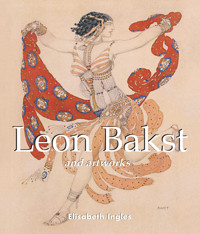
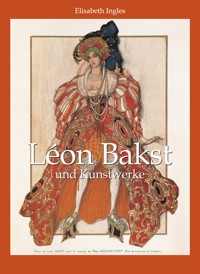
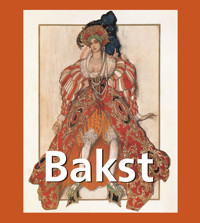
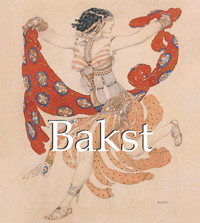
Léon Bakst (1866-1924) was a painter, illustrator, stage and costume designer. He is universally acknowledged for representing a synthesis of creative energy in the late 19th and early 20th centuries. Bakst travelled widely throughout Europe and in 1890 joined the World of Art journal circle which numbered many artists among its members, the most famous being Benois and Diaghilev. This book illustrates the wealth of Bakst's contribution to the world of theatre and dance. His best known work includes sets for Stravinsky's Firebird, and Weber's Spectre de la Rose.
Das E-Book können Sie in Legimi-Apps oder einer beliebigen App lesen, die das folgende Format unterstützen:
Seitenzahl: 70
Veröffentlichungsjahr: 2023
Ähnliche














Elisabeth Ingles
Leon
Text: Elisabeth Ingles
© 2023, Confidential Concepts, Worldwide, USA
© 2023, Parkstone Press USA, New York
© Image-Barwww.image-bar.com
All rights reserved. No part of this may be reproduced or adapted without the permission of the copyright holder, throughout the world.
Unless otherwise specified, copyright on the works reproduced lies with the respective photographers. Despite intensive research, it has not always been possible to establish copyright ownership. Where this is the case, we would appreciate notification.
ISBN: 978-1-78160-862-3
CONTENTS
Foreword
Biography
Introduction
Formative Influences:Childhood, Youth and Early Career1866-1890
Russia and France:The Creation of the World of Art1890-1909
Towards a Coloured Universe 1910-1913
The Grey Eminence 1914-1924
List of Illustrations
Foreword
“A marvellously decorative artist with great taste, infinite imagination, extraordinarily refined and aristocratic.“
— Bakst’s friend and colleague Anna Ostroumova-Lebedeva.
Biography
1866:
Leon Bakst (originally called Lev Samoilovich Rosenberg) was born on 9 May in Grodno (Belarus) into a middle-class Jewish family.
1883-1886:
He attended the Imperial Academy of Fine Arts in St Petersburg but was expelled after displeasing the school authorities with his painting of Madonna Weeping Over Christ in which all the figures were Jewish.
From 1886:
He started his artistic career as an illustrator for magazines.
1890:
He met Alexandre Benois and with him travelled regularly through Europe where he came in contact with local artists. He studied in Paris with a number of notable artists including Jean-Léon Gérôme at the Académie Julian.
1896:
He returned to St Petersburg and began to gain notoriety for his book designs and his portraits.
1898:
He co-founded the group World of Art with Alexandre Benois and Serge Diaghilev (Mir Iskusstva).
1902-1903:
He debuted with the stage design for the Hermitage and Alexandrinsky Theatres in St Petersburg. Afterwards, he received several commissions from the Mariinsky Theatre.
1906:
He was invited to teach drawing at Yelizaveta Zvantseva’s liberal school of painting, one of whose later students was Marc Chagall. He also went to Paris to prepare the Russian section of the annual art exhibition, the Salon d’Automne.
1909:
He again returned to France in 1908, where he began his collaboration with Sergei Diaghilev. This resulted in the founding of the Ballets Russes, where Bakst became the artistic director. His stage designs quickly brought him international fame.
1910s:
Bakst’s brilliant and exotic creations influenced fashions in dress and interior decoration for many years to come. He was the principal artist to introduce Orientalism into fashion. Most notable are his costume designs for Diaghilev’s Shéhérazade (1910) and L’Après-Midi d’un faune (1912).
1912:
He settled in Paris in 1912, after being exiled because of his Jewish origins.
1920:
The publisher of Vogue Magazine, Conde Nast, was after Bakst to persuade him to draw a cover for Vogue.
1924:
He died in Paris on 27 December, at the age of fifty-eight.
Introduction
Between the 1870s and 1917, the whole way of life in Russia was undergoing a tremendous series of changes. A vast range of disparate factors contributed to the restlessness of the period, not only in cultural developments but in the political arena as well. The literature of the day both stimulated and reflected these currents of change. Dostoyevsky and Turgenev had much to say on the subject of social injustice.
Gorky embraced the growing revolutionary fervour of the turn of the century, and a prose poem written by him in 1901 provided a rallying-call for the reforming movement.
Ballet, which had developed in St Petersburg from 1738 as a consequence of Peter the Great’s admiration for French and Italian culture and later took root in Moscow, remained one of the most popular artistic entertainments throughout the nineteenth century, achieving new heights of grandeur through the input of such choreographers as Marius Petipa (1822-1910) and composers such as Piotr Ilyich Tchaikovsky (1840-1893) – a partnership responsible for the three evergreen classics: Swan Lake, The Sleeping Beauty and The Nutcracker. Opera, too, was beginning to emerge from the obscurity in which it had languished earlier in the century. Nothing really innovative leapt out at the audience; little, except perhaps Tchaikovsky’s operatic essay on the super-natural, The Queen of Spades, administered a shock to their sensibilities.
Diaghilev was to change all this. Somehow he had the vision to put together an infinite variety of widely divergent talents and see what happened. Diaghilev and his fellow-founders of Mir Iskusstva (the World of Art) drew into their orbit artists, musicians, dancers and singers whose names are today a byword for excitement, for colour and glamour, and for the shock value of a radical new approach to the arts.
Diaghilev’s Ballets Russes, the immediate offshoot of this artistic grouping, was to be the showcase for the genius of the painters Benois and Picasso as well as Bakst; the composers Ravel, de Falla, Debussy and Stravinsky; the choreographer Fokine and the dancers Pavlova, Karsavina and Nijinsky. Bakst fits effortlessly into this incomparable roll-call of stars.
Paris Welcoming Admiral Avelan, 1893-1900
Oil on canvas. The Central Navy Museum, St Petersburg
Portrait of Valery Nuvel, 1895
Watercolour on paper, mounted on cardboard, 57 x 44.2 cm. Russian Museum, St Petersburg
Portrait of Alexander Benois, 1898
Watercolour and pastel on paper mounted on cardboard. 64.5 x 110.3 cm. Russian Museum, St Petersburg
Dolls Market, 1899
Design for poster, pastel on cardboard, 72 x 98 cm. Russian Museum, St Petersburg
The Chinese Woman, c. 1900
Series of twelve postcards for the ballet The Fairy Doll. Editions de la commune Sainte Eglise
Formative Influences:Childhood, Youth and Early Career 1866-1890
Bakst came from a bourgeois Jewish family of comfortable means – his father was a successful businessman, his grand-father had earned a very good living as a tailor. The boy was born Lev Samuilovich Rosenberg on 9 May, 1866 in the town of Grodno, in what is now Belarus. The family moved to St Petersburg, then the Russian capital, when he was a few months old, and the northern city was to be his home town for nearly thirty years. As soon as he was old enough, Bakst was taken by his parents to the theatre, and drank in every detail of this wonderful world of make-believe. No doubt his childish “performances”. At home were also fuelled by the plays he saw – certainly the home theatricals would have grown more polished and sophisticated.
Obstinately, he insisted that he wanted to study art, and eventually his parents’ opposition crumbled when they received advice from the sculptor Mark Antokolski, a leading figure among the Itinerants, that Lev was capable of producing work of top quality.
At the age of seventeen the young Bakst was enrolled at the Academy, an institution that was unfortunately already in decline and had little to offer the brightest talents of the day. He did not have unqualified success there – quite the opposite, in fact.
He showed no particular leaning to any of the essential core subjects: history, religion and life studies did not interest him, and it showed. He failed to shine in any field, and finally overstepped the limits of his teachers’ patience when he produced an altogether too realistic representation of a religious subject. The Lamentation of Christ portrayed Mary as an old woman, red-eyed with weeping, and other characters exhibited pronounced Jewish features.
It was too much for the strait-laced, deeply conventional and probably racially-biased Academy of the 1880s.
By this time, his family’s circumstances had altered for the worse following the recent death of his father. Bakst was forced to start looking for a means of providing financial support for himself and his mother and sisters.
After some searching, he was taken on as an illustrator at a studio that produced educational and children’s books.
The owner of this educational enterprise, the writer Alexander Kanayev, took the young man under his wing and introduced him to various leading lights on the cultural scene, most notably Chekhov. Bakst came to know other artists as well as writers and publishers, and following his first commission from Kanayev found he was soon able to earn a modest living. Little of the work he produced during this early period was of any lasting value.
From 1888, however, when he illustrated editions of Shakespeare’s King Lear and Schiller’s The Maid of Orléans




