


18,99 €
Mehr erfahren.
- Herausgeber: John Wiley & Sons
- Kategorie: Geisteswissenschaft
- Serie: Key Contemporary Thinkers
- Sprache: Englisch
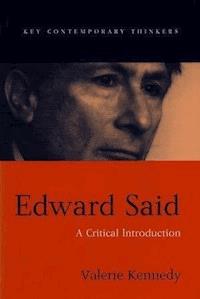
Edward Said is one of the foremost thinkers writing today. His work as a literary and cultural critic, a political commentator, and the champion of the cause of Palestinian rights has given him a unique position in western intellectual life. This new book is a major exploration and assessment of his writings in all these main areas.
Focusing on Said's insistence on the connection between literature, politics and culture, Kennedy offers an overview and assessment of the main strands of Said's work, drawing out the links and contradictions between each area. The book begins with an examination of Orientalism, one of the founding texts of post-colonial studies. Kennedy looks at the book in detail, probing both its strengths and weaknesses, and linking it to its sequel, Culture and Imperialism. She then examines Said's work on the Palestinian people, with his emphasis on the need for a Palestinian narrative to counter pro-Israeli accounts of the Middle East, and his searing criticisms of US, Israeli, and even Arab governments. The book closes with an examination of Said's importance in the field of post-colonial studies, notably colonial discourse analysis and post-colonial theory, and his significance as a public intellectual.
This book will be of great interest to anyone studying post-colonialism, literary theory, politics, and the Middle East, as well as anyone interested in Said's writings.
Sie lesen das E-Book in den Legimi-Apps auf:
Seitenzahl: 367
Veröffentlichungsjahr: 2013
Ähnliche



















Table of Contents
Cover
Title page
Copyright page
Key Contemporary Thinkers
Acknowledgements
Abbreviations
Works by Said
Works by other authors
Introduction
Edward Said: a significant figure
A man of more than one world
Early criticism: from Joseph Conrad to The World, the Text, and the Critic
Overview
1 Orientalism
Introduction
The scope and arguments of Orientalism
The question of definition
Contradictory methods and values: Foucault, Gramsci and humanism
Gender in Orientalism: a neglected factor
Conclusion: Said, Orientalism and the question of positionality
2 Imperialism in the Middle East: Palestine, Israel and the USA
Introduction
Permission to narrate
Modifying the discursive framework
The lonely critical voice and the search for an alternative
Questions of representation, position and objectivity
Conclusion
3 After Orientalism: Culture and Imperialism
Introduction
Overview
The methodological framework
The search for an alternative
Conclusion: the oppositional stance of the secular intellectual
4 Said and Postcolonial Studies
Introduction
Said and the field of postcolonial studies
Postcolonial theorists: Edward Said, Homi Bhabha and Gayatri Spivak
Orientalism and the literature of empire
Orientalism and the study of imperial travel writing
Conclusion
Conclusion
Bibliography
Index
Copyright © Valerie Kennedy 2000
The right of Valerie Kennedy to be identified as author of this work has been asserted in accordance with the Copyright, Designs and Patents Act 1988.
First published in 2000 by Polity Press in association with Blackwell Publishers Ltd
Editorial office:
Polity Press
65 Bridge Street
Cambridge CB2 1UR, UK
Marketing and production:
Blackwell Publishers Ltd
108 Cowley Road
Oxford OX4 1JF, UK
Published in the USA by
Blackwell Publishers Inc.
Commerce Place
350 Main Street
Malden, MA 02148, USA
All rights reserved. Except for the quotation of short passages for the purposes of criticism and review, no part of this publication may be reproduced, stored in a retrieval system, or transmitted, in any form or by any means, electronic, mechanical, photocopying, recording or otherwise, without the prior permission of the publisher.
Except in the United States of America, this book is sold subject to the condition that it shall not, by way of trade or otherwise, be lent, re-sold, hired out, or otherwise circulated without the publisher’s prior consent in any form of binding or cover other than that in which it is published and without a similar condition including this condition being imposed on the subsequent purchaser.
ISBN 0-7456-2018-3
ISBN 0-7456-2019-1 (pbk)
ISBN 9780-7456-6745-4 (epub)
ISBN 9780-7456-6744-7 (mobi)
ISBN 9780-7456-7759-0 (epdf)
A catalogue record for this book is available from the British Library and has been applied for from the Library of Congress.
Key Contemporary Thinkers
Published
Jeremy Ahearne, Michel de Certeau: Interpretation and its Other
Peter Burke, The French Historical Revolution: The Annales School 1929–1989
Michael Caesar, Umberto Eco: Philosophy, Semiotics and the Work of Fiction
Colin Davis, Levinas: An Introduction
Simon Evnine, Donald Davidson
Edward Fullbrook and Kate Fullbrook, Simone de Beauvoir: A Critical Introduction
Andrew Gamble, Hayek: The Iron Cage of Liberty
Philip Hansen, Hannah Arendt: Politics, History and Citizenship
Sean Homer, Fredric Jameson: Marxism, Hermeneutics, Postmodernism
Christopher Hookway, Quine: Language, Experience and Reality
Christina Howells, Derrida: Deconstruction from Phenomenology to Ethics
Simon Jarvis, Adorno: A Critical Introduction
Douglas Kellner, Jean Baudrillard: From Marxism to Post-Modernism and Beyond
Valerie Kennedy, Edward Said
Chandran Kukathas and Philip Pettit, Rawls: A Theory of Justice and its Critics
James McGilvray, Chomsky: Language, Mind, and Politics
Lois McNay, Foucault: A Critical Introduction
Philip Manning, Erving Goffman and Modern Sociology
Michael Moriarty, Roland Barthes
William Outhwaite, Habermas: A Critical Introduction
John Preston, Feyerabend: Philosophy, Science and Society
Susan Sellers, Hélène Cixous: Authorship, Autobiography and Love
David Silverman, Harvey Sacks: Social Science and Conversation Analysis
Dennis Smith, Zygmunt Bauman: Prophet of Postmodernity
Geoffrey Stokes, Popper: Philosophy, Politics and Scientific Method
Georgia Warnke, Gadamer: Hermeneutics, Tradition and Reason
James Williams, Lyotard: Towards a Postmodern Philosophy
Jonathan Wolff, Robert Nozick: Property, Justice and the Minimal State
Forthcoming
Maria Baghramian, Hilary Putnam
Sara Beardsworth, Kristeva
Mark Cain, Fodor: Language, Mind and Philosophy
James Carey, Innis and McLuhan
Rosemary Cowan, Cornell West: The Politics of Redemption
George Crowder, Isaiah Berlin: Liberty, Pluralism and Liberalism
Thomas D’Andrea, Alasdair MacIntyre
Eric Dunning, Norbert Elias
Jocelyn Dunphy, Paul Ricoeur
Matthew Elton, Daniel Dennett
Nigel Gibson, Frantz Fanon
Graeme Gilloch, Walter Benjamin
Karen Green, Dummett: Philosophy of Language
Espen Hammer, Stanley Cavell
Keith Hart, C.L.R. James
Fred Inglis, Clifford Geertz: Culture, Custom and Ethics
Sarah Kay, Žizžek: A Critical Introduction
Paul Kelly, Ronald Dworkin
Carl Levy, Antonio Gramsci
Moya Lloyd, Judith Butler
Dermot Moran, Edmund Husserl
Harold Noonan, Frege
Steve Redhead, Paul Virilio: Theorist for an Accelerated Culture
Chris Rojek, Stuart Hall and Cultural Studies
Wes Sharrock and Rupert Read, Kuhn
Nick Smith, Charles Taylor
Nicholas Walker, Heidegger
Acknowledgements
Many thanks to Susanne Kappeler for initiating this project. I would also like to thank Lester Barber, Stephen Buick, Thomas F. Daughton, Jamil Khadir, Anthony Lake, Hasna Lebbady and Sita Schutt for reading and discussing part or all of various versions of this text, and for their support and encouragement. Thanks to Mohammed Dahbi and Michael Toler for copies of articles and to Francesca Cauchi for reading the proofs and help with the index. I would also like to thank Bilkent University, Ankara, Turkey, for some financial support for this project.
I would like to express my most grateful thanks to Edward W. Said for his gracious permission to reproduce material from the following works:
Culture and Imperialism (World English language rights, excluding the USA).
‘Opponents, audiences, constituencies, and community’; ‘Interview’, in Diacritics, 1976; ‘Shattered myths’, ‘From silence to sound and back again’, ‘Figures, configurations, transfigurations’; ‘Interview’ in boundary 2, 1993; ‘Homage to a belly-dancer’; ‘Interview’ in Edward Said: A Critical Reader, ed. Michael Sprinker; ‘Interview’ in A Critical Sense, ed. Peter Osborne; ‘The Arab Right Wing’; ‘The Arab-American war’, ‘Identity, negation, and violence’; ‘The Other Arab Muslims’; ‘Orientalism reconsidered’; ‘The politics of knowledge’.
I would also like to thank the following for their kind permission to reproduce material from the following works:
Random House UK and Chatto and Windus for Culture and Imperialism by Edward Said; Faber and Faber Ltd. for ‘Tradition and the individual talent’, in The Sacred Wood (new edition, 1997) by T. S. Eliot; Harcourt Inc. for ‘Tradition and the individual talent’ in Selected Essays by T. S. Eliot.
I would also like to thank Random House USA for permission to reproduce material as follows:
From Orientalism by Edward W. Said. Copyright © 1978 by Edward W. Said. Reprinted by permission of Pantheon Books, a Division of Random House Inc.; From Culture and Imperialism by Edward W. Said. Copyright © 1993 by Edward W. Said. Reprinted by permission of Alfred A. Knopf Inc.
Abbreviations
Works by Said
Books
ALS After the Last Sky (1986)
B Beginnings (1975)
BV Blaming the Victims (1988)
CI Culture and Imperialism (1993)
CIs Covering Islam (1981)
JC Joseph Conrad and the Fiction of Autobiography (1966)
ME Musical Elaborations (1991)
O Orientalism (1978)
PandS The Pen and the Sword (1994)
PD Peace and Its Discontents (1995)
PolD The Politics of Dispossession (1995)
QP The Question of Palestine (1979)
RI Representations of the Intellectual (1994)
WTC The World, the Text, and the Critic (1983)
Interviews
D Diacritics interview (1976)
I Interview with Jennifer Wicke and Michael Sprinker (1992)
Articles
F ‘Figures, configurations, transfigurations’ (1990)
FW Foreword to Little Mountain by Elias Khoury (1989)
Int Introduction to Days of Dust by Halim Barakat (1983)
OR ‘Orientalism reconsidered’ (1985)
O ‘Opponents, audiences, constituencies, and community’ (1982)
RC ‘Representing the colonized’ (1989)
SM ‘Shattered myths’ (1975)
Works by other authors
Homi Bhabha
LC The Location of Culture (1994)
Free ‘Freedom’s basis in the indeterminate’ (1995)
Benyamin Netanyahu
APN A Place Among the Nations: Israel and the World (1993)
Gayatri Spivak
CSS ‘Can the subaltern speak?’ (1993)
HTR ‘How to read a “culturally different” book’ (1994)
IM Imaginary Maps: Three Stories by Mahasweta Devi (1995)
IOW In Other Worlds: Essays in Cultural Politics (1987)
OTM Outside in the Teaching Machine (1993)
PCC The Post-Colonial Critic: Interviews, Strategies, Dialogue (1990)
RS ‘The Rani of Sirmur’ (1984)
TWT ‘Three women’s texts and a critique of imperialism’ (1985)
Introduction
Edward Said: a significant figure
As a literary and cultural critic and social commentator, Edward Said is a highly significant and at times controversial figure in contemporary intellectual life. His œuvre is impressive in terms of both scope and importance, and he has exercised a significant influence in the field of cultural and postcolonial studies. His writings on Orientalism and related phenomena have provided the inspiration for a large number of new studies, including many which extend his work in unexpected ways or in ways which implicitly or explicitly challenge his own ideas. A writer of avowedly conservative literary and cultural biases, Said has increasingly come to analyse the complex and vital relationship between literature, politics and culture. This analysis has taken three main forms in his work. First, two of his most important books, Orientalism and Culture and Imperialism, consider the relationship between the West and the East in the colonial and postcolonial contexts. Second, Said has been directly concerned both with Palestine and the situation of Palestinians in the Middle East, and with larger issues related to the Arabo-Islamic world and its relationship with and representation in and by the West. Third, he has devoted considerable time and energy to defining the role and responsibilities of the intellectual in the contemporary world.1
The first main area of his work deals with the political implications of Western colonialism and imperialism and the West’s domination and representation of the East or, more generally, the non-European world. Orientalism, first published in 1978, examines the development of Western conceptions and representations of the Orient from the middle of the eighteenth century to the present. Orientalism is seen as a set of academic disciplines concerned with studying the Orient, but also as a style of thought based on an existential difference between the Orient and the Occident. Both these are related to the development of the institutional and administrative procedures of Western imperialism. The book offers a variety of perspectives on the proliferating discourses of Orientalism in such disparate areas as literature, linguistic and other types of scholarship, travel writing, anthropology and colonial administration. The varying definitions and views of Orientalism are not always completely consistent, but the book’s central argument about the interdependence of the political and the cultural dimensions of Orientalism and their effects on literary works provided a dramatically new insight in mainstream literary criticism. It has since proved to be one of the key sources, if not the key source, of inspiration for much later work by others in the fields of literary, critical and cultural theory, especially in postcolonial studies. Culture and Imperialism continues and extends the work begun in Orientalism by documenting the imperial complicities of some major works of the Western literary (and in one case, musical) canon. The book’s final chapter looks at the geopolitics of the postcolonial world and pays particular and critical attention to America’s role in it.
The second main focus of Said’s work is the analysis of the situation in Palestine, Israel and the Middle East more generally. His main concern has always been the condition of the Palestinian people, but he has also constantly written about larger political and cultural issues related to the Arabo-Islamic world and its relationship with the West, including the ways in which it is constructed and represented by the West. Said sees his work in this area as being intimately connected to his work on Orientalism. Orientalism was quickly followed by The Question of Palestine (1979) and Covering Islam (1981). The Introduction to Covering Islam argues that the three books deal with the relation between ‘Islam, the Arabs, and the Orient’, on the one hand, and ‘the West, France, Britain, and in particular the United States’, on the other.2 He has also said, in the Afterword to the 1995 edition of Orientalism, that his position on the Palestinian issue has not changed in its essentials since the original publication of The Question of Palestine.3 The many essays that he has written since then bear out this statement. Two main concerns emerge. The first is the documentation of Palestinian existence in the nineteenth and twentieth centuries, with emphasis on the need for a Palestinian narrative to counter the pro-Israeli narrative of events in the Middle East. This is accompanied by the analysis of the distortions, prejudices and racism that all too often characterize the representation of Islam and Arabs, especially Palestinian Arabs, by the Western media and academia. Secondly, Said has consistently provided a critique of US government policy in the Middle East, and of the Israeli and Arab governments and their actions, including those of the recently established Palestinian Authority.
Said’s third central topic is the function of criticism in the contemporary world, especially the role and responsibilities of the intellectual. Two key texts here are The World, the Text, and the Critic (1983) and Representations of the Intellectual (1994). In the first, Said puts forward his own theoretical position, provides a commentary on aspects of contemporary critical theory which is often scathing, and offers some perceptive and idiosyncratic accounts of certain individual writers. He proposes a model of secular criticism, criticizes much contemporary theory because of its detachment from the problems and constraints of the real world and explains why Foucault rather than Derrida provides part of the inspiration for his own approach. Said’s later writings show his increasing impatience with Foucault’s work, which he comes to see as more and more detached from real-life political and social issues, and thus as ineffectual, since it fails to challenge the status quo or bring about change. For Said, the key words for the intellectual are scepticism, memory and, above all, ‘the critical sense’.4 In Representations of the Intellectual he develops his argument that the intellectual should not be seduced by power or official approval, but should remain unco-opted if not uncommitted, ready to challenge orthodoxies and received ideas and to change the world.
The interrelation of these three major areas in Said’s work is one reason for Said’s special position in contemporary Western intellectual life. Others are the wide scope and the rich variety of his analyses of literary works and political and cultural phenomena, and the courage he has shown in expressing his political convictions. He is in many ways the restless embodiment of his own ideal of the unco-opted critical intellectual who refuses to accept orthodoxy of any kind. The reasons for this can be found in the way in which Said has assumed the contradictions and conflicts subsequent to the accident of his birth and the events of his life. Said has made the facts of his birth and his experiences a central strand in his work, uniting the personal and the public dimensions of his life in writing which is compelling and often provocative.5
A man of more than one world6
Said was born in November 1935 in Talbiya, West Jerusalem, in what was then British Mandate Palestine.7 His father’s family, from Jerusalem, was middle-class, conventional, formal and Anglican. His mother’s, from Safad and later Nazareth, was also middle-class but less conventional and more artistically inclined. The family lived mostly in Cairo, but spent long periods in Palestine in 1942 and 1947, and spent their summers in the Lebanese village of Dhour el Shweir for twenty-seven years, beginning in 1943. As a Christian, but a Protestant rather than a member of the Orthodox Church, Said grew up as part of a minority inside a minority. As he says to Imre Salusinszky, ‘Although Palestinians, we were Anglicans: so we were a minority within the Christian minority in an Islamic majority setting.’8 He was baptized in the Anglican cathedral of St George, and in 1947 spent some months at St George’s school, where his father had also studied.9 In Cairo, he attended Gezira primary school, the Cairo School for American Children and finally Victoria College. The family left Jerusalem for good in December 1947, before the Palestinian–Israeli war of 1947 and the expulsion and dispossession of many Palestinians in the annakba, or catastrophe, and returned to Cairo. At the British-run Victoria College, Said was often punished as a troublemaker, partly for speaking Arabic rather than English. Finally he left and was sent to the USA by his father, where he completed his secondary education at Mount Hermon, a boarding school in Massachusetts, before going on to study at Princeton and Harvard. He took up a teaching position at Columbia, where he became University Professor of English and Comparative Literature.10
From the 1970s onwards, Said has sought to turn his initial sense of alienation in the USA and his growing awareness of a divided allegiance as both a Palestinian Arab and an American citizen into something positive by bringing together the two sides of his experience. As he said in an interview, until about 1967 his career was almost purely that of the literary academic. After that date his two lives as American academic and concerned Middle Easterner began to come together in his work. This was due to the Six Day War of 1967 and subsequent events in the Middle East, and to Said’s growing awareness of the interrelation of politics and literature and of his own responsibilities.11 From the late 1960s to the mid-1970s Said moved from being a traditional humanist academic to become one of the most significant Anglophone cultural and political commentators of the later twentieth century.
He has striven for a vision of transnational human interaction avoiding both sectarianism and politics based on divisive notions of ethnic or religious identity. He has written about some aspects of his early life in Palestine and Egypt, his initial feeling of alienation when he arrived in the USA, and the implications of being a man of two worlds, notably in the 1998 essay ‘Between worlds’ and in his 1999 memoir Out of Place. He has also discussed both the current situation and the complex mixture of feelings occasioned by his journeys back to Palestine-Israel in 1992, 1996 and 1998 in a series of articles originally published in the London Review of Books. The more general issue of exile and dispossession is approached in several other essays: Said has come to see his own position as a relatively privileged exile as one variant of the situation of displacement which he sees as a typical feature of the late twentieth century.
Said has returned to Palestine-Israel only a few times since he and his family left in 1947. On the first of these occasions, in 1992, he was accompanied by his second wife, Miriam, his son, Wadie, and his daughter, Naila, aged 20 and 18 respectively. On his second journey, in 1996, he travelled alone, but he spent some time with his son who was then working as a translator for the Jerusalem Media and Communication Centre in the Occupied Territories. In 1998 he returned to make a film for a British television channel about the Palestinians. As might be expected, the feelings aroused by these journeys are strong and conflicting. There is the shock of recognition on seeing the Said family home in West Jerusalem again, and then anger and sadness at the discovery that the house is now inhabited by a ‘right-wing fundamentalist Christian and militantly pro-Zionist group’.12 Generally, Said has a sense of a history finished, places lost, a country where, with the exception of Arab Nazareth, he can no longer feel at home. Moreover, when he visits Gaza, both in 1992 and 1996, he finds conditions worse than those he saw in the South African townships in 1991. Finally, while feeling a sense of solidarity with Palestinians in Israel and the Occupied Territories, Said recognizes that it would be very hard for him to live there, since his own state of exile is relatively liberated and privileged by comparison.13 The 1996 visit reveals a similar mixture of emotions, with the added detail that by then all of Said’s books have been removed from bookshops in Gaza and on the West Bank on the orders of Yasser Arafat.14 The film shown on British television in May 1998 on the anniversary of the establishment of the state of Israel covers similar ground. In addition, Said narrates his visit to Hebron and bears witness to the continuing confiscation and destruction of Palestinian land and property by Israeli soldiers acting on the orders of the state, and the continuing encroachments of Israeli settlers on land under the jurisdiction of the Palestinian Authority. He notes with some bitterness that the Palestinian Authority seems to be doing nothing to stop this process.
Said’s accounts of these journeys are complemented by several pieces in which he explores the condition of exile more generally as a late twentieth-century phenomenon, notably ‘Reflections on exile’ and ‘The mind of winter: reflections on life in exile’, both published in 1984. These argue that it is part of the contemporary intellectual’s role to speak for the displaced and dispossessed, and to use the freedom of exile for positive ends. Indeed, Said uses the image of exile or migrancy elsewhere in his work to characterize the role of the intellectual in the late twentieth century. He argues that the intellectual should be a marginal or migrant figure who helps to produce new types of knowledge as well as to criticize abuses of power and the obfuscations and distortions of official discourse.15
Above all, Said’s work shows a consistent independence of thought, which is his most outstanding characteristic. He has tried to embrace the contradictions and divisions of his position in order to use them for positive ends. Yet if his chosen position as a man between two cultures, worlds and languages has enabled him to make connections which few, if any, had made before, then it also has certain negative consequences. First, despite his desire to allow the marginalized to speak, he is consistently blind to gender, and women are certainly under-represented in his work. Second, there is a potential clash between the detachment of the scholarly humanist and the commitment of the polemicist who argues for Palestinian rights.
Said’s blindness to gender characterizes almost all of his work. It is rare for him to analyse a work by a woman, although there are exceptions to this,16 and he has shown himself to be aware of his deficiencies in this respect. As he has said to Peter Osborne, there are no ‘heroines’ in Orientalism,17 and After the Last Sky also comments on its own failure to pay attention to Palestinian women.18 Said’s neglect of gender is ironic for two reasons. First, his demystification of the construction of the Oriental as Other in Orientalism parallels feminism’s focus on the woman as Other; second, one of the types of scholarly work inspired by Orientalism is the study of women’s role in Orientalism as travellers, writers and artists. Said’s neglect of gender may be at least partially explained by certain features of his context and upbringing. Neither the Palestinian society nor the class into which he was born, nor the elite British and American educational institutions which he attended as a student and at which he later taught, encouraged any awareness of gender as an important theoretical factor or fact of real life. Indeed, Said has spent most of his life as a student and teacher in typical patriarchal institutions, all-male worlds where women’s role and presence were negligible, at least until the recent past.
There is also a potential contradiction between the humanist scholar and the Palestinian polemicist. However, Said does not accept the values of the comfortable world of the Western academic elite uncritically. On the contrary, despite the distance between both his current situation and his class origins, on the one hand, and the poverty and dispossession of the majority of Palestinians on the other, he has tried to forge an oppositional form of Western humanism which defends the rights of the underprivileged. A look at his early works will show both his initial conservatism and the gradual shift from purely literary to more worldly and political analyses.
Early criticism: from Joseph Conrad to The World, the Text, and the Critic
In Joseph Conrad and the Fiction of Autobiography, the focus is on Conrad the great writer and the short stories as significant works of literature. The book avoids those features of Conrad’s writing on which Said focuses in Orientalism and Culture and Imperialism, that is, the themes of colonial domination and exploitation. Said uses the historical context of Conrad’s work primarily as a means of elucidating the letters and short stories as dramatizations of Conrad’s individual psychodrama, although sometimes he does suggest that changes in Conrad are caused by the changes in the external political environment (JC, pp. 73, 75). Although Said refers to Conrad’s awareness of himself as someone who was ‘the product of cross-bred nationalities’ (p. 69), he does not note that, as a Pole, Conrad has suffered Russian colonization, and came to identify himself, at least partially, with the worldview of another imperial power, Britain. The complexities of this potentially contradictory situation are not even signalled, much less analysed, and neither is the potential parallel between Said’s own experiences and those of Conrad, although a much later autobiographical piece explores this point.19
Said’s next book was Beginnings: Intention and Method (1975), which established his reputation as one of America’s foremost contemporary literary critics. As Said himself says in a later interview with Imre Salusinszky, it is somewhat ‘ventriloquistic’, the work of a writer seeking his own voice through the works and voices of others.20 While it shows his continued interest in Conrad, it works on a much broader historical and theoretical basis, relating literature to philosophy, psychology, and critical and cultural theory. Said discusses the development of the European novel from the eighteenth to the twentieth century and sees it in terms of ‘beginnings’, ‘authority’ and ‘molestation’. The novel is seen as having a ‘quasi-paternal role’ until the advent of modernism when this role is exchanged for ‘an almost total supplementarity’ (B, p. 151). The problem of locating a beginning point in critical theory is approached from the point of view of certain types of French critical thought such as structuralism, post-structuralism (Foucault) and deconstruction (Derrida). Derrida’s ideas are not examined at any length, although he is important in exposing the problems of structuralism (pp. 339–43). The book relates literature to other types of narrative, but to those of philosophy (Vico, Marx, Kierkegaard, Nietzsche), psychology (Freud) and critical and cultural theory (Foucault, Derrida, Lévi-Strauss), rather than those of history, politics or economics. The theory of narrative authority and molestation pays no attention to the specific historical or political contexts of texts. For example, Nostromo is read through its author’s psychobiography, and the colonial and postcolonial contexts of both author and text are ignored (pp. 100–37).
Nonetheless, Beginnings is important since it indicates three of Said’s later major concerns. These are, first, his growing consciousness about what is involved in the activities of creative writing and criticism, and of the implications of his own position in relation to the European critical tradition and to the American academy. The second is his exploration of secular beginnings rather than divine origins. Thirdly, Said’s desire to consider literature in connection with other forms of human activity, that is, as worldly, emerges alongside his awareness of the conservatism of his own ‘cultural biases’ (B, pp. xiii–xiv).
After Beginnings, ‘Shattered myths’ (1975) and the 1976 Diacritics interview indicate the way in which Said’s work underwent a fundamental change of direction in the mid-1970s.21 In ‘Shattered myths’ many of the key themes and ideas of Orientalism are already present. For example, Said pinpoints what he calls the ‘key reduction’ of Orientalism, the hierarchical opposition between Westerners and Easterners, describing it in terms which appear almost unchanged in Orientalism (SM, pp. 413–14, O, p. 49). He also focuses on a number of over-generalizing and demeaning stereotypes of Arabs (pp. 417, 421–2) and on Renan’s anti-Semitic linguistic studies (pp. 431–3) as he does in the later work. Said identifies Orientalism’s institutional basis, underscores its ‘political, social, and even economic significance’ (pp. 425–6) and indirectly evokes the issue of representation (pp. 440–1) which is to be so important and so problematic in Orientalism (O, p. 273). What is lacking, interestingly, is any reference to Foucault’s ideas of the archive or a discourse or systems of disciplinary control.
The Diacritics interview, conversely, is directly concerned with literary theory, Foucault’s ideas of discourse and the question of intellectual responsibility. It opens with a discussion of Said’s view of the reception of what both he and his interviewer call the ‘critical avant-garde’ in American universities. Said recognizes the value of the work done by critics such as Harold Bloom as innovative and exciting, but regrets ‘its comparative neglect of historical, you might say archival concern’ (D, pp. 30–1, emphasis in the original, and see p. 33). In a parallel fashion, Said finds the ‘New New critics’, especially the deconstructionists at Yale, ‘quietistic’ in that ‘They seem uninterested in political questions.’ He declares that he shares a number of their interests, but also notes that he feels ‘separated from [them] on a great many other grounds’, notably in relation to politics (p. 35).
Evoking his two lives as teacher and politically involved individual, he explains that the links between the two are beginning to emerge in his work. He states: ‘I guess that what moves me mostly is anger at injustice, an intolerance of oppression, and some fairly unoriginal ideas about freedom and knowledge’ (p. 36). The phrase looks forward to many of his later pronouncements on intellectual responsibility. The rest of the interview is taken up with the project of the book on Orientalism, including some illuminating references to Foucault’s ideas. Foucault functions as an enabling figure who connects the realm of theory with the realm of worldly concerns of power, domination and representation. Said praises Foucault’s attack on the figure of the author as originating figure (p. 40), but he describes Foucault’s diagnosis of the systematic and constraining nature of discourse as even more important (pp. 36, 41). Defining Orientalism as a ‘myth-system’, Said describes himself as ‘an Oriental writing back at the Orientalists … I am also writing to them, as it were, by dismantling the structure of their discipline’ (p. 47, emphasis in the original). Here Said describes himself as outside the field of discourse of Orientalism, writing from the Archimedean point outside the system that he is so sceptical about elsewhere.
By 1976 Said can be seen to be in the process of formulating his central ideas about critical responsibility. These are his scepticism about ‘technical criticism’, and his desire to link literature, history and politics by using theory to analyse the structures of social and political power and domination. These concerns lead him to formulate his key concepts of worldliness and secular criticism in The World, the Text, and the Critic.
For Said, to say that texts are worldly means that ‘they are … a part of the social world, human life, and of course the historical moments in which they are located and interpreted’ (WTC p. 4).22 If texts are worldly, then criticism must also deal with the world. One of the recurrent complaints about theory in Said’s writing in the 1970s and 1980s is that ‘American or even European literary theory now explicitly accepts the principle of noninterference.’ Conversely, he believes that ‘criticism and the critical consciousness’ should take account of ‘The realities of power and authority’ as well as those of resistance (WTC, pp. 3, 5). In ‘Reflections on American “left” literary criticism’, first published in 1979, Said laments the lack of ‘real opposition’ in academic work, finding it ‘for the most part stunningly silent’ about the relationships between intellectuals, culture and the power and authority of the state. However, he quotes Foucault, Ohmann, Poulantzas and unnamed ‘Feminist critics’ as partial exceptions to this rule (WTC pp. 160, 169–70).
Said finds both formalism and structuralism wanting: formalism since it treats literary texts in abstraction from their social and political contexts, and structuralism for not being able to deal adequately with texts, their authors or intentions.23 Said’s unease with the structuralist project is primarily that it denies the specificity of the literary text and obliterates historical change and domination with its over-emphasis on system and method (B, pp. 319, 335, 337, 338). He exempts both Derrida and Foucault from these criticisms, and finds Foucault more congenial and suggestive for his own work than Derrida. As he says in the 1983 essay, ‘Criticism between culture and system’ (first published as ‘The problem of textuality’ in 1978), ‘Derrida’s criticism moves us into the text, Foucault’s in and out’ (WTC, p. 183, emphasis in the original). The essay documents Said’s reservations about Derrida’s reading of texts.24 Derrida’s work is seen as excessively abstract, over-reliant on the philosophical systems which it deconstructs, and tending to assume that concepts such as différance can remain both permanently undecidable and practical at the same time (pp. 209–10). Most importantly, for Said, Derrida does not provide enough ‘specification’ about the institutional basis and the power relations that underlie the Western metaphysical tradition. His work also ignores oppression and cannot criticize its own ethnocentrism (pp. 209, 212). However, although Foucault does include power relations in his work, his approach is also found wanting by Said. He has a passive and sterile view of how power works, he pays no attention to such notions as class struggle, state power, economic domination and so on, and there is no equivalent of Gramsci’s idea of hegemony in his work. Finally, Foucault is unable to account for historical change and does not include Europe’s domination of the non-European world in his analysis (pp. 221–3).
After the mid-1970s, there is in Said’s work a sense of an ever-growing impatience with writers who do not actively seek to promote change or, at least, a new awareness of the situation, whether within the academy or outside it. For him, it is one of the functions of the intellectual in the wider world to work towards this change in reality and awareness. In terms of his own œuvre, Orientalism may be said to have achieved precisely this.
Overview
This study will begin by discussing Orientalism as a ground-breaking book, and the only one, as Said says in his Afterword to the 1995 edition, that he wrote as one continuous project.25 Chapter 1 will present Orientalism’s scope and arguments. It will then analyse three central problematic aspects of the book: the issue of definition, the use of Foucault, Gramsci and the tradition of literary humanism and the conflicts in methodology and values which Said’s eclectic approach entails, and the book’s almost total neglect of gender as a theoretical category. Finally, ‘Orientalism reconsidered’ and Said’s ‘Afterword’ to the 1995 edition of the book will be discussed in relation to questions of positionality and to Said’s plea for alternative forms of knowledge and secularity.
Secularity is also a key term for Said in his writings on Palestine and the Middle East, to be examined in chapter 2. Said offers several versions of the Palestinian narrative, and he challenges what Foucault calls the ‘regime of truth’,26 that is, the assumptions underlying discussions of Israeli and Palestinian history. He also provides a critique of all of the major players in the area, as well as of Zionism, the policies of the US and Israeli governments and the role of the American media. Much of his writing on these issues is characterized by his equivocal position both inside and outside the Middle East situation and by his vacillations on the issues of objectivity and representation.
The third chapter will argue that Culture and Imperialism continues both the work begun in Orientalism in connecting literature and politics, and the attempt to analyse some aspects of American domination and neo-imperialism in the contemporary world that characterizes Said’s writings on Palestine. The organization, scope and main arguments of the book will be presented, the methodological framework – especially the use of T. S. Eliot, Fanon, Raymond Williams and Foucault – analysed, and the three elements of Said’s search for a third way examined and evaluated. These are: first, the radical elements in his work; second, his contrasting conservative preferences and priorities; and finally, his call for alternative modes of reading and interpretation and for secular opposition to official conformism, religious fundamentalism and coercive systems of thought of every kind.
The final chapter of the book will focus on what might be called Said’s legacy to the fields of postcolonial studies, whose development owes a great deal to Said’s ideas especially in relation to postcolonial theory and colonial discourse analysis. However, there are important differences in approach between Said and postcolonial theorists such as Homi Bhabha and Gayatri Spivak, notably regarding such matters as history, theory and positionality. Said’s work has been the inspiration for a more historicized and politicized approach to the literature of empire and imperial travel writing. It has also provided the impetus for the expansion of the field he began to open up with Orientalism, notably in the study of the genre of travel writing, especially travel writing by women.
Finally, since the issue of positionality is one of the themes of this study of Said, it is necessary to situate my own perspective. Said’s journey from the colonized periphery to the metropolitan neo-colonial centre was dictated by historical, political, and family necessities. My journey has been different. Born a British citizen, I have moved from near the centre to the periphery. Since 1976 I have been living and teaching in Kenya, Morocco and Turkey. The two journeys are in many ways incomparable. Still, tinged with postcolonial complicity as my journey inevitably is, it has also allowed me to arrive at perspectives on political and cultural issues that I could never have had if I had stayed in Europe. Without Said’s work, neither contemporary literary studies nor postcolonial theory would be quite the same: one major reason for this is Orientalism.
Notes
1 Said has also written quite extensively about music, a topic that will not be discussed in this work.
2 Said, Covering Islam, p. xlix.
3 Said, ‘Afterword to the 1995 printing’, Orientalism, p. 338.
4 Osborne, ‘Orientalism and after’, p. 79.
5 In Edward Said: The Paradox of Identity, Bill Ashcroft and Pal Ahluwalia view Said in similar terms, arguing that Said’s construction of his identity and his writing on Palestinian politics and literary and cultural theory are inextricably intertwined. They see his concept of worldliness as the key to his work as a whole, and take the paradoxes of his position to be typical of the hybridity and contradictions of the postcolonial situation (pp. 3, 12, 30).
6 In ‘Identity, authority, and freedom’, p. 11, Said says: ‘I belong to more than one world. I am a Palestinian Arab, and I am also an American.’
7 ‘Palestine, then and now’, pp. 47, 50. The presentation of Said’s life here is based on the following articles and books by Said: Out of Place; After the Last Sky, pp. 88, 91, 116–19, 169–72; ‘Edward Said: an exile’s exile’; ‘Palestine, then and now’; ‘Return to Palestine-Israel’ in The Politics of Dispossession; ‘Lost between war and peace’; and ‘Between worlds’.
8 Salusinszky, ‘Edward Said’, p. 128; see also ‘Edward Said: an exile’s exile’, p. 30.
9 ‘Palestine, then and now’, pp. 48, 50–1.
10 The controversy that erupted in September 1999 about Said’s early life can be seen largely as a politically motivated attempt to discredit Said, and, through him, the Palestinian cause. Said’s memoir, Out of Place, published in 1999, makes it clear that Said spent most of his childhood in Cairo, with extended visits to Palestine on several occasions. However, it is equally clear that he was born in Jerusalem, and did attend St George’s school there before the family left for Cairo in 1947. Despite the assertions of Justus Reid Weiner, Said has never claimed that he was a refugee; indeed, he explicitly rejected the word in talking to Imre Salusinszky. See Salusinszky, ‘Edward Said’, p. 127, and Jaggi, ‘Out of the shadows’, p. 6.
11 Osborne, ‘Orientalism and after: Edward Said’, pp. 66, 67. See also Said, ‘Interview: Edward W. Said’, Diacritics, p. 35; ‘Between worlds’, p. 5; Out of Place, p. 293. See also Ashcroft and Ahluwalia, Edward Said, p. 2.
12 ‘Palestine, then and now’, p. 50.
13 Ibid., p. 55.
14 ‘Lost between war and peace’, p. 14.
15 For more extensive discussion of Said’s views on the intellectual as expressed in his Representations of the Intellectual, see Ashcroft and Ahluwalia, Edward Said, pp. 131–46.
16 The analysis of Jane Austen’s Mansfield Park in Culture and Imperialism is one exception. Said has also written about the Egyptian novelist Ahdaf Souief in ‘Edward Said writes about a new literature of the Arab world’, and ‘Review of Ahdaf Souief’s In the Eye of the Sun’. In addition, there is his review of Joan Didion’s Miami in ‘Miami twice’, and his discussion of Tahia Carioca, the Egyptian actress and dancer. See ch. 4, pp. 126–31 for an analysis of Said’s views of Soueif, Carioca and other Arab writers and artists.
17 Osborne, ‘Orientalism and after’, p. 68.
18 Said, After the Last Sky, p. 77.
19 Said, ‘Between worlds’, p. 3. For comments on Said’s fascination with Conrad, see Ashcroft and Ahluwalia, Edward Said, pp. 14–16, 39–40, 106–7.
20 Salusinszky, ‘Edward Said’, p. 134.
21 See Brennan, ‘Places of mind, occupied lands’, p. 75, and Ashcroft and Ahluwalia, Edward Said, p. 95.
22 For a detailed analysis of Said’s elaboration of the concept of worldliness in The World, the Text, and the Critic, see Ashcroft and Ahluwalia, Edward Said, pp. 31–56.
23 For example, see his critique of Hartman’s formalistic approach to fiction as opposed to poetry in ‘What is beyond formalism?’, pp. 939–40, 945.
24 The essay appears in the later volume unchanged, except for a rewritten introductory section. Said distinguishes, here and elsewhere, between Derrida’s ideas and the use made of them by his followers.
25 Said, Afterword to the 1995 printing, Orientalism, p. 329.
26 Foucault, ‘Truth and power’, in Power/Knowledge, p. 131; see also pp. 112–13.
1
Orientalism
Orientalism is theoretically inconsistent, and I designed it that way.1
Introduction
It is almost impossible to overestimate the significance of Orientalism for the study of literature in English in the Anglo-American academic context. First published in 1978, it introduced a global perspective of political and economic realities to which literary studies had hitherto remained closed.2 Said brought politics into literary studies by insisting that scholarly Orientalism needs to be seen in the context of Western perceptions of the Orient dating back to Classical times. He argued that these perceptions need to be seen in relation to the Western domination of the Orient through colonialism and imperialism as well as neo-colonialism.3 A corollary of this argument is that Western academic institutions are compromised by their relation to power, especially in departments such as Area Studies.4




