


14,99 €
Mehr erfahren.
- Herausgeber: Parkstone International
- Kategorie: Geisteswissenschaft
- Sprache: Englisch
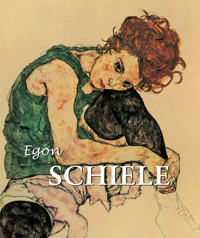
Egon Schiele’s work is so distinctive that it resists categorisation. Admitted to the Vienna Academy of Fine Arts at just sixteen, he was an extraordinarily precocious artist, whose consummate skill in the manipulation of line, above all, lent a taut expressivity to all his work. Profoundly convinced of his own significance as an artist, Schiele achieved more in his abruptly curtailed youth than many other artists achieved in a full lifetime. His roots were in the Jugendstil of the Viennese Secession movement. Like a whole generation, he came under the overwhelming influence of Vienna’s most charismatic and celebrated artist, Gustav Klimt. In turn, Klimt recognised Schiele’s outstanding talent and supported the young artist, who within just a couple of years, was already breaking away from his mentor’s decorative sensuality. Beginning with an intense period of creativity around 1910, Schiele embarked on an unflinching exposé of the human form – not the least his own – so penetrating that it is clear he was examining an anatomy more psychological, spiritual and emotional than physical. He painted many townscapes, landscapes, formal portraits and allegorical subjects, but it was his extremely candid works on paper, which are sometimes overtly erotic, together with his penchant for using under-age models that made Schiele vulnerable to censorious morality. In 1912, he was imprisoned on suspicion of a series of offences including kidnapping, rape and public immorality. The most serious charges (all but that of public immorality) were dropped, but Schiele spent around three despairing weeks in prison. Expressionist circles in Germany gave a lukewarm reception to Schiele’s work. His compatriot, Kokoschka, fared much better there. While he admired the Munich artists of Der Blaue Reiter, for example, they rebuffed him. Later, during the First World War, his work became better known and in 1916 he was featured in an issue of the left-wing, Berlin-based Expressionist magazine Die Aktion. Schiele was an acquired taste. From an early stage he was regarded as a genius. This won him the support of a small group of long-suffering collectors and admirers but, nonetheless, for several years of his life his finances were precarious. He was often in debt and sometimes he was forced to use cheap materials, painting on brown wrapping paper or cardboard instead of artists’ paper or canvas. It was only in 1918 that he enjoyed his first substantial public success in Vienna. Tragically, a short time later, he and his wife Edith were struck down by the massive influenza epidemic of 1918 that had just killed Klimt and millions of other victims, and they died within days of one another. Schiele was just twenty-eight years old.
Das E-Book können Sie in Legimi-Apps oder einer beliebigen App lesen, die das folgende Format unterstützen:
Seitenzahl: 117
Veröffentlichungsjahr: 2012
Ähnliche



















Authors:
EstherSelsdonAndJeanetteZwingerberger
Layout:
Baseline Co. Ltd
61A-63A Vo Van Tan Street
4th Floor
District 3, Ho Chi Minh City
Vietnam
Library of Congress Cataloging-in-Publication Data
Selsdon, Esther.
Egon Schiele / Esther Selsdon, Jeanette Zwingerberger. - 2nd ed. p. cm.
Includes index. 1. Schiele, Egon, 1890-1918. I. Schiele, Egon, 1890-1918. II. Zwingerberger, Jeanette. III. Title. N6811.5.S34S45 2011 759.36-dc23 2011023924
1. Schiele, Egon, 1890-1918. I. Schiele, Egon, 1890-1918. II. Zwingerberger, Jeanette. III. Title. N6811.5.S34S45 2011 759.36-dc23 2011023924
© Confidential Concepts, worldwide, USA
© Parkstone Press International, New York, USA
All rights reserved.
EstherSelsdon
JeanetteZwingerberger
Contents
His life
Schiele’s Childhood
The Favourite Sister, Gerti
Vienna at the Turn of the Century
Gustav Klimt, the Father Figure
Schiele’s Models
Expressive Art Process
Encounter with the Mirrored Image
First Exhibitions
Vienna Art Scene
Schiele’s Close Circle of Friends
Wally, his first love
Self-Portrait as Nude Study
Schiele, the Man of Pain
Fascination with Death
Phantom-Like Creatures
Body Perspectives
Vampire-Like Trait of Sex
Disgust and Allure
The Age of the Pornographic Industry
Schiele’s Arrest
International Artist
Schiele’s Socially Advantageous Marriage
The Bourgeois Schiele
Schiele, a Celebrated Artist
His work
SUNFLOWER I
PORTRAIT OF THE PAINTER ANTON PESCHKA
PORTRAIT OF OTTO WAGNER
SEATED NUDE GIRL
SEATED FEMALE NUDE WITH RAISED RIGHT ARM (GERTRUDE SCHIELE)
KNEELING GIRL IN ORANGE-RED DRESS
THE DEAD MOTHER I
SCHIELE DRAWING A NUDE MODEL IN FRONT OF A MIRROR
FEMALE NUDE
MOTHER AND CHILD
RECLINING GIRL IN A DARK BLUE DRESS
PORTRAIT OF THE PUBLISHER EDUARD KOSMACK
THE PAINTER MAX OPPENHEIMER, THREE-QUARTER LENGTH
PORTRAIT OF ARTHUR ROESSLER
SEATED MALE NUDE (SELF-PORTRAIT)
NEWBORN BABY
THE POET (SELF-PORTRAIT)
TWO LITTLE GIRLS
GROUP OF THREE GIRLS
THE DANCER MOA
MOA
OBSERVED IN A DREAM
TWO GIRLS (LOVERS)
SEATED GIRL, FACING FRONT
AUTUMN TREES
PROCESSION
PROPHETS (DOUBLE SELF-PORTRAIT)
AGONY
HINDERING THE ARTIST IS A CRIME, IT IS MURDERING LIFE IN THE BUD
AUTUMN SUN I (SUNRISE)
CARDINAL AND NUN (CARESS)
SELF-PORTRAIT WITH CHINESE LANTERN PLANT
PORTRAIT OF WALLY (VALERIE NEUZIL)
PORTRAIT OF IDA ROESSLER
HOLY FAMILY
WOMAN IN BLACK STOCKINGS (VALERIE NEUZIL)
DOUBLE PORTRAIT (CHIEF INSPECTOR HEINRICH BENESCH AND HIS SON OTTO)
SEATED FEMALE NUDE, ELBOWS RESTING ON RIGHT KNEE
BLIND MOTHER
YOUNG MOTHER
NUDE WITH GREEN TURBAN
TWO GIRLS (LOVERS)
PORTRAIT OF FRIEDERIKE MARIA BEER
SELF-PORTRAIT AS ST. SEBASTIAN (POSTER)
TWO GIRLS LYING ENTWINED
COITUS
KRUMAU TOWN CRESCENT (THE SMALL CITY V)
DECAYING MILL (MOUNTAIN MILL)
DEATH AND MAIDEN (MAN AND GIRL)
PORTRAIT OF AN OLD MAN (JOHANN HARMS)
PORTRAIT OF HEINRICH BENESCH
SEATED WOMAN IN UNDERWEAR, BACK VIEW
EMBRACE (LOVERS II)
SITTING WOMAN WITH BENT KNEE
MOTHER WITH TWO CHILDREN III
RECLINING FEMALE NUDE
FOUR TREES
EDGE OF TOWN (KRUMAU TOWN CRESCENT III)
PORTRAIT OF THE PAINTER PARIS VON GÜTERSLOH
THE FRIENDS (ROUND TABLE), SMALL
THE FAMILY (SQUATTING COUPLE)
Biography
Index of Works
Egon Schiele, 1914.
Photo.
His life
In 1964, Oskar Kokoschka evaluated the first great Schiele Exhibition in London as “pornographic”. In the age of discovery of modern art and the loss of “subject”, Schiele responded that for him there existed no modernity, but only the “eternal”. Schiele’s world shrank into portraits of the body, locally and temporally non-committal. Self-discovery is expressed in an unrelenting revelation of himself as well as of his models. The German art encyclopaedia, compiled by Thieme and Becker, described Schiele as an eroticist because Schiele’s art is an erotic portrayal of the human body. Furthermore, Schiele studied both male and female bodies. His models express an incredible freedom with respect to their own sexuality, self-love, homosexuality or voyeurism, as well as skilfully seducing the viewer.
For Schiele, the clichéd ideas of feminine beauty did not interest him. He knew that the urge to look is interconnected with the mechanisms of disgust and allure. The body contains the power of sex and death within itself. A photograph of Schiele on his deathbed depicts the twenty-eight-year-old looking asleep, his gaunt body completely emaciated, his head resting on his bent arm; the similarity to his drawings is astounding. Because of the danger of infection, his last visitors were able to communicate with the Spanish flu-infected Schiele only by way of a mirror, which was set up on the threshold between his room and the parlour.
During the same year, 1918, Schiele had designed a mausoleum for himself and his wife. Did he know, he who had so often distinguished himself as a person of foresight, of his nearing death? Did his individual fate fuse collectively with the fall of the old system, that of the Habsburg Empire? Schiele’s productive life scarcely extended beyond ten years, yet during this time he produced 334 oil paintings and 2,503 drawings. He painted portraits and still lifes of land and townscapes; however, he became famous for his draftsmanship. While Sigmund Freud exposed the repressed pleasure principles of upper-class Viennese society, which put its women into corsets and bulging gowns and granted them solely a role as future mothers, Schiele bares his models. His nude studies penetrate brutally into the privacy of his models and finally confront the viewer with his or her own sexuality.
Schiele’s Childhood
In modern industrial times, with the noise of racing steam engines and factories and the human masses working in them, Egon Schiele was born in the railway station hall of Tulln, a small, lower Austrian town on the Danube on 12 June 1890. After his older sisters Melanie (1886-1974) and Elvira (1883-1893), he was the third child of the railway director Adolf Eugen (1850-1905) and his wife Marie (born Soukoup) (1862-1935). The shadows of three male stillbirths were a precursor for the only boy, who in his third year of life would lose his ten-year-old sister Elvira. The high infant mortality rate was the lot of former times, a fate that Schiele’s later work and his pictures of women would characterise. In 1900, he attended the grammar school in Krems. But he was a poor pupil who constantly took refuge in his drawings, which his enraged father burned.
Self-Portrait with Hand to Cheek,1910.
Gouache,watercolourandcharcoal,
44.3x30.5cm.
GraphischeSammlungAlbertina, Vienna.
Self-Portrait with Black Clay Vas and Spread Fingers,1911.
Oiloncanvas,27.5x34cm.
Historisches Museum der Stadt Wien,
In 1902, Schiele’s father sent his son to the regional grammar and upper secondary school in Klosterneuburg. The young Schiele had a difficult childhood marked by his father’s ill health. He suffered from syphilis, which, according to family chronicles, he is said to have contracted while on his honeymoon as a result of a visit to a bordello in Triest. His wife fled from the bedroom during the wedding night and the marriage was only consummated on the fourth day, on which he infected her also. Despair characterised Schiele’s father, who retired early and sat at home dressed in his service uniform in a state of mental confusion. In the summer of 1904, stricken by increasing paralysis, he tried to throw himself out of a window. He finally died after a long period of suffering on New Year’s Day 1905. The father, who during a fit of insanity burned all his railroad stocks, left his wife and children destitute. An uncle, Leopold Czihaczec, chief inspector of the imperial and royal railway, assumed joint custody of the fifteen-year-old Egon, for whom he planned the traditional family role of railroad worker. During this time, young Schiele wore second-hand clothing handed down from his uncle and stiff white collars made from paper. It seems that Schiele had been very close to his father for he, too, had possessed a certain talent for drawing, had collected butterflies and minerals and was drawn to the natural world.
Years later, Schiele wrote to his sister: “I have, in fact, experienced a beautiful spiritual occurrence today, I was awake, yet spellbound by a ghost who presented himself to me in a dream before waking, so long as he spoke with me, I was rigid and speechless.” Unable to accept the death of his father, Schiele let him rise again in visions. He reported that his father had been with him and spoken to him at length. In contrast, distance and misunderstanding characterised his relationship with his mother who, living in dire financial straits, expected her son to support her; instead, the older sister would work for the railroad.
However, Schiele, who had been pampered by women in his childhood, claimed to be “an eternal child”. By a stroke of fate, the painter Karl Ludwig Strauch (1875-1959) instructed the gifted youth in draftsmanship; the artist Max Kahrer of Klosterneuburg looked after the boy as well. In 1906, at the age of only sixteen, Schiele passed the entrance examination for the general art class at the Academy of Visual Arts in Vienna on his first attempt. Even the strict uncle, in whose household Schiele now took his midday meals, sent a telegram to Schiele’s mother: “Passed”.
The Favourite Sister, Gerti
The nude study of the fiery redhead with the small belly, fleshy bosom and tousled pubic hair is his younger sister Gertrude (1894-1981). In another watercolour, Gerti reclines backwards, still fully clothed with black stockings and shoes, and lifts the black hem of her dress from under which the red orifice of her body appears. Schiele draws no bed, no chair, only the provocative gesture of his sister’s body offering itself. Incestuous fantasies? The sister, four years his junior, was a compliant subject for him.
At the same time as Sigmund Freud discovered that self-discovery occurs by way of erotic experiences, and “the urge to look” emerges as a spontaneous sexual expression within the child, young Egon recorded confrontations with the opposite sex on paper. He incorporated erotic games of discovery and shows an unabashed interest in the genitalia of his model into his nude studies. The forbidden gaze, searching for the opened female vagina beneath the rustling of the skirt hem and white lace. Gerti; with her freckled skin, green eyes and red hair, is the prototype of all the later women and models of Schiele.
Self-Portrait, 1912.
Pencil, watercolours and gouache,
46.5x31.5cm.
Private collection.
The Truth Unveiled, 1913.
Gouache, watercolour and pencil,
48.3x32.1cm.
Pri
Self-Portrait, 1910.
Gouache, watercolour and black crayon,
44.3x30.6cm.
Leopold Collection,
Leopold Museum, Vienna.
Self-Portrait, Facing Right, 1907.
Oil on cardboard, 32.4x31.2cm.
Private collection.
Vienna at the Turn of the Century
Vienna was the capital city of the Habsburg Empire, a state of multiple ethnicities consisting of twelve nations with a population of approximately thirty million. Emperor Franz Josef maintained strict Spanish court etiquette. Yet, on the government’s fortieth anniversary, he began a large-scale conversion of the city and its approximately 850 public and private monumental structures and buildings. At this time, the influx of the rural population coming to the big city was increasing. Simultaneously, increasing industrialisation resulted in the emergence of a proletariat in the suburbs, while the newly rich bourgeoisie settled in and around the exclusive Ringstrasse. In the writers’ cafés, Leon Trotsky, Lenin and later Hitler, consulted periodicals on display and brooded over the future of the new century.
Just how musty the artistic climate in Vienna was is evidenced by the scandal over Engelhard’s picture Young Girl under a Cherry Tree, in 1893. The painting was repudiated on the grounds of “respect for the genteel female audience, which one does not wish to embarrass so painfully vis-à-vis such an open-hearted naturalistic study”. What hypocrisy, when official exhibitions of nude studies, the obligation of every artist, had long been an institution. In 1897, Klimt, together with his fellow Viennese artists, founded the Vienna Secession, a splinter group aiming to separate itself from the officially accepted conduct for artists with the motto: “To the times its art, to the art its freedom”.
In 1898, the first exhibition took place in a building belonging to the horticultural society. It was distinguished from the usual exhibitions, which normally included several thousand works, by offering an elite selection of 100 to 200 works of art. The proceeds generated by the attendance of approximately 100,000 visitors financed a new gallery designed by the architect Olbrich. Exhibitions by Rodin, Kollwitz, Hodler, Manet, Monet, Renoir, Cézanne and Van Gogh opened the doors to the most up-to-date international art world. Visual artists worked beside renowned writers and musicians such as Rilke, Schnitzler, Alternberg, Schönberg and Alban Berg for the periodical Ver Sacrum. Here they developed the idea of the complete work of art, which encompassed all artistic areas. Simultaneously, the Secession required the abolition of the distinction between higher and lower art, art for the rich and art for the poor, and declared art common property. Yet, this demand of the art nouveau generation remained a privilege of the upper class striving for the ideal that ‘art is a lifestyle’, which encompassed architectural style, interior design, clothing and jewellery.
Nude Self-Portrait, Grimacing, 1910.
Pencil, watercolours and gouache,
55.8x36.9cm.
Graphische Sammlung Albertina,
Vienna.
Standing Male Nude with Red Loincloth, 1914.
Pencil, watercolour and gouache,
48x32cm.
Graphische Sammlung Albertina,
Vienna.




