


2,99 €
Mehr erfahren.
- Herausgeber: Hussein Elasrag
- Kategorie: Geisteswissenschaft
- Sprache: Englisch
When people came out in January 2011 for bread, freedom, and social justice, they did not expect some of them to be satisfied with subsidized bread after six years of revolution. This book considers the diverse forms of mass mobilization and contentious politics that emerged during the Egyptian Revolution of 2011 and its aftermath.
In addition to expose the role of the Muslim Brotherhood after the revolution. The book also presents the economic situation in Egypt and the most important challenges facing the Egyptian economy.
Das E-Book können Sie in Legimi-Apps oder einer beliebigen App lesen, die das folgende Format unterstützen:
Veröffentlichungsjahr: 2022
Ähnliche










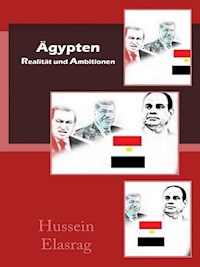


Egypt
Reality and Ambitions
By Hussein Elasrag
Copyright 2017 Hussein Elasrag
When people came out in January 2011 for bread, freedom and social justice, they did not expect some of them to be satisfied with subsidized bread after six years of revolution. This book considers the diverse forms of mass mobilization and contentious politics that emerged during the Egyptian Revolution of 2011 and its aftermath. In addition to exposethe role of the Muslim Brotherhood after the revolution. The bookalso presents the economic situation in Egypt and the most important challenges facing the Egyptian economy.
Contents
1 Introduction
2 President Hosni Mubarak
3 Egypt
4 The Muhammad Ali dynasty
5 Egypt's economy
5.1 The modern history of Egyptian economy:
5.2 Egypt's Economy Sectors
5.2.1 Tourism
5.2.2 Energy
5.2.3 Agriculture
5.2.4 Water Resources in Egypt
5.3 Macroeconomic Indicators
6 The Muslim Brotherhood in Egypt
7 June 2013 Egyptian protests
The Egyptian revolution of 2011, locally known as the January 25 Revolution began on 25 January 2011 and took place across all of Egypt. The Egyptian Revolution which toppled the President Hosni Mubarak not only captured worldwide attention, but it urged upon the national and international media to follow the events as well.1
The 2011 Egyptian Revolution arguably created and made evident two forms of sociopolitical transformation. The first was the political change through years of mobilization that paved the way for the initiation of the January 25 protests and the ensuing revolution. This change occurred in a gradual and incremental manner and among limited circles in Egypt. The second was the political transformation that actually occurred and culminated in the performance of the revolutionary movement during the 18 days of protests, en masse and in a sudden manner through ritualized protests that can be conceptualized as ‘rites of passages’. These two types or levels of changes are interrelated and interactive processes.2
The date was set by various youth groups to coincide with the annual Egyptian "police day" as a statement against increasing police brutality during the last few years of Mubarak's presidency. It consisted of demonstrations, marches, occupations of plazas, non-violent civil resistance, acts of civil disobedience and strikes. Millions of protesters from a range of socio-economic and religious backgrounds demanded the overthrow of Egyptian President Hosni Mubarak. The revolution started by calls for protests from online youth groups. Initially these included liberal, anti-capitalist, nationalist, and feminist elements, but they finally included Islamist elements as well. 3
Egypt’s revolution has been misunderstood, and a great deal of that misunderstanding had been deliberate. An upheaval that began on 25 January 2011, and will continue for years to come, has been framed deceptively by elites both within Egypt’s borders and beyond. Their aim has been to sanitise the revolution and divest it of its radical potential. Over the past half-decade the Arab world’s most populous nation has been engulfed by extraordinary turmoil, the result of millions of ordinary people choosing to reject the status quo and trying instead to build better alternatives. Their struggle – against political and economic exclusion, and against the state violence that is required by both for enforcement – is not separate from struggles that are playing out elsewhere, including in Britain, America and right across the global north. In fact, they are deeply enmeshed. At the heart of Egypt’s unrest are forms of governance that structure all our lives, and modes of resistance that could yet transform them.4
The Egyptian protesters' grievances focused on legal and political issues, including police brutality, state-of-emergency laws, lack of free elections and freedom of speech, corruption, and economic issues including high unemployment, food-price inflation and low wages. The protesters' primary demands were the end of the Mubarak regime and emergency law, freedom, justice, a responsive non-military government and a voice in managing Egypt's resources. Strikes by labour unions added to the pressure on government officials.
International reaction has varied, with most Western nations condoning peaceful protests but concerned about the stability of Egypt and the region. The Egyptian and Tunisian revolutions have influenced demonstrations in other Arab countries, including Yemen, Bahrain, Jordan, Syria and Libya.
On 11 February 2011, Vice President Omar Suleiman announced that Mubarak would resign as president, turning power over to the Supreme Council of the Armed Forces (SCAF). The military junta, headed by effective head of state Mohamed Hussein Tantawi, announced on 13 February that the constitution would be suspended, both houses of parliament dissolved and the military would rule for six months (until elections could be held). The previous cabinet, including Prime Minister Ahmed Shafik, would serve as a caretaker government until a new one was formed. On 24 May 2011, Mubarak was ordered to stand trial on charges of premeditated murder of peaceful protesters and, if convicted, could have faced the death penalty.
After the revolution against Mubarak and a period of rule by the Supreme Council of the Armed Forces, the Muslim Brotherhood took power in Egypt through a series of popular elections, with Egyptians electing Islamist Mohamed Morsi to the presidency in June 2012. However, Morsi's government encountered fierce opposition after his attempt to pass an Islamist constitution that followed extreme Islamist views. Morsi attempted also to change laws granting himself unparalleled powers like no other president in Egyptian history. It sparked general outrage from secularists and members of the military, and mass protests broke out against his rule on 28 June 2013. On 3 July 2013, Morsi was deposed by a coup d'état led by the minister of defense, General Abdel Fattah El-Sisi 5as millions of Egyptians took to the streets in support of early elections. El-Sisi went on to become Egypt's president by popular election in 2014. From the beginning of the revolution until mid-2014, the economic growth rate was stable at around 2%. However, the rate of increase in prices was between 10.4% and 12.5% on average, except for 2012, which saw a sharp drop in inflation to 4.7%.
When people came out in January 2011 for bread, freedom and social justice, they did not expect some of them to be satisfied with subsidized bread after six years of revolution.
In the beginning of November 2016, the government allowed the pound to float, and the currency has lost more than half its value. During the coming months, life will become much harder for the average Egyptian. More than a quarter of the population lives below the poverty line. Government officials rarely seem to comprehend the situation, in part because they have been conditioned by a long history of subsidies. Since 1979, when Egypt agreed to a peace treaty with Israel, the United States has given Egypt approximately fifty billion dollars in aid. The current rate is about $1.5 billion per year, most of which is military aid, including weaponry and other equipment. Naturally, the recipients tend to fixate on these objects rather than on larger economic issues. After Morsi was removed, the Obama Administration decided not to designate the event as a coup, which would have triggered an automatic cancellation of aid. As a half-measure, the U.S. temporarily withheld some key military equipment. But this policy, instead of inspiring deep reflection about democracy and human rights, resulted in ever more obsessive thinking about certain pieces of shiny metal.
Hosni Mubarak became President of Egypt after the assassination of Anwar El Sadat in 1981. The President of Egypt is a governmental position that has existed since 1952, when the constitutional monarchy in power before that time was overthrown. Today, people with the right to vote elect the President based on House of Representatives recommendation or broad public support. The President holds executive powers, appoints the Prime Ministers, and under martial law, can appoint deans of university faculties. The requirements to become President include Egyptian citizenship, being born to Egyptian parents (exclusive of dual citizenship), having military experience, and being at least 40 years of age.
Hosni Mubarak was the Arab Republic of Egypt’s longest serving President. In 1971, the country once again changed names and became the Arab Republic of Egypt, its current title. Mubarak served in this republic from 1981 until 2011. Under his Presidency, Egypt was readmitted to the Arab League and became home for the organization’s headquarters. The country was involved in the Gulf War of 1991 and worked to remove Iraqi forces from Kuwait. Mubarak is also remembered for improving access to affordable housing and medicine. He was also very involved in the workings of the different Ministries and would fire or suspend public officials for corrupt activities. During his terms, he survived 6 different assassination attempts that were due to his stance against Islamic fundamentalism and his friendly relations with Israel.In 2005, because of mounting criticism in regard to his successive reelections to office, he changed the rules for the candidacy and ran a multiple-party election. Observers claimed the elections were filled with corrupt activities. Despite these allegations, Mubarak once again won the election. After violent protests against his Presidency in 2011, Mubarak resigned prior to the upcoming elections. He servied time in prison on corruption charges.
In February 2005, President Mubarak made the historic decision to open up the political process. In this regard, he called on parliament to craft changes to the constitution, which would allow multiple candidates to stand in direct democratic presidential elections. By May 2005, Egypt's upper house of parliament had approved the blueprint for the constitutional changes, which would provide for the country’s first multi-candidate presidential elections. The plan was yet to pass through the lower house for approval. Once approved, the blueprint would have to pass a public referendum ahead of the September 2005 election date. Opposition figures criticized the plan, noting that the regulations set forth in the blueprint would exclude competitors to President Hosni Mubarak. Indeed, the regulations would prohibit religious groups from contesting elections. The religious base most strenuously opposes Mubarak’s regime and has draw support from anti-secular circles within Egypt. For his part, Mubarak had not announced his decision to run for another term.6
Elections were held on June 1, 2010, in Egypt for a third of the seats in the legislative Shura council -- the upper house of the Egyptian parliament. The ruling National Democratic Party (NDP) was hoping to secure its majority, while the country's biggest opposition group, the Muslim Brotherhood, was hoping to gain a footing in the Shura Council upper house. Technically, the extremist militant Muslim Brotherhood had been barred from contesting elections and participating in Egypt's political scene; accordingly, candidates affiliated with it had to run in elections as independents. Ahead of these elections, independents affiliated with the Muslim Brotherhood held control over a fifth of the lower house seats, but none in the upper house. Thus, there was an impetus for a good performance at the polls in these elections. The NDP was ahead having won an overwhelming 209 of the 222 seats already decided in the first round. Now with the opposition electing to stay out of the equation, the NDP would undoubtedly extend that lead with the rest of the seats to be determined. A day after the second round, with 508 of the elected parliamentary seats at stake (518 in total including the 10 seats appointed by the president), the result showed the ruling NDP now in control of 419 of the 508 elected seats -- an ultra-super majority in parliament. While the Independent Coalition for Elections' Observations warned that the legitimacy of the election result was at risk due to reports of violence, fraud and other irregularities, Prime Minister Ahmed Nazif dismissed these claims and maintainted that there had been no interference into the integrity of the elections by the Egyptian authorities.7
Parliamentary elections were scheduled to take place on November 28, 2010 in Egypt with the seats in the "Majlis ash-Shaab" or People's Assembly at stake. Once composed of 454 seats, with 444 elected by popular vote and ten appointed by the president, the People's Assembly was now expanded to 518 seats with 64 seats allocated for female candidates and ten seats appointed by the president. Since the previous elections in 2005, the People's Assembly has been dominated by the ruling National Democratic Party (NDP). While the Muslim Brotherhood has the distinction of being the largest opposition group in Egypt, it has been officially banned for decades. Its members contest elections as independents and won 88 seats in the 2005 elections.
Mubarak's National Democratic Party (NDS) maintained one-party rule under a continual state of emergency. His government received support from the West and aid from the United States by its suppression of Islamic militants and peace with Israel. Mubarak was often compared to an Egyptian pharaoh by the media and some critics, due to his authoritarian rule. He was in the 30th year of his reign when the Revolution of 2011 began. Mubarak openly groomed his son Gamal for political power, and the extended family profited from corruption on a staggering scale. Mubarak’s wife, Suzanne, was also highly involved in politics, especially on behalf of women’s rights, and her role often offended Islamists and other conservatives. After the revolution, Mubarak and his sons were imprisoned.
According to a U.S. Embassy report, police brutality has been widespread in Egypt. In the five years before the revolution, the Mubarak regime denied the existence of torture or abuse by police. However, claims by domestic and international groups provided cellphone videos or first-hand accounts of hundreds of cases of police brutality. According to the 2009 Human Rights Report from the U.S. State Department, "Domestic and international human rights groups reported that the Ministry of Interior (MOI) State Security Investigative Service (SSIS), police, and other government entities continued to employ torture to extract information or force confessions.




