


Erhalten Sie Zugang zu diesem und mehr als 300000 Büchern ab EUR 5,99 monatlich.
- Herausgeber: Librooks
- Kategorie: Lebensstil
- Sprache: Englisch
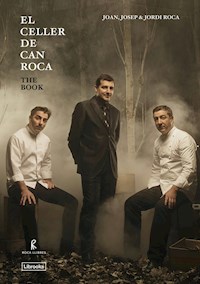
The definitive work about El Celler de Can Roca: large format (24 x 32.5 cm), printed with the finest materials and details. Fully illustrated in colour with photographs by David Ruano, Paco Amate and Francesc Guillamet. It gathers the thoughts of writer Josep Maria Fonalleras in "A day at El Celler." History, philosophy, techniques, values, sources of inspiration, creative processes, over 90 detailed recipes, a collection of the 240 most outstanding dishes from the 25-year history of this magnificent restaurant. An open door to the secrets of El Celler de Can Roca, revealed in 16 chapters and organised according to the sources of inspiration that nurture the Roca brothers: Tradition, Memory, Academia, Product, Landscape, Wine, Chromatism, Sweet, Transversal creation, Perfume, Innovation, Poetry, Freedom, Boldness, Magic, Sense of Humour "A book in which we not only show what we do, but explain how and why we do it." Joan, Josep and Jordi Roca
Sie lesen das E-Book in den Legimi-Apps auf:
Seitenzahl: 541
Veröffentlichungsjahr: 2022
Das E-Book (TTS) können Sie hören im Abo „Legimi Premium” in Legimi-Apps auf:
Ähnliche



















PREFACE
—Joan, Josep and Jordi Roca
I.THE PATH TO THE NEW CELLER
—Rosanna Carceller
A SHORT ACCOUNT OF ITS BEGINNINGS
GROWING UP BEHIND A BAR
THREE ROADS TO ONE DESTINATION
THE FIRST CELLER: 1986-1997
THE SECOND CELLER: 1997-2007
DESSERTS, THE LAST VERTEX OF THE TRIANGLE
2007: THE THIRD CELLER
THE MATURATION OF A DREAM
THE RESULT
Record of the Project of interior design for El Celler de Can Roca
—Sandra Tarruella and Isabel López
THE CULMINATION
II.CREATIVE LINES AND BASES
EXTERNAL INSPIRATION
A — TRADITION
The influence of classic and modern culinary literature in the dishes of El Celler —Joan, Josep and Jordi Roca
B — MEMORY
The muse of El Celler
—Salvador Garcia-Arbós
C — ACADEMIA
Sauces revisited, the basis of Joan Roca’s cuisine
D — PRODUCT
E — LANDSCAPE
F — WINE
A sensory wine cellar
G — CHROMATISM
H — SWEETNESS
I — TRANSVERSAL CREATION
The creative exchange
J — PERFUME
K — INNOVATION
An update to sous-vide cooking
Perfume-cooking, aroma permeation
INTERNAL MOTIVATION
L — POETRY
Poetry and seduction in the dining room
—Josep Roca
M — FREEDOM
N — BOLDNESS
O — MAGIC
The creative sequence around smoke by Jordi Roca
Rocambolesc. The desserts of El Celler become ice cream
P — SENSE OF HUMOUR
III.APPENDIX
1. BASIC RECIPES
2. GLOSSARY
3. ANALYTICAL CATALOGUE
A day at El Celler with a black notebook
—Josep Maria Fonalleras
PREFACE
—JOAN, JOSEP AND JORDI ROCA
Books are always a way to process knowledge; in the following pages, we try to show who we are and what we have learnt. The challenge of this endeavour has been to gather and order our thoughts conscientiously, to open the door to what we do and to how and why we do it, so that if you don’t know very much about us, you can construe our personality and our background—Girona, an exceptional place. We wanted to reconstruct our sweetest and most fruitful life and professional experience. We who have benefited from different culinary sources, now wish to be a fountainhead. We want to be like three Rocks that are rounding off with the passage of time; we want to show our three-party game, our brotherly connection, our professional polishing... And to illustrate how we have given wings to the creative process: with six hands and three heads under a single hat.
The book El Celler de Can Roca. Una sinfonía fantástica (Jaume Coll, 2006) was a way of emphasizing our respect for gastronomic literature. Jaume Coll, doctor in philology, gave us an important piece of literature, reworking it into the culinary language with his experience and talent. That book, which he left by the door of the new restaurant, honoured us in its last lines stating the author’s wish to finish what he called “the fifth movement of a fantastic symphony,” that is to say, to carry on the literary and gastronomic process undertaken with a second volume. This time, however, we felt the need to speak with a unique voice. Our own voice. A modest voice, but felt in first person and with the aim to explain what we know best: our labour, transversal work focused on vanguard cuisine. As Dr. Jaume Coll would say: Ars culinaria nova. But we didn’t want to do without the convergence between “object cookery book” and the literary arts, which is why we entrusted a section of the book to prestigious author Josep Maria Fonalleras. He approaches every chapter with linguistic precision, clarity and brilliance. Also, throughout the book you will find fragments of an account written by him that is a record of a day spent at El Celler. A captivating text, rich in details, in which not a single word is too much.
When the restaurant moved, on 15 November 2007, it marked a decisive point in our work. We improved our traceability with full equipment, from holm oak embers to the Rotaval. We reinforced our ability to seduce. The expectation of those who visit us grows and that stimulates us. We achieved unbeatable conditions to dig into the secret paths of cooking, we went on to have a factory of dreams, a utopia made reality, and many challenges for the future. That is where the desire was born to share our journey and show you the ways of the culinary process that have made it possible for what began as acoustic to become symphonic.
We want to underscore our creative vitality, share it and be loyal to didactic sense. To reflect a conceptual maturity. To assemble the groundwork of a cuisine that is created, lived and shared with the family (we can never thank enough Montse, Josep, Anna, Marc, Marina, Encarna, Martí, Maria, Ale, grandparents Payet, Paquita, Salvador, Encarna and Angeleta for past times...), and with a competent team that has changed through the years and is now spread out around many points of the planet.
To them all we also owe part of the merit of this work, to them and to the great amount of collaborators and our chef and server friends who, in these first twenty-five years have made our history their own, working shoulder to shoulder with us. We are aware of the human and emotional richness that their support has meant during all the time we have been cooking values. To them, who have felt close to Montse, to el Jefe, and to grandma Angeleta, the muse to whom Salvador Garcia-Arbós dedicated an emotional memory, we would like to show our gratitude.
Special thanks and acknowledgment also to all those people who feel great fondness for our restaurant and who have even grown in gastronomic terms with us. The truth is that, if we had customers before, we now believe to have friends and followers. This book is also for them. And we can’t forget to express our gratitude for the essential and crucial role of gastronomic journalists; sharp and brilliant ambassadors with a special sensibility to communicate the vitality in gastronomy.
Lastly, we also want to mention that the book we now present to you wouldn’t have been possible without the support of Cèlia Pujals, who together with the team at Bisdixit has maintained its thematic coherence, taking great care of its design and edition. Everything is easier if you have someone like her sorting out ideas. The photographs of the dishes, in charge of Francesc Guillamet, have allowed us to show a rigorous, luminous and precise vision of gastronomy, and the atmospheric job of David Ruano has provided us with a poetic patina and the desired tone to evoke the warmth and intimacy of a discourse whispered in your ear.
As a final point, the book you have in your hands gathers the projects and memory of over twenty-five years in the making, and at the end it includes as an evolutionary synthesis, a documentary catalogue of some of the most emblematic dishes of our restaurant, emerged throughout a history that began in August 1986. It’s an attempt to gather the joie de vivre, Gastronomy in capital letters and in the first person, of showing a life persistent in its search of flavour and knowing how to feel, with constant learning, luck, joy, stubbornness, perseverance, divertimento, faith and passion. We want to leave physical lasting proof of all of it and also write an account of the vanguard cuisine of the end of the 20th century and the beginning of the 21st century, the best years of your lives.
EL CELLER DE CAN ROCA, (TECHNO)EMOTIONAL REVOLUTION
Today, gastronomy shows its polyhedral side as a recipient of the changes experimented by the parameters of luxury. The rituals of wealth are now focused on the quality of the details, whose fulfilment requires a certain freedom and feeling of wellbeing. The importance of what we could call “the strength of intentions” grows. Luxury is now sustained in the field of emotions, which has entered fully and triumphantly the world of gastronomy, making an incredible turn.
We relate to the idea of an emotional revolution, equipped with an invisible technology, product of our dialogue with science and that wants to convey generation after generation. We relate to the term “techno-emotional cuisine” coined by Pau Arenós (La cocina de los valientes, 2011). We have blind faith in the force of feelings, the ability to delve in the psychological impact produced by flavour, and the power to evoke memories, stirring the emotive aspect of those who visit us. We know the forcefulness of taste of each ingredient can be a tool to break the cloak with which we protect ourselves. People grant us their time and open their arms and senses to seduction; we want to be sensible to the management of those emotions.
In this book we divide the creative process into sixteen chapters that will help you understand that, where there was discipline and rigidity, we try to add audacity and transgression. We try to exchange snobbish coldness for closeness and eclectic vision for sustainability, recapturing the often neglectful dialogue with the producer and the landscape. We want to substitute obsequiousness and sobriety in our offers for sense of humour and fantasy; redundant maturity for innocence and imagination; classicism for courage; routine for reflection and will to open transversal roads. And finally, we have brought the ever-presence of wine into the kitchen and it is there to stay.
Advances in science, nourished with information technology and communication, have situated us at the doors of the third millennium, in a new gastronomic world we experience actively. In this new reality emerges a sort of triangle of knowledge formed by the fields of physics, biology and new technologies, with the creation of fascinating synergies between one and the other, which will offer us moments of great emotional well-being.
We try to stage the colours of emotions, both internal and external, through taste, smell and the visual aspect. We want for our cuisine to flirt with poetry. We want to awaken yearning, a wish, and to fill it with memories. Here is where techno-emotional cuisine takes over nouvelle cuisine and we bet decisively on it. To enjoy more and more the smell and taste and the feel of our memories. To commit to suggestion and essence brings us closer to a more highly evocative sense, a sense that is most linked to emotions, images, memories and stories—smell. With our creative lines in cooking we hope to exhibit colour, transitoriness, awareness, science, boldness and social agriculture, in addition to showing a specific geoclimatic location, but also exuding the fusions that have come to us from past generations and faraway places. We get inspiration from the Mediterranean, its luminosity, spirit of freedom and ancestral cultural leadership, with flavour as the central theme. We take in a light that doesn’t blind, a light that doesn’t hide; a privileged light. In a society of global tendencies, we try to show our closer cultural habits with pride. We think universally and act emphasizing on food and local agricultural products.
For us, the future of cuisine will oscillate between the tendency toward the product and the process, as it has always been the case in the history of gastronomy. We are convinced that cannelloni, ham croquettes and gazpacho can live side by side with spherification and mimetic tricks.
The cuisine of El Celler de Can Roca wants to make a fresh and thoughtful offer that undresses and dresses (as if undressing and dressing were one thing) with techniques used from conceptual maturity, but merely suggested and always prioritizing flavour.
The creative process captured in the sixteen chapters of this book—Tradition, Memory, Academia, Product, Landscape, Wine, Chromatism, Sweetness, Transversal Creation, Perfume, Innovation, Poetry, Freedom, Boldness, Magic and Sense of Humour—is a life and thought reality built from everything we have done in the last twenty-five years.
Even if the calling of the cook leads us through the paths of craftsmanship, the aim comes closer to goldsmithing, with artistic and innovative attitude as a fundamental incentive. In our opinion, the cook is not exactly an artist, but must still invariably have the freedom to act, constantly reclaiming creativity and navigating a warm cuisine where the acoustic alternative of a live performance has its place, as well as the symphonic option of a more complex construction. The culinary tendency we want to follow has four cardinal points: authenticity, boldness, generosity and hospitality. We bet on a simple and proactive attitude toward new culinary horizons of emotional revolution. We “cook to generate feelings.”
This books hopes to be proof of our strong commitment and conviction that we must know how to live in a flavourful manner and believe cuisine is a way to happiness, culture and land. Turn the page and we will guide you through the secrets of the cuisine of El Celler through a door wide open.
GROWING UP BEHIND A BAR
Cookery was written in the fate of the Roca brothers. Or perhaps they have written their fate in their own handwriting with the effort, patience and rigour that have characterized them over the last twenty-five years and that still define them. Hard work has earned them recognition and a name, but their childhood milieu was, without a doubt, a determinant factor in their development.
Can Roca, the restaurant opened by their parents in 1967 in Taialà—an outlying district of Girona populated by immigrants from Andalusia—was the living room where the three brothers grew up, tossed coins, did homework and watched Un, Dos, Tres, a popular Spanish TV show back in the seventies. “Our table at the bar was next to a gas stove,” recalls Joan. A crowded bar prevented their parents from dedicating more time exclusively to the boys. So the restaurant’s kitchen and dining room became the perfect place for them to spend hours, first as spectators of the hustle and, soon after, as active participants. “Our grandparents and even the customers, who often times were also our friends, looked after us. That was a very fun place, we spent time with many people and many things happened,” says Josep. Upstairs from the restaurant there were five or six rooms that were part of the inn to accommodate workers from Navarre, Andalusia, or Aragon working in Barcelona factories like the neighbouring Nestlé, or in the construction of the AP-7 motorway. “Suddenly our family was very big. We shared a roof and even, sometimes, a table with all these people who came to our house. We spent time with them and that, for us, was rewarding and enriching,” explains Joan.
The elder brother looked after the two younger ones; he was the more responsible, diligent, and the one who established rigour and order. From an early age, the role of Joan Roca was to be the most mature of the three. Dedicated, hardworking, serious and passionate about the profession of his grandmother, Angeleta, and his mother, Montserrat, the cook of Can Roca. As young as nine, his mother had a chef jacket tailor-made for him, which he still has and lets his son occasionally dress up with. He spent his afternoons in the kitchen and, unknowingly, began to engineer his future. When the time came, he didn’t hesitate to decide what he wanted to be when he grew up: “I saw that people were happy at my parents’ restaurant.” That was all he needed; he wanted to keep making people happy.
The scents of his childhood include the escudella i carn d’olla, stocks and, in the afternoon, vanilla for custards. Back then, there was a lot of work to do at Can Roca, there was never a break and, as soon as the three lunchtime shifts were over, it was time to prepare the dishes for the following day or the upcoming week. After school, Joan helped in any way he could: “Every Tuesday afternoon I made sausages with my father. We minced the meat, and then we seasoned and stuffed it. I practiced so much with the hand mincer that I won every arm-wrestling match in school!” Grandma Angeleta, grandma Francisca and other elderly ladies, friends of the grandmothers, were always in the kitchen peeling garlic, onions or beans; spent the afternoon chatting and solving the problems of the world. It was, after all, our home kitchen.
In spite of being well aware of his calling, Joan kept good grades and, in those times, a studious boy had to go to university. Professional training was stigmatized, but fate lent him a hand and one of the only two culinary arts schools in the country opened in Girona, only a few kilometres from home. “Life is full of circumstances that make everything go in a certain direction, and I’m sure the Culinary Arts School made it possible for me to study cooking at the time. If I hadn’t done it in that moment, everything would have turned out different.” The school didn’t only determine Joan’s future, but also that of his brothers, who followed on his footsteps a few years later.
No esperem el blat,
EXPECT NO WHEAT
sense haver sembrat,
WITHOUT SOWING,
no esperem que l’arbre
EXPECT NO TREE
doni fruits sense podar-lo;
BEARING FRUIT WITHOUT PRUNING;
l’hem de treballar,
THEY MUST BE WORKED ON,
l’hem d’anar a regar,
THEY MUST BE WATERED
encara que l’ossada ens faci mal.
EVEN IF OUR BONES HURT.
. . .
WE MUST MOVE FORWARD
Cal anar endavant
WITHOUT FALLING OUT OF STEP.
sense perdre el pas.
THE EARTH MUST BE WATERED WITH THE SWEAT
Cal regar la terra amb la suor
OF HARD WORK.
del dur treball.
FLOWERS MUST BE BORN EACH MOMENT.
Cal que neixin flors a cada instant.
«CAL QUE NEIXIN FLORS A CADA INSTANT», («FLOWERS MUST BE BORN EACH MOMENT»), LLUÕS LLACH
Josep recalls perfectly the first time he served a bag of crisps to a customer and put the money in his pocket. His father reacted quickly and warned him that things at home didn’t work that way. That is how he became aware that it was his home but also a restaurant where business took place.
Josep’s eyes light up when he talks about how, as young as five, he was assigned the task of refilling with wine—of the Cariñena variety from the Empordà—the empty litre bottles used for serving. A nervous and mischievous kid, he was unable to sit around doing nothing while a bottle filled up: “I used to play to see how many bottles I could fill up at once and I would always spill the wine of one of them. To me, it was a wine-scented game.” Josep played with wine, soaked in wine. It became clear it was a world that fascinated him and it slowly became more than a game. “When I was eight, I used to go fishing with my uncle and what thrilled me the most was breakfast, because I knew he would bring his wineskin and let me have a sip. Some went fishing to return with fish. My aim was different.” Without realizing, he started collecting the flavours of those childhood sips, not only of wine, but also, when the time came, liquors: “The bar was like the UN, we had liquors from all over the world. I tried it all and remember my favourites were Quina San Clemente and Ponche Caballero. On the other hand, I didn’t like Cynar, made with artichokes; it was very astringent.”
Josep has a special sensibility for the earth. He is passionate about wine, but also about geology and botany, which he considered studying when the time came to decide his future. But this option required maths—which he deemed mostly a nuisance—and excluded philosophy and literature—two subjects he enjoyed greatly. “I was interested in part of the earth, but also the whole philosophical approach. It was all too pure and too extreme for me to opt for one thing or the other.” And it was in that moment of doubt when the zeal of his brother Joan, two years the elder, gave him the answer: “Joan has always had a special ability to make any mad idea understandable and to get involved in scientific method. He was already rigorous, methodical and meticulous when was a young boy. I, on the other hand, was just the opposite: clumsy, mischievous, rebellious, a hooligan... I made my dad, my mother, the customers angry... I had ants in my pants and was insecure; I was left-handed and thought I wouldn’t be able to serve with tongs, to debone a fish, or to peel an orange in front of a customer.” But Joan’s passion helped Josep decide to follow the road he’s always known at home, gastronomy, discovering the new paths of the academic scope.
We have to jump ahead in time to speak of Jordi’s childhood, fourteen and twelve years younger than Joan and Josep, respectively, an age gap that conditioned him from an early age. The youngest, he was spoiled and refused to study. He was the kid at home who adored prawns, cockles and ham from Jabugo, who was perfectly able to detect a common Serrano ham when someone was trying to con him. “By living in a bar, I had a lot more luxuries than my friends. There were always cockles, olives, ham... or suddenly popular packaged chocolate-filled sweets!” Times had changed and his parents allowed him to have things his brothers probably wouldn’t have even dreamt of.
Jordi went from having to help his parents in their restaurant to having to help his brothers in theirs. At that time, they were to him the equivalent of two additional parents to whom he had to answer and show a certain degree of responsibility. But not only that. To him, Joan and Josep were role models, idols he looked up to: “I remember the first day an unknown man called the restaurant asking for Pitu (Josep). At that moment I realised there were people who did not belong to my family, who were not part of our surroundings, people from the industry who knew him. And that stuck to me.”
His childhood was therefore spent among kitchens and customers, without a clear calling for gastronomy, but with the hope—perhaps hidden in his subconscious—of being able to do something that would make his family proud, especially his older brothers. And at fourteen, without having fully sorted out his ideas, he let himself be carried by inertia and enrolled in the Culinary Arts School of Girona. Back then, Joan and Josep still couldn’t have imagined the little brat at home would become a key piece for the future of El Celler.
THREE ROADS TO ONE DESTINATION
Joan, Josep and Jordi grew up between the classrooms of the Culinary Arts School of Girona and the cooker of Can Roca. But also among sanctuaries. Laughing ironically, Josep recalls the day trips organised by their parents, who were unaccustomed to thinking about leisure time. On Saturday afternoons, their only time off as a family, they went out to explore the world: “Our great celebration was visiting sanctuaries. Hilarious! They took us to Sant Miquel del Faig, to Salut, to the Àngels sanctuary... Very cheerful day trips! People asked: ‘Don’t you go out?’ And I replied: ‘No, we’re very monastic people’.”
It was unthinkable to close our doors on Sunday, the busiest day of the week, because that was when the neighbourhood people had family meals. After much struggle, Montserrat talked el Jefe into allowing the family a few hours of privacy on Saturdays without customers or menus, first only afternoons but, later, the whole day. But the head of the family broke their pact and started letting regular customers in for breakfast, somewhat in secret... through the back door! For the first time Can Roca was closed, but the restaurant was still crowded, just like before. “It was a combination of generosity, caring, and also the fear of losing those customers, because you would be subject to punishment if you made them drink their coffee at the competition for a day. It was a feeling of hesitation, odd, hard for everyone to swallow; for my father, but especially for us, because we didn’t understand a thing,” recalls Josep. When the last customers, the tramps fond of anisette and coffee, had left the restaurant, the most highly awaited moment arrived: the family snack that has had such an impact on the gustative memories of the three brothers: “It was like a sacred fizzy drink, we were finally completely alone, and that moment transformed into a celebration with cockles and squids.”
Joan lived his childhood and teenage years at Can Roca and learnt to cook from his mother and grandmother, but it was at the Culinary Arts School where he discovered that behind the lentils, escudella, macaroni, or potato salad they served at home, there were the ravigotes, meunières, veloutés or parmentières he read about in classical French cuisine manuals. These terms, unknown at home, started to make sense and manifest themselves in his gastronomic imagination during his years of academic instruction. Le Guide Culinaire by Auguste Escoffier, Modern Culinary Art by Henri Paul Pellaprat, and some works by Catalan gourmet Ignasi Domènech, were reference books in his classes. Baroque presentations, heavy sauces and opulence defined the French cuisine he learnt about: lobster à la parisienne, sole à la meunière or Thermidor lobster are some examples. Joan recalls his teachers back then, chefs who inspired respect: “Mr. Barberà really commanded respect, he came from prestigious restaurants in Barcelona; Mr. Andreu was a maître d’, an admirable person; and then came professors Romero and Ruiz from Granada, who are still teaching and have done a great educational job.”
Because only Girona and Madrid had culinary arts schools in the whole country, their educational institution became a welcoming site for people from Murcia, Valencia, Aragon and all over Catalonia. On the top floor of the building, constructed by the old Spanish Trade Union Organisation, were dormitory rooms for first-year students. Then, as they familiarised with the city and the dynamics of their classes, the students moved into shared flats. Joan joined the “group of Lleida:” “Those from Lleida lived in a flat near our house and I joined the group along with Salvador Brugués. We went to all the parties and gatherings of the time in Girona. It was a lot of fun.” And it was with those friends that Joan began to discover good food and enjoy life outside the kitchen.
To turn eighteen meant going to military service. Joan was sent to Alicante, but he was transferred to Valencia and appointed as cook to the captain general: “I remember the first day I was very scared. When a recruit is told he has to cook for the captain general, he panics. We got off on the right foot right away, and the captain’s wife was very affectionate and treated us like her sons.” At the Valencian barracks he found a much better equipped kitchen than that of the restaurant at home, but it was of no use: the captain’s wife ate light, almost religiously, and accepted little more than boiled vegetables, omelettes and grilled meat. He abided this simplicity, but his trips to the Russafa market and frequent days of leave to visit his family facilitated his adaptation into a new military life. Upon his return to Girona, he had a chance to get back to real cookery, doing both the usual and what he learnt at the Culinary Arts School.
Josep was a vigorous boy who spent his day thinking about the football match of that afternoon or over the weekend, and made use of the few minutes he had between serving tables to kick the ball around a bit. “I was somewhat of a hooligan and sporty on the street. I would talk my friends into playing football using the kitchen door as a goal. We would play ‘shoot to score’ and I was the keeper. The goal was easy to spot: if the kitchen’s metallic door was hit and the loud noise was followed by my mum’s screams, it was considered a goal.”
He helped out in the kitchen but was always after additional entertainment, making his co-workers or customers laugh, finding a joke or a comical situation to play down the hard work required in a restaurant. “When you peel onions, a lot of onions, and just think I was peeling two sacks every Tuesday and Thursday, you want to wipe your tears with your sleeve. Big mistake. As you bring your hand closer to your eyes, you feel an unbearable burning that makes you cry. Tired of crying for no reason and with my typical playfulness, I made the decision to stop the tears. The first thing I thought of was wearing swimming goggles. The first few minutes you would be fine, but when the sulphur goes up your nostrils, your tear ducts get irritated. The solution was to wear diving goggles: eyes and nose covered, breathing through the tube, avoiding the spattering from the damned hurt and livid onions.”
The potato and onion sacks drove him mad. Soon it became clear that he was made for the dining room. At fifteen or sixteen, he challenged himself to balance as many plates on his arms as he could: he did balancing acts and played at arranging the chicken thighs and pork loins and macaroni and soups like a puzzle. He was left-handed and very clumsy, but that lack of skill never manifested itself in the dining room, because the plates and trays became natural extensions of his hands that danced to his own tune. The first day at the Culinary Arts School he noticed that, while his fellow students had to work hard to keep a tray in balance, he could do pirouettes, and while the others barely began to practice coffee making techniques, he already had internalised the movements of his coffee-making arm. And that was how the feeling of insecurity that had triggered comparisons with Joan’s culinary abilities disappeared. He mastered the more mechanical aspects of the dining room, but realized there was a world of knowledge ahead of him: “The career of a waiter is fascinating because it includes everything. Everything related to cooking and everything representing the polyhedral nature of gastronomy, including the world of wines, breads, oils, products, psychology, chemistry, physics, and geology.” And so, this complexity furthered even more his passion for the trade he was meant to do. By the same token, with time his admiration for the world of wine grew and, unaware of it, Josep brought his friends into his circle and established a meeting point in a bar in Girona called El Museu del Vi: “I took charge and pushed them to drink a sacramental wine before going out to party. One or two or three or four wines.”
And Josep not only urged his friends to drink sacramental wine. He spent years doing trial-and-error, experimenting and discovering the world of cocktail acrobatics. “The office in the dining room upstairs from my parents’ bar was reserved for my friends and I. Defiant, I showed off my acrobatic talents and they got drunk on sugary alcohol. I used up the Bacardí bottles. When we emptied them, I refilled them by making a hole on the dripping cap; then I would cover it with Sellotape to imitate the same dripping produced when the bottle is new and full. That way I could practice many times and counted the seconds it took to pour the centilitres needed for a third, two quarters, three halves... for me it was a game, but a nightmare for the parents of my friends.”
Jordi finished his primary education and had no plans to continue in school. He didn’t like studying and studying didn’t suit him: “I did everything out of duty; I did not care, it was everything I had learnt at home. My brothers wanted it, they earned it. But I didn’t have my own plan. I was in the middle, between my parents and my brothers. I felt responsible because I had to prove something.” The circumstances added even more pressure, because at the Culinary Arts School, where he started at fourteen, his brother was already a role model, a good student and good professor. “Having my brother as a teacher was uncomfortable for both of us. Joan didn’t want anyone thinking he favoured me, and so he underestimated me in front of people, even if he thought differently. He gave me lower grades than I deserved.” In class, both brothers hardly spoke to each other; they kept their distances and a somewhat odd relationship.
Jordi remembers a trimester in particular in which he failed every class except sports. But he studied hard and was so driven to pass that in a matter of months he made up for all his classes: that was proof that if he didn’t get better grades in school is was not out of a lack of ability, but of a lack of interest. The anger at home is tremendous, but it helped him realize he was wasting his time at the School.
In those years, Jordi was the “errand boy” at Can Roca, lending a hand where needed. “On weekends there were four waiters, all family members. I was a child and was always mixed up in something. I didn’t even think of being in the kitchen. It seemed like such a complicated world, so forbidden... It was a different world”. The moment came to help his brothers and, for a summer, he worked in the dining room at El Celler. “I was eighteen and finished work at three in the morning. But I wanted to party... I realized cooks finished at midnight and decided I liked the kitchen better. That’s why I moved to the kitchen!” Jordi continued without a definite path, and took any given road according to external circumstances, without conviction, unable to find his place. To help him find his way, Joan thought the best option was for the youngest sibling to leave the home and work in a different environment. He sent him to the Aiguablava Hotel, in Begur (Costa Brava). “I worked an entire summer without one single day off, working from eight in the morning to two at night. And that first work experience outside the familiar surroundings had an impact on me, because it was then that I realized how good I had it at home.” So, he returned home, where soon after Damian Allsop showed up and became a crucial figure in the formation of the Roca triangle.
THE FIRST CELLER: 1986-1997
Joan was twenty-two and had recently returned from doing military service. He had had to cook so many omelettes for the Captain General of Valencia that it became clearer than ever that what he wanted to do was to cook. Josep, who was then twenty years old, was told there was no space for him to do his compulsory military service and that therefore he wouldn’t have to wear the uniform. It was the perfect moment. Both were at home, both had finished their catering studies, and both were toying with the idea of opening a gastronomic restaurant, without really knowing what it entailed.
“For us, it was simply about doing something more fun that what our parents did back then, which is the same menu they do today: Monday, rice with fried eggs and tomato sauce; Tuesday, macaroni...” states Joan.
“At school we learnt about the demi-glace, hollandaise sauce, tartar sauce... everything represented by the cuisine of Escoffier, and the most powerful cuisine of the 19th and early 20th centuries. We began with the desire to show people everything we had learnt. It’s a big change to go from making a green or a Catalan salad, to a shrimp salad with raspberry vinaigrette. It is extraordinary, one has nothing to do with the other,” adds Josep.
What the two brothers wanted more than anything was for people to enjoy the experience of eating at El Celler: “We observed that people at our restaurant enjoyed themselves. Even when eating a six euro menu they were happy. And we wanted the same: for people to eat well and to have a good time. And we built it little by little.”
Their parents had bought a house right next to Can Roca for the boys to live when they got married, and instead they asked for permission to start their own project there.. Indeed, later on Joan and Josep married, but the first marriage those walls witnessed was that of the two older brothers with gastronomy. “I never thought of opening a restaurant there. It was never part of my plans. But my sons knocked down my plans and also the walls” admits their mother Montserrat, laughing.
Opening a gastronomic restaurant in the mid-1980s in a working-class neighbourhood of the outskirts of Girona seemed like an insane idea. A row of provisional barracks, built to accommodate immigrants arriving from southern Spain, separates the neighbourhood of Taialà from the wealthy neighbourhoods in Girona. “For people, it was a difficult border to cross. Our neighbourhood, all in all, was no more than a land that received people and immigration. We were located between Sant Gregori, originally a farming town, and the Girona of the most private and introverted bourgeoisie. People had to take great strides to come and see us,” says Josep.
Their mother tried to understand and encourage them: “Effort, sacrifice and, especially, bravery, are values we learnt from our mother. She encouraged us to keep going; she understands the concept of ‘audacity’ and our father doesn’t. Back then, he was taken aback: they had a restaurant that did well serving three daily meals. It was absurd to him to do anything different,” recalls Joan. “The boss”—Josep Roca senior—has always been a pragmatic man. He was a bus driver, and his idea was to open Can Roca right across from one of the bus stops he drove by every day, because he saw the flow of people as a good opportunity to do business. And now that the restaurant operated perfectly well and was crowded every day the kids, who went to school to continue in the business, wanted to open another establishment next door. He had no other choice but to wonder if they have gone mad.
In spite of doubts, the reluctance amongst the family and the limited initial logic of the whole idea, Joan and Josep got started. On their own and looking forward to seeing what was brewing, they began remodelling the house: “We knocked down the four partitions that divided the rooms and left a mark on the floor where the walls used to be, which we covered with cement; the construction job was completely botched!” With a half-smile, Joan recalls that dear botched job for the first Celler, also decorated by them with hanging plants around the dining room and lamps with tassels they dug out of a chest.
Then, one day in August 1986, their dream took the first step to become a reality: El Celler de Can Roca opened its doors. “We don’t remember the date we opened. It was probably the day we had installed a neon sign that read “El Celler de Can Roca.” And nobody came in.” It is significant that, as Joan says, they don’t remember the date, because it speaks of their innocence, modesty and humility with which they started their first restaurant, not suspecting it would grow and without any pretentions. “We didn’t think the date was important, we didn’t want to have an opening ceremony, we didn’t want to tell people. We thought we had to have an opening our way and then the customers would come. We knew if it didn’t go well, we could return to our parents’ restaurant,” explains Josep who, on the other hand, recalls perfectly who was the first person to enter the new establishment: “It was the then mayor of Girona, Quim Nadal, who was probably on his way to Can Roca and saw what the kids had done and went in to take a look.”
El Celler back then was very different from that which now occupies one of the first places in the world in restaurant rankings; it was a Celler that set out with a very precarious infrastructure, with some of the machines kept at the kitchen of Can Roca and the rest in theirs. According to Joan, “We built a griddle out of hard chrome. We approached the blacksmith and they installed a sheet of chrome over one of steel, then we placed some flan tins under it to create an incline for the fat from the griddle to slide into a kitchen sink... It was a true botched job!”
At the beginning, the roles of each of them were still not well defined, they had to roll up their sleeves and help out wherever it was required. Josep was not only in charge of the dining room, but also placed orders, and served tables whenever necessary, without ever forgetting his character: “I went into the kitchen to help out wherever it was needed. I tried to combine peeling potatoes with the potato peeling machine and playing football in the kitchen, because I knew each potato took a certain amount of minutes.
At the beginning, the idea was to help out, get energies from anywhere.” The truth is that he dared to do much more than peeling potatoes. When Joan began teaching at the Culinary Arts School of Girona, it was he who organized the mise en place, always under the culinary eye of his older brother.
The first dish of El Celler was hake in garlic and rosemary vinaigrette, inspired by a trip Joan took to the Basque Country a few weeks before opening the restaurant. The first menus clearly showed the influence of this traditional cuisine, but also of classical French dishes—a lot more baroque and learnt from books, like the sea bass filled with shellfish: “Poor sea bass... we treated it so poorly! I remember we used to remove the bones, fill it with a shellfish paste, wrapped it in bacon and, as if that was not enough, sliced it and reheated it, then topped it with a white wine sauce. People were fascinated. It was a new and very elaborate dish, not common at all.” At the time, people were used to eating and cooking stuffed squid, but never a sea bass like the one the Roca brothers were offering. It was haute cuisine at a time when Girona still didn’t have a gastronomic culture.
The community of Girona who tried the first El Celler de Can Roca were also marvelled by the chicken with prawns or the fideuejat with clams, a version of the fideuà they learnt at home but that was yet not common in restaurants. Other highlights of those first years of experimentation are also the lobster parmentier (1988) or the pig trotter carpaccio (1989). Later on appeared the apple and foie gras timbale with vanilla oil (1996), one of the most outstanding and elaborate creations of the restaurant’s history.
The grand finale of the meals of the time was the desert cart, a luxury offered in the past by other renowned establishments like El Bulli or Hotel Empordà. Cakes, mousses, flans, creams and fruits were brought to the guest like a show of freshness and sweetness with a special garnish. Jordi was still a child when the two brothers prepared these delicacies, but he already felt the attraction: after school, the first thing he did at home was stop by the kitchen of El Celler and have a small afternoon snack of cake left over from lunch. He still couldn’t imagine he would someday revolutionise this part of the restaurant’s cooking.
El Celler also impressed its customers from the start by incorporating French service rituals, such as peeling an orange with a fork and knife before the guest, a surprise for the senses back in the eighties. It was a time when they drew with creams and coulis on desserts prepared in front of the guest, garnishes prepared by Encarna, Josep’s wife, who joined the restaurant in 1987.
In the summer of 1989, Joan spent a month and a half in the cold section of El Bulli and became aware of what was starting to happen in Cala Montjoi. They were years of great restlessness, travelling, practicing, experimenting, getting to know other people in the business and forming the basis of what would be the future of haute cuisine in Catalonia and the world. But they were also years of uncertainty, because while the traditional restaurant of their parents was always crowded at every meal, not a soul came into their new restaurant. Josep, who could see the positive side of everything, made use of the slow hours to play with a table football table they installed in an isolated area of the dining room: “It was a gift for Jordi and we kept it for ourselves. We put it in the back dining room, which normally wasn’t full so we had transformed it into a playing area. It even bothered us when people came in and the match was too exciting!”
By the mid to late 80s news began to arrive to Catalonia about a new Basque cuisine and the consolidation of the French Nouvelle Cuisine. In 1991, both brothers took a revealing tour to the best kitchens in the neighbouring country. “When we went to Pic de Valence or Troisgros de Roanne, the great three-star restaurants in France, we began to have a dream, we were reasserted. That was when I thought this is what I wanted to be, that I wanted to be a chef, that those people had a great time!” explains Joan with conviction. The Roca brothers studied about the great French cuisine but never experienced it up close.
And their first experience fascinated, captivated and left them flabbergasted. These are restaurants with large infrastructures, well-organized areas, and a much elevated concept of what it means to cook and what it means to eat. “We also realized that the customers at these restaurants were much happier, and probably the chefs too, because they had a lot more means and resources, the ideal structure, and worked with the best products. When you visualize the dream, you go after it,” exclaims an enthusiastic Joan.
And Josep agrees, particularly fascinated with the images of their visit to the restaurant of old Pic (André Pic, a three-star Michelin restaurant since 1934): “Seeing old Pic was like meeting the Pope. I don’t know what very devout Catholics feel when they see the Holy Father, but I had the sensation of meeting someone very important. If I try to recall role models I’ve met face-to-face, I would say Dalí in the first place, followed by Monsieur Pic.”
Of that day, what Josep remembers best are the ice creams he discovered: “They were not balls, or set on a cone, or a bar. They were rectangular frozen parfaits, but not crystallised. That, back in the eighties, to me seemed something mind-boggling, a cold ice cream, with the texture of a cream...” But he was not only captivated by that ice cream, but by the great difference he saw up close in the level of French gastronomy. “Parameters of flavour, interpretations, product quality, texture in the sauces, aesthetics, exaggeration in the assortment of breads, cheeses, three sommeliers at our disposal, a garnish for each dish, a change of cutlery for desserts, golden cutlery... It was excellence in catering. It awakened our senses; it was a world we wanted to make our own.”
When they visualized the dream, they did, in fact, go after it. It was a world they wanted to adopt. All of a sudden, it was clear which road to take, all obstacles disappeared. They shared this desire and dove in with both feet.
And slowly but surely, either by mistake or out of curiosity, guests started to walk in. The restaurant began to consolidate and the tables fill with customers. The city of Girona began to appreciate what the two brothers had created and the rumour of a possible Michelin award began to spread. In 1991, for the first time, an inspector of the prestigious French guide tried to visit El Celler de Can Roca. He tried and failed because, perhaps, that time fate decided it was not yet time for a first star: the critic entered the restaurant of their parents by mistake instead of visiting the gastronomic restaurant of the sons.
The following year, nevertheless, he returned and this time found the right door. Josep, who at the time didn’t know he was talking to Victoriano Porto Canosa, one of the most important bosses of the Michelin guide, served him a baby squid stew with lentils and a sirloin with foie: “I served the sirloin on a marble plate, those pretty ones we had in the past, cold. When he finished, I asked if he had liked it. He said: ‘I’m a bit finicky and found the sirloin cold in the middle. But take into account I’m very particular...’ he added.” After that encounter, Josep and Mr. Porto Canosa began a cordial acquaintance.
Also in 1992, Rafael García Santos visited the restaurant for the first time, and had a meal Josep remembers perfectly. “After six years, for the first time somebody came to eat and described my brother the same way I saw him. It was the first time I came across a coherent, sensible and talented critic with a depth in tasting I had never seen before. I discovered true gastronomic criticism. He was probably the most visionary character in gastronomy back then.”
From then on, they began to get a feeling of recognition and a pure concept of gastronomy. They didn’t have a desperate need to earn Michelin stars because they were savouring what was happening in Catalan cuisine. In 1995, Joan’s sous-vide cuisine—using the Roner he designed together with Narcís Caner and Salvador Brugués, which allows cooking at low temperatures—appears on the stage of the restaurant’s menu with a dish that became an example: warm cod with spinach, cream of idiazabal cheese, pine kernels and pedro ximénez reduction. The new technique was a true revolution in product cooking methods and opened many doors for the future of the restaurant and haute cuisine.
The first Michelin star finally arrived in 1995 and it found them fully prepared. “That was truly wonderful. It was a historical milestone. The first star places you in the map of gastronomy and we got it under very precarious conditions,” explains Joan. Josep, on the other hand, is convinced that first star was not as important for the people of Girona as the participation of El Celler in preparing the menu for the wedding of Infanta Elena in Seville. “In Girona, nobody knew what a Michelin star was. But people—republicans, independentists, conservatives and socialists—were happy because it was the wedding of the first Infanta and the Roca brothers were cooking in Seville. This wedding put us on the spotlight. Today we are used to it, but back then, for a cook to appear on TV was something very exceptional.”
But what is most important for the Roca brothers is the trust they earned from their customers. “The summit for a chef is when the customer trusts him and comes to the restaurant to be happy. That is everything, because it gives you a margin for creativity and also for playing and establishing the dialogue and commitment that give significance to your work and that we like so much,” explains Joan.
With this great leap ahead arose the increasingly urgent need to have a larger kitchen and a better infrastructure. And the second El Celler de Can Roca began to take shape.
THE SECOND CELLER: 1997-2007
Eleven years passed since Joan and Josep opened the first restaurant. The little house next to Can Roca not only helped them get their project going, but also to position themselves in the world of gastronomy and get a Michelin star, in spite of having everything against them. This time, however, it was becoming increasingly difficult to keep growing: they ran into every wall in that small, thirty square-meter kitchen, where before there were two people working and now there were seven or eight. It wasn’t only that they couldn’t do their job, but they practically couldn’t move. They depended on their parents’ kitchen to get by: their mother rolled cannelloni surrounded by dressed up waiters coming and going, and cooks on the other side removed the rice from the heat because they needed the burners to make an olive oil caramel sweet. The Riedel glasses were washed in the sink at the bar and, invariably, an inadvertent nudge by a customer having barreja and coffee with liquor, ended up breaking one.
“We have always determined our needs and growth. We have sought improvements according to our own demands,” states Joan. Recognition from the gastronomic guides and the arrival of criticism were not the only factors that determined the widening of the space; they wanted to continue evolving and began to study the best options to do so.
In 1993, the brothers bought the Torre de Can Sunyer hoping to move there one day. In the midst of the financial crisis of the 90s, with interests as high as 16%, they were forced to find ways to pay their debt to the bank, as Joan explains: “We thought of offering receptions in this property to pay the credit off and that’s what we did for sixteen years. We worked seven days a week: from Monday to Friday at the restaurant and organising weddings and communions on the weekend. We decided to save to avoid financial burdens in the future and we spent ten years without rest, some very tough years.”
In fact, the initial idea when they bought the Torre was not only to organise events, but to combine them with the daily activities of the restaurant. But the date when they realised how unfeasible that was became engrained in Josep’s mind: “On February 12, 1995, with our first event, we realised what we wanted was impossible. The space was not enough; the intimacy of a wedding was counterproductive to the meaning of an à la carte menu. And it was a moment of disappointment, a failed dream.”
After this moment of frustration, the key to get ahead and not get discouraged was patience, one of the most important virtues of the Roca brothers throughout their career. Going slowly, breathing deeply, step by step, that’s what helped them evaluate what the best answer to their deficiencies was at that time. They were aware they still didn’t have enough of their own resources to make a definite move, and after the debt they had incurred with the purchase of the Torre, they didn’t want to play around too much with banks. The issue was not losing the freedom to cook, that is, not having to make concessions with more commercial concepts in gastronomy, which would probably bring them further financial gains but not the personal and professional satisfaction they were after.
This is how the idea of reinvesting their savings in restructuring and expanding El Celler was born. Joan reveals that this decision, at least for him, was not the end of the road, but simply another step before reaching the summit: “It was still not time for the dream to come true. We made a concession on time; we were prudent and decided to start these remodelling. It was an important point of inflexion, a change of structure... But the truth was that we already sensed we would encounter other limitations. We knew we would have to take another step later on.” But in spite of this sideways glance into the future, they wanted the new site to seem permanent, that the public as well as the industry saw it as a matured change, the result of much thought. Idealism and wisdom were again the basis of evolution for the three brothers.
The remodelling project was tackled by an interior designer from Girona, Joan Bosch, who understood the needs of the restaurant from the beginning. In the three months when bricklayers, carpenters and electricians flooded the building, their activity moved to the Torre de Can Sunyer, in a sort of premonitory rehearsal. Joan admits the improvement was substantial: “We made the space more intimate, comfortable, warm, not lavish, but austere and elegant at the same time, and we made it integrate well. One of the advantages of that space was that everything was very compact: the kitchen, the dining room and the small cellar for daily use were together.”
The second El Celler de Can Roca meant significant changes in their work organization, starting with the hiring of more personnel, which finally allowed them to organise the kitchen into sections, as it is done in all large gastronomic establishments. “In the first Celler we had one person preparing hot dishes and another doing cold dishes! But now meats, fish, starters and desserts had their own sections. In other words is, we began to articulate a kitchen with a more conventional crew. We began to look more like a restaurant,” explains Joan as he compares the before and after.
Moreover, in 1997 Jordi joined the team permanently, taking charge together with pastry chef Damian Allsop of developing their sweet cuisine. “It was an important fact and a point of inflection in which we incorporated a more carefree and daring aspect into the kitchen we’re slowly building,” says Joan. With this breath of fresh, young air, the Roca triangle began to take shape: savoury, sweets and wines—three worlds perfectly represented by the three brothers.
Another key factor should be mentioned: the expansion of the space allowed for the installation of all the necessary machinery to bring the cooks ideas to fruition and thus contributed to the foundation of a period of complete creative turmoil. To get an idea of the transformation it is important to consider that, until that moment, pastries at El Celler were baked in a normal gas oven, without temperature control. They acquired a new professional convection oven when they made the structural changes of 1997.
A few years earlier, sous-vide cooking first appeared in the restaurant’s menu (with the warm cod and spinach, idiazabal cream, pine kernels and pedro ximénez reduction). But it was only until the end of the 90s when the space permitted the installation of a Roner in the kitchen of El Celler. “By having the Roner in the kitchen we were able to introduce the use of modern technology to our processes and work more precisely. That is, we began to use technology in a closer, more practical way.”
At this stage, other innovative concepts also evolved, such as distillation or perfume-cooking—preparing products, basically crustaceans, to which they incorporated the aroma of some spice or liquor. Joan’s prominent creations developing from this idea were the saffron lobster (2004) or scampi perfumed with cardamom and citrus fruits (2005).
We were, creatively speaking, at the most explosive moment in the history of the restaurant, says Joan: “It was a very productive time in terms of techniques, ideas, creativity... It offered us many joys and very good times. The culminating point in our work takes place when we discover something new, because that’s what boosts up our energy and makes us feel good. This gets harder and harder, because we’re becoming more demanding, but when it happens it’s fantastic. And back then it happened a lot. We were all in very high-spirits.”
The emotional and professional environment of El Celler de Can Roca had been demanding for years their second Michelin star, which caught them, just like the first, with all their homework done. When this second acknowledgement finally came true in 2002, Joan, Josep and Jordi achieved the credibility they deserved from the world of gastronomy, and the necessary peace to work free of pressure. The second star is the fondest to their mother: all three of her sons were at home when they heard the news, and Can Roca as well as El Celler came together in a general hug, a sea of laughter and congratulations: “Now we have many good news, but back then there weren’t many, and we felt them very intensely. That day we released a lot of tension, a lot of emotions and a whole lot of joy.”




