


11,49 €
Mehr erfahren.
- Herausgeber: Titan Books
- Kategorie: Fantasy und Science-Fiction
- Sprache: Englisch
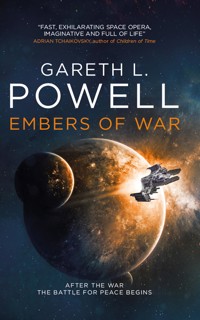
From BSFA Award winning author Gareth L. Powell comes the first in a new epic sci-fi trilogy exploring the legacies of war. The sentient warship Trouble Dog was built for violence, yet following a brutal war, she is disgusted by her role in a genocide. Stripped of her weaponry and seeking to atone, she joins the House of Reclamation, an organisation dedicated to rescuing ships in distress. When a civilian ship goes missing in a disputed system, Trouble Dog and her new crew of loners, captained by Sal Konstanz, are sent on a rescue mission. Meanwhile, light years away, intelligence officer Ashton Childe is tasked with locating the poet, Ona Sudak, who was aboard the missing spaceship. What Childe doesn't know is that Sudak is not the person she appears to be. A straightforward rescue turns into something far more dangerous, as Trouble Dog, Konstanz and Childe find themselves at the centre of a conflict that could engulf the entire galaxy. If she is to save her crew, Trouble Dog is going to have to remember how to fight...
Das E-Book können Sie in Legimi-Apps oder einer beliebigen App lesen, die das folgende Format unterstützen:
Veröffentlichungsjahr: 2018
Ähnliche













CONTENTS
Cover
Also by Gareth L. Powell and available from Titan Books
Title Page
Copyright
Dedication
Prologue: Pelapatarn
Part One: Three Years Later
One: Sal Konstanz
Two: Ona Sudak
Three: Ashton Childe
Four: Sal Konstanz
Five: Trouble Dog
Six: Sal Konstanz
Seven: Ashton Childe
Eight: Sal Konstanz
Nine: Sal Konstanz
Ten: Trouble Dog
Eleven: Ona Sudak
Twelve: Sal Konstanz
Thirteen: Trouble Dog
Fourteen: Nod
Fifteen: Sal Konstanz
Sixteen: Ona Sudak
Seventeen: Sal Konstanz
Eighteen: Ashton Childe
Nineteen: Ona Sudak
Twenty: Sal Konstanz
Twenty-One: Ashton Childe
Twenty-Two: Trouble Dog
Twenty-Three: Ona Sudak
Twenty-Four: Sal Konstanz
Twenty-Five: Trouble Dog
Twenty-Six: Ashton Childe
Twenty-Seven: Trouble Dog
Twenty-Eight: Nod
Twenty-Nine: Ona Sudak
Thirty: Sal Konstanz
Thirty-One: Nod
Thirty-Two: Ona Sudak
Thirty-Three: Sal Konstanz
Thirty-Four: Nod
Thirty-Five: Ashton Childe
Thirty-Six: Sal Konstanz
Thirty-Seven: Ona Sudak
Thirty-Eight: Ashton Childe
Thirty-Nine: Ona Sudak
Forty: Trouble Dog
Forty-One: Sal Konstanz
Part Two: The Marble Armada
Forty-Two: Ona Sudak
Forty-Three: Sal Konstanz
Forty-Four: Nod
Forty-Five: Trouble Dog
Forty-Six: Sal Konstanz
Forty-Seven: Ashton Childe
Forty-Eight: Trouble Dog
Forty-Nine: Sal Konstanz
Fifty: Nod
Fifty-One: Ashton Childe
Fifty-Two: Ona Sudak
Fifty-Three: Trouble Dog
Fifty-Four: Ona Sudak
Fifty-Five: Sal Konstanz
Fifty-Six: Ashton Childe
Fifty-Seven: Ona Sudak
Fifty-Eight: Trouble Dog
Fifty-Nine: Sal Konstanz
Sixty: Ashton Childe
Sixty-One: Ona Sudak
Sixty-Two: Sal Konstanz
Sixty-Three: Ona Sudak
Sixty-Four: Nod
Sixty-Five: Trouble Dog
Sixty-Six: Ashton Childe
Sixty-Seven: Sal Konstanz
Sixty-Eight: Trouble Dog
Sixty-Nine: Sal Konstanz
Seventy: Sal Konstanz
Seventy-One: Ashton Childe
Seventy-Two: Trouble Dog
Seventy-Three: The Marble Armada
Seventy-Four: Nod
Acknowledgements
About the Author
Also Available from Titan Books
“Fast, exhilarating space opera, imaginative and full of life.”
ADRIAN TCHAIKOVSKY, AUTHOR OF CHILDREN OF TIME
“Fast-paced and fun and full of adventure… on my must-read list.”
ANN LECKIE, AUTHOR OF ANCILLARY JUSTICE
“Space opera with scope, action, colour and humanity, skillfully told at a cracking pace.”
KEN MACLEOD, AUTHOR OF THE CORPORATION WARS
“An exciting and deeply satisfying start to a new series.”
EMMA NEWMAN, AUTHOR OF PLANETFALL
“This is the real thing… a headlong, rip-roaring gem of a story.”
DAVE HUTCHINSON, AUTHOR OF EUROPE IN AUTUMN
“Mashes together solid space opera with big concepts, real people, and a freewheeling rock’n’roll vibe.”
JONATHAN L. HOWARD, AUTHOR OF CARTER & LOVECRAFT
“Powerful, classy and mind-expanding SF, in the tradition of Ann Leckie and Iain M. Banks.”
PAUL CORNELL, AUTHOR OF LONDON FALLING
“Built on a foundation of powerful discussions about the morality of war and its effect on unique and interesting characters. [A] fascinating universe.”
MELINDA SNODGRASS, AUTHOR OF THE IMPERIALS SAGA
“Everything you would want in a space opera and more… Powell hits that Iain Banks sweet spot while being something completely new.”
TADE THOMPSON, AUTHOR OF ROSEWATER
“A powerful and sympathetic examination of what it means to be a soldier.”
BENNETT R. COLES, AUTHOR OF VIRTUES OF WAR
“One of the most inventive voices in British science fiction.”
DANIEL GODFREY, AUTHOR OF EMPIRE OF TIME
Also by Gareth L. Powell and available from Titan Books
Fleet of Knives (February 2019)
Light of Impossible Stars (February 2020)
GARETH L.
POWELL
EMBERS OF WAR
TITANBOOKS
Embers of War
Print edition ISBN: 9781785655180
E-book edition ISBN: 9781785655197
Published by Titan Books
A division of Titan Publishing Group Ltd
144 Southwark Street, London SE1 0UP
First edition: February 2018
10 9 8 7 6 5 4 3 2 1
Names, places and incidents are either products of the author’s imagination or used fictitiously. Any resemblance to actual persons, living or dead (except for satirical purposes), is entirely coincidental.
© 2018 Gareth L. Powell
No part of this publication may be reproduced, stored in a retrieval system, or transmitted, in any form or by any means without the prior written permission of the publisher, nor be otherwise circulated in any form of binding or cover other than that in which it is published and without a similar condition being imposed on the subsequent purchaser.
A CIP catalogue record for this title is available from the British Library.
Did you enjoy this book?
We love to hear from our readers. Please email us at
[email protected] or write to us at
Reader Feedback at the above address.
TITAN BOOKS.COM
For Edith and Rosie
“Blood was its Avatar and its seal.”
EDGAR ALLAN POE,
“The Masque of the Red Death”
PROLOGUE
PELAPATARN
Another ship dropped off the tactical grid, obliterated by a shower of pin-sized antimatter warheads. In the war room of her Scimitar, the Righteous Fury, Captain Annelida Deal uttered a venomous curse. The Outward ships were putting up more of a fight than she had anticipated, determined to protect their forward command post on the planet below. If she could only get past them, locate the bunker where the conference was taking place, and drop a decent-sized warhead of her own, the war might be over. At one stroke, she would have fulfilled her orders, which were to decapitate the enemy’s command structure, leaving its forces in a state of vulnerable disarray.
Intelligence projections had suggested an easy in-and-out operation. The Outward had gone for a minimal fleet presence, hoping not to attract attention. In theory, she should have been able to sweep them aside with ease. But these bastards were putting up more of a fight than anyone—maybe even they themselves—could have guessed, and the Conglomeration forces had already lost a couple of frigates and a light cruiser. A dirty smoke trail showed where the cruiser had fallen through the atmosphere, shedding debris and sparks, until it broke up over the night side of Pelapatarn, scattering wreckage across a wide swathe of ocean.
Alarms rang through the ship. More torpedoes were coming in.
In the war room, Captain Deal clung to the edge of the tactical display table. Around her, the hologram faces of her lieutenants were nervous and grim as they awaited her response.
“We can’t get through,” one of them said, and she saw that he was right. The bulk of the Outward fleet lay between her ships and the planet. Any ordnance fired would be intercepted and destroyed before it hit the atmosphere. All she could hope to do was try to fight her way through the blockade. But that would take time and lives. Her Scimitars were faster and more advanced than the Outward cruisers, but the enemy had their backs to the wall. By the time she got within striking distance of the planet—assuming she ever did—the Outward commanders would have fled their conference. If she wanted to end this war, she had to strike now.
She opened a channel to Fleet Headquarters, and was told a pack of four Carnivores were inbound from Cold Tor. As reinforcements, they wouldn’t be enough to decisively sway the outcome of the battle, but those in command had another use in mind for them.
And they wanted her to give the order.
“Get me the Adalwolf,” she said to her communications officer.
“Yes, sir!”
The main display dimmed, and a hologram of the Adalwolf’s commander appeared. Captain Valeriy Yasha Barcov had a smooth scalp and a thick, bushy beard. He was in his command couch, with a profusion of thin fibre-optic data cables plugged into the sockets at the back of his head.
“Dobryj dyen, Captain.” He smiled wolfishly, obviously relishing the anticipated conflict. “We will be with you momentarily.”
Captain Deal shook her head. “No, Captain, I have a different mission for you.”
The man raised an eyebrow. “Speak, and it shall be done.”
Resting her weight on her hands, Deal leant across the table. “You are ordered to jump past the Outward fleet. Do not engage them. Your target is the planet.”
Barcov’s quizzical expression fell into a frown. “But we do not know where the conference is located. By the time we survey the jungle, the Outward ships will be upon us.”
“That’s why I want you to skip the survey.”
His confusion deepened. “But what shall we bomb?”
Deal swallowed. She could feel her heart beating in her chest. “Everything.”
Barcov opened and shut his mouth a few times. Finally, he said, “You wish me to destroy the sentient jungle of Pelapatarn?”
Deal felt the sweat break out on her forehead. “We have been ordered to raze it to the fucking ground,” she said.
For a moment, the old warhorse looked taken aback. Then he drew a deep breath through his cavernous nostrils and drew himself straight.
“It shall be done.”
* * *
Captain Deal watched the holocaust from the bridge of her Scimitar. She wanted to see the results of the order with her own eyes, not via a computer graphic. She knew soldiers from both sides were down there in the jungle, as well as several thousand civilians. But she told herself their sacrifice would be worth it. She was sure those in charge were right, and a swift and decisive end to the hostilities would, in the long term, save more lives than would be lost in the firestorm.
As the first mushroom clouds burst over the planet’s single supercontinent, she felt her stomach go light, as if the gravity had momentarily failed. All activity on the bridge ceased. Even the Outward fleet stopped firing.
Screaming low through the planet’s atmosphere, the four bullet-shaped Carnivores unleashed their entire arsenal of destruction, raining fire and death in swathes five hundred kilometres abreast. Nuclear explosions cratered the land and set millions of square kilometres of vegetation aflame; antimatter explosions tore at the very fabric of the planet, throwing up great plumes of dirt and rock, while smaller munitions rained down on likely targets, picking off anything that walked, crawled or flew.
One pass was enough.
They came out of nowhere, and then jumped away again before anyone in the enemy fleet could turn and engage them. And in their wake they left a billion-year-old biosphere ablaze, and an atmosphere choked with ash and radioactive dust.
The fires burned for six weeks.
The war was over in one.
PART ONE
THREE YEARS LATER
“For as this appalling ocean surrounds the verdant land, so in the soul of man there lies one insular Tahiti, full of peace and joy, but encompassed by all the horrors of the half-known life.”
HERMAN MELVILLE, Moby Dick
ONE
SAL KONSTANZ
“I hear knocking.” Still crouched, Alva Clay rocked back on her boot heels and lowered her goggles. “I’m guessing at least two people.”
I turned my head away as she fired up her cutting torch.
“Hey, George,” I called, “we’ve found some more. Get over here.”
Back towards the stern of the drifting wreck, George Walker—instantly recognisable in his bright orange medical jumpsuit—glanced up from the stretchered patient he had been tending.
“Yes, Captain.” He lumbered towards me, his old-man gait unsteady as the deck groaned and flexed on the swell.
“We’ve got more survivors,” I told him. We’d already pulled four bodies from another hole Clay had cut in the top of the crashed scout ship, but only one of them had been alive.
Right now, the Hobo wallowed in the sea with only a few dozen square metres of its upper structure still protruding above the waves. A metre from where I stood, sluggish wavelets, tinged pink by the sun, lapped at the edge of the hull. I rubbed my forehead. How had this happened? The Hobo had been surveying the planet for possible colonisation. How had these idiots managed to land in an ocean and flood their entire vessel?
My ship, the Reclamation Vessel Trouble Dog, stood a few hundred metres to the east, hanging in the air like a monstrous bronze bullet. Before she had joined the House of Reclamation, the Trouble Dog had been a Carnivore-class heavy cruiser for one of the more powerful human factions, the Conglomeration. Engines accounted for eighty-five per cent of her mass. Weapon emplacements, sensor blisters, drone hangars and empty missile racks interrupted the otherwise smooth lines of her streamlined hull.
“How are you doing, ship?” I asked her.
Speaking through the bud implanted in my ear, the Trouble Dog said, “I have been unable to recover the Hobo’s primary personality. I have accessed its core, but it appears to have erased its higher functions.”
I frowned. “No black box? Why would it do that?”
“According to its last status update, it blamed itself for the crash.”
Clouds were massing on the horizon, threatening to blot out the low, bloodshot sun. A sea breeze ruffled my hair. I pulled my flight jacket closed and sealed the zip.
“Isn’t that unusual?” I’d never heard of a ship’s personality deliberately committing suicide.
“It’s these scouts,” the Trouble Dog said in a matter-of-fact tone. “They spend too much time out here on their own, and it drives them to peculiarity.”
I watched the ripples gnaw the edge of the Hobo’s mostly submerged upper surface, and shrugged. None of this was our concern; all we had to do was recover the bodies, living or dead, and get them back to Camrose Station. When that had been done, other people—safety investigators and claims adjusters—could worry about the specific causes of the accident.
“What about the rest of the ship?” I asked.
“Still filling with water. I estimate no more than fifteen minutes until it finally submerges.”
“How deep’s this water?”
“Fifteen hundred metres, and bristling with life.”
I peered over the edge. Fish-like shadows skittered and scattered beneath the water. Their flanks flashed like silver knives. Larger shapes stirred in the depths below.
“Okay.”
“Plus, there’s a storm front coming in from the east. No more than ten minutes.”
“Then I guess we’d better get a move on, huh?” I turned my attention back to Alva Clay. “Did you hear any of that?”
Clay had tied back her dreadlocks with a frayed and oily bandana. She wore heavy gauntlets to protect her hands and wrists, but her arms were bare, displaying the tattoos she’d acquired during the Archipelago War, as a foot soldier in the sentient jungles of Pelapatarn. Her dark goggles reflected the actinic flare of the torch in her gloved hands. Where the flame touched, sparks fountained from the hull.
“I’m cutting as fast as I can.”
“Cut faster, unless you want to get your feet wet.” Even after all this time, her tats still bothered me. I had my own share of ghosts, but I kept them to myself; I didn’t feel the need to parade them for the entire world to see.
The knocking from inside the stricken craft had ceased. If the people trapped in the compartment below had any sense, they would be cowering away from the flame, and the fifty-centimetre-wide plug of hull metal that was going to fall inward when Clay finished cutting her circle.
George Walker un-shouldered his medical pack and began to unroll a pair of self-inflating stretchers. His thinning grey hair appeared pink in the russet sunlight. Water lapped at his scuffed plastic boots.
“Careful,” I said. “Don’t get too close to the edge. I don’t want to have to pull you out.”
The old man’s eyes crinkled in amusement. He thought I fussed too much. He had served as a medical officer aboard the Trouble Dog during the ship’s military days in the Conglomeration Fleet, and had stayed aboard when she was decommissioned and transferred to the House of Reclamation. On my first day as captain, he’d been the one to give me the tour of the ship, and he’d shown me the secret nooks, patches and workarounds that only someone who’d lived and served on the ship for years could have known. Apparently, I reminded him of his daughter, a lawyer living back on Earth with two kids and a crippling mortgage. I’d met the woman once, during an unscheduled layover in Berlin, but hadn’t been able to grasp any similarity; whatever had led the old man to conflate his feelings for us was beyond my capacity to fathom.
“Don’t worry about me, Captain,” he said. “You concentrate on getting us out of here before the whole mess sinks to the bottom.”
I cast a wary glance at the horizon. I didn’t like the look of those clouds. “I’ll do my best.”
By the time Clay’s circle was complete, the wreck had settled lower in the water and the wavelets had advanced another half a metre up the deck. The breeze had begun to pick up. Time was running out and we all knew it. We weren’t carrying the equipment necessary to operate below the surface. If we could get these two out, they would be the last survivors pulled from the Hobo before it took that long, final spiralling fall into darkness and silence. The rest, if there were any, would be lost.
We had done all we could.
Clay switched off her torch and laid it aside. “Captain,” she said, “do you want to do the honours?”
Thunder growled in the distance. Those clouds were the leading edge of the oncoming storm. The circle’s molten outline burned like an ember. I raised my right boot and stamped down on its centre. Metal cracked and scraped, and the entire section fell away, splashing into the seawater flooding the compartment below. For a moment, we stood paralysed, waiting for movement, a voice, anything. Then Alva Clay swore, and slid through the hole, boots first.
When she reappeared, moments later, puffing and blowing air and water from her lips, she had her arm clamped around a young man’s neck. They were both kicking to stay afloat. I lay on the wet deck and reached down and, with Walker’s help, managed to pull the kid up into the sunlight.
We rolled him onto a stretcher.
“Is he injured?”
A sudden wind blew across the deck, chilling my exposed skin. Walker checked the kid’s pulse with one hand, waved me away with the other. “Go on, I’ve got this.”
I left him bent over the stretcher and slithered back to the edge of the hole. Lying with my head and shoulders hanging over the rim, I could see Clay’s flashlight cutting this way and that through the shadowy water below. Her movements stirred up clouds of junk. I saw objects whirl through the circle of daylight thrown by the hole: a plastic fork, a comb, an empty cup, a loose shoe…
Another clap of thunder rolled in from the horizon.
If we’d had more time, I would have sent a drone in to help her. As it was, we were already pushing our luck.
When Clay reappeared a second time, her dreads were sodden and plastered to her head, and her goggles were missing.
“There’s something in here.” She lunged upward and grabbed the lip of the hole. “Get me out.”
I took hold of her wrists.
“What are you—?”
“I’m not kidding, Sally.” She tried to pull herself up. “Get me the fuck out!”
I didn’t argue. In the three years I’d known her, I’d never seen Clay this rattled. I’d seen her tense and anxious, maybe, but never actually afraid. I dragged her up with all the strength in my arms. Then, when she was halfway out and levering herself up on her elbows, I reached down and grabbed her by her tool belt. I pulled back hard and she slithered up on top of me. Her clothes were soaked, and I tasted salt water. We rolled apart and sat panting on the wet deck while lightning danced like fire among the clouds and the quickening wind delivered the first spots of rain.
“Where’s the other one?”
Clay swallowed, trying to control her breathing. “Gone.”
I climbed to my feet and scrutinised the circle of darkness. “But there were two…”
“Something took him.” She wrapped her arms across her chest.
“What was it?”
“I don’t know.” Her chest rose and fell. “But it was big, and fast.”
“Like a shark?” With one of the submerged airlocks left open, I could see how a big fish might have wormed its way into the Hobo’s drowned interior.
“No.” Clay shook her head. “No, it had tentacles.” She stood up and drew her pistol, and backed away from the hole. I took one last look into the depths of the flooded cabin and then did likewise.
Another peal of thunder split the sky. Although the clouds were still some distance from us, the rain rode ahead of them, blown like spittle.
“We need to leave.” Clay had her gun trained on the hole in the hull, seemingly expecting some aquatic horror to rise up from within. She was scared, and she was right to be. The weather was closing in and the Hobo was in danger of dropping out from under us at any moment. We were out of time and we needed to evacuate the survivors, pronto.
I opened my mouth to order the Trouble Dog’s shuttle to come pick us up, but stopped as I heard a splash behind me. I turned in time to glimpse something orange being pulled beneath the waves. At the same moment, an alarm pierced my ear as the Trouble Dog clamoured for my attention. Clay heard it too. She risked looking away from the hole for an instant.
“Hey,” she said, her face mirroring my confusion. “Where’s George?”
TWO
ONA SUDAK
Despite being kept awake for most of the night, I forced myself to get out of bed at 0600 hours, same as every other morning.
Without waking Adam, I slid from the sheet and pulled on a robe. His gently snoring body lay like a bony xylophone. Loosened from its ponytail, his hair spilled down across his youthful face. His faux leather trousers had been carelessly tossed across the back of one of my chairs, and one of his boots, having been kicked away in the impatience of passion, now wallowed upended in my metal sink. I thought about kissing his forehead, but didn’t want to wake him. I had my morning routine, and I didn’t want him getting in the way. So I stepped out of the cabin and closed the door as quietly as I could.
The corridor outside opened onto a deep shaft, maybe fifty metres from top to bottom and half that again in width, bordered on all sides by balconies and hanging gardens. The air was sweet and pleasantly warm, and smelled of roses and rich, mossy soil. Birds and butterflies flittered through the empty spaces. Bees fumbled among the flowers. I stood for a few moments, drinking all of it in. One day, I intended to write a poem about life on the ’dam, or one of her pen-shaped sister ships.
One day, but not today.
Fastening the robe’s sash in a loose knot, I made my way to the nearest transport tube and descended half a dozen decks to the gym. Every morning without exception, I did an hour’s exercise before breakfast. It was a habit ingrained after long years in the—
I caught myself before completing the thought, and turned my attention instead to the waiting treadmills and weights.
* * *
By 0700 hours ship’s time, my muscles were cooling after a strenuous workout, and I was recovering in the pool, contemplating the distant glimmer of the dusty stars beyond the large picture window occupying the whole of the gym’s back wall.
In a couple of hours’ time, we would make a close approach to the Brain—the first of the Objects we were to encounter.
The Geest van Amsterdam hadn’t wanted to linger in the Gallery a moment longer than necessary, but the other passengers and I wanted to get a closer look at the Objects, and we had been most insistent. Quite apart from the fact that the Gallery lay in a disputed tract of space, the ’dam had its itinerary to consider, and strict adherence to schedule had always been a matter of much pride among such vessels. Nevertheless, when Captain Benton finally interceded on our behalf, the ship reluctantly agreed to extend our presence in the system long enough to perform a close flyby of the Brain, the Inverted City, and the Dodecahedron.
We were overjoyed. Like most of humanity, I had only seen second-hand footage of the Objects, so the chance to see three of them with my own eyes seemed like the kind of opportunity that strikes only once in a lifetime—the kind of experience one might relate to a grandchild. When the ship made its announcement, I was delighted by its concession. After seven weeks of careful flirtation, I had finally allowed myself to be seduced by the young poet Adam Leroux, who had been pursuing me with a gauche and tragic fervour for the duration of the cruise, and I looked forward to viewing the mysterious sculptures in the company of my youthful paramour. I wanted to see them through his eyes. His delight would be purer and more childlike than anything I felt capable of mustering, and I would use it in the poem I intended to write about the encounter, recycling his sense of innocent wonder as my own.
* * *
Adam was eighteen and a half years old, with the gangly awkwardness of an adolescent, yet he affected a world-weary disdain for what he termed the “mundanity of ordinary existence”. He had been born and raised on the ’dam, and had seen many worlds during his short life—but mostly through the windows and view screens of his suite. He had little experience beyond the safe environs of the ship, and even less experience of women. He was very different to the men I had known, and I guess that novelty was one of the things about him that attracted me. It certainly wasn’t his poetry, which was execrable, full of extremity and unnecessary drama and lacking the subtlety an older mind might have brought to its subjects. Had the cruise been shorter, I would never have allowed him into my bed.
Even now, wallowing in the warm water, I wasn’t sure I hadn’t made an embarrassing mistake. He was so much younger than me, for a start; and he wanted me to teach him everything I knew about poetry.
I could have done that in about half an hour.
Over the past three years, I had published a handful of epic poems to somewhat rapturous and unexpected applause. But none of them were what I’d consider to be masterpieces. They weren’t poetic. On the contrary, the language I had used was almost clinical in its plainness, and the poems themselves were stark and guilt-laden, and not written for mass consumption. And yet, their simplicity and lack of pretension seemed to catch something in the mood of the post-war public, giving voice to all their lingering feelings of loss and remorse. And, quite to my surprise and dismay, I found my artless words celebrated across the Generality, and acclaimed as the voice of a lost generation.
Looking back now, I knew I should never have published, not even privately. But I could not have known that a well-meaning friend would post my poetry to a system-wide literary server, or that those words would have such appeal to the readers of the Generality. I had meant them as a small, private tribute, like funeral ashes scattered into the ocean of culture. Instead, my unanticipated readership saw in my retelling of old works a new political hope, and a rejection of the territorial posturing that had led us to the Archipelago War. Quite by accident, I had become a figurehead, a symbol of regeneration.
But all I really wanted to do was disappear, and forget the war. I didn’t want to keep talking about it in interviews. I was sick of seeing my face on newscasts and literary feeds. All I wanted was to forget the whole thing.
Which is why I was looking forward to seeing the Objects.
* * *
Ten thousand years ago, the solar system we now know as the Gallery had been a remote and unremarkable place: just a small yellow sun with seven perfectly ordinary planets. Then, some time around ten thousand years ago, those planets had been carved into seven immense sculptures, and nobody knew why or by whom.
Arriving on the scene six thousand years after their fashioning, human explorers had named the carvings according to their shapes. Counting outwards from the sun, they became known as the Teardrop, the Jagged Bolt, the Brain, the Inverted City, the Dodecahedron, the Flared Goblet, and the Broken Clock.
Even now, their significance remained a mystery. But, as they had endured for so many millennia, I hoped I would be able to find among them a way to throw my personal history into some sort of perspective. Through contemplation and the act of writing, I intended to stack my handful of days against the vastness of ten thousand years, and thereby exorcise their pain; and maybe, by seeing the Objects through Adam’s young eyes, I could achieve that.
The first Object we were to approach was the Brain. It is a fat ovoid the size of Mars. Like the other objects, it started life as a reasonably commonplace globe. Then the sculptors, using some unimaginable technology, reshaped it, etching deep and convoluted designs into its surface. The largest lines are the size of canyons, the smallest no wider than a few centimetres. Together, they form an intricate, planet-sized labyrinth of exquisite complexity, with no identifiable beginning or end, no entry point or centre.
My plan was to remain in the pool for another half an hour, watching our progress towards the Brain through the window. I hoped the water would soothe the remaining tension in my neck and shoulders, and rinse away the fatigue from my workout. When we got closer to the Brain, I’d return to my cabin to wake Adam. We’d get dressed and take tea and sushi on the observation deck at the front of the ship, where most of the crew and passengers would be gathered beneath the transparent dome to witness our closest approach.
* * *
I had begun to drift off to sleep when the water quivered around me. At first, it was a pleasant sensation, like being rocked in a parent’s arms. Then a second, stronger shudder wrenched me from my doze, and I gripped the side of the pool. The lights flickered. Beyond the window, I glimpsed a swarm of firefly sparks.
Torpedoes!
We were under attack, but by whom? And why weren’t the alarms sounding? Why weren’t we retaliating?
The engines were off, and even the air conditioning had stopped. The resulting silence was eerier and more terrifying than any amount of noise could have been.
I surged from the water and grabbed my robe. A couple of teenagers emerged from one of the saunas looking perplexed, but I pushed straight past them, shoving my way towards the corridor. There was no time now to think. No time to warn anybody else. It was entirely possible, likely even, that I only had a few minutes of life remaining, and there were things I needed to do.
THREE
ASHTON CHILDE
The electric fan rattled. The air was hot down here by the equator. Humidity plastered my shirt to my ribs, and I envied the residents of the planet’s more northerly, cooler climes. Even with the office door closed, I could smell the creeping reek of the jungle beyond the airfield’s perimeter. I contemplated the gun on the desk before me. It was small, compact and efficient-looking: a black metal L-shape with a touchpad trigger and a small aperture at the business end. If I had to spend one more day in this stinking craphole, I worried I might snap and use it to shoot somebody. And I worried that somebody might be me.
Lesen Sie weiter in der vollständigen Ausgabe!
Lesen Sie weiter in der vollständigen Ausgabe!
Lesen Sie weiter in der vollständigen Ausgabe!
Lesen Sie weiter in der vollständigen Ausgabe!
Lesen Sie weiter in der vollständigen Ausgabe!
Lesen Sie weiter in der vollständigen Ausgabe!
Lesen Sie weiter in der vollständigen Ausgabe!
Lesen Sie weiter in der vollständigen Ausgabe!
Lesen Sie weiter in der vollständigen Ausgabe!
Lesen Sie weiter in der vollständigen Ausgabe!
Lesen Sie weiter in der vollständigen Ausgabe!
Lesen Sie weiter in der vollständigen Ausgabe!
Lesen Sie weiter in der vollständigen Ausgabe!
Lesen Sie weiter in der vollständigen Ausgabe!
Lesen Sie weiter in der vollständigen Ausgabe!
Lesen Sie weiter in der vollständigen Ausgabe!
Lesen Sie weiter in der vollständigen Ausgabe!
Lesen Sie weiter in der vollständigen Ausgabe!
Lesen Sie weiter in der vollständigen Ausgabe!
Lesen Sie weiter in der vollständigen Ausgabe!
Lesen Sie weiter in der vollständigen Ausgabe!
Lesen Sie weiter in der vollständigen Ausgabe!
Lesen Sie weiter in der vollständigen Ausgabe!
Lesen Sie weiter in der vollständigen Ausgabe!
Lesen Sie weiter in der vollständigen Ausgabe!
Lesen Sie weiter in der vollständigen Ausgabe!
Lesen Sie weiter in der vollständigen Ausgabe!
Lesen Sie weiter in der vollständigen Ausgabe!
Lesen Sie weiter in der vollständigen Ausgabe!
Lesen Sie weiter in der vollständigen Ausgabe!
Lesen Sie weiter in der vollständigen Ausgabe!
Lesen Sie weiter in der vollständigen Ausgabe!
Lesen Sie weiter in der vollständigen Ausgabe!
Lesen Sie weiter in der vollständigen Ausgabe!
Lesen Sie weiter in der vollständigen Ausgabe!
Lesen Sie weiter in der vollständigen Ausgabe!
Lesen Sie weiter in der vollständigen Ausgabe!
Lesen Sie weiter in der vollständigen Ausgabe!
Lesen Sie weiter in der vollständigen Ausgabe!
Lesen Sie weiter in der vollständigen Ausgabe!
Lesen Sie weiter in der vollständigen Ausgabe!
Lesen Sie weiter in der vollständigen Ausgabe!
Lesen Sie weiter in der vollständigen Ausgabe!
Lesen Sie weiter in der vollständigen Ausgabe!
Lesen Sie weiter in der vollständigen Ausgabe!
Lesen Sie weiter in der vollständigen Ausgabe!
Lesen Sie weiter in der vollständigen Ausgabe!
Lesen Sie weiter in der vollständigen Ausgabe!
Lesen Sie weiter in der vollständigen Ausgabe!
Lesen Sie weiter in der vollständigen Ausgabe!
Lesen Sie weiter in der vollständigen Ausgabe!
Lesen Sie weiter in der vollständigen Ausgabe!
Lesen Sie weiter in der vollständigen Ausgabe!
Lesen Sie weiter in der vollständigen Ausgabe!
Lesen Sie weiter in der vollständigen Ausgabe!
Lesen Sie weiter in der vollständigen Ausgabe!
Lesen Sie weiter in der vollständigen Ausgabe!
Lesen Sie weiter in der vollständigen Ausgabe!
Lesen Sie weiter in der vollständigen Ausgabe!
Lesen Sie weiter in der vollständigen Ausgabe!
Lesen Sie weiter in der vollständigen Ausgabe!
Lesen Sie weiter in der vollständigen Ausgabe!
Lesen Sie weiter in der vollständigen Ausgabe!
Lesen Sie weiter in der vollständigen Ausgabe!
Lesen Sie weiter in der vollständigen Ausgabe!
Lesen Sie weiter in der vollständigen Ausgabe!
Lesen Sie weiter in der vollständigen Ausgabe!
Lesen Sie weiter in der vollständigen Ausgabe!
Lesen Sie weiter in der vollständigen Ausgabe!
Lesen Sie weiter in der vollständigen Ausgabe!
Lesen Sie weiter in der vollständigen Ausgabe!
Lesen Sie weiter in der vollständigen Ausgabe!
Lesen Sie weiter in der vollständigen Ausgabe!
Lesen Sie weiter in der vollständigen Ausgabe!
Lesen Sie weiter in der vollständigen Ausgabe!
Lesen Sie weiter in der vollständigen Ausgabe!
Lesen Sie weiter in der vollständigen Ausgabe!
Lesen Sie weiter in der vollständigen Ausgabe!
Lesen Sie weiter in der vollständigen Ausgabe!




