


8,49 €
Mehr erfahren.
- Herausgeber: Titan Books
- Kategorie: Fantasy und Science-Fiction
- Sprache: Englisch
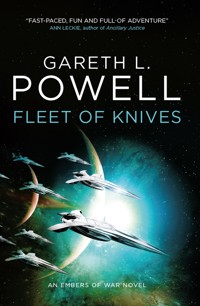
From award-winning author Gareth L. Powell, the second book in the critically acclaimed Embers of War space opera series. The former warship Trouble Dog and her crew of misfits is called upon by the House of Reclamation to investigate a distress call from the human starship the Lucy's Ghost. Her crew abandon their crippled ship and seek refuge abroad an abandoned, slower-than-light generation ship launched ten thousand years before by an alien race. However, the enormous ship contains deadly secrets of its own. Recovered war criminal, Ona Sudak, faces a firing squad for her actions in the Archipelago War. But, at the last moment, she is smuggled out of her high security prison. The Marble Armada has called for her to accompany its ships as observer and liaison, as it spreads itself across the human Generality, enforcing the peace at all costs. The alien ships will not tolerate resistance, and all dissenters are met with overwhelming and implacable force. Then her vessel intercepts messages from the House of Reclamation and decides the Trouble Dog has a capacity for violence which cannot be allowed to endure. As the Trouble Dog and her crew fight to save the crew of the Lucy's Ghost, the ship finds herself caught between chaotic alien monsters on one side, and on the other, destruction at the hands of the Marble Armada.
Das E-Book können Sie in Legimi-Apps oder einer beliebigen App lesen, die das folgende Format unterstützen:
Veröffentlichungsjahr: 2019
Ähnliche













CONTENTS
Cover
Praise for Embers of War
Also by Gareth L. Powell and available from Titan Books
Title Page
Copyright
Dedication
Prologue
Part One
Chapter One
Chapter Two
Chapter Three
Chapter Four
Chapter Five
Chapter Six
Chapter Seven
Chapter Eight
Chapter Nine
Chapter Ten
Chapter Eleven
Chapter Twelve
Chapter Thirteen
Chapter Fourteen
Chapter Fifteen
Chapter Sixteen
Chapter Seventeen
Chapter Eighteen
Chapter Nineteen
Chapter Twenty
Chapter Twenty-One
Chapter Twenty-Two
Chapter Twenty-Three
Chapter Twenty-Four
Chapter Twenty-Five
Chapter Twenty-Six
Chapter Twenty-Seven
Chapter Twenty-Eight
Chapter Twenty-Nine
Chapter Thirty
Chapter Thirty-One
Chapter Thirty-Two
Chapter Thirty-Three
Chapter Thirty-Four
Chapter Thirty-Five
Chapter Thirty-Six
Chapter Thirty-Seven
Chapter Thirty-Eight
Chapter Thirty-Nine
Chapter Forty
Part Two
Chapter Forty-One
Chapter Forty-Two
Chapter Forty-Three
Chapter Forty-Four
Chapter Forty-Five
Chapter Forty-Six
Chapter Forty-Seven
Chapter Forty-Eight
Chapter Forty-Nine
Chapter Fifty
Chapter Fifty-One
Chapter Fifty-Two
Chapter Fifty-Three
Chapter Fifty-Four
Chapter Fifty-Five
Chapter Fifty-Six
Chapter Fifty-Seven
Chapter Fifty-Eight
Chapter Fifty-Nine
Chapter Sixty
Chapter Sixty-One
Chapter Sixty-Two
Chapter Sixty-Three
Chapter Sixty-Four
Chapter Sixty-Five
Chapter Sixty-Six
Chapter Sixty-Seven
Chapter Sixty-Eight
Chapter Sixty-Nine
Chapter Seventy
Chapter Seventy-One
Chapter Seventy-Two
Chapter Seventy-Three
Chapter Seventy-Four
Chapter Seventy-Five
Chapter Seventy-Six
Chapter Seventy-Seven
Chapter Seventy-Eight
Chapter Seventy-Nine
Chapter Eighty
Chapter Eighty-One
Chapter Eighty-Two
Chapter Eighty-Three
Acknowledgements
About the Author
Also Available from Titan Books
PRAISE FOR EMBERS OF WAR
“Ferociously good, proper galaxy smashing space opera.”
AL ROBERTSON
“A compulsively readable, expansive space opera.”
THE GUARDIAN
“Deep and juicy in the details… a morality play within a space opera, with literary-style character exploration in thriller-style structure and pacing.”
NEW YORK JOURNAL OF BOOKS
“A big book that hits all of the buttons that make space opera one of my favourite genres.”
TOR.COM BEST BOOKS OF 2018 SO FAR
“This is a true space opera, full of suspense, and mystery, and stuff blowing up real good—but it’s the humanity of Powell’s vision that truly makes it something special.”
BARNES AND NOBLE BEST SCIENCE FICTION AND FANTASY BOOKS OF 2018 SO FAR
“An excellently paced adventure that swells with energy and force, upping the stakes at every turn of the page.”
BOOK PAGE
“Vivid and sharp, and at times grittily poetic.”
LOCUS MAGAZINE
“Thoughtful, creative and lively… this is top-class space fiction.”
MORNING STAR
“A great sci-fi series, one likely to delight fans of Peter F. Hamilton and Iain M. Banks. Great stuff.”
STARBURST MAGAZINE
“An explosive finale with strong series potential.”
PUBLISHERS WEEKLY
“Gareth L. Powell’s work has lost none of its engaging action, but has gained depth and nuance.”
HUGO AWARD BOOK CLUB
“It’s hugely entertaining, and hints at a wider universe with the tantalising prospect of filling a Banksian hole in modern sci-fi.”
BRITISH FANTASY SOCIETY
“Read it, because before long blurbs will be comparing new and upcoming works with Gareth L. Powell.”
SFFWorld
“A first-rate author of space opera and alternate history.”
SFREVUE
FLEET OF KNIVES
Also by Gareth L. Powell and available from Titan Books
Embers of War
Light of Impossible Stars (February 2020)
GARETH L.
POWELL
FLEET OF KNIVES
AN EMBERS OF WAR NOVEL
TITAN BOOKS
Fleet of Knives: An Embers of War Novel
Print edition ISBN: 9781785655210
E-book edition ISBN: 9781785655227
Published by Titan Books
A division of Titan Publishing Group Ltd
144 Southwark Street, London SE1 0UP
First edition: February 2019
10 9 8 7 6 5 4 3 2 1
Names, places and incidents are either products of the author’s imagination or used fictitiously. Any resemblance to actual persons, living or dead (except for satirical purposes), is entirely coincidental.
Gareth L. Powell asserts the moral right to be identified as the author of this work.
Copyright © 2019 Gareth L. Powell
No part of this publication may be reproduced, stored in a retrieval system, or transmitted, in any form or by any means without the prior written permission of the publisher, nor be otherwise circulated in any form of binding or cover other than that in which it is published and without a similar condition being imposed on the subsequent purchaser.
A CIP catalogue record for this title is available from the British Library.
Did you enjoy this book?
Please email us at: [email protected]
To receive advance information, news, competitions, and exclusive offers online, please sign up for the Titan newsletter on our website:
TITAN BOOKS.COM
To Edith and Winter
“There would be no dance, and there is only the dance.”
T.S. ELIOT
PROLOGUE
SAL KONSTANZ
“I’m almost at the top.”
I’d been climbing since first light. The high desert wind’s thin fingers kept snatching at my cape. I had a scarf wrapped across my mouth and nose to keep out the swirling sand and ash, and wore dark goggles to protect my eyes from the glare.
“I know.” The Trouble Dog’s voice came via an implant in my right ear. “I’m monitoring your position, and your vital signs.” She sounded impatient, but I didn’t have the breath to respond. The Temples of the High Country stood on an imposing mesa, high above an arid wasteland, and the only way to reach them was via steps carved into the side of the mesa’s rust-coloured cliffs.
“I still think it would have been quicker for me to drop you at the top,” she said.
“You know that’s forbidden.” The steps had been smoothed to a shine by the millennial action of wind and sand, and the tread of countless feet—both human and otherwise. My lungs and thighs burned from the ascent. I spoke between laboured breaths. “And besides, it’s kind of missing the point. Climbing the steps is part of the experience.”
Altogether, it had taken me three hours. I had camped at the foot of the cliffs and set out in the chilly pre-dawn light, determined to reach the summit before the midday heat made such effort even more arduous.
“If you say so.”
The Temples of the High Country were some of the oldest alien ruins known to mankind. They were a spiritual and archaeological treasure beyond value—but I hadn’t climbed all this way just to look at a few crumbling sandstone walls. I unslung my pack and let it drop to my feet. Set against the antediluvian backdrop of these ruins, my own problems seemed minor and ephemeral, my own worries petty and futile. I crouched beside the pack and withdrew a black long-stemmed rose from a side pocket. Its silk petals fluttered in the wind.
“A couple of paces to the left,” the Trouble Dog said. Although she was currently languishing in a parking orbit, forty thousand kilometres above this desert, her sensors could still resolve and locate surface features to within a micron.
I shuffled position. “Here?” I looked at the ground between my feet. Fifteen years ago, at the outbreak of the Archipelago War, Gunnery Sergeant Greta Nowak had died defending the top of this great stone staircase. “Are you sure?” The tactical computers overseeing the battle had logged her exact position at the moment of her death—but now, a decade and a half later, nothing remained to mark the spot, not even a stain on the exposed, wind-scoured rock.
“I am.”
“Okay, then.”
From my pocket, I pulled an antique silver frame containing a photograph of George Walker, the Trouble Dog’s former medical officer. He had been killed while we were trying to rescue the crew of a ditched scout ship. I’d neglected to order a risk assessment of the local fauna, and he’d paid with his life.
I rubbed the glass with my sleeve, wiping away dust and finger smudges. The frame was solid silver, and hopefully heavy enough not to be blown from this site by the high desert winds. The picture had been taken in the Trouble Dog’s infirmary during the Archipelago War, before the ship resigned its commission and declared its allegiance to the House of Reclamation. In it, George wore the bright orange jumpsuit of a naval medic. He looked younger than I remembered him. His hair wasn’t completely grey, his face not as deeply lined. And yet, there could be no mistaking that smile. I knelt down and leant the frame against the powdery red stone of the nearest wall, angled so that, each morning, the first rays of the rising sun would strike it and illuminate his face. I ran a fingertip across the glass, tracing the line of his cheek. A dry wind tugged at the hem of my cape. To the west, three of the planet’s five moons were still visible, lingering like pale onlookers.
“Sorry, George.” It was all I could think of to say. I raised the rose to my covered lips, and then laid it in front of the frame, its stem weighed down with a fist-sized rock. I had nothing to say to Greta Nowak. I hadn’t known her. She had fallen here, and her recovered-but-unclaimed body had been harvested for its organs and stem cells. Although shrapnel had peppered her heart and lungs, her kidneys, liver and spleen had helped save the lives of three wounded comrades. Meanwhile, her stem cells had been forwarded to a naval facility a dozen light years distant where, a year later, they were used to grow organic processors—brains—for a pack of six Carnivore-class warships. And those six had been the Trouble Dog and her siblings.
The rose was the Dog’s way of acknowledging this, just as the photograph was my way of saying goodbye to George.
* * *
As noon approached, I lay in the shadow of the temple wall, with my head resting on my arm. The rocks beneath me were hard and awkward, stripped of sand by the desert wind. Unable to find a comfortable position, I watched shimmers of heat rising from the stones at the plateau’s edge.
“So, what now?” The Trouble Dog sounded bored. “Are you going to climb all the way back down?”
“First I need to wait for it to get cooler.”
“And when will that be?”
“In a couple of hours.”
“Are you quite sure you don’t want me to come and pick you up?”
I smiled behind the scarf. “I’m very sure, thank you.” We both knew the ruins lay at the centre of a dome-shaped no-fly zone. And, to tell the truth, I was rather enjoying the solitude. After what we’d been through in the Gallery, we were due some time away from our duties.
In fact, that was the point of this shakedown cruise.
Following the battle, we had been placed in quarantine until the doctors satisfied themselves we weren’t unwittingly carrying any alien pathogens. Even the Dog had what it called “a check-up from the deck up.” Then, when they were quite certain we posed no medical threat, the House elders subjected us to an extensive debriefing. Our testimonies, and the ship’s records of events, were pored over in exhaustive detail, from the initial distress call sent by the Geest van Amsterdam to the emergence of the million-strong Marble Armada, and my reluctant assassination of a Conglomeration admiral on the bridge of his flagship.
Throughout its history, the House of Reclamation had been an apolitical organisation, dedicated simply to the preservation of life and the rescue of stranded spacefarers. So it came as no surprise that the House elders were less than thrilled to find themselves suddenly thrust into the centre of the biggest military and political shake-up since the Archipelago War.
We spent weeks being cross-examined, physically examined, and subjected to every test they could think to run upon us. The Trouble Dog had emerged from that distant mausoleum at the head of an alien armada large enough to outnumber the combined forces of every government in the Human Generality—and the elders were under a lot of external pressure to discover how much influence the Dog and its crew might have on the forthcoming actions and intentions of that armada.
We answered all their questions to the best of our abilities. And when the Dog finally declared she was flat-out leaving, they at least had the good sense not to argue.
Carnivore-class heavy cruisers can be headstrong beasts, and this one had recently been betrayed by—and forced to kill—one of her siblings.
Sometimes, it was easy to forget that a human mind lurked at the heart of the ship. At a hundred and seventy-two metres in length and displacing ten thousand tons, she was a formidable creature conditioned for battle. But behind the missile racks, torpedo tubes and sensor blisters, she was becoming increasingly capable of genuine emotion. Even though three quarters of her thoughts ran on artificial processors, no amount of silicon could fully mask the storm of grief and guilt now swirling in that cloned cortex.
She had killed her sister. It had been in self-defence, but that didn’t make the fact of it any easier for her to deal with.
And me?
I’d ordered the death of another human being. I’d done it to save his crew from a fight they couldn’t possibly hope to win, but I still felt like a murderer.
We both needed time to come to terms with what we’d done, and we needed to say goodbye to our fallen comrades.
The elders of the House had, extremely reluctantly, granted us a sabbatical. And frankly, we’d earned it.
Lying there, in the shadow of the ruined wall, I stared into the sky and thought about George, about the war, and about the people we’d lost. About how life accumulates its hurts upon us the same way asteroids find themselves weathered and pocked by cold barrages of interplanetary dust.
* * *
What is honour?
While commanding a medical frigate during the war, I had the opportunity to talk to a lot of wounded soldiers—both men and women. Some were struggling with mortal wounds. Sightless, jaws clenching against the pain, they would grip my hand and ask if I thought they’d acquitted themselves with honour. They seemed to equate honour with bravery; to have been wounded while acting with honour meant they had faced the enemy without fear, that they were more than just shredded cannon fodder—that they had behaved in such a way that their families could draw comfort from their conduct, knowing they had upheld the values for which they fought.
But to me, honour has always meant something else. Something nobler and more personal. My great-great-grandmother defined it when she wrote in the founding documents of the House that, “Courage is making the choice to forgive, even when every nerve in your body cries out for vengeance.”
For me, honour is having that courage, and the strength to do the right thing, even though it might run counter to my own interests. And by that token, the Conglomeration commanders dishonoured themselves at the Battle of Pelapatarn. Faced with a choice between losing the war and destroying an ancient, irreplaceable world filled with billions of arboreal intelligences, they chose the latter. They chose the wrong path because it suited their short-term needs. But those trees had been there for untold millennia, growing and dying, each with a lifespan greater than many human civilisations. Destroying them was a desecration. It was a genocide of staggering short-sightedness. And, as far as I was concerned, they all shared the blame, from the generals who’d given the order to the commander of the Conglomeration Fleet, who in turn passed it along to the captains of the ships that finally prosecuted the atrocity. I held complicit everyone in the chain of command, from Captain Deal down to the individual, anonymous ships in her strike force. If they had possessed a scrap of honour, they would have laid down their own lives rather than participate in such barbarity.
I had been in the system when the crime took place, but my frigate had been ordered to hold position with the other support ships, in orbit around the larger of Pelapatarn’s two moons. We could only watch in horror as the pictures came in—pictures of a world aflame, and death on an unimaginable scale.
I’d joined the Outward Navy when my parents died. I’d done it because I wanted to escape the shadow of my family, and especially my great-great-grandmother. But in the aftermath of Pelapatarn, I knew I could no longer serve an organisation dedicated to violence, however righteous or justified—or honourable—that violence might be. And so I resigned. I turned the medical frigate over to my second-in-command, and transmitted an application to the House of Reclamation.
And when I pinned on that sixteen-pointed yellow star, and read the emblazoned motto, Life Above All, I knew with certainty that I had found a place where I could serve the remainder of my days with real honour—the kind that comes from compassion and forgiveness rather than cruelty and expedience.
* * *
I awoke two hours later, stiff from lying on such a hard surface, and surprised to have slept so long. The climb up the side of the mesa must have tired me more than I’d realised.
“Welcome back.” The sound of the Trouble Dog’s voice filled me with an unexpected pang of desolation. Why was I out here, lying on a desert rock a hundred light years from where I’d been born? A hundred light years from the graves of my parents, and who knew how much further from the frozen husk of the only man I’d ever loved.
“Did you sleep well?” she asked.
I rubbed my eyes and levered myself up on my elbows. The wind still felt warm, but it had lost the furnace-like breath of midday.
“As well as can be expected.” I sat up. Something clicked in my lower back, and I suppressed a groan.
“Why didn’t you wake me?”
“I thought you might appreciate the rest.”
I blinked in surprise. “That’s unusually considerate of you. If I didn’t know better, I might suspect you were maturing.”
I packed away my things and walked back towards the head of the steps. As I approached, I saw a small knot of tourists cresting the edge of the plateau on donkeys. They had ridden up during the heat of the day, and were all red-faced and panting beneath their wide-brimmed hats. When they caught sight of me, their smiles were filled with the comradeship of mountaineers passing each other on a high peak. As they dismounted from their rides, we passed a few pleasantries about the heat, the steepness of the climb and lack of safety rails.
Then one of the men asked, “Are you a member of the House?” He had a thick moustache and a military bearing. I looked down at my loose clothes, wondering how he could have guessed. Then I remembered the badge I’d used as a clasp for my cape: a relief image of the House of Reclamation’s sixteen-pointed star, rendered in bronze. I brushed it with my fingers.
“Yes.”
“We saw your cruiser in orbit.” He jerked a thumb at the implacable desert sky, and I had to resist the urge to glance upward in response.
“Yes,” I said, “she’s with me.”
He nodded, seemingly understanding the complex relationship I had with the offensive heavy cruiser I called both home and sister.
“She’s a Carnivore, isn’t she?”
“Decommissioned.”
“I thought so.” He tapped his barrel-like chest. “I spent eighteen years in the Conglomeration Navy. Saw action around Charlotte’s World during the war.”
He seemed so proud, so pleased with himself, that I couldn’t help saying, “I was at Pelapatarn.”
For an instant, some of his bluster dropped away.
“You fought at Pelapatarn?”
“I commanded a medical frigate.”
“Really?” He leaned forward, clearly impressed despite himself. “Was it as bad as they say? The battle, I mean.”
“Worse.” I couldn’t bring myself to elaborate. Some things can’t be put into words, and the defeat of the Outward forces at Pelapatarn was an atrocity I had no way to articulate. Luckily, he seemed to understand this as well. We both looked at the dust between us, lost for a moment in our own experiences of the war.
The rest of the tour group moved off, towards the temple ruins. The moustachioed man forced a smile.
“Well, it was a pleasure to meet you, Captain.” He saluted. “And it’s good to see some ships still have human crews.”
I returned the salute, feeling faintly ridiculous. I was getting impatient to begin my descent. I felt sticky and in need of a shower and a cold drink. But his last remark puzzled me.
“Human crews?” All ships carried human personnel, except… “You’re talking about the Marble Armada?”
His smile collapsed into a scowl. He hawked phlegm and spat it into the dust.
“Fucking invasion fleet, if you ask me.”
“Really?” He obviously had no idea of the part I’d played in rousing the Armada from their millennial slumber. “They don’t seem to have done anything hostile.” As far as I knew, the Armada had taken station on the edge of the Camrose System, and was currently locked in discussion with the elders of the House, trying to figure out how best to accomplish their mission, which was the prevention of another conflict on the scale of the Archipelago War. I said as much, but my new friend was not to be so easily placated.
“What do we really know about them,” he insisted, flushed and sweating, “except they survived the death of the race that built them, and now they’re here, offering to help us in turn?”
The Conglomeration had always been introspective and suspicious of other species. It was an attitude that, as a former member of the Outward, I’d always found deeply irritating.
“They don’t seem hostile,” I said.
He shook his head, disappointed by my naivety. Then he jabbed his thumb against his chest.
“Well, I don’t trust them,” he said, “and neither should you.”
PART ONE
LUCY’S GHOST
The universe has an almost infinite capacity to charm and appal.
Sofia Nikitas
CHAPTER ONE
JOHNNY SCHULTZ
The attack came while we were in the higher dimensional void, and it came without warning. I’d had a late-night card session with Santos and Kelly, and was making my way up the companionway to the bridge, eyes still bleary with sleep, when the Lucy’s Ghost slammed sideways, smacking me hard against the bulkhead.
I ended up on my back at the foot of the ladder. My left shoulder felt battered, and I’d scraped my right shin. I’d been carrying my antique leather pilot’s jacket in one hand, and had dropped it when I hit the wall; and somehow, I’d cut my forehead. When I put my hand to it, the fingertips came away red and sticky with blood.
“Hey!” I yelled up the companionway. “What the fuck was that?”
I could feel the artificial gravity flickering as it tried to recalibrate, having been unable to compensate for the savagery of the lurch.
Above me, Vito Accardi’s face appeared at the hatch.
“Something hit us, chief.”
Keeping one hand over the cut on my head, I scooped up my jacket and scrambled to my feet.
“Yeah, no shit?” I held onto the wall for support. With the gravity skittish, I didn’t want to get caught off guard by a second impact. “What was it? Are we being shot at?”
Looking down at me with wide eyes, Vito shook his head.
“I don’t know. But you’d better get up here.”
* * *
The Lucy’s Ghost was a medium-sized trader, licensed to carry a hundred and sixty tons of cargo between the various worlds of the Generality. She was three hundred metres in length and a hundred and fifty across her beam. In profile, she was a blocky, industrial-looking three-sided chisel, with a blunt nose at the front, and chunky propulsion units at the rear. She’d had many owners in her time, and had travelled the length and breadth of the Generality, all the way from Earth to the Rim Stars and the Trailing Edge. In cross-section, she resembled a triangle with rounded points, split into three levels. The cargo area filled most of the large lower deck, with the remainder taken up by fuel containment and engines. The middle deck housed crew quarters, passenger staterooms, a cramped galley, maintenance shops and equipment storage. The smaller upper deck had been given over almost entirely to the bridge, but also housed the main passenger airlock and a small communal lounge area that sported a picture window, torn and scuffed leather seats and a variety of brown brittle-leafed spider plants.
The story around the ports—a rumour I’d done my best to encourage—was that at the age of seventeen, as a young dock rat, I’d won her in a game of cards. It wasn’t true, but it helped my reputation.
I had actually bought her with a combination of money inherited from a childless uncle and a large mortgage from the bank—a mortgage I was still paying off in monthly instalments. Now, ten years and around a thousand light years later, I’d been playing the part of “Lucky” Johnny Schultz for so long, even I sometimes found it hard to remember which version of the story was real and which was made up.
I pulled myself up the ladder and through the hatch, onto the bridge. The main display screen showed an external view of the grey mist that surrounded the ship. A second, smaller screen held a computer-generated image of the Lucy’s crew interface: a young girl with bright, playful eyes and hair the colour of starlight.
I dumped my leather jacket across the back of the captain’s chair, and strapped myself in, wiping blood-sticky fingers on my thigh.
“What do we know?”
“Not much,” Vito said. “The ship didn’t see anything.”
I looked at the Lucy. “Nothing?”
On the screen, she pursed her virtual lips. “Sensor readings remain normal, dearie.”
Even after all this time, it still felt strange to hear an old woman’s phrasing coming from someone so young-looking; but while the avatar’s image had remained frozen since the ship’s inception, her mind had aged over the decades she’d been plying the cargo circuits of the Generality.
“No readings of heat, mass, anything like that?”
“Just the void, same as ever it was.”
Carefully, I flexed my shoulder. It was already beginning to stiffen.
“Vito?”
The pilot shrugged. He looked rattled. “Something hit us.”
“But you didn’t see what it was?”
“It didn’t come from the front.” I could see beads of sweat like jewels on his upper lip. “And the ship didn’t see it…”
“Are you sure it was an impact? Could it have been explosive decompression?” I thought maybe something had blown internally, causing a hull rupture.
The Lucy answered, “All internal compartments read as still pressurised, dearie. But I’m detecting serious damage to the starboard hull plates. Whatever hit us definitely came from outside.”
That ruled out accident, malfunction or sabotage.
Vito rubbed his lips with a nervous hand.
“Pirates?”
“In the void?” I shook my head. “It’s not possible. You can’t track another ship through the hypervoid. And besides, even if there were another ship out here, the Lucy would have seen it.”
“Then what hit us?” He seemed on the verge of giggling. “A hypervoid monster?”
“Don’t be stupid.” Faced with the abyssal emptiness of the void, the human brain—with its evolved ability to spot camouflaged predators lurking in the long grass—tended to impose patterns and threats where none existed. Men and women who stared into the shifting mists of the higher dimensions sometimes saw shadows moving in their peripheral vision, and imagined strange, impossible beasts skulking at the limits of visibility, like wolves circling the glow of a campfire.
Vito’s laugh had a nervy edge. “Well, what else do you think it was, chief? A chunk of rock? An old beer bottle chucked from somebody’s airlock?”
“Not likely.” You needed an engine to stay in the hypervoid. Anything without power would quickly drop back down through the dimensions, into the normal, everyday universe. So the chances of us having hit some piece of random debris were infinitesimally small. I pulled up feeds from all the external cameras on the hull, but saw nothing more than the usual shifting emptiness.
“Nothing on your sensors?” I asked the Lucy again.
“Not a sausage, dearie.”
“Hmm…” Keeping one eye on the external screens, I called down to the crew lounge. Riley Addison answered. Twenty-five years old, with long auburn hair and a gold stud in her right eyebrow, she was the ship’s loadmaster, in charge of the loading and unloading of cargo, and keeper of the ship’s stores.
“What’s going on?” she asked.
“We hit a bump.” I could see her frowning at the blood smeared across my forehead. “Is everybody else okay?”
“Mostly just a few cuts and bruises.” She had a red mark on her cheek, as if she’d taken a glancing blow from something small and heavy, like a loose coffee mug or screwdriver. “Although Chet was down in engineering when it happened. It got thrown around pretty bad.”
“How is it?”
“It looks like it might’ve busted a couple of ribs.” Chet was the ship’s Druff engineer. It had shiny scales, six limbs, and six hands that also doubled as faces.
“Shit.”
“Any idea what hit us?”
“I’m working on it. Have you heard from Abe?” Abe Santos was the ship’s cook. He would have been in the galley, preparing the midday meal.
“He dropped a saucepan on his foot.”
“Is he okay?”
“It’s swelling up and he’s in a lot of pain. Looks like a nasty break, coupled with some scalding. Though to be honest, he seems more annoyed about the ruined spaghetti than anything else.”
I smiled. “Well, that can’t be helped. Any word from Jansen and Monk?”
“I haven’t been able to reach them.”
“Keep trying.” I reached for the button that would end the call. “Get Dalton to do what he can for the others, and then make sure you’re all strapped in. I don’t want any more injuries.”
Addison threw a half-assed salute. “Yes, sir!”
I returned my full attention to the outside view. I’d never been particularly bothered by the emptiness of the hypervoid. Perhaps it was because I’d been crewing ships since I was fifteen years old, and had become accustomed to the swirling, tenuous mists. Maybe I was braver than most. Or maybe I simply lacked the imagination to conjure up horrors from nothingness. Whatever the reason, I wasn’t frightened of staring into the abyss.
“Coming up on target in five minutes,” Vito said. He activated the intercom and his voice rang through the ship. “All hands, prepare to drop back into reality. Four minutes forty-five, and counting.”
Although he was the pilot, the Lucy’s Ghost carried out the vast majority of navigational calculations. An unaided human brain simply couldn’t crunch the kind of numbers necessary to plot a course through the higher dimensions—and hurling yourself into the hypervoid without doing the math was a good way to disappear and never be heard from again.
Nothing had changed on the external screens, so I asked the Lucy to keep monitoring them while I took a final look at the details of our target.
We were planning to intercept an old Nymtoq generation vessel called The Restless Itch for Foreign Soil. It had been constructed from a hollowed-out asteroid in the days before the Nymtoq discovered higher dimensional travel, and had been in flight now for almost ten thousand years. The society within fell apart and died out long before it reached its intended destination, and so the Nymtoq had been maintaining the old ship as a memorial, placing it on a looping course that took it back and forth through their territories, endlessly plying the dark spaces between the stars, at speeds that ensured it only came close to the light of inhabited systems once every few centuries.
Our plan was to pull alongside, cut our way in, and strip out as much saleable tech as we could carry. The battles of the Archipelago War had left wrecked human ships in a dozen systems across the Generality. Over the past couple of years, we’d scraped a living salvaging materiel and spare parts from them, but now the good finds were drying up, and we needed an alternate source of income—even one that was technically illegal, and likely to land us in a world of trouble if the Nymtoq ever discovered what we’d done. They would consider what we were planning an act of piracy, but I preferred to think of it as salvage. The Restless Itch had been adrift for centuries with its crew gone and systems dormant, while the rest of the universe zipped past it in the hypervoid, covering similar distances in days rather than decades. It was a monument, a flying tomb. And we were archaeologists, come to case it for valuable antiquities.
At least, that’s what I told myself. The truth was, we were simply going to break in and lift anything that took our fancy. We didn’t have the time or inclination for finesse.
Vito cleared his throat. “Four minutes fifteen.” He began to throttle back the engines, preparing for a gradual transition back into normal space. If the Lucy’s calculations were correct—and the coordinates I’d bought worth the money I’d paid for them—we’d emerge into empty space a few tens of kilometres from the massive, drifting bulk of the Restless Itch.
“Four ten.”
I gripped the arms of my couch and offered a silent prayer to any gods that might be listening. If we failed here, I wouldn’t be able to afford to pay the crew, let alone fuel and provision the ship for another flight. Yes, we were risking the ire of an alien species, and the wrath of human customs officials, but if we couldn’t secure a decent cargo, and bring it safely to market, we’d all be grounded and out of a job.
“Three fifty.”
I double-checked my harness. The transition to normal space could occasionally be rough, and I’d been thrown around enough for one day. I tested the fastenings and adjusted the straps to make them more comfortable. My heart had begun to pound with the excitement and anticipation of the coming raid.
Only another three minutes…
I was still looking at the countdown when I caught movement in my peripheral vision: an impression of something black slipping between wisps of mist. By the time I turned my eyes to the screen it was gone.
“Ship, what was that?”
“What was what, dearie?”
I indicated the display in question. “There was something on the starboard screen, just for a second.”
“My sensors aren’t registering anything.”
“There it is again!” This time the image was on the forward screen: a lithe black shape twisting through the murk, maybe two hundred metres from the Lucy’s prow.
“Where?”
“There!” I jabbed my finger at the picture, but the thing had already disappeared back into the mist.
I turned to the pilot. “You saw it, didn’t you?”
Vito’s eyes were wild. His fingers gripped the edge of his console. He tried to speak, but nothing came out. I saw him swallow hard, and he gave a tight, fearful nod. I wasn’t hallucinating; he had seen it too, which meant it had to be real. And yet, still the Lucy’s avatar frowned.
“I’m afraid I’m still not detecting anything,” she said.
“Are all your sensors working?”
“I checked them twice.” She sounded vaguely indignant. “And all the diagnostics came back green.”
“Then use landing radar, infrared. Turn on everything we’ve got.” I could feel my pulse thumping in my chest. My stomach fluttered. I glanced at Vito.
“Two minutes to dropout.” He’d found his voice. I gave him a thumbs-up, and returned to the screen.
And there it was!
Space twisted and split, and from the distortion a creature leapt. A huge, impossible creature that fell with the speed of a striking hawk, its lacy black wings folded back against its body, its mouth open and fangs gleaming in the starlight. I had the impression of a gaping jaw filled with jewelled teeth. Then the screen blanked, and the ship wrenched itself sideways.
For a moment, we were being shaken in those titanic jaws. Then we were tumbling free as the creature swirled away like smoke, circling around for another strike.
“Drop us out!” I called to Vito, as alarms filled the bridge. “We can’t wait for it to hit us again. Drop us out, now!”
His hand jerked the controls, and the Lucy’s Ghost fell. Without finesse, she battered her way through the transitional zone between dimensions and spilled out into normal space, wounded and toppling, gas venting from holes in her starboard side. The stars whirled sickeningly around us for a couple of seconds—and then we slammed into the rocky flank of the Restless Itch like a hang-glider into the side of a mountain.
CHAPTER TWO
ONA SUDAK
From the window of my cell, I watched the sky grow pale. Somewhere, beyond the prison walls, birds were singing. Below me, in the flagstone courtyard that occupied the centre of the prison, half a dozen uniformed soldiers stood loading and inspecting their rifles in the thin, predawn light. Their voices were soft and low and, in the frosty morning air, their exhalations came as little ephemeral wisps of cloud. Between them and the rearmost wall, a pockmarked wooden stake marked the spot where, in a few short moments, I was scheduled to die.
Four years ago, under my real name of Annelida Deal, I had led the fleet that sterilised Pelapatarn. It was an action that brought the grinding attrition of the Archipelago War to an abrupt, horrific end, at the cost of a few thousand human lives and the destruction of a billion-year-old sentient jungle. And even though I had been acting under orders when I allowed my ships to commit that atrocity, the courts—under growing pressure from a populace appalled at the lengths to which its military had gone on its behalf—held me responsible for the destruction and loss of life, and sentenced me to be put to death here in this prison, on the anniversary of the armistice.
In my head, the two sides of my personality were at war. The part of me that had once pretended to be a poet named Ona Sudak railed against the injustice of it all—against dying here in this squalid little prison after everything I had done and seen—while the side of me that was Annelida Deal and had lived through the war laughed, and asked, Why not? What makes you so special? Did you think you had a destiny? That the universe had a purpose in sparing you thus far? Well, guess what? So did every casualty on every battlefield throughout history: every serf murdered by an unjust lord; every peasant that starved in their hovel; every victim of accident, disease or random violence… They all thought the world had a plan for them, and they were all wrong. And they died shitty, untimely and disillusioned deaths because of it—because individual life means nothing in the cascade of history, and the gods have better things to worry about than your survival.
I watched one of the soldiers clip a fresh magazine into his carbine. The rifles they were using were the same model I’d used in basic training: a robust firearm with few moving parts, designed primarily for ruggedness and simplicity of use.
In the cell behind me, the military chaplain coughed.
“If you wish to unburden yourself, now would seem to be the time.”
I turned away from contemplation of my soon-to-be executioners.
“No, thank you.”
The Reverend Thomas Berwick was an avuncular man with a round face and wide, sympathetic brown eyes. He wore the black robes of the Church, and clutched in his lap a thick, leather-bound holy book.
“This might be your last chance to confess,” he said, “and make peace with your gods.”
I felt my fists clench. “Why? So I can salve the consciences of those who condemned me?”
He gave a sympathetic half-smile, and spread his hands. “No, my daughter. For the sake of your soul.”
My soul? If I’d had the energy, I might almost have laughed. “Have you ever seen a man die, padre? And I don’t mean here,” I jerked my head at the window, “where it’s relatively quick and clean. I mean on the battlefield, when they’re hit by an artillery shell and reduced to a splatter of slurry, and all that’s left’s a stinking mess of blood and shit and gristle? Or in a naval battle, when their section depressurises and the blood boils in their lungs? Or when they step on a mine and it blows their leg off up to the waist, and their innards are spilling out into the dust and they don’t die quickly, and they most certainly don’t die quietly?”
The chaplain’s Adam’s apple bobbed as he swallowed back his distaste.
“No, I can’t say that I have.”
“Well I’ve been there.” I lowered my voice. “I’ve seen men and women die in ways so brutal and horrific that you probably can’t even begin to imagine them, and I’ll tell you this: I’ve seen nothing to convince me we’re anything more than meat and bone and sinew.” I tapped the side of my head. “We live in here, beneath this cap of bone, and there’s nothing else. No emergency escape hatch that whisks us to heaven. No undying ghost that leaps from our mouth when the bullets enter our cranium.” I turned back to the window with an angry shrug. “When you’re dead, you’re dead. There’s no afterlife, no mystical white light, just darkness, oblivion, and an endless eternity of nonexistence.”
Berwick was silent for a moment. Then he said, “That’s a very negative point of view.”
I shook my head. Below the window, the soldiers were practising their stances.
“It’s not a point of view, padre, it’s a fact. And as for being negative, well, I’m about to be shot, so you’ll have to forgive me if I lack my usual cheery temperament.”
Far beyond the prison walls, a dark speck appeared. Low and moving fast against the backdrop of the dawn, it skimmed the crests of the distant hills that had for the past six months marked the furthest boundaries of my visible horizon. I watched for a couple of seconds, and then lost sight of it as it dropped below the level of the wall.
I heard chair legs scrape the stone floor as the chaplain pushed himself laboriously to his feet.
“We only have a couple of minutes,” he puffed. “They’ll be coming for you soon. Do you at least have any final words? Any messages of comfort you’d like me to convey to your friends or family?”
I looked down at my hands.
“Tell them I followed orders. Tell them I respected the chain of command. And, ultimately, I did what I thought was for the best.”
“You believe you did what was right?”
I pictured six Carnivore-class heavy cruisers entering the atmosphere of Pelapatarn and sweeping across its single continent in an arrowhead formation. I pictured their fusion warheads blossoming over the jungles, igniting firestorms that would choke the atmosphere for months, and I pictured the wrecked ships in orbit, the smouldering tree stumps and cremated animals on the ground. I imagined the terror of the soldiers from both sides as they saw the bombardment—an almost solid curtain of nuclear fire—sweeping across the treetops towards them, knowing there could be no escape, nowhere to hide. Had they appreciated the sacrifice they were making, in those last few instants before they were vaporised? Could they possibly have understood that their deaths would bring an almost immediate end to the war—and if so, could they have found it in their hearts to forgive me?
“No.” The word came out hoarse. “That’s not what I said. My exact words were, ‘I did what I thought was for the best.’ There’s an important distinction.”




