


Erhalten Sie Zugang zu diesem und mehr als 300000 Büchern ab EUR 5,99 monatlich.
- Herausgeber: Titan Books
- Kategorie: Fantasy und Science-Fiction
- Sprache: Englisch
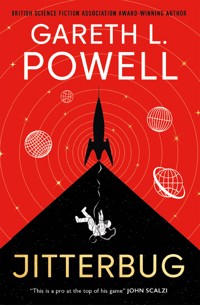
In this twisty and action-packed adventure from the BSFA award-winning author of Descendant Machine and Future's Edge, a crew of bounty hunters find themselves ensnared in a conspiracy on the very fringes of the devastated solar system. Perfect for fans of James S. A. Corey and Adrian Tchaikovsky. "On Earth, they depicted justice as blindfolded and impartial, but out here on the frontier, she was red in tooth and claw." Jupiter and Saturn are gone, and a mysterious force has built a huge habitable sphere from their ashes. When criminals try to lose themselves on this new frontier, bounty hunters like Copernicus Brown and the crew of his sentient ship Jitterbug get paid to hunt them down. But when Brown rescues Amber Roth, sole survivor of a pirate attack, the Jitterbug and her crew find themselves the target of powerful political factions who want control of the data chip hidden in Roth's stomach. And all the while, something vast and ancient creeps towards them from the depths of space…
Sie lesen das E-Book in den Legimi-Apps auf:
Seitenzahl: 377
Veröffentlichungsjahr: 2026
Das E-Book (TTS) können Sie hören im Abo „Legimi Premium” in Legimi-Apps auf:
Ähnliche











Contents
Cover
Title Page
Leave us a Review
Copyright
Dedication
Prologue Justice Brown
Part One The Handiwork of Gods
Chapter One Copernicus Brown
Chapter Two Jitterbug
Chapter Three Copernicus Brown
Chapter Four Jitterbug
Chapter Five Copernicus Brown
Chapter Six Jitterbug
Chapter Seven Copernicus Brown
Chapter Eight Amber Roth
Chapter Nine Copernicus Brown
Chapter Ten Copernicus Brown
Chapter Eleven Amber Roth
Chapter Twelve Danielle Lanzo
Chapter Thirteen Copernicus Brown
Chapter Fourteen Amber Roth
Chapter Fifteen Jitterbug
Chapter Sixteen Copernicus Brown
Chapter Seventeen Amber Roth
Chapter Eighteen Danielle Lanzo
Chapter Nineteen Copernicus Brown
Chapter Twenty Jitterbug
Chapter Twenty-One Amber Roth
Chapter Twenty-Two Copernicus Brown
Chapter Twenty-Three Danielle Lanzo
Chapter Twenty-Four Copernicus Brown
Chapter Twenty-Five Danielle Lanzo
Chapter Twenty-Six Copernicus Brown
Part Two The Unknown, Remembered Gate
Chapter Twenty-Seven Amber Roth
Chapter Twenty-Eight Danielle Lanzo
Chapter Twenty-Nine Copernicus Brown
Chapter Thirty Jitterbug
Chapter Thirty-One Danielle Lanzo
Chapter Thirty-Two Copernicus Brown
Chapter Thirty-Three Jitterbug
Chapter Thirty-Four Amber Roth
Chapter Thirty-Five Danielle Lanzo
Chapter Thirty-Six Copernicus Brown
Chapter Thirty-Seven Jitterbug
Chapter Thirty-Eight Copernicus Brown
Chapter Thirty-Nine Amber Roth
Chapter Forty Copernicus Brown
Chapter Forty-One Amber Roth
Chapter Forty-Two Jitterbug
Chapter Forty-Three Danielle Lanzo
Chapter Forty-Four Copernicus Brown
Chapter Forty-Five Jitterbug
Chapter Forty-Six Copernicus Brown
Epilogue I Justice Brown
Epilogue II Copernicus Brown
About the Author
Jitterbug is a thrilling journey filled with witty banter, unlikely allies and friendships, secrets and sacrifices, and found family, exploring the cyclical nature of both history and the future, and the way our fates are often shaped not just by choice but also by luck and coincidence.”
AI JIANG, author of A Palace Near the Wind
“Jitterbug is a haunting, propulsive odyssey across the ruins of our solar system—where justice, grief, and the ghosts of creation itself collide. Gareth L. Powell writes with both fire and tenderness, crafting a space opera that pulses with human ache amid cosmic wonder. It’s poetic, cinematic, and deeply humane—science fiction with a beating heart and a reckoning soul.”
CYNTHIA PELAYO, Bram Stoker Award®–winning author of Children of Chicago and The Shoemaker’s Magician
“Imagine the solar system as a mighty ocean full of pirates and you have the beating heart of Jitterbug – a roaring whirlwind of a novel, full of adventure, emotion, wit and great characters.”
DAVID QUANTICK, author of All My Colours
“Every time I thought I had the flight path of Jitterbug all figured out, Gareth L. Powell banked a hard left in the most delightful way. From space pirate brawls to bounty hunter chases and political machinations, Powell pairs thrills with richly imagined characters that pulse with life. I don’t think I’ve ever rooted so hard for a shipboard AI. Bold and cinematic, Jitterbug proves that Powell is a master of scale—balancing galaxy-spanning stakes with moments of vibrant, intimate heart.”
NATHAN TAVARES, author of A Fractured Infinity
JITTERBUG
Also by Gareth L. Powelland available from Titan Books
Future’s Edge
Who Will You Save?
THE CONTINUANCE SERIES
Stars and Bones
Descendant Machine
THE EMBERS OF WAR TRILOGY
Embers of War
Fleet of Knives
Light of Impossible Stars
LEAVE US A REVIEW
We hope you enjoy this book – if you did we would really appreciate it if you can write a short review. Your ratings really make a difference for the authors, helping the books you love reach more people.
You can rate this book, or leave a short review here:
Amazon.com,
Amazon.co.uk,
Goodreads,
Barnes & Noble,
Waterstones,
or your preferred retailer.
Jitterbug
Paperback edition ISBN: 9781835414514
E-book edition ISBN: 9781835415504
Published by Titan Books
A division of Titan Publishing Group Ltd
144 Southwark Street, London SE1 0UP
www.titanbooks.com
First edition: March 2026
10 9 8 7 6 5 4 3 2 1
This is a work of fiction. All of the characters, organizations, and events portrayed in this novel are either products of the author’s imagination or are used fictitiously. Any resemblance to actual persons, living or dead (except for satirical purposes), is entirely coincidental.
© Gareth L. Powell 2026. All rights reserved.
Gareth L. Powell asserts the moral right to be identified as the author of this work.
No part of this publication may be reproduced, stored in a retrieval system, or transmitted, in any form or by any means without the prior written permission of the publisher, nor be otherwise circulated in any form of binding or cover other than that in which it is published and without a similar condition being imposed on the subsequent purchaser. A CIP catalogue record for this title is available from the British Library.
EU RP (for authorities only)eucomply OÜ, Pärnu mnt. 139b-14, 11317 Tallinn, [email protected], +3375690241
Typeset by Richard Mason.
For Edith, Rose, and Robin
PROLOGUE
JUSTICE BROWN
Come sit here by me, Copernicus. Listen to your grandmother. I want to tell you a story. I want to tell you how it all began…
It was a hot night in South London, back on Earth. This was many years ago, when your father was just a baby. It was the kind of night you have all the windows open, and it doesn’t make a lick of difference, except you can hear the traffic and the sirens in the streets nine floors below.
I’d just got the baby down when Leon called and told me to come up to the roof.
“Why the hell am I coming up to the roof?” I asked him.
He laughed, but I could hear he was scared. “It’s Saturn, Justice.”
“What about Saturn?”
“It’s started.”
“But Malcolm—”
“Bring Malcolm. This is historic.”
“I only just got him to sleep.”
“Juss, I got the telescope set up. The neighbours are all here. Just come on up.”
So, I grumbled to myself, and I pulled on a T-shirt and a pair of pyjama bottoms, and I carried baby Malcolm, your father, up four flights of stairs to the roof.
As residents, we weren’t supposed to have access to the roof of the tower block, but the maintenance door had been broken for as long as anyone could remember, and no one seemed in a hurry to get it fixed.
Up on the roof, I could hear the cars and the drunks down in the streets. Leon was waiting for me. He had a beer bottle in one hand and his eyes were wild.
“You gotta see this, Justice.”
The lights of a police helicopter blinked high above Clapham Common. I saw people on other roofs. Some of them also had telescopes or binoculars. Others just seemed to be partying, enjoying the vibe. I smelled barbeque. I’d already had dinner, but the smoky jerk chicken spices and charred sweetcorn ribs set my stomach rumbling something fierce, which did nothing to improve my mood.
“Is this like that Uranus thing?”
“Yes, and Neptune before that.”
I sighed. “You brought me and the baby up here for lights in the sky?”
“Juss, it’s so much more than that.”
“You said that last time, and it was just a little star turning into a bright smudge.”
Leon took a slug of beer. He seemed wired. “First off, Uranus wasn’t a star, it was a planet. And secondly, it didn’t turn into a smudge, it disintegrated.”
“Like the other one, a few years ago.”
“Like Neptune, yes.”
I raised my eyes to the light-choked sky. Only a handful of the brightest stars could penetrate the city’s glow. “And you dragged me out to see the same thing, a third time?”
He looked crestfallen. “But, Justice, this is Saturn. It’s historic.”
“And I got work tomorrow.”
He shrugged, and I think if I’d walked away then, he’d have let me go. We had a funny sort of relationship. He was more than a best friend. More like a brother, I suppose. And he loved baby Malcolm, your father. And because he cared for Malcolm as if he was his ownson, I let him. He took care of me, too, and he never asked for anything in return.
Anyhow, as I was saying, I’d made my mind up to go back downstairs and put the baby back in his crib. But before I could move, we heard cries from the folk clustered around the scope. Shouts from other rooftops. Stupidly, I looked up, but I didn’t know where to look, and even if I did, there was nothing visible to the human eye.
Leon took my free wrist and pulled me across to the telescope. As it was his, people made way for him, and he took a quick look, bending his face to the viewer. He whistled in appreciation, and then bade me look.
Bending over was awkward with Malcolm on my shoulder, but I didn’t want to hand him off to anyone else in the crowd.
What I saw chilled me to the bone.
I’d seen pictures of Saturn at school. It was the one with the rings around it. Only now, there was something up with the rings. Gradually, almost too slowly for the human eye to register the movement, they had begun to unravel, unmoored fountains of ice spinning free like the sparks of a pinwheel firework. My entire body went cold. The idiots on the other roofs were whooping it up, but I knew right there and then, that I had just looked into the eye of death. I hadn’t really paid attention when the other two, Neptune and Uranus, had fallen apart, spreading their gases like a slick along the paths of their orbits. But Saturn was iconic. It was the one with the rings. Now that those rings were coming apart, it felt like someone had bulldozed the Pyramids, filled in the Grand Canyon, or toppled the Eiffel Tower. I stood up and stared out across the city. I felt the warmth of my son, your father, asleep on my shoulder, and wanted to scream.
Leon said, “Juss, are you all right?”
“Of course, I’m not fucking all right.”
Malcolm stirred and I patted his back, trying to soothe him.
“What is it?” Leon asked.
“It doesn’t take a genius to connect the dots,” I told him. “First, Neptune. Then, Uranus. Now, Saturn. Whatever’s doing this is getting closer. It’s moving inwards.”
He grew serious. “Yeah, I know.”
“So, what happens when it reaches Earth?”
I watched the gears of his mind crunch as he tried to decide how to respond. His brow creased, then his mouth opened. He put the beer bottle down and rubbed his chin. The neighbours clustered on the roof around us had fallen silent, watching us with the uncertainty of teenagers caught whistling at a funeral.
“It’s going to be okay,” he said quietly.
I gave a snort. “And how can you possibly know that?”
He put a fist to his mouth. “I just… do.”
The other roof parties were falling silent as people turned to the news updates on their phones. We hadn’t got good pictures of the other gas giants falling apart, but Saturn was that much closer. Any fool with a backyard telescope could see her plain as day, so you can imagine the detail they were getting from the big observatories.
Saturn, a planet many times larger than the Earth, was being unstoppably ripped apart. The rings were going, but so were the gases that made up its body. Ten-thousand-mile-wide storms whirled around its equator as the atmosphere sprayed into space like blood from a dozen gunshot wounds. Lightning sparked and flickered in the tortured clouds, and aurora raged at both poles.
What had started as another astronomical curiosity had suddenly revealed itself for the urgent, existential threat we’d been pretending it wasn’t.
Leon shook his head. “Trust me.” He held out a hand. “It’s going to be all right for you, and little Malcolm. You’re going to be safe.”
“What?”
He held up a hand, as if to ward me away. “It’s going to be okay.”
I wasn’t convinced. “I just saw the same shit you did. And the way I see it, what’s happening to Saturn is gonna happen here, and there’s not a damn thing anyone can do to stop it.”
“It won’t, trust me.”
“Trust you? We’re all going to die, and you want me to take the word of your ignorant ass that it’s all gonna be just peachy?”
“I don’t want to say any more.”
“Leon, what the fuck are you talking about? You don’t want to say any more? Are you trippin’?”
“Justice, please…”
Even as he said it, even as he backed away, I could see he was frightened.
He kept retreating, waving his hands in denial. I said, “Leon—”
“No, don’t ask me.”
“Leon, look out!”
The backs of his legs hit the low wall at the edge of the roof, and he lost his footing. For an instant, he teetered there, eyes wide, arms windmilling as he tried to regain his balance. If I hadn’t been cradling Malcolm, perhaps I could have saved him somehow—but before I could do anything, he fell. His backside hit the top of the wall, and he rolled backwards like a scuba diver flipping out of a boat. One instant he was there; the next, he was gone.
I turned away, but even thirteen floors above the pavement, I heard the noise he made when he hit.
PART ONE
THE HANDIWORK OF GODS
CHAPTER ONE
COPERNICUS BROWN
I trudged through the foot-churned mud at the side of the road, walking with my head down and my hands in the pockets of my leather jacket, avoiding eye contact. One hand gripped a hidden pistol, the other a concealed knife. I wasn’t looking for trouble but in my line of work, and especially in this part of town, you didn’t grow old by attracting attention or being unprepared.
Grant’s Landing was a typical Swirl settlement. It had grown outwards from an improvised and ragged kernel, with each new wave of refugees and immigrants accreting like rings around a tree stump. On the outskirts of this newest ring, the store owners had constructed their frontages from cannibalised packing materials, with hand-painted signs above their doors. Here on the edge of town, and the edge of the shattered solar system, there hadn’t yet been time to erect anything more permanent.
My grandmother had been in her late thirties when the Swirl started to coalesce from the wreckage of the gas giants; my father, Malcolm, had been among the first generation to move out to the territories that had been created from their material; and now here I was, hunting criminals through this new frontier—neither a part of these streets nor entirely apart from them.
I knew the rest of my crew awaited me back on the Jitterbug. With luck, they would have completed the repairs and maintenance that the old ship so desperately needed if she were to fly again. I hunched my shoulders against the thin wind. As soon as I had my target secured, I’d be able to join them; and if this bounty paid out, I’d be able to fuel the Jitterbug, fill the kitchen with enough ramen to keep us all fed for a month, and perhaps even get those janky landing motors overhauled when we got back to Luna. Our three-week enforced layover on this backwater dump would be at an end and we could spiral inwards, to warmer climes.
That’s if we didn’t kill each other first.
As you’d expect, since we’d run out of fuel, tensions had been running high. Boredom and poverty can be a combustible mixture.
I put a call through to the ship.
Hey, I thought, how are we doing?
The ship’s personality stirred at the back of my mind.
>Things have been better.
In my head, her voice was that of a particularly eloquent parrot, the sentences punctuated by clicks and whistles. I even ‘heard’ the occasional clack of her beak.
How are the crew?
>Restless. How goes the hunt?
I’m close.
>Take care. This one’s a real piece of work. Four counts of conspiracy to commit piracy. Two of being an accessory to murder. Seven of fencing stolen goods…
I tightened my grip on my weapons. I’ll be fine.
>Make sure you are. Ulf’s very hungover, and Kiki’s needling him about it. It’s going to end in a fight, and McKenzie can’t keep them apart forever.
Tell them I want them all alert, sober, and ready to fuel up and clear atmo’ the moment I get back.
>Roger that.
Ahead, sepia tavern lights spilled out onto the dirty sidewalk. Mutters of conversation. Jagged laughter. I was close now. If my information was correct, my target used this place to sell stolen property. I drew myself up, and pushed my way through the door.
Inside, the place reeked of sour beer and stale sweat. Eyes turned towards me. I hesitated for a second, then squared my shoulders and strode up to the counter.
“What’ll it be?” The barman was more machine than man, with scars that suggested old radiation burns.
“Vodka and coke.”
“We ain’t got no coke.”
“Surprise me.”
He poured a thimble’s worth of neat potato vodka. The bottle clinked against the lip of the glass.
“You’re new here.”
I leant against the bar. “Isn’t everybody?”
He gave a shrug to show he neither knew nor cared, and moved off to serve someone else. I picked up my drink and turned to survey the room, seeing a selection of the sorts of faces you’d expect to see in a frontier town: itinerant construction workers, farm labourers, spacers looking for work, two-bit hustlers, and assorted lowlifes. The set of their shoulders showed they were tired, disillusioned, and probably thinner than they had been when they’d left Earth. A few of them glanced at me, then looked away. Either they figured I wasn’t worth their time, or they’d guessed what I was and wanted no part of what was about to happen.
Jimmy Malbec fell into that second category. He hunched in a corner booth like a cornered rat, his collar turned up and his thin chin almost touching the top of his beer glass.
Got him.
>Be careful.
Where’s the fun in that?
I drained my drink and carefully placed the glass on the counter. Then I walked over, my footsteps suddenly the only sound in the place. Jimmy didn’t look up. “What do you want?”
“You know why I’m here.”
“You got the wrong guy.”
I pulled my licence from my back pocket and flashed it at him. “Jimmy Malbec, you are a wanted man and I’m here to take you in.”
“I told you, I ain’t no Jimmy Malbec.”
“Of course you are. Now, do you feel like cooperating, or are we going to cause a scene?”
His eyes darted to the holdall on the seat beside him, and I guessed he had a weapon there. I pulled my own gun from my pocket and showed it to him. “Let’s not do that.”
Jimmy looked from his bag to the barrel of my pistol, and he seemed to deflate. The resistance went out of him, leaving only a skinny guy in a cheap coat.
“I still say you got the wrong man.”
I tossed him a cable tie. “That’s for the judge to decide. Now, shut up and put that over your wrists.”
“Why should I?”
We were attracting a lot of attention now, and I wanted to get out of there before any of the local chucklefucks decided to get involved.
“It’s either that,” I said, loudly enough for the others to hear, “or I shoot you in both kneecaps and drag your sorry ass out by the collar.”
It was a bluff, but it worked. Malbec blanched and did what I told him.
“Now, tighten it,” I said. “Use your teeth.”
I watched him grab the end of the tie in his mouth and pull.
“Tighter than that,” I said.
“Any tighter and it’ll cut off my circulation.”
“My heart bleeds for you.” He gave the plastic a final tug, and I nodded my satisfaction. “Now, get on your feet and we’re going to walk to the exit, all nice and easy, okay?”
I waited for him to edge out of the booth, then followed him, keeping the pistol trained on the small of his back.
We almost made it to the door.
A boot tripped me. I stumbled but didn’t fall. Then a pair of plaid-wrapped arms grabbed me from behind, pinning my arms to my sides. I saw Malbec, still tethered, looking back wide-eyed.
The guy holding me snarled. “Fucking bounty hunter.”
I stood six feet tall and weighed 180 pounds, but this guy was a full head and shoulders taller than me, and probably twice as heavy. With that size and strength, he was either a construction worker or hired muscle, and maybe even both, and I knew I was going to have to fight dirty. I raked the heel of my boot down the front of his shin and ground it into his foot. He growled in pain and tightened his grip.
Seeing his chance, Malbec bolted for the street.
I struggled, but the guy holding me was strong, and some of the other drinkers looked like they wanted to get in on the action. I had to get free and get after Malbec before I lost him altogether. I dropped my arm and put a bullet through the big guy’s boot. He gave a cry and, as his arms dropped, I turned and smashed the butt of the pistol into the bridge of his nose. Blood exploded across his beard and chest, and he dropped onto his ass. Everyone else froze. I backed towards the door with the gun at the ready, and then turned and ran.
I found Malbec in an alley a little way down the street. He was trying to saw the cable tie against the edge of an open dumpster. He looked like a racoon trying to open a food packet. He saw me and straightened up, holding his still-bound hands in front of him in a gesture of surrender.
“Sheriff’s office,” I said. “Start walking.”
He gave a long, low sigh. “Okay,” he said. “You got me. But maybe we can do a deal?”
“What kind of deal?”
“I got some information that might be worth a few credits.”
“What kind of information?”
“If I tell you, you’ll let me go?”
I smiled. “Sure…”
* * *
I cleaned my gun while one of the deputies processed Malbec, locked him in a cell, and transferred the reward money to my account.
Start refuelling, I told the ship.
>Thank you. (Whistle) Are you coming back now?
I’m on my way.
I left the sheriff’s office and took a grateful lungful of cold night air. The adrenalin had started to wear off, and I had to clench my fists to stop my hands from shaking. I’d been lucky and I knew it. I had a couple of new bruises, but tonight could have gone very differently.
When I got back to the Jitterbug, I found Kiki in the galley watching cartoons. She looked up and grinned as I entered. “What’s the good word, Captain?”
“I got him.”
“Yes!”
“Where are the others?”
“Below decks. I think Ulf’s sulking.”
“Well, this might cheer him up. We have a full tank, and we’re ready to leave. I’ll need you in the pilot’s seat, running pre-flight checks, and I need the other two down in the engine room, working their magic.”
She leapt to her feet. “Fuck, yeah!”
I walked over to the companionway that led down to the engine room and yelled, “You two down there?”
“Yes, Captain,” Ulf replied.
“We’re here!” McKenzie added.
“Wheels up in five minutes,” I told them. “Get everything squared away and ready for flight.”
“Yay!”
I smiled, and then followed Kiki up the ladder to the bridge, where she was already buckling into her chair and activating her consoles.
How are we doing? I asked the ship.
>Raring to go. It’s been a long three weeks standing in slush. I was starting to worry I’d rust.
Let me know the moment you’re ready to go.
>I will, but, Captain…?
Yes?
>Where are we going?
I strapped into my own couch. Take us to Mars.
>Mars is dangerous. Nobody goes there anymore.
That’s the accepted wisdom.
>So, why are we heading there?
I got a lead.
>A lead on a bounty?
Malbec told me some of his old smuggling contacts have a cache there. They use it as a staging post for runs into the Swirl. If we can find it and tag it, we’ll be able to sell the location to Sol-Sec for a decent chunk of change.
>And he just told you this (click, whistle) voluntarily?
Well, I may have lied to him about letting him go.
>The crew aren’t going to like this. They don’t like getting close to the Broken Places.
They’ll like it well enough when we get paid.
* * *
I sat in my command couch as the Jitterbug powered away from the shard on which I’d had to leave it parked for so long. I cradled a hot cup of tea in my hands. Around me, I heard the familiar creaks and groans as different sections of the hull warmed in raw sunlight and froze in airless shade.
To someone of my grandmother’s generation who remembered the stately orrery of the planets, our altered solar system might have appeared chilling in its artificiality—but to us, it was home.
Almost a century ago, something had disassembled the gas giants and used their material to create an entirely new set of structures. Where the asteroid belt had once been, now eight sections of a hollow sphere hung in stately orbit around the Sun.
Imagine an orange. Slice it into eight equal pieces and remove the peel. Now arrange those eight pieces of peel at regular intervals around a tea light. If you move them inwards, they will meet to form a hollow sphere with the candle at the centre, trapping all its light within. Spaced out, they only block half the light, letting the rest escape. Their inner surfaces are warm, their outer rinds turned to the darkness. The eight shards of the Swirl were those pieces of orange peel writ large. They measured 340 million kilometres from tip to tip, and 85 million across at their widest points. If they moved inwards, they would meet and join somewhere between the orbits of Mars and Earth, completely enclosing our sun in a colossal sphere. Fortunately for us, they seemed content to stay where they were for now, equally spaced around its light. Their inner surfaces were habitable, with oxygen-nitrogen atmospheres, cold-but-manageable surface temperatures, skies that somehow polarised to provide a thirty-hour day/night cycle, and a gravity approximately three-quarters that of the Earth. Nobody knew how or why they managed to maintain these characteristics, nor why the orbits of the inner planets had been seemingly unaffected by their ferocious mass, but for the past few decades, humans had been slowly colonising these strange new habitats. And with the scientific community’s general consensus that the Swirl’s creators were most probably long dead, what had seemed frightening and inexplicable to my grandmother’s generation now represented a wide-open land of opportunity.
Sitting at her console to my left, Kiki said, “Hey, Cap. Are you going to give me the skinny on why you’re taking us to Mars?”
I called up a magnified image of the red planet. It looked like a cracked nut. Parts of it had begun to flake away. Dust and rock streamed out behind it like the tail of a comet—a savage reminder that the mechanism responsible for taking apart the gas giants wasn’t finished yet, and that once this planet had been cannibalised, Earth would probably be next.
“We’re not actually going to the surface.”
“Well, thank fuck for that.”
“We’re heading for the debris trail.”
“I assume you’re kidding?”
“Do I look like I’m kidding?”
She regarded me for a long moment, and then exhaled theatrically. “I deserve hazard pay.”
“You already get hazard pay.”
She cackled manically. “I deserve more.”
* * *
Once underway, we were able to unstrap and move around, so I gathered the crew in the galley.
Ulf and McKenzie wore greasy orange jumpsuits and heavy toolbelts. McKenzie had a pair of welding goggles pushed up on her forehead, and Ulf had braided his grey beard into a thick rope that reached his chest and made him look like a Viking. I waited while they got themselves coffee, and Kiki brewed a pot of green tea. As she waited for the water to heat to the correct temperature, she sang one of her made-up cooking songs under her breath.
“Take rice and beans and spicy meat-o,wrap ’em all up an’ make a burrito…”
From experience, I knew her repertoire of galley-centric tunes included the other self-penned hits ‘Hubbly-Bubbly Soup’, ‘Mama’s Got That Ramen Rhythm’, and my personal favourite, ‘I Don’t Know Who’s Clearing This Shit Up (But It Sure as Shit Ain’t Me)’.
The Jitterbug joined us using her remote—an artificial parrot with synthetic bright blue, red, and black plumage that flapped noisily into the room and perched on the back of a chair, steel talons gripping the worn upholstery.
“So,” Ulf said once they were all settled around the table. “Who’s our target this time?”
“It’s not so much a who as an it,” I told him. “More specifically, a smuggler’s cache.”
“Are we going to loot it?” McKenzie asked.
“No, we’re simply going to tag it and report the location to Sol-Sec.”
“That doesn’t sound much fun.”
“They’ll pay us a bounty if the information checks out.”
“How much?”
“More than we can afford to pass up.”
Ulf gave a grunt. “And where is this cache?”
Kiki beamed. “It’s on Mars.”
He scowled at her, then turned to me. “Is this true?”
“It’s in the debris cloud,” I said. “On one of the larger rocks.”
“You can’t be serious.” He shook his head. “Flying into that cloud’s like flying into a meat grinder.”
“Which makes it the perfect hiding place.”
“We’ll be pulverised.”
“Kiki can do it.”
“The manic pixie nightmare girl?” The big man rolled his eyes. “Lord, help us.”
“Well, I think it sounds exciting,” McKenzie put in.
Ulf snorted. “You won’t feel that way when the thing that’s taking apart the planet starts taking apart the ship.”
Her eyes widened. “Is that a possibility?”
I spread my hands on the table. “Honestly, I don’t know. But if the smugglers have been using this location for some time, I must assume it’s relatively safe.”
Ulf turned to the Jitterbug’s remote. “What do you think?”
The parrot angled her head at him. “I go where I’m told,” she squawked.
“Don’t give me that. We all know you have an opinion.”
She made a rapid clicking noise—her equivalent of laughter. “Well, of course I do.”
“And?”
“And I agree with McKenzie. I think it sounds exciting.”
Kiki jumped up and hugged the parrot. “That’s my girl.”
Ulf shook his head sadly. “You are all fuck-nut insane.”
“Aw.” Kiki beamed. “That’s why you love us.”
After that, the meeting broke up, Kiki climbed back to the bridge with the parrot on her shoulder and Ulf took a bottle of aquavit to his cabin. I went to my bunk. It was around midnight, and I’d been through quite enough for one evening.
I lay on the mattress and stared at the metal ceiling. The cabin wasn’t spacious—it wasn’t much longer than the bed, and gave me just enough room to dress without banging my knees and elbows against the walls—but it had been my father’s and now it was mine.
He had been a distant figure for much of my childhood, only visiting us for brief layovers between cargo runs. It hadn’t been until my mother died that he finally brought me to live with him on the Jitterbug. I had been twelve years old and grieving. I spent my adolescence on this ship, and had now spent the majority of my adult life encased within its hull.
I closed my eyes and listened to the familiar sounds of shipboard life: the low rumble of the engines; the hum of the air circulation system; the clangs and thumps of other people moving around; and the pings and creaks of the flexing hull.
Someone knocked on my door. I muttered a curse, sat up and swung my legs over the side of the bed. “Come in.”
The hatch opened to reveal McKenzie.
“Is there a problem?”
She shook her head. “No.”
“Then what is it?”
She bit her lip and looked around. She hadn’t been in here before, and seemed surprised by how small it was. I guess she’d assumed the captain’s cabin would be bigger than the rest.
“I know this wasn’t your idea,” she said. “To take me on, I mean. I know my mother put pressure on you.”
“Your mother can be quite insistent when she wants to be.”
“Oh, believe me, I know.” McKenzie smiled nervously. “I just wanted to thank you.”
“For stranding you on Grant’s Landing for three weeks?”
“For not holding it against me.”
“You’re a good engineer.”
A flush crept across her cheeks. “I just want you to know I appreciate it. I always looked up to you when I was a kid.”
“You looked up to me?”
“Of everyone in the family, you were the only one who got out on their own terms.”
“I didn’t have a lot of choice.”
“But you did it. The rest of us stayed on the ground and did as we were told, but you escaped.”
“Only because my mother died.”
Her face fell. “I’m sorry, I—”
“Forget it.”
She rubbed her forehead. “I’m messing this all up. I just wanted to say thank you. You didn’t have to take me on.”
I shrugged. “What was I going to do, say no to your mother?”
“One day, perhaps somebody will.”
I gave a laugh. “And on that day, may God have mercy on their soul.”
I expected her to leave then, but she hesitated.
“There’s something else I wanted to talk about.”
“A problem?”
“Kind of.”
“Well, spit it out.”
“It’s Ulf.”
“What about him?”
She held up a hand. “Don’t get me wrong, he’s great. I like working with him but…”
“But what?”
“He hovers.”
“I don’t understand.”
She sighed. “He’s been working that engine room for a long time, and he’s got everything just the way he wants it.”
I thought I understood. “So, whenever you try to do anything—”
“He’s hovering over my shoulder, watching in case I mess it up.”
“You are still learning,” I reminded her. “And he’s poured his life into those engines.”
“I know, but it’s really hard to work with someone breathing down your neck. I just wish he’d trust me a little more. I’m not going to wreck the ship. If I don’t know what to do, I’ll ask him.”
I smiled. “He has a lot of faith in you.”
“He doesn’t show it.”
“Trust me, if he had any doubts about your abilities, he wouldn’t let you anywhere near the ship’s systems. The fact he does, even if he’s keeping an eye on you while you work, is a massive sign of trust.”
She looked uncertain. “Really?”
“Look, when we’ve done this job, I’ll sit the two of you down and we can talk it through, okay? You’ll see I’m right.”
“I don’t know…”
“We’ll figure it out.”
She bit her lower lip and shrugged, still plainly unconvinced. “If you say so.”
* * *
After she’d gone, I remained on the edge of my bunk, looking down at my boots, feeling an unwelcome weight settle on my shoulders.
Hey, ship?
>Yes, Copernicus?
We are doing the right thing, aren’t we?
>It depends on what you mean by right.
I don’t want to put McKenzie in harm’s way.
>You’ve never been one to shy away from a risk.
I know, but this is different. I’m responsible for her now. Is Ulf right? Is going after this cache a step too far?
>Life has burdened Ulf with an excess of common sense. If it were his decision, we’d spend the rest of our lives doing safe delivery runs.
And that would be a bad thing?
>I’d die of boredom.
I laughed. I think I would, too.
>You know it’s true.
So, we press on?
>I promise I’ll alert you the instant I detect anything even remotely sketchy. And you know that despite all her exuberance, Kiki is a survivor. Remember how she made us pass up that contract last month because the ‘vibes were off’.
Yeah, the guy turned out to be a real psycho. He would have made mincemeat of us. In the end, it took eight Sol-Sec officers to bring him down.
>Exactly. She may act reckless sometimes, but she’s not stupid. She’s not about to fly into anything she can’t handle.
Thank you. I needed to hear that.
>You’re welcome. You shouldn’t second-guess yourself so much. Your father always went with his gut.
To be fair, it was a lot bigger than his brain.
>See, you’re feeling better already.
I suppose I am. Goodnight, ship.
>Goodnight, Copernicus.
* * *
MESSAGE BOARD
WANTED: Passage to Brandt’s Haven on Swirl Segment #2 for family of four plus dog. No questions asked.
[Click to Read More]
* * *
CREW NEEDED: Engineer’s mate needed for cargo hauler Temeraire out of New Carson City, Luna, bound for Agricultural Research Station 51 on Swirl Segment #3.
[Click to Read More]
* * *
BOUNTY: $280K USD for capture of notorious pirate Natalya Ponomarenko or information leading to apprehension and conviction.
[Click to Read More]
* * *
CRAZY LARRY’S HARDWARE AND DRY GOODS. For all your homesteading and farming needs. Don’t leave Earth without visiting Crazy Larry! Our prices are out of this world!
[Click to Read More]
CHAPTER TWO
JITTERBUG
Freed from the gravitational pull of the shard, I executed a slow barrel roll, luxuriating in the caress of the solar wind against my hull. My sensors fizzed and crackled with the sounds of a thousand garbled transmissions. Distant sparks marked other ships firing their engines to correct course or decelerate towards one of the Swirl settlements. And beneath it all, the ever-present background hiss of the Big Bang.
Around me, the Swirl’s shards seemed to fill the sky. Illuminated by the Sun, their reflected brilliance flooded the inner solar system, robbing the Earth of darkness and playing hell with the diurnal rhythms of life.
But what did I care about life on Earth? I’d been constructed in Lunar orbit and spent most of my long career hauling back and forth between the inner system and the Swirl. Even when collecting cargo from the planet, I’d never had cause to breach the atmosphere, let alone land. Everything and everyone that needed to be shipped from the surface came up one of the elevators sprouting from the equator, and all I had to do was dock with the station at the top of the structure. Earth was for capybaras, lizards, and humans; it held no place for me.
An aerospace corporation had built me during the first wave of exploration and expansion, as the chaos of the Swirl began to organise itself into chunks of solid matter. Back in those days, only small fragments of the larger segments had so far resolved from the dust cloud and humanity was grappling with the realisation that entities possessing a technology far beyond anything they could conceive had dismantled the gas giants on purpose—although the exact nature of those entities remained a topic of furious debate. Many assumed those responsible for reshaping the solar system were extraterrestrial in origin. All we really knew was that the objects they were building beyond the orbit of Mars were landscaped and held a breathable atmosphere—so, of course, every nation and corporate interest wanted to establish their own outpost there.
Now, sixty years later, I’d served half a dozen different owners and purposes, from cargo hauler to explorer, and racked-up almost half a million hours of flight time. For twenty-two of those years, I flew as a freighter for Copernicus’s father—right up until the day of his murder. As Malcolm’s only child, Copernicus inherited me. Now, rather than hauling cargo, I helped him track criminals who’d fled into the anonymity of the frontier, hoping to hide in the Swirl. Bringing them to justice wasn’t a glamorous or respectable profession, but I enjoyed moving around a lot. I hated being still. That’s why I was glorying in the sensation of flight after so many days spent grounded. Stranded at the bottom of a gravity well, I was as helpless as a hatchling fallen from its nest. The vacuum was my milieu. I was a machine designed for space, a bird evolved for an infinite sky in which the parochial planetary concepts of up and down held no meaning. Humans often spent their lives seeking a sense of purpose; mine came already hardwired. I might have been nearly a century old, but my enthusiasm for flight remained as sharp as it had when I’d been fresh off the assembly line.
I have to say, I nevertheless missed the Old Man. He’d been impetuous and cantankerous, but he’d always treated me as a friend and a part of his crew. It had been his idea to get a synthetic parrot to act as a remote, allowing me to be ‘in the room’ with the rest of the crew rather than a disembodied voice echoing from the ceiling. When we were in port, I used to ride around on his shoulder. It was the first time I’d left the confines of my hull, and the sights and sounds of a bustling dock had been intoxicating. By taking me with him like that, he’d broadened my world, providing context that helped me relate to my crew, and I think he liked the way he looked with me perched there. It made him instantly recognisable on the concourse. Everybody knew him, and he never let on that I was anything other than a genuine, flesh-and-blood bird.
I could see traces of his stubbornness in his son. Copernicus even had the same frown lines as his father and had claimed the Old Man’s leather jacket as his own, despite it being a size too large. Losing the Old Man had been a terrible blow to us both. And if Copernicus’s way of dealing with his grief involved hunting down outlaws and renegades, then at least he was putting that grief to a socially useful purpose. As a lightly armed freighter, my own means of expression were more limited, but by helping him, I could extract some measure of satisfaction by proxy.
I was certainly glad Ulf had decided to remain on board. He had flown with the Old Man for years, and he was a good engineer. When sober, his experience and gruff manner made him a steadfast and pragmatic presence, which was something both Copernicus and his father had sorely needed.
In contrast, Kiki was a chaotic, if capable, pilot. Habitually clad in mis-buttoned Hawaiian shirts and half-fastened dungarees, she treated the bridge as her personal fiefdom, leaving trails of abandoned mugs, old paperbacks, and discarded hair scrunchies everywhere she went. Technically, I was perfectly capable of piloting myself, but regulations stipulated every transport carry a human pilot in case of malfunction. Her untidiness drove Ulf to distraction, but nobody knew more than her about coaxing every pound of thrust from my ageing engines. Born on one of the oldest freight transports hauling supplies to and from the Swirl, she’d figured out how to remotely dock a cargo skiff before she’d learned how to spell her name. She could calculate a Hohmann transfer orbit in her head and plot three-dimensional thrust vectors at least as well as any computer. She and I were like a show horse and its rider. Neither of us could do what we did alone, and each made the other more graceful, masterful, and efficient.
Her love of Hawaiian shirts came from her father, who had been born on the islands; and her fondness for combat boots and her piloting prowess were both traits inherited from her mother, who’d been the matriarch of their family haulage business, and had taught Kiki all she knew about three-dimensional navigation and the finer points of guiding a ship between two points in a constantly shifting solar system.
At only nineteen, McKenzie was the most recent addition to our crew. She was Copernicus’s younger cousin, and her presence as Ulf’s assistant was the result of a favour to her mother, who simply didn’t know what else to do with a daughter who kept taking apart every appliance to see how it worked. Ulf often complained about having to babysit her, but it was clear he secretly enjoyed having such an enthusiastic apprentice.




