


9,49 €
Mehr erfahren.
- Herausgeber: Sonicbond Publishing
- Kategorie: Geisteswissenschaft
- Serie: On Track
- Sprache: Englisch
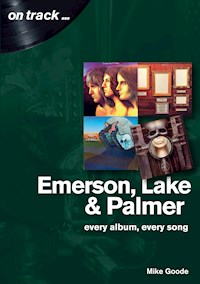
Emerson, Lake & Palmer were, without question, one of the great rock bands of the 1970s. Selling millions of albums across the globe, with all three members winning awards for their dazzling musical ability, ELP were no ordinary group. Their pioneering attitude was adored by their legions of fans, none more so than in the USA, where they toured widely. Despite ELP being the embodiment of the dinosaurs that punk sought to kill. However, just like their peers – Yes, Genesis and Pink Floyd – they survived punk’s onslaught, continuing to make albums until the mid-90s and touring right until their final concert, a headlining performance at London’s High Voltage Festival in 2010.
This book charts their rise, via every track on all nine of their studio albums recorded between 1970 and 1994 including Tarkus, Trilogy and Brain Salad Surgery. Key recorded live performances – such as 1971’s Pictures at an Exhibition – are also included as well as overviews on all three member’s solo projects, With informed insight and information, this is the ultimate guide to the band’s music – a must-own companion to Emerson, Lake & Palmer’s recorded legacy.
Since graduating from art college in the early 1980s, Mike Goode has pursued a successful career in the creative industry – as a designer, art director and writer. However, his biggest passion is music – specifically anything related to Emerson, Lake and Palmer. A fan since hearing Pictures as an Exhibition as a teenager in the 70s, there’s no person better suited or qualified to write and research this book on these progressive rock legends. He lives in Brecon, Powys.
Das E-Book können Sie in Legimi-Apps oder einer beliebigen App lesen, die das folgende Format unterstützen:
Seitenzahl: 285
Veröffentlichungsjahr: 2022
Ähnliche




















Sonicbond Publishing Limited
www.sonicbondpublishing.co.uk
Email: [email protected]
First Published in the United Kingdom2019
First Published in the United States 2019
This e-publication June 2022
British Library Cataloguing in Publication Data:
A Catalogue record for this book is available from the British Library
Copyright Mike Goode 2018
ISBN 978-1-78952-000-2
The rights of Mike Goode to be identified as the authors of this work have been asserted by them in accordance with the Copyright, Designs and patents Act 1988.
All rights reserved. No part of this publication may be reproduced, stored in a retrieval system or transmitted in any form or by any means, electronic, mechanical, photocopying, recording or otherwise, without prior permission in writing from Sonicbond Publishing Limited
Printed and bound in England
Graphic design and typesetting: Full Moon Media
www.fullmoonmedia.co.uk
With Thanks
The writing of this book was way more difficult than I ever imagined. When I happily volunteered to write it for Stephen Lambe, Managing Director at Sonicbond Publishing, I had no idea of the road immediately ahead. How could anyone possibly know that in a very short while I’d have upped sticks from where I was living in the south-east of England, to return home to Wales to be closer to my Mother who had been diagnosed with Motor Neurone Disease. I am writing this just three months short of the day she passed away, finally at peace. Mum knew I was writing this book and wished me all the best with its publication. It is to her memory this book is dedicated.
It is only fitting that Dad also gets a tip of the hat. Whereas Mum probably wouldn’t have recognised any ELP if she heard it – maybe aside from Greg Lake’s Christmas single – Dad most certainly would. I once even ‘caught’ him playing one of my ELP albums on his beloved Sony music centre! A lover of big band jazz, he immediately recognised that Carl Palmer’s drumming owed much to the style of jazz drumming legend Buddy Rich. He was right, it does. At the time I didn’t even know who Buddy Rich was. Years later, Dad even accompanied me to a Carl Palmer drum clinic, enjoying the flamboyant demonstration as much as any of the ELP fans in attendance. Dad, who passed away a couple of years before Mum, this is for you too.
Thanks must also go to my wife Laura, who graciously gave me the time and space needed to complete this book. Most of the words were written in the kitchen of our new house in Wales, the rest of the building in absolute turmoil as builders and tradesmen of every description generated enough dust to create a weather warning across the entire South Wales region. I kid you not. Thankfully, as I type these words, most of the building work has been done. I can finally look forward to the day when my mancave is once more graced by the many ELP albums and band-related ephemera that has been living on our kitchen table for months. The question is, when I finally put it all back on the shelves, should I order alphabetically or chronologically?
In creating this book, of all the fellow ELP fans, former roadies and associates who have contributed with their memories, I must give a big heartfelt thank you to the artist and designer William Neal. William, who worked on the Tarkus, Pictures at an Exhibition and Trilogy album covers, graciously gave me a lot of his time in retelling the stories from his days working with the band. It was heartwarming to hear the high regard in which he holds Keith Emerson, Greg Lake and Carl Palmer.
And without all three, there would of course be no albums and therefore no book. I therefore thank each of them individually, and as a band, for enriching our lives with the music they created. Although we have lost both Keith and Greg in recent years, ELP’s musical heritage lives on.
Lastly, a very special thanks to you for buying this book. I hope that my passion for all-things ELP is passed on and that you too become similarly enthused. Assuming of course that you’re not already afflicted!
Contents
Foreword (it has never been cool to like ELP)
By Way of an Introduction (From the Beginning)
Emerson, Lake & Palmer (1970)
Tarkus (1971)
Pictures at an Exhibition (1971)
Trilogy (1972)
Brain Salad Surgery (1973)
Works Volume 1 (1977)
Works Volume 2 (1977)
Love Beach (1978)
Black Moon (1992)
In the Hot Seat (1994)
ELP Live Albums
ELP collaborations and solo albums
Emerson Lake & Powell (1986)
Solo Projects
References & Bibliography
Foreword (it has never been cool to like ELP)
The full blame for this book rests squarely on the shoulders of Steve Lewis. It is his fault. Although Steve, of course, will blame his older cousin. Perhaps I should explain.
In the dim and distant Seventies, Steve and I were at school together. The very same school that years later would produce Gareth Bale, Sam Warburton and Geraint Thomas. As far as I am aware, there is zero connection between ELP and said sporting heroes, so why I tell you all this I’m not sure.
More relevant is the fact that Steve’s dad was into hi-fi. And it was on said hi-fi that Steve played me an album his cousin had recommended to him – a first pressing of Pictures at an Exhibition. The combination of ELP and hi-fi was potent. I have to say, if I’m being totally honest, that I’m not sure the effect would have been quite the same if Pictures had been played on my Mum’s Dansette. So Steve’s dad deserves credit for his part in all this. Thanks Mr Lewis!
For me, it was a Eureka! moment, the point at which there was no looking back to Slade and The Sweet of a few months earlier. My world had exploded in a cacophony of synthesisers, prog symphony and science fiction. I had never heard of a Moog synthesiser so the unearthly sounds coming from the hi-fi were a complete mystery. As for who Keith Emerson, Greg Lake or Carl Palmer were, I had no idea. In fact, for a while afterwards I assumed they were American. It was only later I discovered their pedigree and the fantastic bands they had sprung from.
One thing was very quickly evident. Being into ELP was not cool. It would get even worse before the end of the decade but even in the mid-70s writing ELP on your school satchel would be unlikely to gain you a knowing nod from the playground cognoscenti. And it goes without saying that carrying an ELP album under your arm was extremely unlikely to gain admiring glances from girls. In fact, carrying any prog album was the equivalent of wearing an invisibility cloak in that respect. This you probably already know.
Smitten, Steve and I went on the hunt for further ELP albums. We eventually plucked up the courage to enter the dark caverns that masqueraded as Cardiff record shops at that time, quickly discovering Tarkus and Trilogy – both of which I taped from Steve. Ample evidence, your honour, that the ‘home taping is killing music’ campaign was beyond daft. In fact, today I must own at least half a dozen copies of each album.
By the time we’d familiarised ourselves with the rest of ELP’s back catalogue and had started sniffing around The Nice, King Crimson and Atomic Rooster, I’d already fallen a long way down the rabbit hole of prog and classic rock. This is mainly thanks to enlightenment at the altar of Alan Freeman’s legendary Saturday Rock Show. Not arf!
I soon realised there was not, and never has been, another band like ELP. They were, and are, totally unique. And despite brief dalliances with other bands – and even other genres – it is ELP who I’ve returned to again and again. Their music conjures something deep within me that words alone cannot hope to describe. Sure, part of it is nostalgia, but part of it is also a recognition of a time when rock music was at its peak. Has the musicianship, songwriting and creative use of technology from those times ever been bettered? I don’t think it has.
Punk came and went, only briefly tempering my ELP obsession. Then, in the late-80s, I found myself working for IPC Magazines, the publisher of Melody Maker and the NME. Given a free run of the archives, I became acutely aware that the files marked ELP were getting increasingly dusty and looking forlorn. I think that was the moment I knew I had to do something. Although admittedly it has taken me a while!
The chance to write and compile this book is thanks to Stephen Lambe. If ever there was someone who deserves an award for services to prog and classic rock, Stephen is the man. It is his day job as a publisher than has resulted in this book, but his passion as a music fan that brought us together. I hope you enjoy this book, which is an attempt to compile and convey the information I have gathered from many years of being an ELP fan. However, more than anything else, the aim of Emerson, Lake & Palmer On Track is to enhance your enjoyment of the music Keith Emerson, Greg Lake and Carl Palmer collectively.
Mike Goode, September 2018
By Way of an Introduction (From the Beginning)
This book is not intended to be a comprehensive history of Emerson, Lake & Palmer (hereafter written as simply ELP) and their solo careers. It does, however, detail every known studio track the band ever recorded – starting with ELP’s debut release and continuing until their last studio album, In The Hot Seat. As well as the author’s personal comments and opinion on each track, included are details on the band’s recording sessions and any alternative studio versions. Where relevant, information on the band’s live performances of the track in question have also been mentioned.
If any new information comes to light that supersedes some of what is written in this book, the author politely asks the reader to forgive any such oversights. First and foremost a fan, the author further requests to be informed of any such information, believing it is paramount that all information on ELP and their recorded legacy be as accurate as possible. All opinion, it goes without saying, is the author’s own.
Emerson, Lake & Palmer (1970)
Personnel:
Keith Emerson: Hammond organ, piano, Moog synthesiser IC
Greg Lake: vocals, bass, acoustic guitar, electric guitar
Carl Palmer: drums & percussion
Released: 20 November 1970 (UK), 1 January 1971 (USA)
Recorded: Advision Studios, London, July 1970
Highest chart place: 4 in UK, 18 US Billboard 200
When ELP got together in the Summer of 1970, they spent time rehearsing, both in preparation for gigs and recording their much anticipated debut album. The new band was quickly dubbed a supergroup – a tag they intensely disliked. Although Greg Lake had won plaudits for his role as the vocalist and bassist on King Crimson’s In the Court of the Crimson King, most of the attention was on Keith Emerson. His previous band, The Nice, had been a huge concert draw – although album sales had arguably not met record company expectations. By hooking up with Lake, who was a more accomplished singer and bass player than The Nice’s Lee Jackson, Emerson knew that the sky was the limit for his musical ambitions.
After holding auditions for a drummer, Emerson and Lake settled on Carl Palmer, then playing with Atomic Rooster, but formerly of The Crazy World of Arthur Brown. Although Palmer was initially reluctant to join – mainly because the new venture was such an unknown quantity – he was eventually convinced by their passionate vision and the undeniable musical chemistry when all three jammed together. According to Melody Maker’s Chris Welch, who helped champion the new band, they’d only played together four times when the journalist was invited to meet them at their rehearsal space – a church hall in Notting Hill, London. Despite Emerson and Lake’s more illustrious pedigree, it was evident to Welch that Palmer was being treated as an equal and was already eagerly contributing ideas. In fact, it was as a result of Palmer’s suggestion that the band tackled an arrangement of Bartok’s Allegro Barbaro – a piece that became ‘The Barbarian’, the opening track on the new album.
Although briefly considering Triton as a name, they decided to call themselves Emerson, Lake & Palmer, to signal the fact they were all equal partners and to help take away the focus from Emerson. Lake, in particular, was keen that the new band not be seen as The Nice ‘mark two’. His one concession was in agreeing to play ‘Rondo’, a piece Emerson had promised The Nice fans he would continue to play in his new band. Initially, they also rehearsed King Crimson’s ‘21st Century Schizoid Man’. However, neither were intended for the new album. In the end, ‘21st Century Schizoid Man’ didn’t even make it into the live set.
By the time they entered Advision Studios in July 1970, ELP had rehearsed almost enough material for their debut album. Advision, as the name implies, had initially been conceived as a studio for commercial voice-overs for the advertising industry. Located at 23 Gosfield Street, in London’s Fitztrovia, it featured a massive studio space – large enough to house a 60-piece orchestra. In the late ‘60s its central location helped make it popular with bands such as The Yardbirds and The Move. Then, in 1968, it became the very first studio in the UK to have an 8-track tape machine. With rock music in the ascendancy, a new wave of bands began using the studio – even more-so after a custom 24-channel mixing desk was installed in late 1970. Little wonder then that ELP were keen for a slice of the action. Their passion to embrace new technology became a constant across their entire career.
With Greg Lake taking the role of producer – something that Emerson frequently claimed was not a conscious democratic band decision – Eddy Offord was recruited as sound engineer. Offord has since, rather disparagingly, claimed that Advision was an outdated studio with an old mixing desk and very little in the way of outboard effects aside from an echo plate. This lack of fancy equipment may seem incredible to musicians today, but back then it was fairly normal in the UK. It was very different in the USA, where Offord later moved. Besides, a lack of ‘bells and whistles’ encouraged creative experimentation – something ELP were definitely not averse to. The band used the eight tracks available to them by recording live, keeping overdubs to a minimum. Despite Emerson’s comments with regard to Lake seizing the production role, there were no criticisms about the quality of his work. He’d already gained invaluable production experience working on In the Court of the Crimson King – a role forced on King Crimson after the band had aborted sessions with The Moody Blues producer, Tony Clarke. At the helm for ELP, Lake learned fast, his teamwork with Offord resulting in an album that is full of vitality and high on audio quality.
The cover was designed by Nic Dartnell. Just 18 at the time, he was working in a record shop in Edinburgh, when his boss – who would later become Simple Minds’ manager – sent the famous dove painting to Island Records in London. The painting obviously impressed as it was shown to ELP, who immediately chose it for their first album. Dartnell claims that, ‘I didn’t even know who ELP were at the time’! In many ways, it is a shame that UK and US releases of the album weren’t given a gatefold sleeve to show Dartnell’s painting to its best effect. That honour was only bestowed on the first pressing of the German issue – which is a rarity today.
‘The Barbarian’ (Bartok, arranged Emerson, Lake, Palmer)
Hearing Keith Emerson playing Bartok’s Allegro Barbaro during an early rehearsal, Carl Palmer suggested they try arranging it for the band. This primeval slice of ELP is highly reminiscent of Atomic Rooster’s debut album, particularly the fuzz bass intro and Palmer’s dry drum sound. When combined with Emerson’s distorted Hammond, the sound pleased fans of The Nice, especially when Emerson switched to piano and started tackling Bartok’s composition in earnest.
The similarity to the original classical piece is strong, making the Hungarian composer’s omission from the credits all the more baffling when the album was originally released. Emerson distanced himself from the furore by claiming writing credits were the role of the record company’s publishing department and that he was simply the musician. Things came to a head when Bartok’s disgruntled widow objected, furious that ELP had taken so many liberties with her beloved husband’s composition. The situation was apparently not helped by the band renaming their adaptation ‘The Barbarian’.
Bartok had written Allegro Barbaroas a piano piece in 1911. ELP’s aggressive treatment must have been alien to the ears of Mrs Bartok, so little wonder she tried to sue for copyright. The band and their management backed down and apologised. As a result, later pressings of the album were given an amended label copyright, although oddly not on the rear sleeve. ‘Adapted from Bela Bartok’s Allegro Barbaro by Emerson Lake & Palmer’ left little doubt as to the track’s origins – and rightly so. Interestingly, when the CD copy of the album was issued, the original error was repeated and Bartok’s name was again nowhere to be seen. The latest CD issues have rectified the situation with a less-wordy ‘Bartok, arranged Emerson, Lake, Palmer’.
Intriguingly, ‘The Barbarian’was omitted from any ELP compilation until 2007’s The Essential Emerson, Lake & Palmer. This is a shame as it is one of the band’s earliest defining moments. It obviously wasn’t considered a prime example of quintessential ELP by compilers, although most fans would heartily disagree. As would the band themselves because ‘The Barbarian’ was in their set from the off – including their show at the Isle of Wight Festival on Saturday 29 August 1970, only their second gig. Such was the power and impact of ‘The Barbarian’ when played live, it was given pride of place as the opening number during their first two UK tours, including ELP’s first excursion to the USA, between April and May 1971. It stayed in the set until usurped by a new opener, ‘Hoedown’, from their third UK tour onwards. ‘The Barbarian’s’ last live appearance, fittingly, was at ELP’s last ever gig at London’s High Voltage Rock Festival in 2010. It features on both the DVD and CD issues of that gig. ‘The Barbarian’ makes just one appearance on ELP’s Original Bootleg Series – the four boxes of live recordings that proudly sits astride virtually their entire career – on Volume One, recorded at the band’s Gaelic Park gig on 1 September 1971. This is the concert experienced by none other than Bob Moog, who described the scenes as ‘biblical’. It was the first time he’d see Emerson play one of his synthesisers live – a seminal moment.
‘Take a Pebble’ (Lake)
Composed on an acoustic guitar,’Take A Pebble’ was one of the handful of songs played to Melody Maker journalist Chris Welch at an early rehearsal. What ELP fan wouldn’t have sold their grandmother to be in attendance that day? In his own words, They played a beautiful number called ‘Pebbles’, which sounded like a rock version of the Modern Jazz Quartet, with Carl on brushes, Keith on piano and Greg singing in a rich, warm style’.
Lake later said that he developed ‘Take A Pebble’ from a guitar line he wrote while in The Shame, one of his earliest bands. He is believed to have played the song to an unimpressed Robert Fripp for inclusion on King Crimson’s debut. Emerson, however, saw potential in the song, taking its bare bones and turning it inside out – a mark of the pioneering creativity that typifies ELP’s ‘golden era’ of the early 1970s. Be honest, how many of us guessed that ‘Take A Pebble’ was originally an acoustic guitar number? Instead of Lake’s delicately picked guitar intro, Emerson holds down the keys on his piano while strumming the strings inside using a guitar plectrum – a sound that intrigued when the album was first released. Joined by Lake’s deep resonant bass and with delicate cymbal work from Palmer, the entire first section of ‘Take A Pebble’ is one of ELP’s most refined moments. When Lake begins singing, backed by Emerson’s improvised piano, it sets the scene for over twelve minutes of some of the most varied and creative music the band ever played. Their subtle playing is light years away from the pomp and bombast they later became renowned for. For many, ‘Take A Pebble’ is the ultimate example of ELP working together as a band, leaving one to wonder why they didn’t attempt to repeat this beguiling formula on future albums.
Eventually, the focus on Emerson’s piano switches to Lake’s acoustic guitar, finally giving hints of how the song might originally have sounded. Partly improvised, Lake’s accurate and highly musical picking on his beloved Gibson J-200 is interspersed with the atmospheric sound of water droplets – generated on Emerson’s Moog. After the tempo suddenly picks up for a brief country-tinged strummed section, complete with handclaps, for the first time on an ELP album we’re treated to Lake’s accomplished cross-picking and use of guitar harmonics. Both would become much-loved hallmarks of his acoustic playing.
After six minutes or so, the piano reintroduces itself, Lake’s sparse bass beautifully complementing Emerson’s accomplished keyboard work. When Palmer joins in, Lake’s jazzy bass runs add colour and the track increases in intensity. At just shy of eleven minutes of this ambitious work, the original theme is revisited, Lake’s double tracked refrain, ‘of our lives’ sung over Emerson’s cascading piano as the track ends in an understated but confident manner. The chemistry between the three musicians is a joy to hear, ‘Take A Pebble’ unlike anything from their former bands and pretty much unlike anything any other progressive rock band ever attempted. This is contemporary progressive rock at its finest.
‘Take A Pebble’ became a mainstay of the band’s live set and was played at all of ELP’s early gigs, including the Isle of Wight Festival, a performance captured on the Live at the Isle of Wight Festival 1970 CD. A mark of the importance of the piece, is that it isn’t easy to find a record of a gig ELP played during their early years that didn’t include it. What is also worth noting is that ELP‘s live performance of the song changed dramatically over the years. In its earliest incarnation, Lake would use the quieter folk-guitar middle section to sing and play short snippets of other songs – such as the folk standard ‘Old Blue’. For an example of the deep well that Lake drew upon in the early days of ELP, fans should listen and compare his rendition to the Byrds version on Dr. Byrds & Mr. Hyde. Lake would also use ‘Take A Pebble’ to sing some of his own acoustic numbers, notably ‘Lucky Man’ and‘Still…You Turn Me On’.
Not to be left out, Emerson used ‘Take A Pebble’ as a vehicle to play a wide variety of solo piano pieces and medleys. At times, listening back to ELP playing ‘Take A Pebble’ live, one gets the strong impression that Emerson had no idea what he was going to play until the moment was upon on him! This lends the piece an incredible amount of vitality and bears repeated listens of the many live examples in existence. On the four box sets that make up The Original Bootleg Series, ‘Take A Pebble’ features no less than eleven times! In later years, Emerson’s piano section was shortened considerably and Lake’s acoustic section was dropped entirely – mainly because his acoustic songs began to be played in their own right.
It is worth noting that the 2012 Steven Wilson reissue of Emerson, Lake & Palmer features an interesting alternate take.On the recording you can hear the band chatting before the song starts, Palmer encouraging the band with an enthusiastic ‘yeah let’s do one man, I feel like it’! The vitality is infectious as the band launch into a three minute and 40 second instrumental run through of the first part of ‘Take a Pebble’.
An excellent DVD of the band playing ‘Take A Pebble’ in their early days is on the Masters From The Vaults DVD – filmed at their Zurich gig on 4 December 1970 – originally broadcast on Belgian TV. Although this isn’t an official release, it perfectly captures the band’s early spirit and virtuosity, making it essential viewing for any ELP fan.
‘Knife Edge’ (Janceck & Bach, arranged Emerson, lyrics by Lake & Fraser)
As with ‘The Barbarian’, the original credits for this track got ELP into deep trouble as they omitted both Janáček and Bach. There is no excuse as the song is largely based on the opening Allegrettofanfare of the Czech-born Leoš Janáček’s Sinfonietta. Composed in 1926 for brass and percussion, ELP’s adaptation takes the main theme as the vocal melody, with added dystopian lyrics by Lake and Fraser. The Fraser here is Dik Fraser, one of Kind Crimson’s original roadies. He gets a writing credit for assisting Lake with the lyrics. Fraser later became ELP’s tour manager.
‘Knife Edge is one of the more immediate songs on Emerson, Lake & Palmer, its strident rock approach making it a popular live number. Angry, dark and heavy, the track sets the mood for much of ELP’s early-70s output, its sci-fi theme in perfect tune with the times. Emerson’s powerful Hammond organ playing, underpinned by Lake’s half-speed bass and Palmer’s hyperactive drumming, propels the track towards a startling conclusion. Evidence that the band were as creative during the mixing as they were when playing.
The Bach writing credit is due to Emerson’s improvised quotation from the German composer’s French Suite – heard just after three minutes and 20 seconds. By the time Emerson, Lake & Palmer was released on the band’s own Manticore label in 1973, Janáček had gained a credit but not Bach – a neglectful situation carried over into the CD era. The situation has only relatively been rectified, finally giving both Janceck and Bach the credits they are due.
Steven Wilson’s ‘deluxe’ edition of Emerson, Lake & Palmer includes a fascinating remix that omits the ‘slowing down’ effect on the tail-out of the original track. This had originally been achieved by manually restricting the speed of the tape when the track was mixed. Rather amusingly, it is an effect impossible to achieve digitally! Thanks to Wilson, on the ‘deluxe’ edition we get to hear the band play on for another minute or so, Emerson torturing his Hammond as the track peters out. As an extra bonus, Wilson also unearthed a previously unheard second version of ‘Knife Edge’on the studio’s master tapes. Although unfinished (the track has no vocals), it is fascinating to hear, the track ending soon after Emerson’s Bach quotation as he hits a sustained chord on his trusty Hammond.
‘Knife Edge’was a staple of the band’s early gigs but was dropped when ELP toured in support of Trilogy. It was revived in 1977, making an appearance in the set backed by the ill-fated 70 piece orchestra. Emerson announced the song at their Madison Square Garden gig on 8 July 1997 with, ‘This is something we had a lot of requests to do, so we dug it up again and re-arranged it’. A live version with the orchestra appears on the original vinyl issue of In Concert, recorded on 26 August 1977 at Montreal’s Olympic Stadium. This gig was reissued, as an expanded set, as Works Live in 1993. In 2013 it was released again, with additional tracks, as Live in Montreal 1977. ‘Knife Edge’appears on all three releases.
When the band reformed in the early-90s, ‘Knife Edge’once again became a staple of the band’s live performances. It appears on Live at the Albert Hall, Live in Poland, Then & Now, High Voltage Festival and Live at Montreux 1997.
‘The Three Fates’ (Emerson)
Side two of the original vinyl album opens with ‘The Three Fates’, a mini suite consisting of three movements. Based on Greek mythology, ‘The Fates’ are sometimes mentioned as the daughters of Zeus and Themis – or in older myths as the daughters of Nyx. The myths commonly portray them as spinners, each Fate being given a different task. Clotho spun the thread of life, while Lachesis measured its length and Atropos cut the cloth with her shears. Sometimes, however, each Fate was associated with time – Clotho was the present, Lachesis was the future and Atropos was the past.
ELP‘s ‘The Three Fates’opens with ‘Clotho’, with Emerson on The Royal Festival Hall’s powerful four-manual pipe organ. The piece confidently surges from organ fanfares to more considered delicate passages, before Emerson switches to piano for the free-flowing ‘Lachesis’. One of Emerson’s most mature studio performances, ‘Lachesis’ is totally free of the indulgences and embellishment that sometimes clouds his later work. As Emerson’s pianobriefly gives way to a second blast of pipe organ, Palmer joins in for ‘Atropos’, the final movement. ‘Atropos’ works its way to an explosive conclusion (literally!), Emerson playing in an atonal manner, initially in 7/8 before the piece resolves in 4/4. The piano here sounds uncannily like a Caribbean steel drumensemble – albeit one playing jazz! It is a supremely confident and eclectic statement. Perhaps tellingly, ‘The Three Fates’never made the transition to the band’s live set.
Steven Wilson’s ‘alternative ELP‘ disc, from the 2012 ‘deluxe’ set, includes a different version of ‘Atropos’. Marginally slower and less intense, Emerson seemingly hesitates as he improvises. Nevertheless, it provides excellent insight into the track’s genesis, Palmer’s vibraslap percussion punctuating the complex piano and drum groove. And as with the original album version, this ‘new’ ‘Atropos’ends with a studio-created explosion heavy with reverb. Sadly, when searching through the ELP studio archives, Wilson could not find similar alternatives for either ‘Clotho’ or ‘Lachesis’, so ‘Atropos’ stands alone.
‘Tank’ (Emerson, Palmer)
Created by Emerson as a vehicle for a Palmer drum solo, ‘Tank’is notable for the first appearance on an ELP album of the iconic modular Moog synthesiser. Emerson often told the story that he was in a record shop when the assistant played him Switched on Bachby Walter Carlos. When looking at the sleeve he immediately noticed the Moog, ‘a huge electronic contraption covered with knobs and cables and stuff’. Desperate to find out more, he discovered that Mike Vickers of Manfred Mann owned a similar Moog Series III. Borrowing it for a concert at the Royal Festival Hall – with Vickers in attendance behind the scenes, pulling and plugging in the Moog’s ‘telephone exchange’ of cables – Emerson remembers he could barely control the huge beast but managed to eke out excerpts from Stanley Kubrick’s movie 2001 to impress fans! When ELP formed, Emerson knew he had to have his own Moog, so he wrote to inventor Bob Moog in the USA to order one. It arrived just in time to be included on Emerson, Lake & Palmer. It is said to have cost the majority of Emerson’s advance from Island Records!
The first section of ‘Tank’opens with a crisp drum groove – backed by lightly phased bass from Lake – before Emerson plays double-tracked piano and clavinet, panned hard left and right. With Lake’s bass initially meandering behind the keyboards and Emerson effortlessly improvising, the two musicians suddenly lock together in unison, interspersed by Palmer’s drum breaks. In Palmer’s drum solo, facets of which he still employs to this day, he seemingly uses every item on his kit, including his famous gongs. Lake’s production adds interest by phasing the sound, swirling the drums around the stereo mix. Back in the day, this was state-of-the-art, making ELP albums ‘de rigueur’ for hi-fi dealers to demonstrate their latest equipment. Although Palmer’s solo is beautifully constructed and paced, one cannot help wonder how ‘Tank’ would have sounded with a far more concise demonstration of his undoubted percussive skills, letting the track stand on its own merits rather than as a vehicle for a solo. The thought obviously occurred to Palmer himself, as this is exactly what he did when re-recording the piece for Works Volume 1.
After the solo, the entire band rejoin Palmer, with clavinet, bass and drums laying down a solid, almost funky groove, with brassy layers of Moog laid over the top. The introduction of the Moog is an historic moment – the first time this ground-breaking instrument appears on an ELP album. Emerson’s enthusiasm for the instrument adds a further dimension with a raspy improvised solo, Palmer’s drumming getting ever more intense as the song races to its conclusion – not dissimilar to the effect later achieved on Trilogy’s ‘Abaddon’s Bolero’.
In a live setting in the band’s early days, ‘Tank’ was often inserted, minus the drum solo, into the improvised middle section of ‘Take a Pebble’. Steven Wilson’s 2012 reissue of Emerson, Lake & Palmer features an alternative take of the ‘Tank’ middle section – essentially, a different version of Palmer’s drum solo. In this instance, Wilson allows us to hear the end section minus any phasing, allowing Palmer’s Buddy Rich style drumming to stand proudly on its own.
‘Lucky Man’ (Lake)
Lake often told the story that ELP had come to the end of recording their debut album but they were short of one track. He suggested trying an acoustic song he’d originally written when just twelve years old. After demoing the song and playing it to the band, Keith Emerson was apparently unsure what he could add to the track – or indeed whether it was suitable for inclusion – so he left Lake and Palmer to record it while he retired to the pub. On his return, Lake had added vocals, bass and electric guitar, fleshing out the sound. With Palmer’s considered and creative drumming, the track had come alive, so Emerson agreed to try a Moog solo overdub at the end. With the tape running, he played an ad hoc solo and shouted to Lake, who was behind the mixing desk in the control room, that he was ready for a take. Lake replied that what he had just done was fine! Although Emerson insisted he could do better, he was convinced to come and hear what he’d just recorded. His improvised runs were left exactly as is – arguably the most famous Moog solo in music history!




